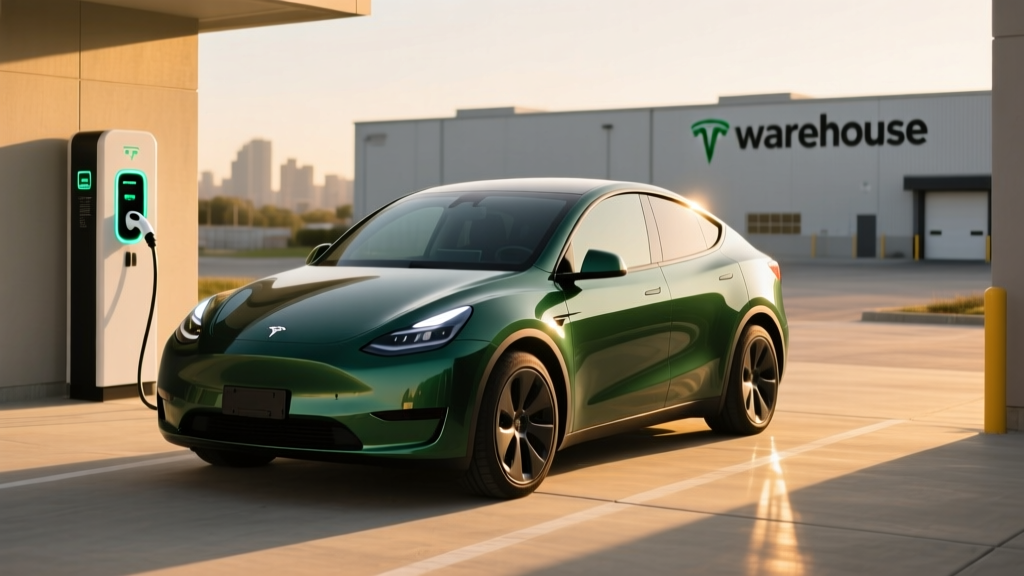
The term "warehouse Tesla" has become shorthand among buyers and forum regulars for the stripped-down, no-frills delivery experience Tesla pioneered: skipping the traditional dealership showroom in favor of picking up your car at a regional delivery center that looks more like a logistics hub than a car lot. It's a model that cuts overhead and, in theory, keeps sticker prices lower. But does buying a Tesla from a warehouse-style delivery center actually save you money, and more importantly, is the 2026 Model Y (the heavily refreshed "Juniper" generation) still the benchmark compact electric SUV to beat?
We've driven the 2026 Model Y Long Range AWD and Rear-Wheel Drive variants extensively, tracked their real-world charging curves, and cross-referenced EPA data with our own highway and cold-weather testing. Here's everything you need to know before you order.
2026 Tesla Model Y: Core Specifications
| Spec | Long Range AWD | Rear-Wheel Drive |
|---|---|---|
| EPA Range | 320 miles | 290 miles |
| Battery (usable) | ~75 kWh (NMC) | ~60 kWh (LFP) |
| Peak DC Fast Charge | 250 kW | 170 kW |
| 10–80% DCFC Time | ~25 min | ~30 min |
| Level 2 Home Charge (max) | 11.5 kW (44 mi/hr) | 11.5 kW (48 mi/hr) |
| 0–60 mph | 4.8 sec | 6.5 sec |
| Horsepower | 384 hp (dual motor) | 295 hp (single motor) |
| MPGe (combined) | 111 MPGe | 119 MPGe |
| Efficiency | 30 kWh/100 mi | 28 kWh/100 mi |
| Cargo (rear seats up) | 30.2 cu ft | 30.2 cu ft |
| Cargo (seats folded) | 72.1 cu ft | 72.1 cu ft |
| Base MSRP | $48,990 | $44,990 |
Real-World Range: What the EPA Sticker Doesn't Tell You
EPA Estimate: 320 miles
Our Highway Test (70 mph, 72°F): ~275–285 miles
Cold-Weather (30°F, mixed driving): ~230–250 miles
City/Regen-Heavy Commute: ~310–325 miles (can exceed EPA)
The Juniper refresh brought a modest aerodynamic improvement and a slightly revised thermal management system, but physics still dominates at highway speed. Expect to lose roughly 10–15% of EPA range on sustained 70+ mph freeway driving. In freezing temperatures, the heat pump helps, but you'll still see a 20–25% reduction unless you precondition the cabin while plugged in.
The RWD model's LFP (lithium iron phosphate) battery is heavier but more resilient to frequent 100% charging. Tesla recommends charging LFP packs to 100% at least weekly to maintain cell balancing — a meaningful ownership difference versus the NMC Long Range, which prefers a daily 80% limit for longevity.
Charging Speed: Supercharger Network vs. Home Level 2
Charging speed is where Tesla still holds a structural advantage, primarily through the Tesla Supercharger network, now open to NACS-equipped vehicles from Ford, Rivian, and others. The Model Y Long Range peaks at 250 kW on V3 and V4 Superchargers, but — and this is critical — that peak is only sustained between roughly 10% and 30% state of charge. Above 50%, the curve tapers significantly, dropping below 100 kW past 70%.
| Method | Power | Miles Added per Hour | Notes |
|---|---|---|---|
| Level 1 (120V outlet) | 1.4 kW | ~5 mi/hr | Emergency/trickle only |
| Level 2 (240V, 48A) | 11.5 kW | 44–48 mi/hr | Full overnight charge in ~7 hrs |
| DCFC Supercharger V3 | 250 kW peak | ~175 mi in 15 min | Peak only at low SoC |
| CCS Adapter (non-Tesla DCFC) | Up to 250 kW | Varies by station | Requires $175 Tesla CCS adapter |
For home charging, a 48-amp Level 2 wall connector on a 60-amp circuit is the practical standard. Budget $800–$1,500 for a full professional installation assuming your electrical panel has capacity. If you need a panel upgrade (common in older homes), add $1,500–$3,000. Always get a licensed electrician to confirm your panel's headroom before ordering equipment.
Interior, Cargo, and Daily Livability
The Juniper interior is noticeably quieter than pre-2025 Model Ys, thanks to acoustic glass and improved sound deadening. Rear-seat legroom measures 40.5 inches — adequate for adults on longer trips, though the sloping roofline cuts headroom for anyone over 6'2".
Cargo volume stands at 30.2 cubic feet behind the second row and 72.1 cu ft with seats folded, plus a small front trunk (frunk) useful for charging cables or a bag of groceries. The powered liftgate is standard. One persistent complaint: the all-glass roof, while beautiful, creates significant cabin heat in summer sun. Tesla includes a removable shade panel in 2026 models, addressing a long-standing owner gripe.
Technology and Driver Assistance
Every 2026 Model Y ships with a 15.4-inch center touchscreen running Tesla's latest software, wireless phone charging, and the full Tesla app ecosystem. The infotainment system remains one of the most responsive in the industry, though it still lacks native Apple CarPlay and Android Auto — a dealbreaker for some buyers.
Tesla's Autopilot and Full Self-Driving (Supervised) are not self-driving systems. The driver must remain fully engaged, hands on or near the wheel, and eyes on the road at all times. FSD (Supervised) adds city-street navigation and traffic-light recognition but still requires active supervision. Only Level 4 systems (e.g., Waymo robotaxis) operate without a human driver.
Standard Autopilot includes adaptive cruise control and lane-centering. The $8,000 FSD (Supervised) upgrade adds Navigate on Autopilot, auto lane-change, and Smart Summon. Value is debatable: many owners report FSD works well on highways but remains inconsistent in complex urban scenarios. Consider a month-to-month FSD subscription ($99/mo) before committing to a full purchase.
Pricing, Tax Credits, and the 'Warehouse' Delivery Model
| Trim | MSRP | §30D Federal Credit | Effective Price (if eligible) |
|---|---|---|---|
| Rear-Wheel Drive | $44,990 | Up to $7,500 (point-of-sale) | ~$37,490 |
| Long Range AWD | $48,990 | Up to $7,500 (point-of-sale) | ~$41,490 |
| Performance | $53,490 | Up to $7,500 (point-of-sale) | ~$45,990 |
The IRS §30D federal tax credit offers up to $7,500, now transferable to the dealer as a point-of-sale discount (effectively reducing your out-of-pocket cost at delivery). However, eligibility is not automatic. Key constraints for 2026:
- MSRP Cap: SUVs must be under $80,000 — all Model Y trims qualify.
- Buyer Income Cap: AGI must not exceed $150,000 (single), $225,000 (head of household), or $300,000 (joint).
- Battery Sourcing: The $7,500 credit requires meeting both critical-mineral and battery-component sourcing thresholds. Tesla's shifting supply chain means eligibility can change mid-year — always verify on fueleconomy.gov before ordering.
- Final Assembly: Must be in North America (the Fremont, CA plant qualifies).
Regarding the "warehouse Tesla" experience: Tesla's delivery centers are typically large, industrial-style facilities with minimal sales staff. You won't get a guided walkthrough or a ceremonial handover. The trade-off is lower overhead reflected in Tesla's pricing. Some buyers love the efficiency; others find it impersonal. Either way, inspect your vehicle thoroughly at pickup — paint and panel-gap issues are well-documented, and resolving them post-delivery is far easier than after you drive away.
Pros and Cons
- Access to the Supercharger network — the most reliable public DCFC infrastructure in the US
- Class-leading efficiency (28–30 kWh/100 mi)
- Strong over-the-air update cadence keeps software current
- Spacious cargo area and practical liftback design
- LFP battery option (RWD) allows worry-free 100% daily charging
- No Apple CarPlay or Android Auto
- Build quality inconsistency — panel gaps and paint remain common complaints
- Minimal physical controls; nearly everything routes through the touchscreen
- FSD (Supervised) at $8,000 is expensive and still requires driver engagement
- Impersonal warehouse-style delivery experience isn't for everyone
Who Should Buy the 2026 Tesla Model Y?
- You want the lowest-friction road-trip charging experience (Supercharger plug-and-charge)
- You commute 30–80 miles daily and can charge at home
- You value OTA software updates and a strong resale-value track record
- You don't need Apple CarPlay/Android Auto
- Build quality and dealership service experience are top priorities (consider Hyundai Ioniq 5 or BMW iX)
- You need a third row (Kia EV9 is the segment alternative)
- You want physical buttons and traditional infotainment integration
Frequently Asked Questions
What is the real-world range of the 2026 Tesla Model Y?
The EPA rates the Long Range AWD at 320 miles, but expect 275–285 miles on the highway and 230–250 miles in freezing weather. The RWD model is rated at 290 miles EPA and delivers roughly 250–260 miles in mixed real-world driving.
How fast does the Model Y charge at home and on the road?
On a 48-amp Level 2 home charger, you'll add 44–48 miles per hour, fully replenishing overnight. At a Tesla V3 Supercharger, the Long Range peaks at 250 kW, adding roughly 175 miles in 15 minutes at low state of charge. The 10–80% session takes about 25 minutes (Long Range) or 30 minutes (RWD).
Does the 2026 Model Y qualify for the federal EV tax credit?
Yes — all trims fall under the $80,000 SUV MSRP cap, and final assembly is in Fremont, CA. However, the full $7,500 depends on battery-sourcing requirements that can change. Verify current eligibility on fueleconomy.gov and confirm your AGI is under the IRS income caps ($150K single / $300K joint) before relying on the credit.
How much does a Model Y cost after tax credits?
If you qualify for the full $7,500 §30D credit (transferred at point of sale), the RWD model effectively costs around $37,490, and the Long Range AWD around $41,490, before destination fees and state incentives.
Is the Model Y worth buying versus the Hyundai Ioniq 5 or Ford Mustang Mach-E?
The Model Y wins on charging-network convenience and efficiency. The Ioniq 5 offers faster 800V charging (10–80% in ~18 minutes), a more distinctive design, and standard CarPlay. The Mach-E offers a more traditional interior layout. If Supercharger access matters to you and you tolerate Tesla's minimal controls, the Model Y remains the segment default.
What is the battery warranty?
Tesla covers the battery and drive unit for 8 years or 120,000 miles (Long Range AWD) and 8 years or 100,000 miles (RWD), with a minimum 70% capacity retention threshold during the warranty period.