Search for "Tesla vans" and you'll find a tangle of concept sketches, patent filings, and Elon Musk's occasional X posts—but no production vehicle you can order today. As of early 2026, Tesla has not launched a dedicated passenger or cargo van in the United States. What the company has done is tease a "Robovan" concept, hint at a next-generation multi-passenger platform, and leave a conspicuous gap in its lineup that competitors like Rivian, Mercedes-Benz, and even Ford are rushing to fill.
This guide cuts through the hype. We'll examine what Tesla has officially confirmed about its van plans, analyze the engineering building blocks already in production that would underpin a Tesla van, compare the competitive landscape, and help you decide whether to wait—or buy what's available now.
The Tesla Robovan: What's Been Announced vs. What's Real
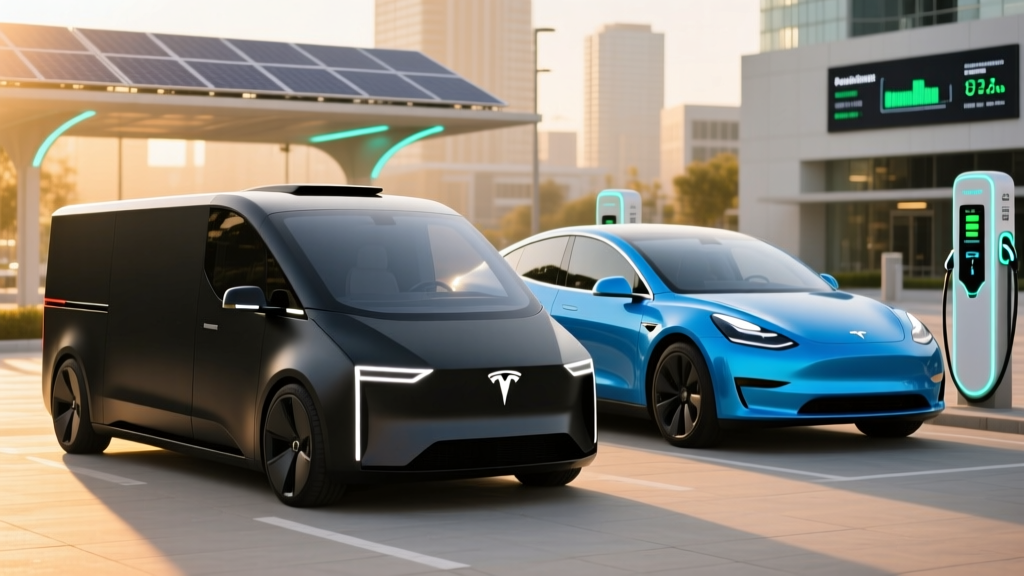
At Tesla's October 2024 "We, Robot" event, the company unveiled a concept it called the Robovan—a streamlined, retro-futuristic passenger vehicle designed to carry up to 20 people in an autonomous shuttle configuration. The vehicle featured a curved glass canopy, no visible steering controls, and a design language that echoed 1930s Art Deco streamliners.
What we can do is project likely specifications based on Tesla's current production architecture—the 4680 battery cells, the structural battery pack used in the Cybertruck, and the powertrain modules shared across the Model Y and Cybertruck platforms. Here's what an informed estimate looks like, clearly labeled as such:
| Specification | Confirmed by Tesla | Informed Projection |
|---|---|---|
| Vehicle Class | Autonomous passenger shuttle (concept) | 10–20 passengers, fleet/robotaxi use |
| Battery Chemistry | Not disclosed | Likely LFP (cost/durability) or NMC (energy density) |
| Battery Capacity | Not disclosed | ~120–150 kWh (based on vehicle mass) |
| EPA Range | Not published | ~250–350 mi (est., heavy vehicle penalty) |
| DC Fast Charge | Not disclosed | ~250–350 kW peak (V4 Supercharger capable) |
| Production Timeline | Not announced | 2027+ at earliest (speculative) |
| Consumer Purchase | Not confirmed | Likely fleet-only initially |
The key takeaway: the Robovan is not a consumer minivan or cargo van you'll find at a Tesla showroom. It's a purpose-built autonomous shuttle, likely destined for Tesla's own robotaxi network or fleet partners—not individual buyers.
Why Tesla Hasn't Built a Consumer Van (Yet)
Tesla's product strategy has always prioritized vehicles with the highest margin and volume potential. The Model Y became the world's best-selling vehicle in 2023 precisely because it sits at the intersection of mass-market pricing and SUV demand. A van—whether a passenger minivan or a commercial cargo van—presents different engineering and market challenges:
- Aerodynamic penalty: Vans have a larger frontal area and bluff-body shape, which increases drag and reduces highway range. Tesla's design DNA prioritizes low drag coefficients (the Model S achieves 0.208 Cd). A van would likely sit above 0.28 Cd, meaning more battery kWh needed for the same EPA range.
- Weight and battery cost: A three-row passenger van or commercial cargo van typically weighs 5,000–6,000+ lbs. That mass requires a larger battery pack (120+ kWh) to achieve competitive range, pushing the MSRP well above the $55,000 cap for SUVs under the IRS §30D federal tax credit rules—making the vehicle ineligible for the full $7,500 credit.
- Market segment risk: The US minivan market has been contracting for years, with the Chrysler Pacifica, Honda Odyssey, and Toyota Sienna fighting over a shrinking buyer pool. Tesla may see more value in a three-row SUV (a potential Model Y refresh or new platform) than a dedicated van.
That said, Tesla's patent filings and job postings suggest the company continues to explore multi-passenger and commercial vehicle platforms. The Cybertruck's 48-volt electrical architecture and steer-by-wire system could translate to a van platform more easily than the older Model S/X architecture.
What a Tesla Consumer Van Would Need to Compete
If Tesla does eventually launch a van aimed at families or commercial fleets, it would need to match or beat the following benchmarks already set by competitors:
| Spec | Rivian R1S (3-Row SUV) | Mercedes EQV (Europe) | VW ID. Buzz (US) | Ford E-Transit (Cargo) |
|---|---|---|---|---|
| EPA Range | ~352 mi (Max Pack) | ~213 mi (WLTP ~233) | ~234 mi | ~126 mi |
| Battery (kWh) | 149 kWh (NMC) | 90 kWh (NMC) | 91 kWh (NMC) | 68 kWh (NMC) |
| Peak DC Charge | ~200 kW | 110 kW | ~200 kW | ~115 kW |
| Seating | 7 passengers | 7–8 passengers | 7 passengers | 2 (cargo config) |
| Base MSRP | ~$79,900 | Not sold in US | ~$59,995 | ~$51,995 |
| Federal Tax Credit | Partial (MSRP & sourcing) | N/A | Check §30D sourcing | Commercial credit |
A Tesla van would need to deliver at least 300 miles of EPA range, support 250+ kW DC fast charging (leveraging Tesla's V4 Supercharger network), and price below $60,000 for a consumer version to be competitive with the ID. Buzz and Rivian R1S. That's a tall engineering order given the physics of a large, heavy vehicle.
Tesla's Existing Fleet Vehicles: Model X and the Three-Row Question
The closest thing Tesla currently offers to a van is the Model X, which seats up to seven in an optional three-row configuration. However, the Model X is a premium SUV, not a van—and its pricing, third-row practicality, and production future raise questions:
EPA estimated: 311–335 miles (depending on wheel size and configuration).
Real-world highway (70+ mph): Expect ~260–285 miles in mild weather.
Cold-weather (below 32°F): Range drops to approximately ~220–250 miles due to cabin heating demand and battery resistance, even with Tesla's heat pump system.
The Model X Long Range starts around $79,990 (2026 MSRP before incentives), placing it well above the $55,000 SUV MSRP cap for the §30D federal tax credit. Buyers will not receive the $7,500 credit on a new Model X. The Plaid variant, with its 1,020 horsepower and 2.5-second 0–60 time, pushes past $94,990.
For families needing genuine van-like space—easy third-row access, flat load floors, sliding doors—the Model X's falcon-wing rear doors and cramped third row don't substitute for a true minivan or passenger van. Tesla appears aware of this gap.
Charging Infrastructure: Tesla's Van Would Have an Advantage
One area where any future Tesla van would hold a decisive edge is charging access. The Tesla Supercharger network remains the most reliable and widespread DC fast-charging network in North America, with over 25,000 stalls in the US alone as of 2026.
Here's how Tesla's current high-capacity charging architecture would benefit a large van platform:
| Charging Level | Power | Speed / Notes |
|---|---|---|
| Level 1 (120V household) | ~1.4 kW | ~3–4 mi/hr — emergency/trickle only |
| Level 2 (240V home, Wall Connector) | ~11.5 kW | ~30–38 mi/hr — full overnight charge |
| DC Fast (V3 Supercharger) | Up to 250 kW peak | 10–80% in ~25–35 min (large pack) |
| DC Fast (V4 Supercharger) | Up to 350+ kW peak | 10–80% in ~18–25 min (est. for 120+ kWh pack) |
A critical nuance for van buyers: larger battery packs (120–150 kWh) can absorb higher charge rates for longer, meaning a Tesla van could sustain 250+ kW deeper into the charge curve than a Model Y with its ~75 kWh pack. However, charging above 80% State of Charge always tapers significantly—plan for an extra 15–20 minutes if you need a full battery for a long trip.
Federal Tax Credit Reality for a Future Tesla Van
If Tesla launches a consumer van, tax credit eligibility will be a major purchase factor. Under current IRS §30D rules, here's what buyers would need to navigate:
- ✔ MSRP Cap: Vans classified as SUVs must be under $80,000; sedans/wagons under $55,000. A Tesla van's classification would depend on how the manufacturer and IRS categorize it.
- ✔ Buyer Income Cap: Modified adjusted gross income must not exceed $150,000 (single), $225,000 (head of household), or $300,000 (joint filing).
- ✔ Battery Sourcing: Critical minerals and battery components must meet phased-in percentages from US or free-trade-agreement countries. Tesla's shift toward LFP cells from CATL (China) has complicated credit eligibility for some models.
- ✔ Point-of-Sale Transfer: Eligible buyers can transfer the credit to the dealer at purchase, reducing the upfront price rather than waiting for a tax refund.
- ✔ Final Assembly: Vehicle must undergo final assembly in North America. Tesla's US factories satisfy this requirement.
Given that Tesla's LFP-equipped Model 3 RWD has periodically lost and regained §30D eligibility as sourcing rules tighten, a van buyer should verify credit status at the time of purchase—not rely on announcements made months earlier. Rules are subject to change, and consulting a tax professional is always recommended.
Should You Wait for a Tesla Van or Buy Now?
- Wait for Tesla if: You need an autonomous shuttle for fleet/commercial operations, you want Supercharger network exclusivity, and your purchase timeline extends to 2028+. Accept that specs, pricing, and availability are entirely unknown.
- Buy the Rivian R1S if: You need three rows, genuine off-road capability, 350+ mile range, and can budget $80,000+. It's available now with proven real-world performance.
- Buy the VW ID. Buzz if: You want the most van-like EV experience currently available in the US—sliding doors, flat floor, retro styling—at ~$60,000. Range (234 mi EPA) is modest but workable for suburban family use.
- Buy the Model X if: You prioritize performance and Supercharger access over third-row practicality, and the $80,000+ price without a tax credit fits your budget.
- Consider a PHEV minivan if: You need maximum range flexibility. The Chrysler Pacifica Hybrid offers 32 miles of electric-only range plus 520+ total miles, at ~$50,000—and it qualifies for a partial credit depending on sourcing.
Frequently Asked Questions
Does Tesla currently sell a van in the United States?
No. As of 2026, Tesla does not sell a dedicated passenger van, minivan, or cargo van. The closest product is the Model X SUV with an optional third row (7-passenger seating). Tesla has shown a "Robovan" concept for autonomous fleet use, but it is not in production and has no confirmed consumer release date.
What is the Tesla Robovan and when will it be available?
The Robovan is a concept autonomous shuttle unveiled in October 2024, designed to carry up to 20 passengers without a driver. Tesla has not announced a production date, pricing, battery specifications, or whether it will ever be available for individual consumer purchase. It is most likely intended for Tesla's robotaxi network or commercial fleet partners.
How much would a Tesla van cost?
Tesla has not announced pricing for any van product. Based on current Tesla pricing and the engineering requirements of a large electric van (120+ kWh battery, heavy-duty powertrain), a consumer version would likely start between $60,000 and $80,000—though this is speculative. The Model X, Tesla's closest current product, starts at ~$79,990.
Would a Tesla van qualify for the $7,500 federal tax credit?
It depends on the final MSRP, the buyer's income, and battery component/critical mineral sourcing at the time of purchase. If the van is classified as an SUV and priced under $80,000, it could qualify—provided the buyer meets income caps and Tesla's battery supply chain satisfies §30D sourcing requirements. Always check the latest IRS guidance and verify eligibility before purchasing.
What's the best electric van alternative available now?
For families: the VW ID. Buzz (234 mi EPA range, ~$60,000, 7-passenger) is the most van-like EV currently sold in the US. For premium three-row SUV needs: the Rivian R1S (up to 352 mi range, ~$80,000). For commercial cargo: the Ford E-Transit (126 mi range, ~$52,000). None match the Supercharger network advantage a future Tesla van would offer.
Does Tesla's Autopilot or FSD make the Model X self-driving?
No. Tesla's Autopilot and Full Self-Driving (Supervised) are SAE Level 2 driver-assistance systems. The driver must remain fully engaged, monitor the road, and be prepared to take over at any moment. These systems do not make the vehicle autonomous. Only Level 4 services like Waymo operate without a human driver, and those are geofenced to specific cities.
- Access to the Supercharger network (25,000+ US stalls)
- Potential class-leading efficiency from Tesla's powertrain tech
- Over-the-air updates and software ecosystem
- Vertical integration may keep pricing competitive
- No confirmed production date—could be 2028 or never
- No published specs: range, battery, pricing all unknown
- Robovan concept targets fleets, not individual buyers
- Competitors (Rivian, VW, Ford) have products available now
- Tax credit eligibility uncertain until sourcing is finalized
Sources: Tesla Investor Relations, IRS §30D Clean Vehicle Credit guidelines (irs.gov), EPA fueleconomy.gov for competitor range data, manufacturer press sites for Rivian, VW, and Ford specifications. All pricing and specifications reflect the latest available data as of early 2026 and are subject to change. Tax credit eligibility depends on individual circumstances—consult a tax professional.