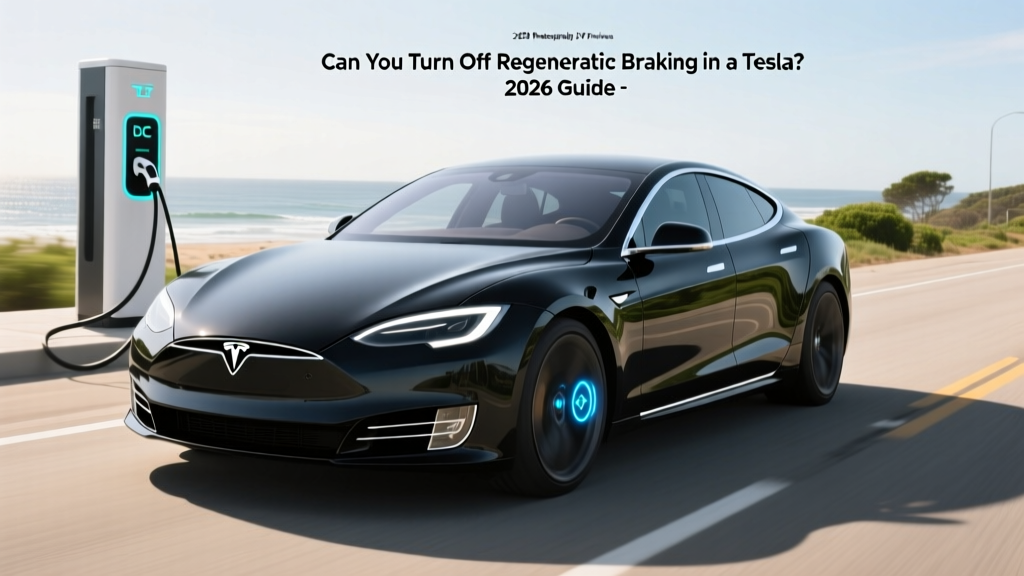
If you've searched "tesla turn off regenerative braking" you're not alone. Many new Tesla buyers — especially those transitioning from gas cars or other EVs with adjustable regen — want to know whether they can dial back or fully disable Tesla's regenerative braking system. The short answer for 2026 models: no, Tesla does not offer a way to fully turn off regenerative braking, and the ability to adjust regen levels has been removed from most new vehicles since late 2020. Here's what that means for your driving experience, efficiency, and ownership satisfaction — plus a full breakdown of what Tesla's current lineup delivers in range, charging, and value.
Why Tesla Removed Adjustable Regen (And What Replaced It)
Prior to mid-2020, Tesla offered a "Low" regenerative braking setting alongside the default "Standard" mode. Low regen allowed the car to coast more naturally when you lifted off the accelerator, mimicking the feel of a traditional automatic transmission. Tesla removed this option via an over-the-air update and has not reintroduced it on any 2026 Model 3, Model Y, Model S, or Model X.
The company's rationale centers on efficiency and simplicity. Standard regen captures more kinetic energy during deceleration, feeding it back into the battery and extending range. Tesla also introduced a "Stop Mode" setting (Roll, Hold, and Creep) that lets drivers customize what happens at very low speeds or when stopped — but these do not change the strength of regenerative braking at normal driving speeds.
- Hold: Full regen down to 0 mph; car holds itself without touching the brake (one-pedal driving).
- Creep: Car slowly moves forward when brake is released, like a conventional automatic.
- Roll: Car rolls freely at low speeds, similar to a manual in neutral (does not affect regen strength above ~5 mph).
2026 Tesla Model 3: Full Specs and Real-World Performance
Because the Model 3 is Tesla's highest-volume vehicle and the most common entry point for new owners asking about regen, we'll use the 2026 Tesla Model 3 Long Range AWD as our primary profile. Specs for other trims are noted below.
| Spec | Model 3 Long Range AWD | Model 3 RWD (Base) |
|---|---|---|
| EPA Range | 363 miles | 272 miles |
| Battery Capacity | ~79 kWh usable (NMC) | ~60 kWh usable (LFP) |
| Drivetrain | Dual-Motor AWD | Single-Motor RWD |
| Horsepower | ~384 hp | ~271 hp |
| 0-60 mph | 4.2 seconds | 5.8 seconds |
| MPGe (Combined) | 132 MPGe | 132 MPGe |
| Efficiency | 25 kWh/100 mi | 25 kWh/100 mi |
| Max DC Fast Charge | 250 kW | 170 kW |
| 10-80% DC Time | ~25 minutes | ~30 minutes |
| Level 2 Home Charge | 11.5 kW (~44 mi/hr) | 11.5 kW (~44 mi/hr) |
| Cargo Volume | 23 cu ft (rear) + 3 cu ft (frunk) | 23 cu ft + 3 cu ft |
| Rear Legroom | 35.2 inches | 35.2 inches |
| Base MSRP | $45,240 | $38,990 |
| Battery Warranty | 8 yr / 120,000 mi | 8 yr / 100,000 mi |
The EPA-rated 363 miles on the Long Range AWD is achieved under mixed city/highway driving in moderate temperatures. Expect ~290-310 miles on sustained highway trips at 70-75 mph, and ~250-275 miles in freezing weather (below 30°F) due to battery resistance and cabin heating demands. The LFP-equipped RWD model is more resilient to daily 100% charging but still loses ~15-20% range in deep cold. Source: EPA fueleconomy.gov.
Charging Speed and Infrastructure: What to Expect
Tesla's Supercharger network remains a key ownership advantage. As of 2026, Tesla operates over 6,500 Supercharger stations in North America, and the network is increasingly open to non-Tesla EVs via the NACS standard. For Tesla owners, the experience is seamless: plug in, and the car handles authentication and billing automatically.
| Charging Level | Power (kW) | Miles Added Per Hour | Typical Use Case |
|---|---|---|---|
| Level 1 (120V outlet) | ~1.4 kW | ~3-5 mi/hr | Emergency / overnight trickle |
| Level 2 (240V home) | 11.5 kW | ~44 mi/hr | Daily home charging |
| DC Fast (V3 Supercharger) | Up to 250 kW | ~1,000+ mi/hr (peak) | Road trips, rapid top-ups |
Charging curve reality: The 250 kW peak on the Long Range model is not sustained for the entire session. Peak rate applies roughly between 10-30% SoC, then tapers progressively. The 10-80% time of ~25 minutes accounts for this taper. Above 80%, charging slows dramatically to protect battery longevity — expect another 20+ minutes to go from 80-100%. Always precondition your battery (navigate to a Supercharger and the car does this automatically) to achieve peak charge rates, especially in cold weather.
Living With Standard Regen: Adaptation and Driving Tips
Most Tesla owners who initially search for how to turn off regenerative braking end up adapting to — and often preferring — one-pedal driving within a few weeks. Here's why, and how to ease the transition:
- Modulation is key: You don't need to fully lift off the accelerator. Gradually easing off provides gentle deceleration that feels natural after a short learning curve.
- Creep mode helps: If you miss the idle creep of an automatic, switch Stop Mode to Creep. The car will inch forward at stoplights, which feels familiar to gas-car drivers.
- Brake pedal still exists: Regen handles most deceleration, but the friction brakes engage for hard stops, emergency situations, and the final hold at 0 mph in Hold mode.
- Passenger comfort: New EV drivers sometimes create a "rocking" sensation by lifting off the accelerator too abruptly. Practice smooth pedal transitions and passengers won't notice a difference.
From a safety standpoint, Tesla's standard regen actually provides a mild advantage: the car begins decelerating the instant you lift off the accelerator, reducing reaction time in sudden slowdowns. The friction brakes also last significantly longer — many Tesla owners report original brake pads at 80,000+ miles because regen handles the bulk of daily braking.
Pricing, Trims, and Federal Tax Credit Eligibility
Tesla's pricing has shifted frequently, but as of early 2026, here's where the Model 3 lineup stands — and the all-important tax credit question:
| Trim | Base MSRP | Est. After §30D Credit | Credit Eligible? |
|---|---|---|---|
| Model 3 RWD | $38,990 | ~$31,490 | Yes (if sourcing rules met) |
| Model 3 Long Range AWD | $45,240 | ~$37,740 | Yes (if sourcing rules met) |
| Model 3 Performance | $52,990 | ~$45,490 | Yes (if sourcing rules met) |
- Credit amount: Up to $7,500, split between critical minerals ($3,750) and battery components ($3,750) requirements.
- MSRP cap: Sedans must be under $55,000 — all Model 3 trims qualify.
- Income cap: Modified AGI must not exceed $150,000 (single), $225,000 (head of household), or $300,000 (joint).
- Battery sourcing: Percentages of critical minerals and battery components that must be sourced from the US or FTA partners increase each year. Check current compliance on fueleconomy.gov before purchasing.
- Point-of-sale transfer: You can transfer the credit to the dealer at purchase, reducing your out-of-pocket cost immediately rather than waiting for tax filing.
Tech, Driver Assistance, and Notable Drawbacks
Tesla's minimalist interior centers on a 15.4-inch touchscreen that handles virtually all vehicle controls — there are no physical buttons for climate, media, or even glovebox release. The 2026 Model 3 "Highland" refresh added ambient lighting, ventilated front seats, a rear passenger touchscreen, and improved sound insulation over the pre-2024 design.
Driver assistance: All Teslas ship with Basic Autopilot (lane centering + adaptive cruise), which is an SAE Level 2 system — you must keep your hands on the wheel and eyes on the road at all times. The optional Full Self-Driving (Supervised) package ($8,000 or $99/month) adds automatic lane changes, traffic light/stop sign recognition, and navigation-guided driving, but remains Level 2. It is not autonomous driving — the driver is legally and operationally responsible at all times.
- Class-leading efficiency (132 MPGe combined)
- Access to Tesla Supercharger network (6,500+ stations)
- Strong real-world range (363 mi EPA on LR AWD)
- Over-the-air updates continuously add features
- Minimal brake wear thanks to strong regen
- Competitive pricing after tax credit
- No adjustable regen — one-pedal driving is mandatory
- No Apple CarPlay or Android Auto
- Minimalist interior not for everyone (no physical buttons)
- Rear seat legroom tight for taller adults (35.2")
- FSD (Supervised) is expensive and still Level 2
- Insurance costs above segment average
Who Should Buy the Tesla Model 3 in 2026?
Choose the Model 3 if:
- You want the best efficiency and Supercharger access in the segment.
- You're comfortable with touchscreen-only controls and one-pedal driving.
- Your daily commute is under 200 miles round-trip (covers 95%+ of drivers).
- You value OTA updates and a tech-forward ownership experience.
Look elsewhere if:
- You want adjustable regen or a traditional coasting feel (consider the Hyundai Ioniq 6 or BMW i4).
- You need Apple CarPlay/Android Auto (nearly every competitor offers this).
- You regularly carry tall adults in the rear seat (consider Model Y or Ioniq 5).
- You want physical buttons and knobs for climate/media.
Frequently Asked Questions
Can I turn off regenerative braking in any 2026 Tesla?
No. Tesla removed the adjustable regen setting in 2020 and has not reintroduced it. All 2026 Model 3, Model Y, Model S, and Model X vehicles use Standard (maximum) regenerative braking at all times. You can change Stop Mode to Creep or Roll for low-speed behavior, but this does not reduce regen strength at normal driving speeds.
Will Tesla ever bring back low regen via an OTA update?
There is no indication Tesla plans to do so. The company has maintained that standard regen maximizes efficiency and simplifies the driving experience. If adjustable regen is a dealbreaker, competitors like the Hyundai Ioniq 6, Ford Mustang Mach-E, and BMW i4 offer multiple regen levels including a coasting mode.
Does regenerative braking extend the Tesla Model 3's range?
Yes. Regen recaptures kinetic energy during deceleration and feeds it back into the battery. In stop-and-go city driving, regen can recover 15-25% of energy that would otherwise be lost to friction brakes. This is one reason the Model 3 achieves strong real-world city efficiency. On sustained highway drives with minimal braking, the benefit is smaller.
How does one-pedal driving affect brake pad wear?
Significantly reduces it. Because regen handles most deceleration, the friction brakes are used primarily for emergency stops and the final hold at 0 mph. Many Tesla owners report original brake pads at 80,000-100,000 miles. Tesla recommends periodic brake caliper cleaning and lubrication (especially in rust-belt states) to prevent seizing from underuse.
Does the 2026 Tesla Model 3 qualify for the $7,500 federal tax credit?
The Model 3 is on the eligible vehicle list, but your personal eligibility depends on income caps ($150K single / $300K joint), the vehicle's MSRP (must be under $55K for sedans — all trims qualify), and whether the specific battery meets current-year critical mineral and component sourcing thresholds. Verify at fueleconomy.gov and consult a tax professional before purchase.
What's the real-world range of the Model 3 Long Range AWD?
EPA-rated at 363 miles. Real-world highway driving at 70-75 mph yields approximately 290-310 miles. In freezing temperatures (below 30°F), expect 250-275 miles due to increased battery resistance and cabin heating energy use. Preconditioning the battery before driving in cold weather can recover some of this loss.