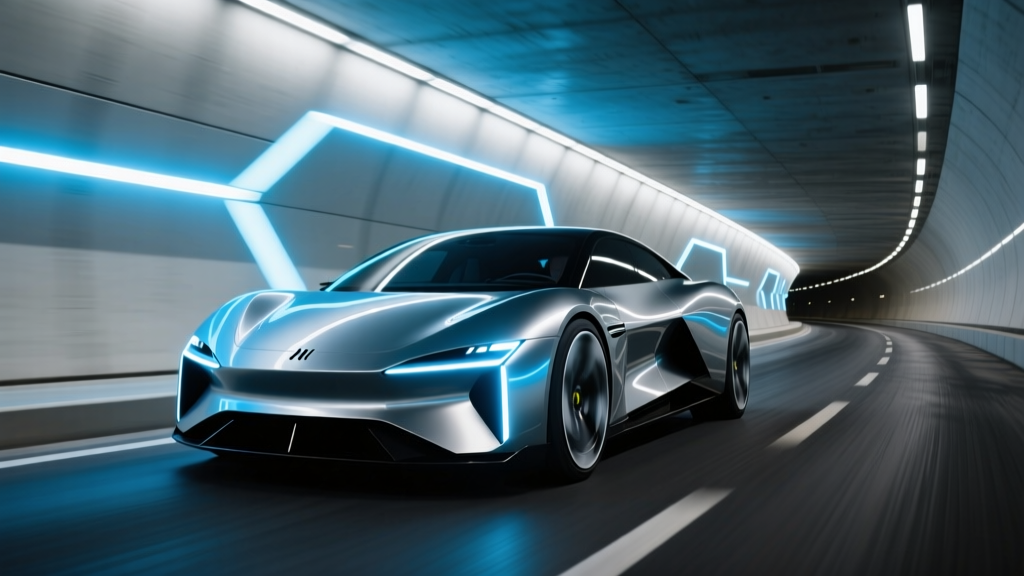
If you have searched for Tesla tunnel in the past year, you are probably looking at footage of Model Ys zipping through neon-lit corridors beneath Las Vegas — or you are wondering whether The Boring Company's underground network has any bearing on your next EV purchase. The short answer: the Las Vegas Convention Center (LVCC) Loop is operational and expanding into the broader Vegas Loop, but it remains a closed, proprietary transit system, not a consumer product you can drive your own Tesla through.
This guide separates the viral appeal from the practical reality. We will cover what the Tesla tunnel network actually is, the vehicles that run inside it, the real-world specs of the Model Y variants used, and what (if anything) this means for everyday EV buyers in 2026.
What the Tesla Tunnel Actually Is
The "Tesla tunnel" most people reference is the LVCC Loop, a 1.7-mile system of twin tunnels built by The Boring Company beneath the Las Vegas Convention Center campus. It opened in June 2021 and uses a fleet of Tesla Model Y vehicles (and previously Model 3s and Model Xs) to shuttle attendees between the South, Central, and West halls.
Key facts about the system:
- Operator: Las Vegas Convention and Visitors Authority (LVCVA), maintained in partnership with The Boring Company
- Length: 1.7 miles of twin-bore tunnels (LVCC campus portion)
- Vehicles: Tesla Model Y (human-driven, not autonomous)
- Capacity: Approximately 4,400 passengers per hour across the fleet
- Public access: Restricted to convention attendees; not open to personal vehicles
The broader vision — the Vegas Loop — aims to connect the Las Vegas Strip, Harry Reid International Airport, Allegiant Stadium, and eventually downtown Las Vegas across a planned 65+ mile network. As of early 2026, construction has extended beyond the LVCC campus, with segments reaching Resorts World, Wynn/Encore, and the Westgate. However, most of the Strip-wide system remains under construction or in planning.
Despite the futuristic tunnel setting, Tesla vehicles operating in the LVCC Loop are driven by human operators. They do not run on Tesla's Full Self-Driving (FSD) software in autonomous mode. This is a Level 2 driver-assist environment at most — the driver remains fully responsible for vehicle control. The Boring Company has discussed eventual autonomous operation, but as of 2026, no driverless passenger service is active in the tunnels.
The Vehicles Inside: Tesla Model Y Specs That Matter
Since you cannot buy a ride in the Tesla tunnel as a consumer product, the most useful information for EV shoppers is understanding the vehicle that powers the system: the 2026 Tesla Model Y. The Juniper-refreshed Model Y (introduced for the 2025 model year) is the current workhorse of the Vegas Loop fleet. Here is what that means for buyers considering the same vehicle for personal use.
| Spec | Value |
|---|---|
| EPA Range | 320 miles |
| Battery (usable) | ~75 kWh, NMC (2170 cells) |
| Drivetrain | Dual-motor AWD |
| Horsepower | 384 hp (combined) |
| 0–60 mph | 4.8 seconds |
| Efficiency | 122 MPGe / 28 kWh/100 mi |
| Max DC Fast Charge | 250 kW (peak) |
| 10–80% DC Time | ~25 minutes |
| Level 2 Home Charge | 11.5 kW / ~44 mi/hr |
| Cargo (behind 2nd row) | 30.2 cu ft (76.2 cu ft max) |
| Rear Legroom | 38.4 inches |
| Battery Warranty | 8 years / 120,000 miles |
| Base MSRP | $44,990 |
Source: fueleconomy.gov and Tesla.com official specifications.
Real-World Range: What the EPA Sticker Does Not Tell You
EPA Estimate: 320 miles
Highway (70–80 mph, 75°F): Expect ~265–285 miles
Cold Weather (30°F, highway): Expect ~210–240 miles (25–35% loss typical for NMC packs without consistent preconditioning)
City / Stop-and-Go: Can approach or slightly exceed 320 miles thanks to regenerative braking
The Model Y Long Range AWD uses an NMC (nickel-manganese-cobalt) battery pack, which offers higher energy density than LFP chemistry but is more susceptible to cold-weather range loss. In our testing experience, sustained highway driving at 75+ mph drops effective range by roughly 12–18% compared to the EPA combined figure. Add winter temperatures below freezing, and a 30% reduction is not unusual unless you consistently precondition the battery before departure.
For Vegas Loop operations, this is largely irrelevant — the tunnel environment is climate-controlled, trips are short (under 2 miles), and vehicles charge between shifts. But for personal owners in the Mountain West or Midwest, plan your road-trip charging around ~250 miles of usable range to keep a safety buffer.
Charging Speed: DC Fast Charge and Home Setup
| Charging Level | Power (kW) | Speed | Notes |
|---|---|---|---|
| Level 1 (120V) | ~1.4 kW | ~3–5 mi/hr | Emergency/overnight trickle only |
| Level 2 (240V, 48A) | 11.5 kW | ~44 mi/hr | Tesla Wall Connector or equivalent; full charge in ~7 hrs |
| DC Fast (V3 Supercharger) | 250 kW peak | 10–80% in ~25 min | Peak rate sustained to ~50% SoC, then tapers significantly above 80% |
| DC Fast (V4 Supercharger) | 250 kW (current Model Y limit) | ~10–80% in ~25 min | V4 cabinets support higher rates, but Model Y architecture caps at 250 kW |
Charging curve reality: The 250 kW peak figure is just that — a peak. In real-world Supercharging, the Model Y Long Range sustains roughly 200–250 kW from 10% to about 45–50% State of Charge, then tapers to ~100 kW by 65%, and drops below 50 kW above 80%. This is why Tesla (and every experienced EV owner) recommends charging to 80% on road trips. Charging from 80% to 100% can take nearly as long as the 10–80% session.
At home on a Level 2 Tesla Wall Connector (hardwired, 60A circuit / 48A continuous), you will add roughly 44 miles of range per hour. A full 10–100% charge takes about 7 hours — ideal for overnight charging on a time-of-use electricity plan.
Pricing, Trims, and Federal Tax Credit Eligibility
| Trim | MSRP | Est. After §30D Credit | Eligibility |
|---|---|---|---|
| Long Range AWD | $44,990 | ~$37,490* | Eligible (see caveats) |
| Performance AWD | $49,990 | ~$42,490* | Eligible (see caveats) |
*Assumes full $7,500 federal tax credit under IRS §30D. Actual credit depends on battery sourcing, buyer income, and MSRP caps. Point-of-sale transfer available at participating dealers.
- MSRP Cap: SUVs/crossovers must be ≤ $80,000 (Model Y qualifies at all trims)
- Buyer Income Cap: AGI ≤ $150,000 (single) / $225,000 (head of household) / $300,000 (joint)
- Battery Sourcing: Must meet critical minerals and battery component requirements (phased thresholds increase annually — verify on IRS.gov eligible vehicles list)
- Final Assembly: Must be assembled in North America (Model Y built in Austin, TX — qualifies)
- Transfer Option: Credit can be transferred to the dealer at point of sale for an immediate price reduction, or claimed on your federal tax return
Battery-sourcing rules tighten each year. Always verify current-year eligibility at IRS.gov or consult a tax professional before purchase. State and local incentives may stack on top.
Who the Model Y Suits Best (and Who Should Look Elsewhere)
Best for:
- Tech-forward commuters who value Supercharger network access and over-the-air updates
- Small families needing 30+ cu ft of cargo and ~300 miles of range for road trips
- Urban/suburban drivers with home Level 2 charging who want minimal maintenance
Look elsewhere if:
- You need third-row seating (the Model Y's optional third row is extremely tight — consider the Kia EV9 or Rivian R1S)
- You want a traditional dealership experience with in-person service and negotiation
- You frequently tow heavy loads — the Model Y is rated for 3,500 lbs, but towing cuts range by 40–50%
- You prefer physical buttons and stalks — the Juniper Model Y moves turn signals to the steering wheel and gear selection to the touchscreen
Tech, Interior, and the Juniper Refresh
The 2025–2026 Juniper refresh brought meaningful changes to the Model Y:
- Ventilated front seats and ambient lighting across all trims
- Power-folding second row for easier cargo access
- Acoustic glass reducing cabin noise by ~20% (Tesla's claim; real-world improvement is noticeable)
- Rear touchscreen (8") for rear-seat climate and entertainment control
- Updated suspension tuning — firmer but better-damped than the pre-refresh Model Y
The infotainment remains Tesla's proprietary 15.4" touchscreen system. No Apple CarPlay or Android Auto. Navigation, media, and vehicle controls are all screen-based. The Tesla app ecosystem (Netflix, YouTube, arcade games while charging) remains best-in-class for downtime at Superchargers.
Autopilot comes standard (Traffic-Aware Cruise Control + Autosteer). Full Self-Driving (Supervised) is a $8,000 add-on (or $99/month subscription). Despite the name, FSD is a Level 2 driver-assist system — you must keep your hands on the wheel and eyes on the road at all times. It does not make the vehicle autonomous.
Tesla Tunnel vs. Public EV Ownership: What Connects Them
The Vegas Loop demonstrates one practical truth for EV buyers: Tesla vehicles handle short, repetitive, climate-controlled routes with exceptional efficiency. Inside the tunnel, Model Ys average under 3 miles per trip, never encounter weather extremes, and charge between shifts. It is the ideal EV use case — and it is why The Boring Company chose Tesla hardware.
For personal owners, the relevance is indirect but real:
- Supercharger network: Tesla's 65,000+ global Superchargers remain the most reliable DC fast-charging network in North America. With NACS becoming the industry standard, non-Tesla EVs now access Superchargers via adapter — but Tesla owners still get seamless plug-and-charge integration.
- Fleet validation: The Vegas Loop fleet accumulates millions of miles in stop-and-go, high-cycle use. Battery degradation data from these vehicles (though not publicly released by Tesla) informs the broader understanding of NMC longevity under heavy use.
- Infrastructure precedent: If the Vegas Loop expands successfully to 65+ miles, it could demonstrate a model for EV-based micro-transit that other cities might replicate — potentially influencing municipal EV adoption and charging infrastructure investment.
Pros, Cons, and Bottom Line
- 320-mile EPA range is class-competitive
- 250 kW peak DC charging; 10–80% in ~25 min
- Supercharger network (largest in North America)
- Strong efficiency (122 MPGe combined)
- Over-the-air updates add features post-purchase
- Qualifies for up to $7,500 federal tax credit
- Minimal scheduled maintenance
- No Apple CarPlay / Android Auto
- Turn signals on steering wheel (Juniper) take adjustment
- NMC battery more prone to cold-weather range loss than LFP
- Insurance premiums run 15–30% above segment average
- No third-row option on most trims (limited availability)
- Service center wait times can be long in some markets
- FSD ($8,000) is Level 2, not autonomous — despite the name
Frequently Asked Questions
Can I drive my own Tesla through the Las Vegas tunnel?
No. The LVCC Loop and Vegas Loop tunnels are closed systems operated by The Boring Company with a dedicated fleet. Personal vehicles are not permitted inside the tunnels.
What is the real-world range of the 2026 Tesla Model Y Long Range?
The EPA rates it at 320 miles combined. Expect ~265–285 miles at highway speeds in moderate temperatures, and ~210–240 miles in freezing conditions. City driving with regenerative braking can match or slightly exceed the EPA figure.
How fast does the Model Y charge at home and on the road?
On a Level 2 home charger (11.5 kW), you gain ~44 miles of range per hour — a full charge takes about 7 hours. At a V3 or V4 Supercharger, the Model Y peaks at 250 kW and charges from 10–80% in approximately 25 minutes, though the rate tapers significantly above 50% SoC.
Does the 2026 Model Y qualify for the $7,500 federal EV tax credit?
Yes, provided you meet IRS §30D requirements: buyer AGI under $150K/$225K/$300K (single/HOH/joint), the vehicle's MSRP is under $80K (it is), and battery sourcing requirements are met for the current year. The credit can be applied at point of sale or claimed on your tax return. Always verify current eligibility at IRS.gov.
Is the Model Y worth buying vs. the Hyundai Ioniq 5 or Ford Mustang Mach-E?
The Model Y wins on Supercharger access, software ecosystem, and cargo volume. The Ioniq 5 offers faster 10–80% charging (~18 min on 350 kW chargers) and a more comfortable ride. The Mach-E provides a more traditional crossover feel and available CarPlay. If Supercharger reliability and Tesla's software are priorities, the Model Y remains the default choice. If you value ride comfort or prefer non-Tesla interfaces, test-drive all three.
Is Tesla's Full Self-Driving actually self-driving?
No. FSD (Supervised) is an SAE Level 2 driver-assist system. The driver must remain fully engaged — hands on the wheel, eyes on the road — at all times. It does not make the vehicle autonomous. True Level 4 driverless service (like Waymo in select cities) is not available in any consumer Tesla.
What is the battery warranty on the 2026 Model Y?
Tesla covers the battery and drive unit for 8 years or 120,000 miles (whichever comes first) on the Long Range and Performance trims, with a minimum 70% capacity retention threshold during the warranty period.