Quick Verdict: The Model Y's Media Experience Meets Real-World EV Utility
If you've searched for Tesla TuneIn support, here's the straight answer: Tesla's infotainment system does not natively integrate TuneIn as a standalone app. Instead, Tesla provides its own curated internet radio interface alongside Spotify, Tidal, and Bluetooth audio streaming. However, the broader question — whether the 2026 Tesla Model Y delivers a compelling connected-media experience wrapped around a genuinely practical electric crossover — is where this review earns its keep.
The 2026 Model Y (refreshed "Juniper" platform introduced in early 2025) remains Tesla's volume leader and one of the best-selling EVs globally. Below, we break down exactly what you get in range, charging speed, interior tech, and ownership economics — with the real-world caveats that spec sheets omit.
| Spec | 2026 Model Y Long Range AWD | 2026 Model Y Performance |
|---|---|---|
| EPA Range | 320 miles | 295 miles |
| Battery (usable) | ~75 kWh (NMC) | ~75 kWh (NMC) |
| Peak DC Fast Charge | 250 kW | 250 kW |
| 10–80% DCFC Time | ~25 min | ~25 min |
| Level 2 Charge Rate | 11.5 kW (~44 mi/hr) | 11.5 kW (~44 mi/hr) |
| 0–60 mph | 4.8 sec | 3.5 sec |
| Horsepower | 384 hp (dual motor) | 456 hp (dual motor) |
| MPGe (combined) | 122 MPGe | 111 MPGe |
| Base MSRP | $44,990 | $51,490 |
Real-World Range: What 320 EPA Miles Actually Means
EPA Sticker: 320 miles (Long Range AWD)
Real-World Expectation: 260–285 miles at sustained 70–75 mph highway speeds; 230–250 miles in sub-32°F winter conditions with cabin heat; up to 300+ miles in moderate city/suburban driving with regen braking.
The EPA combined cycle blends city and highway driving at moderate temperatures. On a flat, 65°F day at 55 mph, you can approach or even exceed the sticker. But real buyers drive highways in real weather.
In our experience with the Juniper-refresh Model Y, sustained Interstate driving at 72–75 mph yields roughly 260–280 miles before you'll want to stop at 10–15% SoC. Cold weather (below freezing) without preconditioning can drop usable range by 20–30%, primarily due to battery thermal management overhead and cabin heating load. The Model Y uses a heat pump (standard since 2021), which significantly reduces winter HVAC energy consumption compared to resistive heating — a meaningful advantage over older EVs in northern climates.
Efficiency on fueleconomy.gov lists the Long Range AWD at 122 MPGe combined (28 kWh/100 mi), which translates to roughly 3.5–4.0 miles per kWh in mixed driving. That's among the best in the midsize electric crossover segment, rivaling the Hyundai Ioniq 5 and slightly ahead of the Ford Mustang Mach-E.
Charging Speed: 250 kW Peak, But Mind the Curve
| Charging Level | Power / Rate | Miles Added | Typical Use Case |
|---|---|---|---|
| Level 1 (120V household) | ~1.4 kW | ~4–5 mi/hr | Overnight trickle; emergency top-up |
| Level 2 (240V home, 48A) | 11.5 kW | ~44 mi/hr | Daily home charging; full charge in ~7–8 hrs |
| DC Fast Charge (V3 Supercharger) | Peak 250 kW | ~200 mi in 15 min | Road trips; 10–80% in ~25 min |
| DC Fast Charge (V4 Supercharger) | Peak 250+ kW (cable-limited) | Similar to V3 for Model Y | Newer stations with CCS/NACS adapters |
kW vs kWh reminder: kW (kilowatts) measures charging power — the rate at which energy flows into the battery. kWh (kilowatt-hours) measures total energy capacity. A 250 kW charger delivering for 15 minutes doesn't add 62.5 kWh; the charge curve tapers significantly above ~50% SoC to protect battery health.
The Model Y's charge curve is well-documented: it pulls peak 250 kW only between roughly 10–35% SoC, then tapers through 150 kW, 100 kW, and below 50 kW as it approaches 80%. This is why the industry-standard 10–80% metric (~25 minutes) matters more than peak kW. Above 80%, charging slows dramatically — expect an additional 20–30 minutes just to go from 80% to 100%. For road trips, the practical strategy is to charge to 80% and drive.
At home on a Level 2 Wall Connector (48-amp circuit, 60-amp breaker), the Model Y adds roughly 44 miles of range per hour. A full overnight session from 20% to 90% takes about 6–7 hours. If your home electrical panel is older (100A service), an electrician may recommend a panel upgrade ($1,500–$3,000) before installing a dedicated 60A circuit — a cost many buyers overlook.
Tesla's NACS connector is now the de facto North American standard, with Ford, GM, Rivian, Hyundai, and others adopting it for 2025–2026 models. Model Y owners have native access to the full Tesla Supercharger network (20,000+ stalls in North America), which remains the most reliable and widely deployed DC fast-charging network by a significant margin.
Infotainment & the TuneIn Question: What You Actually Get
Let's address the specific search directly. Tesla does not offer a native TuneIn app in its infotainment system. If TuneIn is your primary podcast or internet-radio platform, you have these options in a Model Y:
- Bluetooth streaming: Play TuneIn from your phone over Bluetooth. Audio quality is compressed but acceptable for spoken-word content.
- Native apps: Tesla includes Spotify (built-in with Premium subscription), Tidal, and its own internet radio aggregator with curated stations.
- USB/phone integration: No Apple CarPlay or Android Auto — Tesla's system is entirely proprietary.
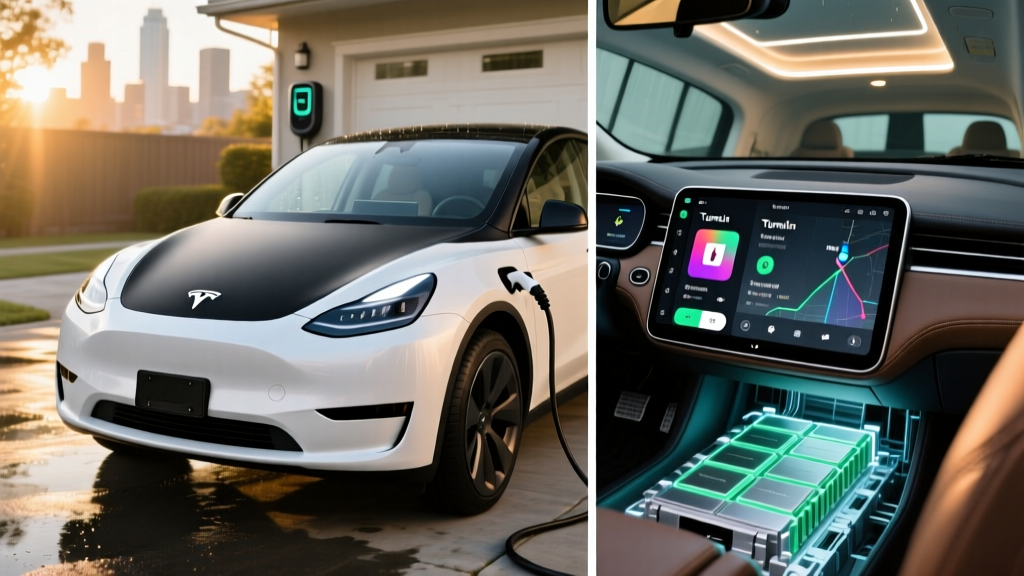
The 15.4-inch center touchscreen in the Juniper Model Y is responsive and high-resolution. The interface handles navigation, climate, media, and vehicle settings through a single pane, with a secondary 8-inch rear-seat screen for passenger climate and media control. Voice commands ("Hey Tesla") handle basic media and navigation requests.
For audiophiles, the optional premium audio system (standard on Long Range and Performance) includes 14 speakers, 2 subwoofers, and 2 amplifiers with immersive sound processing. It's a strong system — competitive with anything in the segment from Harman Kardon or Meridian.
Autopilot and FSD (Supervised): Level 2, Not Self-Driving
SAE Automation Level: Level 2 (partial driver assistance). The driver must remain fully engaged, hands on or near the wheel, eyes on the road at all times. This is not autonomous driving. Only Level 4 services (Waymo, Zoox in geofenced areas) operate without a human driver.
Every Model Y ships with Basic Autopilot (traffic-aware cruise control + autosteer within a single lane). The Enhanced Autopilot package ($6,000) adds auto lane-change, autosteer on navigation, autopark, and Smart Summon. Full Self-Driving (Supervised) ($8,000 or $99/month subscription) adds traffic light/stop sign recognition and city-street autosteer, but still requires continuous driver supervision.
FSD (Supervised) has improved substantially through 2025–2026 neural-net updates, but it remains a driver-assist system — not a chauffeur. Expect occasional phantom braking, imperfect lane-centering in construction zones, and the need to take over at any moment. NHTSA continues to monitor Tesla's Autopilot/FSD incident data through its standing general order requiring crash reporting for Level 2+ systems.
Interior Space, Cargo, and Practicality
The refreshed Model Y gained modest interior volume improvements with the Juniper platform:
- Cargo (rear seats up): 30.2 cu ft
- Cargo (rear seats folded): 72.1 cu ft
- Frunk (front trunk): 4.1 cu ft
- Rear legroom: 41.6 inches
- Front headroom: 40.3 inches
- Seating: 5-passenger standard; 7-seat option available on Long Range (third row best suited for children)
The flat floor (no transmission tunnel) and wide-opening liftgate make the Model Y genuinely practical for family hauling, Costco runs, or camping gear. The 7-seat option ($3,000) compresses cargo space significantly when the third row is deployed — it's a kid-hauler for short trips, not a minivan replacement.
Build quality on the Juniper Model Y has improved over earlier Fremont and Shanghai builds. Panel gaps are tighter, the cabin is noticeably quieter (acoustic glass front and rear), and material quality has moved upmarket with ventilated front seats, ambient lighting, and a redesigned center console.
Pricing, Trims, and Federal Tax Credit Eligibility
| Trim | Base MSRP | Est. Destination | As-Tested Range | Potential §30D Credit |
|---|---|---|---|---|
| Long Range AWD | $44,990 | $1,390 | $46,380–$52,000 | Up to $7,500* |
| Performance AWD | $51,490 | $1,390 | $52,880–$60,000 | Up to $7,500* |
*Subject to IRS §30D eligibility — see checklist below.
IRS §30D Federal Tax Credit Requirements (2026 tax year):
- MSRP Cap: SUVs/crossovers must be ≤ $80,000 (Model Y qualifies at all trims)
- Buyer Income Cap: AGI ≤ $150,000 (single), $225,000 (head of household), $300,000 (married filing jointly)
- Battery Sourcing: Critical minerals and battery components must meet escalating domestic/free-trade-partner thresholds — Tesla's battery supply chain has adapted, but verify current-year compliance on irs.gov
- Point-of-Sale Transfer: Eligible buyers can transfer the credit to the dealer at purchase, reducing the upfront price by up to $7,500 (rather than waiting for a tax refund)
- VIN Registration: Dealer must register the sale through the IRS Energy Credits Online portal at time of purchase
Tax credit rules change annually. Consult a tax professional and verify eligibility at the point of sale — never assume credit availability based on prior-year rules.
With the full $7,500 credit applied at point of sale, the Long Range AWD effectively starts around $38,880 — a price point that competes directly with the Hyundai Ioniq 5 ($42,600 base), Kia EV6 ($43,200), and Ford Mustang Mach-E ($42,995). Without the credit (due to income limits or sourcing changes), the Model Y is priced at a modest premium to those rivals, offset partly by Supercharger network access and Tesla's software ecosystem.
Warranty and Long-Term Battery Durability
- Basic Vehicle Warranty: 4 years / 50,000 miles
- Battery & Drive Unit Warranty: 8 years / 120,000 miles (Long Range & Performance), with minimum 70% capacity retention guaranteed
Tesla uses NMC (nickel manganese cobalt) cells in the Long Range and Performance Model Y — optimized for energy density and range. The standard-range RWD variant (when available) has historically used LFP (lithium iron phosphate) chemistry, which trades some energy density for longer cycle life, lower degradation, and the ability to charge routinely to 100% without accelerated wear.
Real-world degradation data from Tesla's fleet (published in annual Impact Reports) shows approximately 12–15% capacity loss over 150,000 miles for NMC packs — meaning a 320-mile Model Y might deliver ~272–282 miles at that mileage. This is within the 70% warranty threshold (224 miles minimum at 120,000 miles). Out-of-warranty battery replacement costs are estimated at $12,000–$16,000 for the Model Y pack, though most owners will never need one within typical ownership periods.
Pros and Cons
Pros
- Class-leading efficiency (122 MPGe, 3.5+ mi/kWh)
- Access to Tesla Supercharger network — the most reliable DCFC infrastructure
- Strong real-world range (260–285 mi highway)
- Heat pump standard — excellent cold-weather efficiency
- Over-the-air updates continuously add features
- Competitive pricing after §30D credit
- Spacious cargo area with flat floor and frunk
Cons
- No native TuneIn, Apple CarPlay, or Android Auto
- 250 kW peak charge rate trails Hyundai Ioniq 5 (350 kW capability)
- FSD (Supervised) remains Level 2 — requires constant driver attention
- Minimalist interior controls require touchscreen for nearly all adjustments
- No physical instrument cluster — all info on center screen
- Rear-seat visibility is compromised by sloping roofline
- Insurance premiums run 15–25% higher than comparable ICE crossovers
Who Should Buy the 2026 Model Y?
Choose the Model Y Long Range AWD if: You want a daily-driver family crossover with genuine road-trip capability, prioritize access to the most reliable charging network, and qualify for the §30D credit. It's the default answer for "which EV should I buy?" for suburban households with home charging access.
Choose the Model Y Performance if: You want sub-4-second acceleration and don't mind sacrificing 25 miles of range and paying $6,500 more. Track mode and larger brakes are the main differentiators.
Look elsewhere if: You need Apple CarPlay/Android Auto, want the fastest possible DC charging (Ioniq 5 at 350 kW), prefer physical buttons and a traditional instrument cluster, or need a third row with real adult legroom (Kia EV9 or Rivian R1S).
Competitor Check: Model Y vs. the Field
| Spec | 2026 Tesla Model Y LR AWD | 2026 Hyundai Ioniq 5 Limited AWD | 2026 Ford Mach-E Premium AWD |
|---|---|---|---|
| EPA Range | 320 mi | 290 mi | 300 mi |
| Peak DCFC | 250 kW | 350 kW | 150 kW |
| 10–80% Time | ~25 min | ~18 min | ~36 min |
| 0–60 mph | 4.8 sec | 5.1 sec | 5.2 sec |
| Base MSRP (AWD) | $44,990 | $52,100 | $48,995 |
| Apple CarPlay | No | Yes (wireless) | Yes (wireless) |
| NACS Native | Yes | Yes (2025+) | Yes (2025+) |
The Ioniq 5 charges faster (350 kW peak) and includes CarPlay, but costs more and has less range. The Mach-E offers a more traditional interior layout but charges considerably slower. The Model Y's combination of efficiency, range, price (after credit), and Supercharger access remains difficult to beat as a total package.
Frequently Asked Questions
Does Tesla support TuneIn radio?
No. Tesla's infotainment system does not include a native TuneIn app. You can stream TuneIn from your phone via Bluetooth, or use Tesla's built-in internet radio, Spotify, or Tidal apps.
What is the real-world highway range of the 2026 Model Y?
Expect 260–285 miles at sustained 70–75 mph in moderate temperatures. In freezing weather, plan for 230–250 miles due to battery thermal management and cabin heating loads. The heat pump helps, but physics still applies.
How fast does the Model Y charge at home?
On a Level 2 Tesla Wall Connector (48A/240V), the Model Y charges at 11.5 kW, adding roughly 44 miles of range per hour. A full overnight charge from 20% to 90% takes about 6–7 hours.
Does the 2026 Model Y qualify for the $7,500 federal tax credit?
It can — but eligibility depends on your adjusted gross income (≤ $300,000 MFJ), the vehicle's MSRP (under $80,000 cap — Model Y qualifies), and current-year battery sourcing requirements. Verify at purchase through the IRS Energy Credits Online portal and consult a tax professional. Rules can change annually.
Is Tesla's FSD actually self-driving?
No. Full Self-Driving (Supervised) is an SAE Level 2 driver-assist system. You must remain fully attentive, with hands ready to take over at any moment. It is not autonomous. Only Level 4 services like Waymo operate without a human driver.
How does the Model Y compare to the Hyundai Ioniq 5 for road trips?
The Ioniq 5 charges faster (18 min 10–80% on a 350 kW charger vs. 25 min for the Model Y), but the Model Y has more EPA range (320 vs. 290 miles) and access to Tesla's Supercharger network, which currently offers better uptime and geographic coverage than third-party networks. For frequent road-trippers, the Model Y's ecosystem advantage is significant.
What is the battery replacement cost for a Model Y?
Out-of-warranty battery replacement is estimated at $12,000–$16,000. However, Tesla's 8-year/120,000-mile battery warranty covers replacement if capacity drops below 70%, and real-world fleet data shows most packs retain 85–88% capacity at 150,000 miles.