The Tesla Trailer: Separating Fact from Fan Fiction
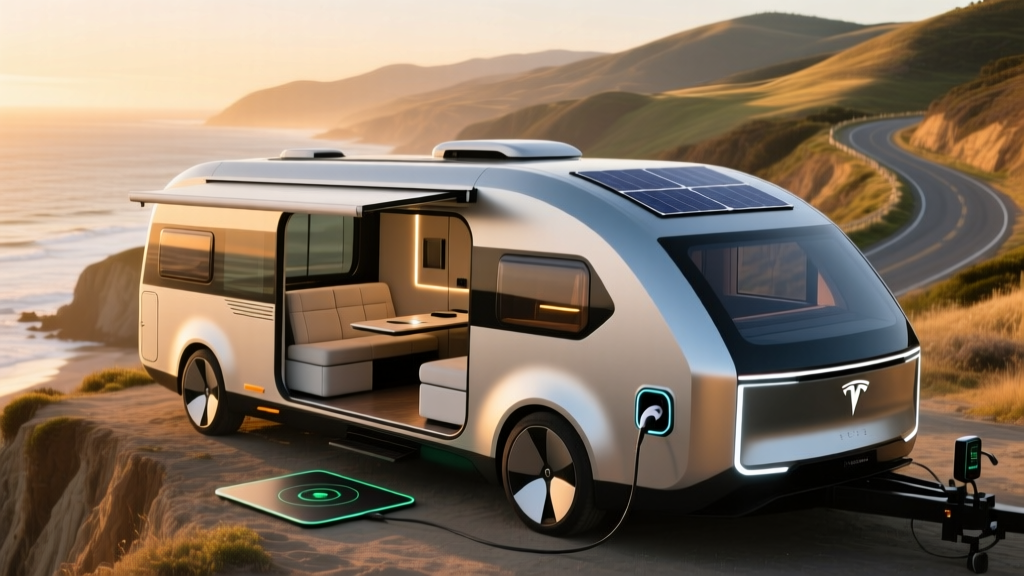
Search "Tesla trailer" and you'll find a flood of renderings, YouTube speculation, and forum threads imagining an all-electric camper or travel trailer wearing the Tesla badge. The concept is irresistible: a sleek, solar-equipped, software-defined trailer that pairs perfectly with the Cybertruck or a future Tesla SUV, extending your off-grid adventures without a drop of gasoline.
But here's the reality check: as of early 2026, Tesla has not officially announced, unveiled, or confirmed any trailer product — not a travel trailer, not a fifth-wheel, not a teardrop camper. There is no Tesla trailer on sale, no configurator page, and no EPA filing. What exists is a combination of Elon Musk's past comments about the idea, patent filings that hint at aerodynamic trailer concepts, and a booming third-party market of EV-optimized trailers from companies like Airstream, Lightship, and Bowlus.
This article breaks down what's actually known, what's plausible based on Tesla's technology stack, and what you should consider if you're an EV owner looking to tow a camper today.
What Has Tesla Actually Said About Making a Trailer?
The "Tesla trailer" rumor mill traces back to a few specific moments:
- Cybertruck unveil (2019): Tesla showed the Cybertruck towing a futuristic-looking trailer concept on stage. It was never named, spec'd, or offered for pre-order. It served as a visual prop to demonstrate towing capability.
- Elon Musk tweets (2020-2022): Musk responded to fan questions about a Tesla camper or trailer with variations of "maybe" and "it's on the list," but never committed to a timeline or product brief.
- Patent filings: Tesla has filed patents related to aerodynamic trailer designs, integrated trailer braking systems, and trailer-mounted solar/battery systems. Patents do not guarantee production — many OEM patents never reach showrooms.
The honest assessment: Tesla's product roadmap is notoriously opaque, and the company has a history of shelving concepts (remember the Tesla roadster 2.0 timeline?). If a Tesla trailer materializes, it would likely debut alongside a Cybertruck refresh or as a standalone accessory — but there is no confirmed date, pricing, or specification sheet as of 2026.
What a Tesla Trailer Would Need: The Engineering Spec Sheet
If Tesla does build a trailer, we can make educated guesses about the engineering based on the company's existing technology and the demands of EV towing. Here's what the spec sheet would need to address:
| Specification | Likely Target | Why It Matters |
|---|---|---|
| Trailer Weight (dry) | 3,000–5,500 lbs | Must stay within Cybertruck's ~11,000 lb tow rating; lighter = less range loss |
| Battery Pack (optional) | 40–80 kWh, LFP chemistry | Onboard battery could offset tow-vehicle range loss; LFP for durability and safety |
| Solar Roof Capacity | 400–800W | Supplemental charging for trailer battery; trickle-charges while parked off-grid |
| Aerodynamic Drag Coefficient | Cd ~0.25–0.30 | Teardrop or shaped profile to minimize the 40-60% range loss typical of boxy trailers |
| Regenerative Braking (trailer axle) | Integrated with tow vehicle regen | Recovers energy on deceleration; reduces brake wear on long descents |
| Thermal Management | Heat pump + active battery cooling | Essential for trailer battery longevity in extreme camping climates |
| Connectivity | Tesla app integration, OTA updates | Monitor trailer SoC, climate, and security remotely from your phone |
The Range Problem: Why Towing Any Trailer Crushes EV Efficiency
The single biggest challenge for any EV trailer — Tesla-branded or otherwise — is the physics of towing. When you hitch a 4,000-pound travel trailer to an electric truck or SUV, you're not just adding weight. You're adding aerodynamic drag, rolling resistance, and often a blunt, boxy shape that acts like a parachute at highway speeds.
Real-World Towing Range Reality: A Cybertruck AWD (EPA 340 miles) towing a 4,500 lb conventional travel trailer at 65 mph can expect its range to drop to approximately 150–180 miles — a 47-56% reduction. Cold weather (below 40°F) and mountain grades compound this further. Plan your charging stops accordingly: you'll need DC fast chargers every 120-140 miles on a towing road trip.
This is not unique to Tesla. Every EV on the market — the Ford F-150 Lightning, Rivian R1T, Chevrolet Silverado EV — suffers similar range penalties when towing. The difference is how you manage it:
- Aerodynamic trailer shape (teardrop vs. box) can recover 10-15% of lost range
- Trailer-mounted battery pack can add 50-100 miles of effective range, but adds weight and cost
- Preconditioning and route planning via Tesla's navigation can optimize charge stops around the trailer's drag profile
- Speed management: Dropping from 70 mph to 60 mph while towing can recover 15-20% range — the physics of drag are exponential
Charging While Towing: The Infrastructure Gap
Even if a Tesla trailer had its own battery pack, charging it on the road presents real challenges. Tesla's Supercharger network (now open to NACS-equipped non-Tesla EVs) was designed for passenger vehicles, not truck-and-trailer combinations.
| Charging Scenario | Power (kW) | Practical Notes |
|---|---|---|
| Supercharger V4 (pull-through) | Up to 350 kW (vehicle) | Newer V4 stalls include pull-through lanes for trucks with trailers — but availability is still limited in 2026 |
| Standard Supercharger stall | 150–250 kW | Must unhitch trailer or block adjacent stall; not practical for quick stops |
| Destination charging (Level 2) | 7–11 kW (vehicle) | Overnight at campgrounds; slow but adequate if you're parked 12+ hours |
| Trailer solar trickle | 0.4–0.8 kW | ~2-4 miles of range per hour of peak sun on a trailer battery; useful for off-grid camping, not road trips |
Tesla has been expanding pull-through Supercharger stalls at select locations, and third-party networks like Electrify America are adding truck-friendly layouts. But in 2026, towing an EV trailer on a long road trip still requires careful route planning around charger type and stall configuration.
Competitors Already Building EV-Optimized Trailers
While the Tesla trailer remains hypothetical, several companies are shipping real products designed for EV towing. If you need a trailer today, these are worth evaluating:
Lightship L1
Battery: 80 kWh onboard pack
Solar: 3 kW roof array
Weight: ~7,500 lbs (GVWR)
Price: ~$125,000 base
Key advantage: The onboard battery powers the trailer's own electric axle, effectively making it self-propelled at low speeds and reducing range loss on the tow vehicle to under 10%. Aerodynamic profile (Cd ~0.22) further preserves range.
Airstream eStream (Concept)
Battery: 80 kWh pack
Solar: 900W roof
Status: Announced/concept, limited availability
Price: TBD (estimated $100,000+)
Key advantage: Airstream's iconic aluminum shell with integrated electric propulsion axle; designed to reduce tow-vehicle range penalty.
Other players include Bowlus (luxury aluminum trailers with onboard batteries), Pebble (Steve Jobs' former design lead's startup, focused on aerodynamic campers with electric axles), and Colorado Teardrops (lightweight, affordable teardrops that minimize range loss by staying under 2,000 lbs).
Could a Tesla Trailer Qualify for Tax Credits?
This is where the speculation gets especially tricky. The federal §30D clean vehicle credit applies to new qualified plug-in electric vehicles — and a trailer is not a vehicle in the IRS definition. Key points:
- Trailers do not qualify for §30D. The credit requires four wheels, a gross vehicle weight rating under 14,000 lbs, and highway-capable propulsion. A trailer — even one with an electric axle — is classified as towed equipment.
- The tow vehicle may qualify. If you're buying a Cybertruck, Model X, or another eligible EV to tow the trailer, that vehicle might qualify for up to $7,500 under §30D, subject to MSRP caps ($80,000 for trucks/vans/SUVs), buyer income limits ($300,000 joint / $150,000 single), and battery component/critical mineral sourcing requirements.
- Energy storage credits may apply. If the trailer has a large standalone battery, it could theoretically qualify under §25D residential clean energy credit as a battery storage system — but only if installed at a residence and meeting specific requirements. Consult a tax professional.
Bottom line: don't buy a trailer expecting a federal tax credit. Budget accordingly.
Who Should Wait for a Tesla Trailer — and Who Should Buy Now?
Wait for a Tesla trailer if:
- You already own or plan to buy a Cybertruck and want ecosystem integration (single app, OTA updates, Supercharger route planning with trailer profile)
- You're 2-3 years from needing a trailer and can afford to see if Tesla delivers
- You prioritize software integration and minimalist design over immediate availability
Buy a trailer now if:
- You have camping trips planned in 2026 and can't wait for an unannounced product
- You need a specific floorplan, weight class, or amenity set that existing trailers offer
- You want to start learning the realities of EV towing (range planning, charging logistics, weight distribution) with available equipment
- Budget matters — you can get a quality lightweight teardrop from Colorado Teardrops or Escapod for $15,000–$30,000, far less than the $100,000+ EV-optimized trailers
Frequently Asked Questions
Has Tesla officially announced a trailer or camper product?
No. As of 2026, Tesla has not announced, unveiled, or listed any trailer product for sale. The concept exists only in renderings, patent filings, and Musk's informal social media comments. Any website or video claiming specific specs, pricing, or release dates for a "Tesla trailer" is speculative.
How much range do I lose towing a trailer with an EV?
Expect a 40-60% range reduction when towing a typical 3,500–5,000 lb travel trailer at highway speeds. A Cybertruck (EPA 340 mi) drops to roughly 150-180 miles. A Model X (EPA 326 mi) drops to roughly 140-170 miles. Lighter teardrop trailers (under 2,000 lbs) reduce the penalty to 20-30%.
Can any Tesla vehicle tow a trailer?
The Cybertruck has a maximum tow rating of 11,000 lbs (AWD tri-motor). The Model X can tow up to 5,000 lbs. The Model Y can tow up to 3,500 lbs (with the optional tow package). The Model 3 and Model S do not have official tow ratings and should not be used for trailer towing. Always check your specific model year and trim.
Would a Tesla trailer with its own battery extend my EV's range?
Theoretically, yes. A trailer with a 40-80 kWh battery and an electric axle could feed power back to the tow vehicle or propel itself at low speeds, reducing the energy burden on the truck. Companies like Lightship and Pebble are building this technology now. However, the added battery weight (500-1,000 lbs) partially offsets the benefit, and the system adds significant cost ($30,000-$50,000+ over a conventional trailer).
What's the best trailer for a Tesla Cybertruck owner today?
For maximum range preservation, choose a lightweight, aerodynamic teardrop or compact trailer under 3,000 lbs — options like the Escapod TOPO2, Colorado Teardrops Peak, or Basecamp by Airstream. If you need more space and budget allows, the Lightship L1 (with its electric axle) offers the least range penalty of any full-size travel trailer, though at a premium price above $125,000.
Does Tesla's Autopilot or FSD work while towing?
Tesla's Autopilot (Level 2 driver-assist) can function while towing, but with important caveats. The system's sensors and cameras must be unobstructed by the trailer. FSD (Supervised) is not designed or tested for towing scenarios and should not be relied upon with a trailer attached. Always maintain full attention — Level 2 requires active driver supervision at all times, and towing adds stopping distance and handling complexity that no current consumer ADAS is calibrated for.
The Bottom Line on the Tesla Trailer
The Tesla trailer remains one of the EV world's most persistent "what ifs." The concept makes sense — Tesla's vertical integration in batteries, software, energy management, and vehicle design could produce a genuinely innovative camper. But "could" is doing a lot of heavy lifting.
If you're an EV owner planning to tow in 2026, the practical path is clear: buy a lightweight, aerodynamic trailer from an established manufacturer, learn the realities of EV towing range and charging logistics, and enjoy the growing (if still imperfect) infrastructure. If Tesla eventually ships a trailer, it will need to solve the same physics problems every other EV-towing setup faces — and at a price that justifies the Tesla premium.
Until there's an official announcement with real specifications, treat every "Tesla trailer" headline as speculation. Bookmark this page — we'll update it the moment Tesla confirms anything concrete.