The Short Answer: Tesla Is Not Building Tiny Homes
If you have seen viral posts claiming is Tesla building tiny homes priced at $10,000 to $30,000, you are not alone. Millions of people have searched that exact question over the past two years. The answer, as of early 2026, is straightforward: No, Tesla does not manufacture, sell, or market tiny homes, modular homes, or any residential housing product.
Tesla's core businesses remain electric vehicles, solar panels, solar roof tiles, Powerwall home batteries, Megapack grid-scale storage, and its Optimus humanoid robotics program. None of these involve building dwellings. The confusion, however, is understandable — and it reveals something important about how Tesla's energy ecosystem is reshaping what compact, off-grid-capable living looks like.
Where the rumor started: AI-generated concept images of "Tesla Model Home" or "Tesla Tiny House" circulated widely on social media starting in 2023. These renderings were never official Tesla products. Tesla CEO Elon Musk has personally lived in a roughly $50,000 prefabricated Boxabl Casita near SpaceX's Boca Chica facility, but that is a third-party product — not a Tesla build.
What Tesla Actually Makes for Homes
While Tesla does not build houses, the company sells a tightly integrated energy stack that many tiny-home and compact-living enthusiasts use as the backbone of their dwellings. Understanding this ecosystem is essential if you are researching electrified living at any scale.
Solar Panels and Solar Roof
Tesla offers traditional rack-mounted solar panels and its Solar Roof, which replaces conventional roofing with active solar tiles. As of 2026, Solar Roof pricing typically falls between $35,000 and $70,000 before incentives for an average home, depending on system size and roof complexity. For a tiny home with a small roof footprint (typically 100–200 square feet), a conventional Tesla solar array of 2–4 kW is more practical and far more cost-effective than Solar Roof tiles.
Powerwall 3
The Tesla Powerwall 3 is a 13.5 kWh usable-capacity home battery with an integrated inverter capable of delivering 11.5 kW continuous power. Multiple units can be stacked for greater capacity. For a tiny home running efficient appliances and LED lighting, a single Powerwall 3 paired with a modest solar array can sustain off-grid operation for extended periods — which is exactly why the tiny-home community associates Tesla with housing, even though Tesla only supplies the energy hardware.
Wall Connector and EV Charging
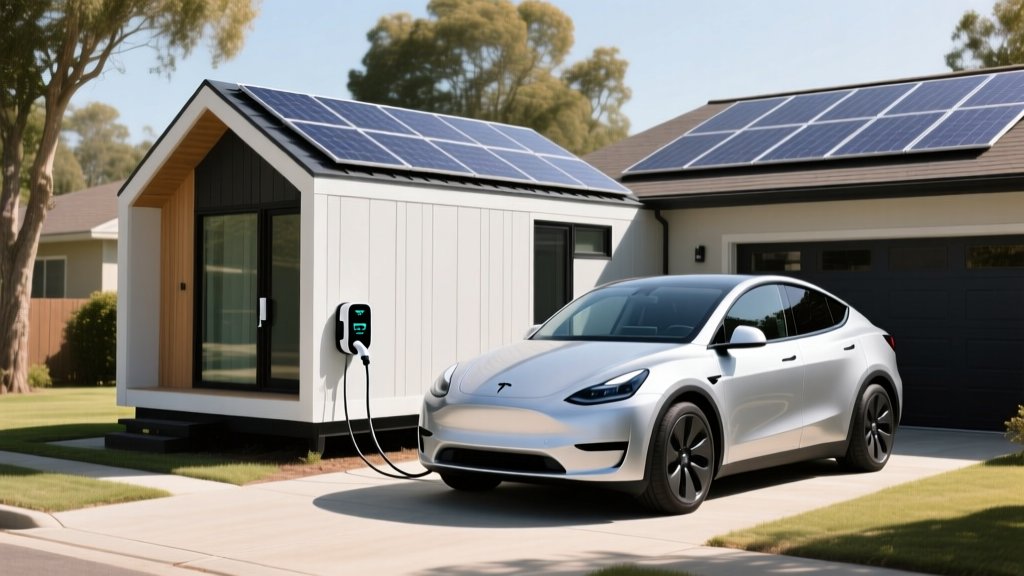
Tesla's Gen 3 Wall Connector delivers up to 11.5 kW (48 amps) on a 60-amp circuit, adding roughly 44 miles of range per hour of charging to a Tesla vehicle. For tiny-home dwellers who also own a Tesla EV, the Wall Connector is the bridge between their home energy system and their transportation — a genuine advantage of staying within the Tesla ecosystem.
Why the Tiny Home Rumor Persists
Three converging trends keep the is Tesla building tiny homes question alive:
- Elon Musk's personal housing choice. Musk's well-publicized use of a Boxabl Casita (a foldable, factory-built micro-home) created an informal association between Tesla's brand and compact living.
- AI-generated concept art. Photorealistic but fabricated images of sleek, Tesla-branded micro-dwellings have been shared millions of times across platforms with no disclaimer that they are fan-made renders.
- Genuine overlap in buyer demographics. The audience interested in tiny homes, off-grid living, and sustainability overlaps heavily with EV buyers. A 2025 survey by the National Association of Home Builders found that buyers pursuing alternative housing are roughly 3.2 times more likely to own an EV than conventional homebuyers.
Tesla has never filed trademarks, announced plans, or allocated capital toward residential construction. The company's 2025 annual report and SEC filings make no mention of housing as a current or planned product line.
Tesla Energy Products for Compact Living: Specs at a Glance
| Product | Key Spec | Approx. Installed Cost (2026) | Federal ITC Eligible |
|---|---|---|---|
| Solar Panels (per watt) | ~$2.49–$3.20/W before incentives | $7,500–$16,000 (3–5 kW system) | Yes — 30% (§48 ITC) |
| Solar Roof | Active + inactive tiles, 25-yr warranty | $35,000–$70,000+ | Yes — 30% (§48 ITC) |
| Powerwall 3 | 13.5 kWh usable, 11.5 kW output | $9,200–$12,500 installed | Yes — 30% (§48 ITC, standalone battery) |
| Wall Connector (Gen 3) | 11.5 kW / 48A, 24-ft cable | $475 unit + $500–$2,000 install | No (EV charger, separate rules) |
Note: The 30% federal Investment Tax Credit (ITC, IRS §48) applies to solar and standalone battery storage. This is separate from the §30D clean vehicle credit for EV purchases. Consult a tax professional or IRS Publication 5695 for eligibility specifics.
Real Tiny-Home Brands That Integrate With EVs
If your interest in is Tesla building tiny homes stems from a desire to pair a compact dwelling with an electric vehicle, several established tiny-home and ADU (accessory dwelling unit) manufacturers offer EV-ready designs:
- Boxabl — The Casita (~$60,000 base) is a factory-folded 375 sq ft studio. Musk's association with the brand boosted its profile, but Tesla has no ownership stake.
- Cover — Los Angeles-based ADU builder using panelized construction, starting around $150,000 for a 400–600 sq ft unit, designed to accommodate solar and EV charging circuits.
- Autonomous WorkPod — A backyard office/studio (~$30,000–$50,000) popular with remote workers; can be paired with a Powerwall and solar array.
- Lightship (formerly Vessel) — Solar-integrated travel trailers starting at ~$75,000, designed for EV towing with low drag coefficients to preserve tow-vehicle range.
Each of these can be equipped with Tesla energy products (solar panels, Powerwall) and a Tesla Wall Connector for EV charging — creating a de facto "Tesla-powered home" without Tesla building the structure itself.
EV Charging Considerations for Tiny-Home Dwellers
Charging an EV from a tiny home presents unique electrical constraints that most conventional-home EV owners never face:
Electrical Panel Capacity
Many tiny homes operate on 100-amp or even 50-amp electrical services. A Level 2 Wall Connector drawing 48 amps requires a dedicated 60-amp circuit — which may consume the majority of a tiny home's total panel capacity. Solutions include:
- Upgrading to a 200-amp service panel ($1,500–$3,500 depending on local utility requirements)
- Using a lower-amperage Level 2 charger (16A or 32A) that draws 3.8 kW or 7.7 kW respectively
- Installing a smart load-management device (such as the Tesla Wall Connector with load-sharing firmware) that throttles EV charging when other appliances are running
Solar + Battery + EV Charging Math
A 4 kW solar array on a tiny home might generate 16–22 kWh per day depending on latitude and season. A Tesla Model 3 Long Range consumes roughly 25 kWh per 100 miles of driving. This means a tiny-home solar system can realistically replenish 60–85 miles of daily driving range — sufficient for most commuters, but insufficient for heavy daily driving without grid supplementation.
Could Tesla Enter Housing in the Future?
Tesla's Master Plan Part 3, published in 2023, outlines a path toward sustainable energy at a global scale, including massive battery manufacturing expansion and grid storage deployment. Housing construction is not mentioned. However, Tesla's expertise in factory-built battery packs, integrated solar, and software-managed energy flows positions the company to supply components to the modular-housing industry even if it never builds homes directly.
The more likely trajectory: third-party home builders increasingly adopt Tesla energy hardware as standard or optional equipment, particularly in markets with high electricity costs and frequent grid outages (California, Texas, Hawaii, Puerto Rico). In that scenario, "a Tesla-powered home" becomes a real category — built by someone else, energized by Tesla.
Bottom line: Tesla is not building tiny homes and has no announced plans to do so. The company's energy products — solar, Powerwall, and Wall Connector — are widely used in compact and off-grid dwellings, which fuels the persistent rumor. If you want a tiny home with Tesla integration, you will need to buy the structure from a dedicated builder and equip it with Tesla energy hardware separately.
Frequently Asked Questions
Does Tesla sell any kind of house or dwelling?
No. Tesla sells solar panels, Solar Roof tiles, Powerwall batteries, EV chargers, and electric vehicles. The company does not manufacture or sell any residential structure.
Why do people think Tesla is building tiny homes?
The rumor stems from AI-generated concept images shared on social media, Elon Musk's personal use of a Boxabl Casita, and the strong overlap between Tesla energy products and the off-grid tiny-home community.
Can I power a tiny home with Tesla solar and Powerwall?
Yes. A modest Tesla solar array (2–4 kW) paired with a single Powerwall 3 (13.5 kWh) can sustain a well-insulated tiny home running efficient appliances, particularly in sun-rich climates.
Is the Tesla Powerwall eligible for a tax credit?
Yes. Standalone battery storage of 3 kWh or greater qualifies for the 30% federal Residential Clean Energy Credit (IRS §48 ITC) as of 2026. This is separate from the §30D vehicle tax credit. Confirm eligibility with a tax professional and review IRS guidelines.
Can I charge a Tesla EV from a tiny home?
Yes, but panel capacity is the limiting factor. A 48A Wall Connector requires a 60A circuit, which may exceed a tiny home's electrical service. Lower-amperage Level 2 chargers or panel upgrades are common solutions.
What companies actually build tiny homes compatible with Tesla products?
Boxabl, Cover, Autonomous WorkPod, and Lightship all produce compact dwellings or trailers that can be equipped with Tesla solar panels, Powerwall batteries, and Wall Connectors for a fully integrated energy and transportation ecosystem.