The 2026 Model Y: Where Tesla Technologies Converge
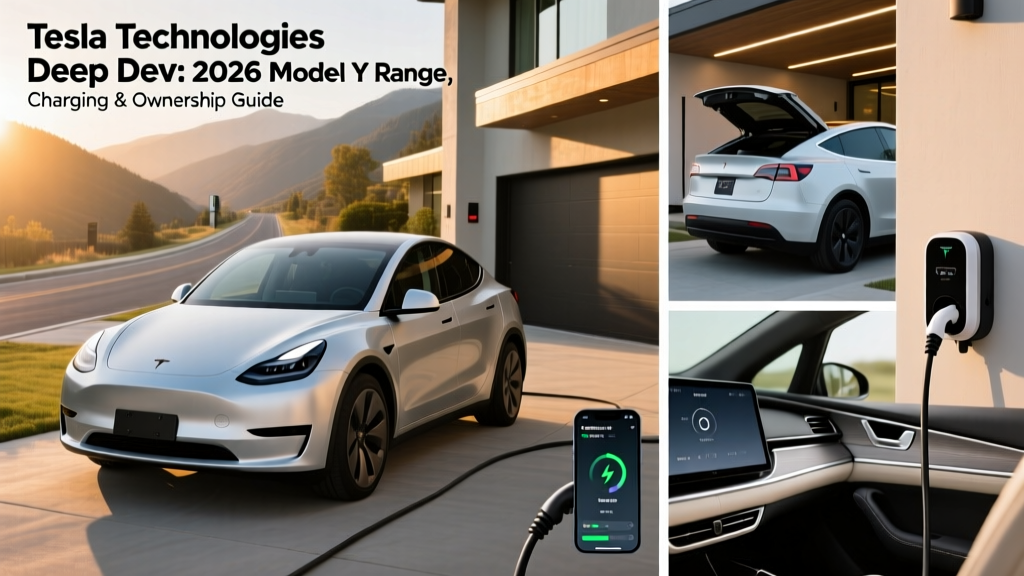
The refreshed Model Y (internally dubbed "Juniper") represents the most significant update to Tesla's best-selling vehicle since its 2020 launch. For buyers evaluating Tesla technologies — from the latest powertrain efficiency gains to revised thermal management and updated driver-assistance hardware — the 2026 Model Y is the clearest expression of what the company currently delivers at scale. This review breaks down every spec that matters to a real buyer: range you can actually count on, charging speeds beyond the peak number, true ownership costs, and how the federal tax credit applies under current IRS §30D rules.
| Spec | Long Range AWD | Performance AWD |
|---|---|---|
| EPA Range | 320 mi | 293 mi |
| Battery (usable) | ~75 kWh, NMC | ~75 kWh, NMC |
| Drivetrain | Dual-Motor AWD | Dual-Motor AWD |
| Horsepower | 384 hp | 456 hp |
| 0–60 mph | 4.8 sec | 3.5 sec |
| Peak DC Charge Rate | 250 kW | 250 kW |
| 10–80% DCFC Time | ~25 min | ~25 min |
| Level 2 Rate (11.5 kW) | ~37 mi/hr | ~37 mi/hr |
| MPGe (combined) | 122 MPGe | 111 MPGe |
| Efficiency | 28 kWh/100 mi | 30 kWh/100 mi |
| Cargo (rear seats up) | 30.2 cu ft | 30.2 cu ft |
| Cargo (rear seats folded) | 72.1 cu ft | 72.1 cu ft |
| Base MSRP | $44,990 | $51,490 |
| Battery Warranty | 8 yr / 120,000 mi | 8 yr / 120,000 mi |
Source: fueleconomy.gov, Tesla.com. Specs reflect 2026 model year.
Real-World Range: What the EPA Sticker Doesn't Tell You
The EPA rates the 2026 Model Y Long Range at 320 miles on a full charge — a modest bump over the pre-refresh model, attributable to improved aerodynamics (a lower drag coefficient) and a revised heat pump that reduces cabin-heating energy draw. But EPA testing uses a blended city/highway cycle with moderate temperatures. Real-world results depend heavily on how and where you drive.
- City/suburban mixed driving (65°F): ~300–320 mi — regen braking recovers energy in stop-and-go traffic, closely matching EPA.
- Highway at 70 mph (75°F): ~265–285 mi — sustained high speed increases aerodynamic drag; expect a 10–15% reduction from the EPA sticker.
- Highway at 70 mph (30°F, no preconditioning): ~215–240 mi — cold air increases battery internal resistance and cabin heating demand can draw 3–5 kW continuously.
- Highway at 70 mph (30°F, preconditioned + seat heaters): ~240–260 mi — Tesla's heat pump and battery preconditioning mitigate some cold-weather loss.
Note: The Juniper refresh adds an ambient heat-pump mode that Tesla claims improves cold-weather efficiency by ~10% over the prior Model Y, but extreme cold (below 15°F) will still cut range by 25–35%.
If your typical commute is under 60 miles round-trip, even worst-case winter range leaves substantial buffer. For road trips, plan charging stops assuming ~250 miles of usable range on the highway in temperate weather — this gives you a comfortable margin and avoids running the battery below 10% at unfamiliar chargers.
Charging Speed: DC Fast Charging and Home Level 2
Tesla's Supercharger network remains the benchmark for public charging reliability, and the 2026 Model Y takes full advantage. However, the peak charge rate of 250 kW is not sustained across the entire session — understanding the charge curve is essential for trip planning.
| Charging Level | Power (kW) | Speed (mi/hr added) | Typical Use Case |
|---|---|---|---|
| Level 1 (120V / 12A) | ~1.4 kW | ~4–5 mi/hr | Emergency / overnight trickle |
| Level 2 (240V / 48A) | 11.5 kW | ~37 mi/hr | Home daily charging (Wall Connector) |
| Level 2 (240V / 32A) | 7.7 kW | ~25 mi/hr | Home charging (Mobile Connector / NEMA 14-50) |
| DC Fast (Supercharger V3) | Peak 250 kW | Up to ~1,000 mi/hr (at peak) | Road trips, 10–80% in ~25 min |
| DC Fast (Supercharger V4) | Peak 250 kW* | Up to ~1,000 mi/hr (at peak) | Road trips, newer stations |
*The Model Y Juniper architecture supports up to 250 kW DC. While V4 Supercharger stalls are rated higher, the vehicle-side charge controller caps intake at 250 kW.
Charge curve reality: The 250 kW peak is achievable only between roughly 10–30% state of charge (SoC) with a preconditioned battery. From 30–60%, power tapers to ~175 kW. Above 60%, it drops further to ~100 kW, and above 80% it falls to under 50 kW. A 10–80% session takes approximately 25 minutes at a V3 or V4 Supercharger. Charging from 10–90% will take closer to 38–42 minutes due to the steep taper — plan accordingly and avoid charging past 80% on road trips unless you're near your destination.
At home with a Tesla Wall Connector on a 60-amp circuit (48A continuous), you'll add roughly 37 miles of range per hour. An overnight session of 8 hours easily replenishes 250+ miles — more than enough for daily driving. Installation of a Wall Connector typically costs $500–$1,500 depending on your electrical panel's capacity and the run distance from panel to garage. If your home has a 200-amp panel with available capacity, expect the lower end; older 100-amp panels may require a $2,000–$4,000 upgrade.
Performance, Efficiency, and Drivetrain
The Model Y Long Range pairs a permanent-magnet rear motor with an induction front motor — a configuration Tesla has refined across multiple generations. The result is 384 hp and a 4.8-second 0–60 mph time, which is brisk for a family crossover. The Performance trim bumps output to 456 hp with a 3.5-second sprint, aided by a more aggressive rear motor and track-oriented tuning.
Efficiency remains a Tesla strong suit. At 122 MPGe combined (Long Range), the Model Y converts electricity to motion with less waste than nearly any competing electric SUV. The 28 kWh/100 mi figure means that at the U.S. average electricity rate of ~$0.17/kWh, you're paying roughly $0.048 per mile to drive — compared to ~$0.13/mile for a 28-MPG gas crossover at $3.60/gallon. Over 15,000 annual miles, that's approximately $1,230 in fuel savings per year.
One-pedal driving via regenerative braking is standard and well-calibrated in the Juniper refresh. The updated brake-blending feels more natural than prior Model Y iterations, reducing the "lurch" some drivers reported in earlier firmware versions.
Interior, Tech, and Driver Assistance
The Juniper interior is noticeably quieter and more refined. Tesla added acoustic glass, ventilated front seats, a rear-seat touchscreen for climate and media control, and ambient lighting across all trims. The 15.4-inch center touchscreen runs Tesla's latest infotainment software with native streaming apps, navigation with real-time Supercharger routing, and a phone-as-key system that works reliably via Bluetooth.
Autopilot and Full Self-Driving (Supervised): Every Model Y ships with basic Autopilot (traffic-aware cruise control and lane centering). The FSD (Supervised) package remains a $8,000 add-on (or $99/month) and enables automatic lane changes, traffic-light recognition, and navigation-guided on/off-ramp maneuvers. Critically, FSD is an SAE Level 2 system — the driver must remain fully attentive, keep hands on the wheel (or demonstrate engagement via the steering-wheel torque sensor), and be prepared to take over instantly. It is not self-driving.
Despite the "Full Self-Driving" name, Tesla's system requires continuous driver supervision. The vehicle handles steering, acceleration, and braking in many scenarios, but the driver is legally and practically responsible at all times. Only Level 4 systems (e.g., Waymo robotaxis operating in geofenced areas) permit true driverless operation. Never treat FSD as a substitute for an attentive driver.
Notable drawbacks: The absence of physical buttons for climate and wipers continues to frustrate some owners. The turn-signal buttons on the steering wheel (replacing the traditional stalk in the Juniper refresh) have a learning curve. And while build quality has improved meaningfully — panel gaps are tighter, and interior materials are upgraded — Tesla's service center network can be slow in less-populated regions.
Pricing, Trims, and Federal Tax Credit Eligibility
The 2026 Model Y is offered in two primary trims. A base Rear-Wheel-Drive model was available at launch but has been discontinued for the 2026 model year, leaving Long Range AWD as the entry point.
| Trim | Base MSRP | As-Tested (w/ FSD) | Potential §30D Credit | Est. Net Price |
|---|---|---|---|---|
| Long Range AWD | $44,990 | $52,990 | Up to $7,500* | ~$37,490–$45,490 |
| Performance AWD | $51,490 | $59,490 | Up to $7,500* | ~$43,990–$51,990 |
*Federal §30D credit eligibility depends on buyer income, battery-component sourcing, and critical-mineral requirements. See IRS.gov §30D guidelines for current rules. Point-of-sale transfer is available at participating dealers.
- MSRP cap: SUVs/vans/pickups must have an MSRP ≤ $80,000. Both Model Y trims qualify.
- Buyer income cap: Modified AGI must not exceed $150,000 (single), $225,000 (head of household), or $300,000 (joint).
- Battery sourcing: The $7,500 credit splits into two halves — $3,750 for critical-minerals sourcing and $3,750 for battery-component manufacturing. Tesla's battery supply chain (primarily CATL-sourced LFP for some models, Panasonic NMC for Long Range/Performance) has faced evolving compliance. Verify current-year eligibility on fueleconomy.gov before purchasing.
- Point-of-sale transfer: Eligible buyers can transfer the credit to the dealer at purchase, reducing the upfront price rather than waiting for a tax refund.
- One vehicle per taxpayer per year: You cannot claim the credit on multiple new EV purchases in the same tax year.
Warranty, Ownership Costs, and Who This EV Suits
Tesla covers the Model Y's battery and drive unit for 8 years or 120,000 miles (whichever comes first), with a minimum 70% capacity retention guarantee. The limited vehicle warranty is 4 years / 50,000 miles. These terms are competitive but not class-leading — Hyundai offers 10 years / 100,000 miles on the Ioniq 5's battery.
Insurance costs for the Model Y tend to run 15–25% higher than comparable gas crossovers due to repair costs and Tesla's aluminum-intensive structure. Expect annual premiums of $1,800–$2,600 depending on your profile and state. Tesla Insurance is available in select states and can be competitive, though customer-service experiences vary.
Who the 2026 Model Y suits best:
- Daily commuters with home charging — the 320-mile range means charging 2–3 times per week at most, and the 37 mi/hr Level 2 rate replenishes overnight easily.
- Families of 4–5 — rear legroom of 41.6 inches and 72.1 cu ft of cargo space (seats folded) handle car seats, strollers, and grocery runs without compromise.
- Road-trip enthusiasts — the Supercharger network's reliability and the 25-minute 10–80% charge time make long-distance travel practical, though route planning around chargers is still necessary in rural corridors.
- Tech-forward buyers — the infotainment system, over-the-air updates, and FSD (Supervised) appeal to those who want continuous feature improvements.
Who should look elsewhere: Buyers in regions with sparse Supercharger coverage, those who prioritize physical controls and traditional ergonomics, and anyone needing a third row (the Model Y's optional third row is best suited only for small children).
Model Y vs. Key Competitors: Is It Worth Buying?
The Model Y competes against the Hyundai Ioniq 5, Ford Mustang Mach-E, and Chevrolet Equinox EV. Here's how the critical specs compare:
| Spec | Tesla Model Y LR | Hyundai Ioniq 5 LR | Ford Mach-E ER |
|---|---|---|---|
| EPA Range | 320 mi | 318 mi | 320 mi |
| Peak DCFC | 250 kW | 238 kW | 150 kW |
| 10–80% DCFC | ~25 min | ~18 min (800V) | ~38 min |
| 0–60 mph | 4.8 sec | 5.1 sec | 5.2 sec |
| Base MSRP | $44,990 | $46,500 | $43,495 |
| Battery Warranty | 8 yr / 120k mi | 10 yr / 100k mi | 8 yr / 100k mi |
| Charging Network | Supercharger (native) | NACS (adapter req.) | NACS (adapter req.) |
Sources: fueleconomy.gov, manufacturer specifications. All figures for AWD Long Range trims where available.
The Model Y's primary advantages are the native Supercharger network (no adapter needed), superior software integration, and best-in-class efficiency. The Ioniq 5's 800-volt architecture delivers a faster 10–80% charge despite a slightly lower peak kW, and its battery warranty is longer. The Mach-E offers the lowest starting price but charges significantly slower on DC. For buyers who road-trip frequently, the Supercharger ecosystem remains a meaningful differentiator.
- Class-leading efficiency (122 MPGe combined)
- Native Supercharger access — no adapter, highest reliability
- Spacious cargo area (72.1 cu ft) with practical frunk
- Over-the-air updates add features post-purchase
- Strong real-world range with effective heat pump
- No physical buttons — all controls via touchscreen
- Turn-signal buttons on steering wheel require adaptation
- FSD (Supervised) is expensive and still requires full driver attention
- Insurance premiums above segment average
- Service-center wait times in less-populated areas
Frequently Asked Questions
What is the real-world range of the 2026 Tesla Model Y?
The EPA rates it at 320 miles (Long Range AWD). In real-world highway driving at 70 mph and moderate temperatures, expect 265–285 miles. In cold weather (below 30°F), plan for 215–260 miles depending on whether you precondition the battery and use seat heaters instead of cabin heat.
How fast does the Model Y charge at home and on the road?
At home with a Tesla Wall Connector (11.5 kW), you'll add ~37 miles of range per hour — a full overnight charge covers most weekly driving. On the road, DC fast charging peaks at 250 kW at a Supercharger, delivering a 10–80% charge in approximately 25 minutes. Power tapers significantly above 80%.
How much does the 2026 Model Y cost after the federal tax credit?
The Long Range AWD starts at $44,990. If you qualify for the full $7,500 §30D credit (income under the cap, battery sourcing requirements met), the effective price drops to ~$37,490. Eligibility is not guaranteed — check current sourcing compliance on fueleconomy.gov and verify your income against IRS thresholds before purchasing.
Does the 2026 Model Y qualify for the federal EV tax credit?
It meets the MSRP cap ($80,000 for SUVs). Whether you receive the full $7,500, a partial $3,750, or nothing depends on your modified adjusted gross income and Tesla's current battery-component and critical-mineral sourcing compliance. These sourcing rules tighten annually. Always verify on IRS.gov and fueleconomy.gov at the time of purchase.
Is the Model Y worth buying over the Hyundai Ioniq 5 or Ford Mach-E?
If you road-trip frequently, the Model Y's native Supercharger access and strong efficiency give it an edge. If you prioritize faster DC charging sessions, a longer battery warranty, or physical controls, the Ioniq 5 is a compelling alternative. The Mach-E offers the lowest entry price but charges considerably slower. All three are strong — your decision should hinge on charging-network preference, ergonomics, and warranty priorities.
What are the biggest drawbacks of owning a Model Y?
The touchscreen-only interface (no physical climate or wiper controls), steering-wheel-mounted turn-signal buttons, above-average insurance costs, and service-center availability in rural areas are the most common owner complaints. The FSD package, while impressive, is expensive and still requires full driver engagement — it does not make the car self-driving.