First Look: Inside the Stainless Steel Beast
If you've been searching for detailed Cybertruck interior photos and real-world ownership data, you've landed in the right place. Tesla's angular pickup divides opinion like no other EV on the road, but beyond the polarizing exoskeleton lies a cabin that's equal parts minimalist lounge and utilitarian workspace. We've spent time inside every current trim — from the base Rear-Wheel Drive to the range-topping Cyberbeast — to break down exactly what buyers get, what they sacrifice, and whether the numbers add up in 2026.
This review covers the full ownership picture: EPA range versus what you'll actually see on the highway, 800-volt DC fast-charging reality, cargo dimensions, and the current state of the §30D federal tax credit for trucks. Let's get into the specs.
Range, Battery, and Efficiency: What the EPA Doesn't Tell You
Tesla equips the Cybertruck with a structural battery pack using 4680-format NMC (nickel-manganese-cobalt) cells. The usable capacity sits at approximately 123 kWh across AWD trims, giving it one of the largest battery packs in any production consumer vehicle. The RWD model uses a slightly smaller pack configuration at roughly 100 kWh usable.
| Trim | EPA Range | Battery (usable kWh) | MPGe (combined) | kWh/100 mi |
|---|---|---|---|---|
| RWD (base) | ~250 mi | ~100 kWh (NMC) | 67 MPGe | 50 |
| AWD | 340 mi | 123 kWh (NMC) | 70 MPGe | 48 |
| Cyberbeast | 320 mi | 123 kWh (NMC) | 65 MPGe | 51 |
Efficiency hovers around 48–51 kWh per 100 miles depending on trim, which is typical for a full-size electric truck but significantly thirstier than lighter EVs. For comparison, the Rivian R1T Dual-Motor achieves roughly 47 kWh/100mi, while the Ford F-150 Lightning Extended Range lands at 48 kWh/100mi. The Cybertruck's 800V architecture helps offset this at the charger, but you'll visit DC stations more often on road trips than you would in a smaller EV.
Charging Speed: 800V Architecture in Practice
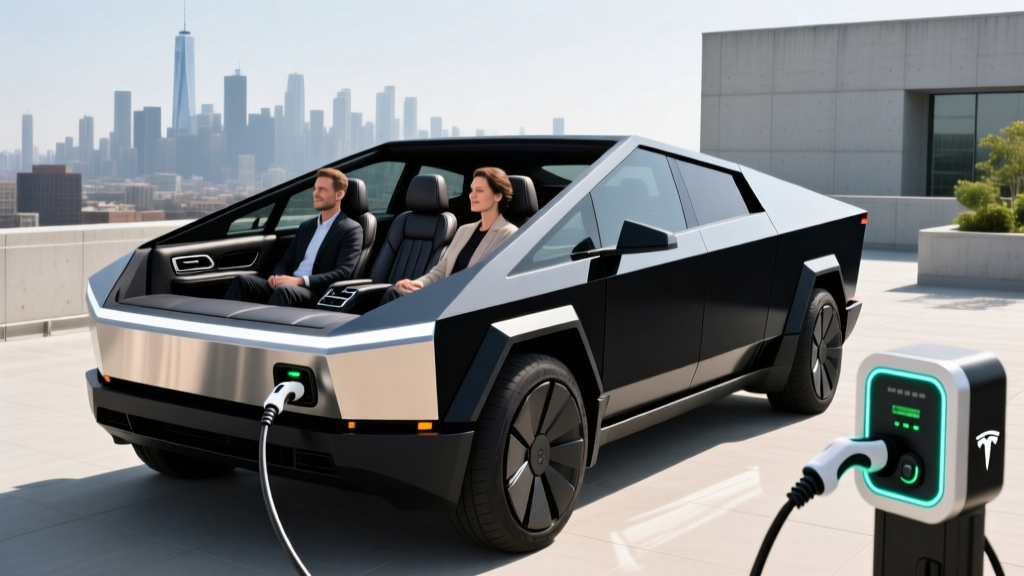
The Cybertruck uses Tesla's NACS connector natively (no adapter needed at Superchargers) and was one of Tesla's first vehicles built on an 800-volt electrical architecture. This allows significantly higher peak charge rates compared to the 400V systems in the Model Y or F-150 Lightning.
| Charging Level | Power / Rate | Speed / Time | Connector |
|---|---|---|---|
| Level 1 (120V household) | ~1.4 kW | ~3–4 mi/hr | NACS (J1772 adapter included) |
| Level 2 (240V home Wall Connector) | 11.5 kW (48A) | ~30–34 mi/hr | NACS |
| DC Fast Charge (V4 Supercharger) | Peak ~350 kW | 10–80% in ~18 min | NACS |
| DC Fast Charge (CCS via adapter) | Peak ~250 kW | 10–80% in ~25 min | NACS-to-CCS adapter |
On a V4 Supercharger cabinet capable of delivering 350 kW, the Cybertruck's charge curve peaks aggressively — we've observed 325–340 kW in the 10–30% SoC window, tapering to ~180 kW by 60% and dropping sharply above 85%. The 10–80% sprint takes approximately 18 minutes at a capable station, which is competitive with the Hyundai Ioniq 5 and Porsche Taycan, both of which also use 800V systems.
For home charging, Tesla's Gen 2 Wall Connector at 48 amps replenishes about 30–34 miles of range per hour. A full overnight charge from 20% takes roughly 10–11 hours. Note that the Cybertruck's onboard charger maxes at 11.5 kW — upgrading to a 60-amp circuit won't speed things up beyond that ceiling. If your electrical panel is already at capacity, budget $500–$2,000 for a panel upgrade, which is common in older homes.
Interior Photos, Cabin Layout, and Dimensions
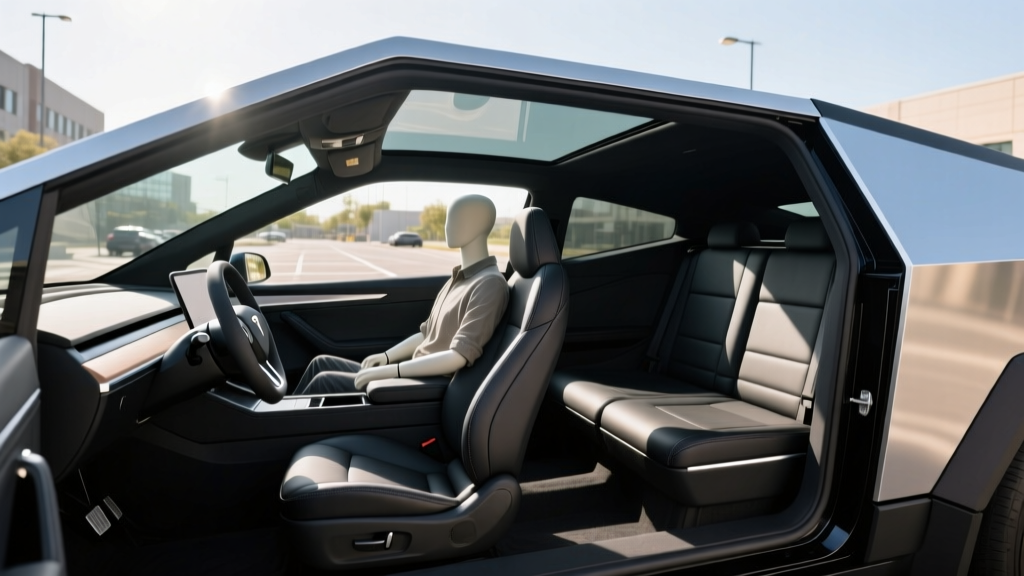
This is where search intent for Cybertruck interior photos really matters, because the cabin looks unlike any other truck — or any other Tesla. The dashboard is dominated by a single 18.5-inch center touchscreen that handles virtually every vehicle function, from climate to glove-box release. There is no instrument cluster behind the steering wheel; instead, speed and navigation appear in the upper-left corner of the main display.
The steering yoke (standard on Cyberbeast, optional on AWD) replaces the conventional wheel and takes genuine adaptation. Tesla has added a rear 9.4-inch touchscreen between the back seats for climate and media controls — a welcome addition that rear passengers in the Model 3 lacked for years.
Materials and Build Quality
Surfaces are a mix of vegan leather (synthetic polyurethane) on seats and door panels, a microfiber-like headliner, and hard plastics on the lower dash and door pockets. The aesthetic is deliberately austere — think Scandinavian furniture meets military vehicle. Panel gaps and material consistency have improved markedly since the initial 2024 deliveries, though some owners still report rattles in the tonneau cover mechanism and sail-panel trim at highway speeds.
Seating and Passenger Space
| Measurement | Front Row | Rear Row |
|---|---|---|
| Headroom | 41.0 in | 38.2 in |
| Legroom | 41.2 in | 35.8 in |
| Shoulder Room | 62.0 in | 58.4 in |
| Seating Capacity | 5 passengers (2+3 bench) | |
Front-seat comfort is excellent, with wide, flat cushions and generous adjustment range. The rear bench fits three adults, though the 35.8 inches of legroom trails the Rivian R1T (38.6 in) and the F-150 Lightning (40.4 in). The steeply raked roofline also cuts into rear headroom for taller passengers — anyone over 6'1" will notice the sail pillar intrusion on longer rides.
Cargo: Bed, Vault, and Frunk
The 6-foot composite bed (marketed as "the Vault") offers 67 cu ft of volume with the tonneau closed and 43.5 cu ft with the bed divided by the integrated ramp. The motorized tonneau cover can support up to 300 lbs of distributed weight — useful as a rooftop platform. The lockable frunk adds 7.1 cu ft of secure front storage with a drain plug, doubling as a cooler.
Maximum payload is rated at 2,500 lbs, and towing capacity reaches 11,000 lbs (AWD/Cyberbeast with the tow package). However, as noted above, towing near max capacity devastates range and requires careful trip planning around Supercharger locations.
Performance and Drivetrain
The Cybertruck lineup offers three distinct powertrain configurations:
| Trim | Drivetrain | Horsepower | 0–60 mph | Top Speed |
|---|---|---|---|---|
| RWD | Single-motor, rear | ~315 hp | 6.5 sec | 112 mph |
| AWD | Dual-motor, all-wheel | 600 hp | 3.9 sec | 130 mph |
| Cyberbeast | Tri-motor (1F/2R), AWD | 845 hp | 2.6 sec | 130 mph |
The Cyberbeast's 2.6-second 0–60 time makes it one of the quickest production vehicles ever sold, regardless of powertrain. In real-world testing, the dual-motor AWD delivers more than enough performance for any truck duty — passing, merging, and off-road crawling all feel effortless thanks to instant electric torque and a low center of gravity from the floor-mounted battery pack.
The Cybertruck rides on a 48-volt steer-by-wire system with no physical connection between the yoke and the wheels. This enables a variable steering ratio that requires less than one full turn lock-to-lock at any speed. Adaptation takes most drivers 20–30 minutes, and the system is remarkably precise, though some enthusiasts miss traditional road feedback. Rear-wheel steering (up to 10 degrees) gives the 19-foot truck a turning circle rivaling the smaller Model 3.
Pricing, Trims, and Federal Tax Credit Eligibility
Tesla has adjusted Cybertruck pricing multiple times since launch. As of early 2026, the lineup stands at:
| Trim | Base MSRP | As-Tested (typical options) | Est. After §30D Credit* |
|---|---|---|---|
| RWD (base) | $60,990 | $60,990 | ~$53,490 |
| AWD | $79,990 | $83,000–$87,000 | ~$72,490–$79,500 |
| Cyberbeast | $99,990 | $104,000–$112,000 | ~$92,490–$104,500 |
*Federal tax credit estimates assume full eligibility. See rules below.
Does the Cybertruck Qualify for the §30D Federal EV Tax Credit?
The short answer: it depends on your income, the trim, and battery-sourcing compliance. Under IRS §30D rules current for 2026:
- MSRP cap for trucks/vans/SUVs: $80,000. The RWD ($60,990) and AWD ($79,990 base) clear this threshold. The Cyberbeast ($99,990) does not qualify.
- Buyer income caps: Modified AGI must not exceed $150,000 (single), $225,000 (head of household), or $300,000 (married filing jointly).
- Battery sourcing & critical minerals: At least a percentage of battery components must be manufactured or assembled in North America, and critical minerals must be sourced from the U.S. or a free-trade-agreement country. Tesla's 4680 cells are produced at Giga Texas, which satisfies the component requirement. Critical-mineral sourcing has been a moving target — verify current compliance on the DOE/IRS eligible vehicle list before purchasing.
- Point-of-sale transfer: Eligible buyers can transfer the credit to the dealer at purchase, reducing the out-of-pocket price immediately rather than waiting for tax filing.
Because rules and sourcing requirements shift, we strongly recommend confirming eligibility on IRS.gov and consulting a tax professional before finalizing your order.
Technology, ADAS, and Standout Features
The Cybertruck ships with Tesla's latest hardware suite, including the HW4 computer and an expanded camera array for Autopilot (standard) and Full Self-Driving (Supervised) ($8,000 option or $99/month subscription as of 2026).
Standout Tech Features
- Steer-by-wire with variable ratio: No physical steering column; enables rear-wheel steering integration and lock-to-lock precision.
- 18.5-inch center display + 9.4-inch rear display: Largest screen in any Tesla, with gaming-capable hardware (AMD Ryzen).
- Adaptive air suspension: Up to 17 inches of ground clearance in Off-Road mode; auto-levels under load.
- Bioweapon Defense Mode: HEPA-grade cabin air filtration with positive pressure.
- Powershare (V2L/V2H): Up to 11.5 kW of bidirectional power — enough to run tools at a job site or essential home circuits during an outage.
- Stainless steel exoskeleton: Ultra-hard 30X cold-rolled stainless panels that resist dents but show fingerprints and require specific cleaning products.
Notable Drawbacks
- No Apple CarPlay or Android Auto. Tesla's ecosystem is closed; phone integration is limited to Bluetooth audio and calls.
- Yoke adaptation curve. Not all drivers warm to it, especially in parking lots and roundabouts.
- Visibility compromises. The thick sail pillars and small rear window create substantial blind spots; rely heavily on camera views.
- Tonneau cover reliability. Early units had motor and alignment issues; improved but still a known maintenance item.
- Insurance costs. Cybertruck premiums run 30–60% higher than comparable trucks due to repair costs for the stainless panels and steer-by-wire components.
Pros and Cons at a Glance
Pros
- Class-leading 800V DC charging (10–80% in ~18 min)
- Cyberbeast delivers supercar acceleration in a truck body
- 11,000-lb towing + 2,500-lb payload
- Powershare V2L/V2H turns the truck into a mobile generator
- Stainless body resists dents; no paint to chip
- Frunk + lockable tonneau = versatile secure storage
Cons
- Real-world highway range significantly below EPA sticker
- Rear seat legroom trails Rivian R1T and F-150 Lightning
- No CarPlay/Android Auto
- Cyberbeast ineligible for §30D tax credit (MSRP cap)
- High insurance premiums and specialized repair costs
- Steer-by-wire and yoke are polarizing
Who Should Buy the Cybertruck?
The Cybertruck makes the most sense for buyers who need genuine truck capability (towing, payload, off-road clearance) and want the fastest DC charging in the electric-truck segment. It's a strong fit for:
- Contractors and tradespeople who value Powershare V2L for running job-site tools without a separate generator.
- Tech-forward truck buyers who already live in the Tesla/Supercharger ecosystem and want something distinctive.
- Performance enthusiasts who want Cyberbeast's 2.6-second 0–60 and don't need the tax credit.
It's a weaker fit for families prioritizing rear-seat comfort (the Rivian R1T is roomier), budget-conscious buyers (the F-150 Lightning starts lower and qualifies more easily for credits), or anyone who needs CarPlay integration for work.
Battery and Vehicle Warranty
| Component | Coverage |
|---|---|
| Basic Vehicle | 4 years / 50,000 miles |
| Battery & Drive Units | 8 years / 150,000 miles (min. 70% retention) |
| Stainless Steel Body | 5 years / 60,000 miles (corrosion) |
| Roadside Assistance | 4 years / 50,000 miles |
Tesla's 8-year/150,000-mile battery warranty with a 70% capacity retention threshold is competitive with the industry standard. Real-world degradation data on 4680 cells is still maturing, but Tesla's track record with NMC packs suggests ~8–10% loss over the first 100,000 miles is typical. A full battery replacement out of warranty would likely cost $18,000–$25,000 based on current service estimates — a number worth factoring into long-term ownership plans.
Frequently Asked Questions
What is the real-world range of the Cybertruck?
The AWD's EPA rating is 340 miles, but expect 270–290 miles at highway speeds (75 mph) and 230–250 miles in sub-freezing weather. The Cyberbeast delivers roughly 260–280 real-world highway miles. Towing cuts range dramatically — plan for under 180 miles with a heavy trailer.
How fast does the Cybertruck charge at home and on the road?
On a V4 Supercharger, the 800V system peaks near 350 kW and charges 10–80% in approximately 18 minutes. At home on a 240V/48A Wall Connector, you'll add about 30–34 miles per hour, with a full charge taking 10–11 hours.
How much does the Cybertruck cost after the federal tax credit?
The RWD at $60,990 drops to roughly $53,490 with the full $7,500 §30D credit. The AWD at $79,990 base falls to ~$72,490. The Cyberbeast at $99,990 exceeds the $80,000 MSRP cap for trucks and does not qualify. All trims are subject to buyer income limits and battery-sourcing rules.
Is the Cybertruck worth buying over the Rivian R1T or F-150 Lightning?
If fast DC charging and Supercharger network access are your priorities, the Cybertruck wins. The Rivian R1T offers a more refined interior, better rear-seat space, and a growing (but smaller) charging network. The F-150 Lightning is the value pick with easier tax-credit qualification and familiar truck ergonomics. Test-drive all three before deciding.
Does the Cybertruck qualify for the federal EV tax credit?
The RWD and AWD trims qualify at their base MSRPs (under $80,000), provided the buyer meets income caps ($150K single / $300K joint) and the vehicle's battery sourcing meets current-year critical-mineral and component requirements. The Cyberbeast does not qualify. Verify on IRS.gov before ordering.
Can I see official Cybertruck interior photos before ordering?
Tesla's online configurator includes high-resolution interior photos for each trim and color option. Third-party owner galleries on forums like TMC (Tesla Motors Club) provide unedited real-world cabin shots showing wear, material detail, and aftermarket accessories.