Tesla sells more than just electric vehicles — it sells an ongoing software relationship. In 2026, Tesla subscriptions span Full Self-Driving (Supervised), Premium Connectivity, Acceleration Boost, and rear-seat heating unlocks, turning a one-time car purchase into a layered ownership cost. For buyers evaluating a Model 3 or Model Y, understanding which subscriptions deliver measurable value — and which are optional upsells — is now as important as comparing EPA range or charging speed.
This guide dissects every active Tesla subscription offering as of the 2026 model year, anchored to the vehicles they apply to. We'll pair each subscription's cost with the hardware it runs on, the real-world utility it provides, and whether it changes the total-cost-of-ownership equation versus key competitors that bundle similar features at no extra charge.
The Tesla Subscription Stack: What You're Actually Paying For
Tesla's subscription menu breaks into four distinct categories, each tied to different vehicle systems. Unlike traditional automakers that bundle features into trim levels, Tesla uses software locks to gate functionality that the hardware already supports. Here's the full 2026 lineup:
| Subscription | Monthly Cost | Alternative Purchase | Applies To |
|---|---|---|---|
| Full Self-Driving (Supervised) | $99/mo | $8,000 one-time | Model 3, Y, S, X, Cybertruck |
| Premium Connectivity | $9.99/mo (or $99/yr) | None | All Tesla vehicles |
| Acceleration Boost | N/A (one-time) | $2,000 OTA purchase | Model 3 Long Range RWD/AWD |
| Rear Heated Seats | N/A (one-time) | ~$300 OTA unlock | Model 3 Standard Range (older builds) |
The FSD subscription is the revenue heavyweight. At $99 per month, it costs $1,188 annually — meaning the $8,000 lump-sum purchase breaks even at roughly 6 years and 9 months of continuous use. For owners who plan to keep their Tesla beyond that horizon, purchasing outright makes financial sense. For leaseholders or those uncertain about FSD's trajectory, the monthly option limits exposure.
Full Self-Driving (Supervised): SAE Level 2, Not Autonomy
Despite the "Full Self-Driving" name, Tesla FSD (Supervised) is an SAE Level 2 system. The driver must remain fully attentive, keep hands on or near the wheel, and be prepared to take over instantly. It is not a Level 4 autonomous system like Waymo's driverless robotaxi service. NHTSA requires Tesla to market it with the "Supervised" suffix for this reason.
FSD (Supervised) adds several capabilities beyond Tesla's standard Autopilot (which itself is included with every new Tesla at no extra cost):
- Navigate on Autopilot: Automatic highway interchanges and exit routing with lane-change suggestions the driver must confirm
- Auto Lane Change: Initiates lane changes when turn signal is activated and path is clear
- Autopark: Parallel and perpendicular parking assist
- Summon / Smart Summon: Low-speed parking lot retrieval from up to ~150 feet
- Traffic Light & Stop Sign Control: Detects and responds to signals (driver confirmation often required)
- City Streets: Handles turns, roundabouts, and intersections on surface roads — the most ambitious and most variable feature
- Drive without an attentive human behind the wheel
- Handle all construction zones, unmapped roads, or severe weather reliably
- Replace the driver's legal responsibility — you are liable for all vehicle actions
- Guarantee door-to-door autonomy on any given route
The real-world experience varies enormously by geography. In well-mapped suburban areas with clear lane markings, FSD handles 80-90% of a commute with minimal interventions. In dense urban cores, construction zones, or rural roads without clear markings, intervention frequency rises sharply. Owners report an average of 1-3 interventions per 20 miles in mixed driving, though this has improved with each software revision.
Competitors like GM's Super Cruise and Ford's BlueCruise offer hands-free driving on pre-mapped divided highways — a narrower operational design domain but one that genuinely allows hands-off operation within its geofenced areas. Tesla's approach is broader in coverage but requires constant supervision, making it more mentally taxing on long highway stretches where Super Cruise excels.
Premium Connectivity: Navigation, Streaming, and Sentry Mode
Every new Tesla includes Standard Connectivity for the first 30 days (as of 2026 policy; previously it was longer). After that trial, basic navigation and Bluetooth music still work, but you lose:
- Live traffic visualization on the navigation map
- Satellite-view maps (terrain/satellite imagery)
- In-car media streaming (Spotify, YouTube, Netflix, etc. over cellular)
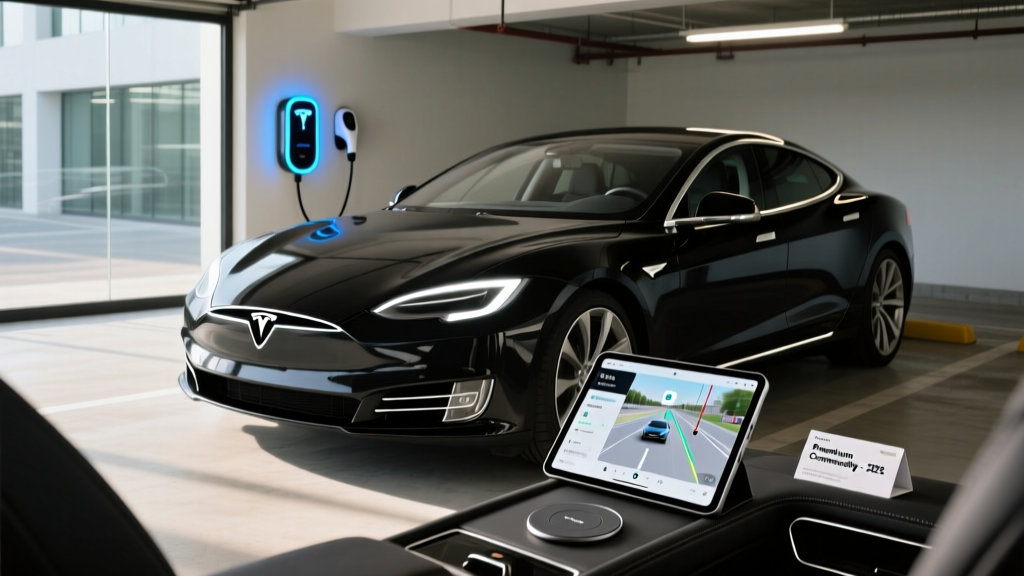
- Sentry Mode live camera access via the Tesla app
- Caraoke streaming library
- Video streaming while parked
At $9.99 per month or $99 annually, Premium Connectivity is the lowest-stakes Tesla subscription. For owners who regularly use the built-in navigation (which routes through Superchargers automatically — a genuine advantage for road-trippers), live traffic data alone justifies the cost. Streaming media is nice-to-have if you have a phone you'd rather tether, but Sentry Mode remote viewing is a legitimate security feature for those parking in high-risk areas.
The annual plan saves $20 per year versus monthly billing. If you know you'll keep the car for 3+ years, paying annually removes a recurring decision point.
Acceleration Boost: The One-Time Software Unlock
This isn't technically a subscription — it's a one-time over-the-air purchase — but it sits in Tesla's software monetization ecosystem and deserves mention. Available for the Model 3 Long Range, Acceleration Boost drops the 0-60 mph time by approximately 0.5 seconds for $2,000.
| Model 3 Long Range AWD | Without Boost | With Boost |
|---|---|---|
| 0-60 mph | 4.9 seconds | 4.4 seconds |
| Horsepower (est.) | ~346 hp | ~384 hp |
| EPA Range Impact | 341 miles | 341 miles (no change) |
The range doesn't change because the battery capacity remains identical — the software simply allows more aggressive power delivery. For most daily driving, 4.9 seconds is already quick. This purchase appeals to enthusiasts who want the Performance model's acceleration without the higher MSRP and firmer ride.
The Vehicles Behind the Subscriptions: Model 3 and Model Y at a Glance
Tesla subscriptions only matter if the underlying vehicle is worth owning. Here's how the two highest-volume Tesla models stack up in 2026, since these are the vehicles most buyers are evaluating when they encounter the subscription upsells.
2026 Tesla Model 3 Long Range AWD — Spec Summary
| Specification | Value |
|---|---|
| EPA Range | 341 miles |
| Battery Capacity | 79 kWh usable (NMC chemistry) |
| Efficiency | 25 kWh/100 mi (131 MPGe combined) |
| Max DC Fast Charge | 250 kW (CCS via NACS adapter or native NACS) |
| 10-80% DC Charge Time | ~25 minutes |
| Level 2 Home Charge Rate | 11.5 kW (~44 mi/hr) |
| 0-60 mph | 4.9 sec (4.4 with Acceleration Boost) |
| Horsepower | 346 hp (dual motor AWD) |
| Cargo Volume | 23 cu ft (rear trunk + frunk combined) |
| Rear Legroom | 35.3 inches |
| Battery Warranty | 8 years / 120,000 miles (70% minimum retention) |
| Base MSRP | $47,740 (before incentives) |
2026 Tesla Model Y Long Range AWD — Spec Summary
| Specification | Value |
|---|---|
| EPA Range | 320 miles |
| Battery Capacity | 79 kWh usable (NMC chemistry) |
| Efficiency | 27 kWh/100 mi (122 MPGe combined) |
| Max DC Fast Charge | 250 kW |
| 10-80% DC Charge Time | ~27 minutes |
| Level 2 Home Charge Rate | 11.5 kW (~37 mi/hr due to higher consumption) |
| 0-60 mph | 5.0 seconds |
| Horsepower | 384 hp (dual motor AWD) |
| Cargo Volume | 76 cu ft (rear seats folded) + 4.1 cu ft frunk |
| Rear Legroom | 38.4 inches |
| Battery Warranty | 8 years / 120,000 miles (70% minimum retention) |
| Base MSRP | $48,990 (before incentives) |
The Model Y sacrifices 21 miles of EPA range compared to the Model 3 but gains substantial cargo utility and rear-seat comfort. For families, the Model Y is the clear pick; for commuters prioritizing range and efficiency, the Model 3 wins. Both support the full Tesla subscription stack identically.
Pricing, Tax Credits, and the True Cost of a Tesla with Subscriptions
Federal tax credit eligibility for Teslas in 2026 depends on the current IRS §30D rules, which impose three simultaneous constraints: buyer income caps, vehicle MSRP caps, and battery component/mineral sourcing requirements. Here's where the Model 3 and Model Y stand:
| Factor | Model 3 Long Range | Model Y Long Range |
|---|---|---|
| Base MSRP | $47,740 | $48,990 |
| MSRP Cap (SUV: $80k / Sedan: $55k) | Under $55k cap ✓ | Under $80k cap ✓ |
| Income Cap (Joint: $300k / Individual: $150k) | Buyer-dependent | Buyer-dependent |
| Battery Sourcing Compliance | Qualifies (as of early 2026) ✓ | Qualifies (as of early 2026) ✓ |
| Maximum §30D Credit | $7,500 | $7,500 |
| Effective Price (with full credit) | $40,240 | $41,490 |
Critical caveat: Tesla's battery sourcing compliance has shifted with supply chain changes and evolving IRS critical mineral requirements. Always verify current eligibility on the IRS qualified vehicles list before purchasing. The point-of-sale transfer option allows the dealer to apply the credit at purchase, reducing your out-of-pocket cost immediately rather than waiting for a tax refund.
Now add subscriptions to the ownership math:
| Annual Cost | FSD Subscription | Premium Connectivity | Combined |
|---|---|---|---|
| Year 1 | $1,188 | $99 (annual plan) | $1,287 |
| Year 2 | $1,188 | $99 | $1,287 |
| Year 3 | $1,188 | $99 | $1,287 |
| 3-Year Total | $3,564 | $297 | $3,861 |
| 5-Year Total | $5,940 | $495 | $6,435 |
Over a 5-year ownership period, Tesla subscriptions add $6,435 to your total cost — on top of the vehicle purchase. Compare this to a Hyundai Ioniq 5 or Chevrolet Equinox EV, which include their driver-assist suites (Highway Driving Assist and Super Cruise on select trims, respectively) and connected services for the first 3 years at no additional charge.
Tesla Subscriptions vs. Competitor Feature Bundling
✓ Tesla Wins: Network Integration
FSD routes through the Supercharger network natively. No competitor's ADAS plans charging stops as seamlessly. The Supercharger network's reliability (95%+ uptime per Tesla data) remains a tangible advantage, and FSD leverages this for road-trip autonomy planning.
✗ Tesla Loses: Feature Gating
GM includes Super Cruise (hands-free, eyes-monitored) on qualified highways with a 3-year subscription included in the vehicle price on higher trims. Hyundai/Kia bundle Highway Driving Assist standard. Tesla charges $99/mo for a system that requires more driver attention than either competitor's highway-specific solution.
The honest assessment: Tesla's FSD is the most ambitious driver-assist system in terms of coverage area — it attempts to work on any road, not just pre-mapped highways. But ambition is not the same as reliability, and the supervision burden falls entirely on the driver. For highway-dominant commuters, GM Super Cruise's hands-off capability within its operational domain is a more relaxing experience. For those who want a system that at least attempts surface streets and city driving, Tesla FSD has no direct rival.
Who Should Subscribe — and Who Should Skip
Subscribe to FSD ($99/mo) If:
- Your commute includes varied road types (city + highway) where FSD's broad coverage helps
- You want to try FSD before committing $8,000 — the monthly option is ideal for evaluation
- You plan to keep the vehicle under 5 years (subscription costs less than the lump sum)
- You're interested in Tesla's future robotaxi aspirations and want to be in the early-adopter testing pool
Skip FSD If:
- Your driving is 80%+ highway — Super Cruise or BlueCruise-equipped competitors offer better hands-free experiences for less
- You find constant supervision more stressful than just driving manually
- You plan to keep the car 7+ years — the $8,000 purchase breaks even at ~6.75 years vs. subscribing
- You're on a tight ownership budget — $1,188/year is meaningful money
Always Get Premium Connectivity ($9.99/mo or $99/yr):
Live traffic navigation, Sentry Mode remote access, and satellite maps are worth $8.25/month for virtually every Tesla owner. The annual plan is the obvious choice if you're committed to the vehicle.
Pros and Cons of the Tesla Subscription Ecosystem
Pros
- FSD is the broadest-coverage consumer ADAS available — no geofencing to highways only
- Monthly FSD subscription lets you try before committing $8,000
- Premium Connectivity is affordable and genuinely useful (live traffic, Sentry Mode)
- OTA updates continuously add features to subscriptions you already pay for
- Supercharger network integration makes FSD road-trip routing superior
- Acceleration Boost adds performance without hardware changes or range penalty
Cons
- FSD requires constant supervision — not a true autonomous experience despite the name
- $1,188/year for FSD adds up; competitors include highway ADAS free for 3+ years
- Feature gating via software (heated seats, acceleration) feels anti-consumer to many buyers
- FSD performance is inconsistent — excellent in some areas, unreliable in others
- Subscription costs are on top of an already premium-priced vehicle
- FSD's resale value transfer to new owners remains uncertain
- No refunds on Acceleration Boost or FSD lump-sum purchases if you sell early
Frequently Asked Questions
What is the real-world range of Tesla's most popular models?
The 2026 Model 3 Long Range AWD carries an EPA rating of 341 miles. Real-world highway driving at 70-75 mph yields approximately 280-300 miles. In cold weather (below 30°F), expect 240-260 miles. The Model Y Long Range AWD is EPA-rated at 320 miles, with real-world highway results around 265-285 miles and cold-weather range of 225-245 miles. Per fueleconomy.gov, the Model 3 achieves 131 MPGe combined, making it one of the most efficient EVs in its class.
How fast does a Tesla charge at home and on the road?
On a DC fast charger (Tesla Supercharger V3 or equivalent CCS station), the Model 3 and Model Y peak at 250 kW, achieving a 10-80% charge in approximately 25-27 minutes. Note that peak rate is not sustained — the charge curve tapers significantly above 60% State of Charge, which is why 80-100% takes disproportionately longer. At home on a Level 2 Wall Connector (48-amp circuit), both vehicles charge at 11.5 kW, adding roughly 44 miles of range per hour in the Model 3 and 37 miles per hour in the Model Y. A full overnight charge from 20% to 90% takes about 7-8 hours.
How much does a Tesla cost after federal tax credits?
With the full $7,500 §30D federal tax credit applied at point of sale, the 2026 Model 3 Long Range drops from $47,740 to approximately $40,240, and the Model Y Long Range from $48,990 to $41,490. Eligibility requires meeting IRS income caps ($300,000 joint / $150,000 individual modified AGI), MSRP caps ($55,000 sedans / $80,000 SUVs), and battery sourcing requirements. Verify current compliance on the IRS qualified manufacturer list before purchase, as sourcing rules evolve.
Is a Tesla with subscriptions worth it vs. competitors?
For buyers who value the Supercharger network, OTA updates, and the broadest-coverage ADAS (with supervision), the Tesla ecosystem justifies the subscription costs. For buyers who primarily drive highways and want hands-free operation, a GM vehicle with Super Cruise or a Ford with BlueCruise offers a more relaxed experience for less ongoing cost. The Hyundai Ioniq 5 and Kia EV6 offer strong value with included driver-assist features and competitive charging speeds, though their public charging experience depends on third-party networks.
Can I cancel the FSD subscription at any time?
Yes. The $99/month FSD subscription can be cancelled through the Tesla app at any time with no penalty. You lose access to FSD features immediately upon cancellation and revert to standard Autopilot (which still includes adaptive cruise control and lane centering). If you later want to resubscribe, you can do so without re-qualifying.
Does FSD transfer if I sell my Tesla?
This is one of the most contentious issues in Tesla ownership. Tesla has occasionally offered FSD transfers to new Tesla purchases as a promotion, but the standard policy is that FSD (both purchased and subscribed) stays with the original vehicle and owner. A purchased FSD does add some resale value, but significantly less than the $8,000 original cost — typically $2,000-$4,000 in private-party sales based on market data. Subscription-based FSD does not transfer at all.
What happens to Premium Connectivity if I don't subscribe?
You retain basic navigation (without live traffic), Bluetooth audio, and Wi-Fi-dependent features when connected to a home network. You lose satellite maps, live traffic visualization, in-car streaming services over cellular, and Sentry Mode remote camera access. Most owners find the $99/year plan worthwhile for navigation and security features alone.