The Rumor: Is Tesla Discontinuing Model S and Model X?
Every few months, speculation resurfaces that Tesla will stop making Model S and X. The whispers aren't baseless — these flagship vehicles represent a tiny fraction of Tesla's global volume, and the company's Fremont factory is shared with the higher-volume Model 3 and Model Y. But as of early 2026, both the Model S and Model X remain in production and available for order on Tesla's website. The question isn't whether they exist today, but whether their days are numbered — and whether that should factor into your purchase decision.
This review examines the current state of both vehicles with exact 2026 specs, real-world range data, charging performance, pricing, and the ownership calculus that determines whether these aging-but-capable flagships still earn their premium price tags.
2026 Tesla Model S: Specs, Range, and Real-World Performance
The Model S enters 2026 largely unchanged from its 2021 refresh — a reality that itself feeds discontinuation rumors. Tesla offers two trims: the Long Range and the Plaid.
| Spec | Long Range | Plaid |
|---|---|---|
| EPA Range | 402 miles | 396 miles |
| Battery (usable) | ~95 kWh, NMC | ~95 kWh, NMC |
| Drivetrain | Dual-Motor AWD | Tri-Motor AWD |
| Horsepower | 670 hp | 1,020 hp |
| 0-60 mph | 3.1 seconds | 1.99 seconds |
| Top Speed | 155 mph | 200 mph |
| MPGe (combined) | 120 MPGe | 116 MPGe |
| Efficiency | 28 kWh/100mi | 29 kWh/100mi |
| Cargo (rear + frunk) | 28.0 cu ft (rear) + 3.1 cu ft (frunk) | 28.0 cu ft + 3.1 cu ft |
| Rear Legroom | 35.4 inches | 35.4 inches |
| Base MSRP | $74,990 | $89,990 |
Charging Performance
| Level | Rate | Speed |
|---|---|---|
| Level 1 (120V) | ~1.4 kW | ~3–4 miles/hour |
| Level 2 (240V, 48A) | 11.5 kW | ~30–34 miles/hour |
| DC Fast Charge (peak) | 250 kW (Supercharger V3) | 10–80% in ~27 minutes |
The Model S uses Tesla's proprietary NACS connector, which has become the North American standard adopted by nearly every major automaker for 2025 and beyond. At a V3 Supercharger, the 95 kWh battery peaks near 250 kW but tapers significantly above 60% state of charge — the 60–80% portion alone can take 10–12 minutes. For road trips, plan 20–25 minute stops every 250–300 miles to stay in the fast-charging sweet spot.
Warranty Coverage
Tesla provides a 4-year/50,000-mile basic vehicle warranty and an 8-year/150,000-mile battery and drive unit warranty with a minimum 70% capacity retention threshold. That battery warranty is among the more generous mileage limits in the industry, though some competitors now match or exceed the 8-year standard.
2026 Tesla Model X: Specs, Range, and Real-World Performance
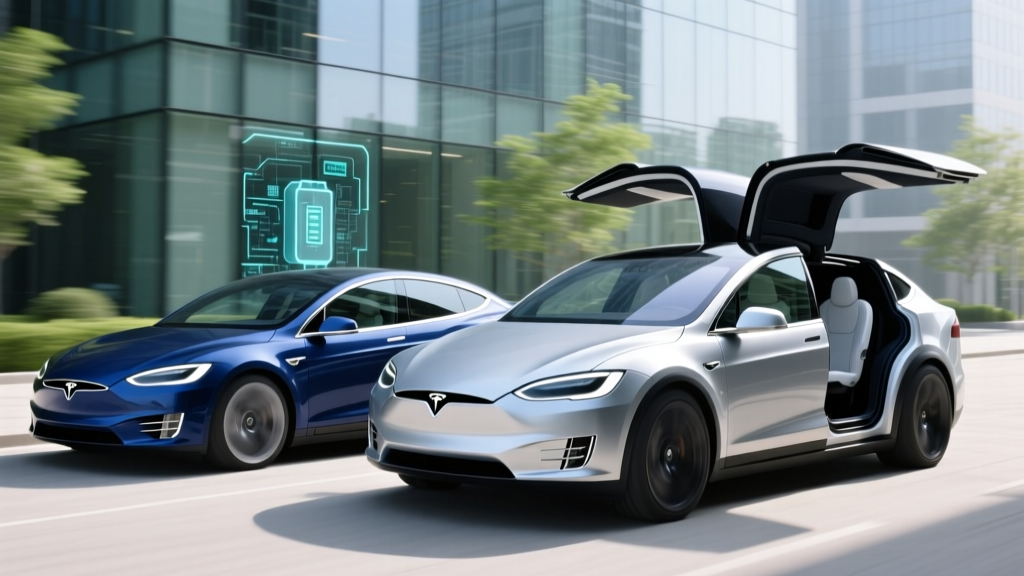
The Model X shares its platform with the Model S but trades some efficiency for SUV utility, falcon-wing rear doors, and an available third row. Like the sedan, it comes in Long Range and Plaid trims.
| Spec | Long Range | Plaid |
|---|---|---|
| EPA Range | 335 miles | 326 miles |
| Battery (usable) | ~95 kWh, NMC | ~95 kWh, NMC |
| Drivetrain | Dual-Motor AWD | Tri-Motor AWD |
| Horsepower | 670 hp | 1,020 hp |
| 0-60 mph | 3.8 seconds | 2.5 seconds |
| MPGe (combined) | 103 MPGe | 98 MPGe |
| Cargo (behind 2nd row) | 37.1 cu ft (+ 3.1 cu ft frunk) | 37.1 cu ft + 3.1 cu ft |
| Cargo (max, 2nd row folded) | 77.5 cu ft | 77.5 cu ft |
| 2nd-Row Legroom | 38.4 inches | 38.4 inches |
| Towing Capacity | 5,000 lbs | 5,000 lbs |
| Base MSRP | $79,990 | $94,990 |
Charging specs mirror the Model S: 250 kW peak DC fast charging (10–80% in ~27 minutes) and 11.5 kW Level 2 at home. The larger frontal area means the Model X consumes more energy per mile, so each charging session buys fewer miles than the sedan.
Who Are These Vehicles For in 2026?
The Model S remains a strong choice for drivers who want maximum range in a luxury sedan with Supercharger network access and don't need the latest interior design. It suits long-distance commuters, road-trippers who value the Supercharger ecosystem, and performance enthusiasts (the Plaid is still one of the quickest production cars ever made).
The Model X targets families who need three rows, towing capability, and cargo space but want EV powertrain benefits. The falcon-wing doors are genuinely useful for car-seat access in tight parking spaces, though they add mechanical complexity. It's a niche vehicle — buyers cross-shopping the Rivian R1S, BMW iX, or even the Tesla Model Y will find compelling alternatives depending on priorities.
Choose Model S/X If:
- You rely heavily on the Tesla Supercharger network for road trips
- You want class-leading range (Model S) or tri-motor performance
- You prefer Tesla's software ecosystem and OTA update cadence
- You value the hatchback cargo flexibility (Model S) or third-row seating (Model X)
Look at Competitors If:
- You want a fresh interior design — the S/X cabin hasn't been updated since 2021
- Build quality and panel consistency are top priorities
- You need a luxury SUV with a more refined ride (BMW iX, Mercedes EQS SUV)
- You want the latest battery chemistry options (LFP, semi-solid-state)
Federal Tax Credit Eligibility: The MSRP Problem
Under current IRS §30D rules, the federal EV tax credit of up to $7,500 is available only for vehicles with an MSRP at or below $55,000 for sedans and $80,000 for SUVs, vans, and trucks. Buyer income caps also apply ($300,000 joint / $225,000 head of household / $150,000 individual modified adjusted gross income).
| Model | Base MSRP | Vehicle Class | MSRP Cap | Eligible? |
|---|---|---|---|---|
| Model S Long Range | $74,990 | Sedan | $55,000 | No — exceeds cap |
| Model S Plaid | $89,990 | Sedan | $55,000 | No — exceeds cap |
| Model X Long Range | $79,990 | SUV | $80,000 | Borderline — base only, no options |
| Model X Plaid | $94,990 | SUV | $80,000 | No — exceeds cap |
The Model S does not qualify for the federal credit in any configuration. The Model X Long Range at its base MSRP of $79,990 technically falls under the $80,000 SUV cap, but adding any factory option (paint color beyond free white, larger wheels, FSD capability) pushes the MSRP above the threshold. Battery sourcing and critical mineral requirements add another layer — always verify current eligibility on IRS.gov and consult a tax professional before relying on the credit in your purchase decision.
Key Competitors and How They Compare
Neither the Model S nor Model X competes in a vacuum. Here's how the primary alternatives stack up on the metrics that matter:
| Vehicle | EPA Range | Peak DC Charge | 0-60 mph | Base MSRP | Tax Credit |
|---|---|---|---|---|---|
| Tesla Model S LR | 402 mi | 250 kW | 3.1s | $74,990 | No |
| Lucid Air Pure | 419 mi | 200+ kW | 3.5s | $69,900 | No |
| BMW i5 eDrive40 | 295 mi | 205 kW | 5.7s | $57,900 | Limited |
| Tesla Model X LR | 335 mi | 250 kW | 3.8s | $79,990 | Borderline |
| BMW iX xDrive50 | 324 mi | 195 kW | 4.4s | $87,250 | No |
| Rivian R1S Dual | 352 mi | 220 kW | 4.5s | $75,900 | No |
The Lucid Air Pure undercuts the Model S on price while exceeding it on EPA range, though it lacks Tesla's Supercharger network (though Lucid has begun integrating NACS for Supercharger access). The BMW i5 sacrifices range for a lower price point and traditional luxury build quality. In the SUV segment, the Rivian R1S offers genuine off-road capability and a more modern interior, while the BMW iX delivers a quieter, more refined ride at a higher price.
So — Will Tesla Actually Stop Making Model S and X?
As of 2026, there is no official announcement from Tesla confirming discontinuation. However, several factors keep the rumors alive:
- Low production volume: Model S and X combined represent roughly 3–5% of Tesla's quarterly deliveries. The Fremont production lines could be repurposed for higher-volume vehicles or next-generation platforms.
- Aging platform: The current generation launched in 2021 (with the underlying architecture dating to 2012). Tesla has not announced a next-generation Model S or X, while competitors have introduced entirely new platforms.
- Strategic pivot: Tesla's public focus has shifted toward the more affordable next-generation vehicle platform, robotaxi development, and energy products. Flagship sedans and SUVs don't align with a mass-market growth strategy.
- Parts and service considerations: If you buy a Model S or X today, Tesla is legally obligated to support parts and service for years. But low-volume vehicles historically receive slower software updates and longer repair wait times as the fleet ages.
The most likely scenario: Tesla continues low-rate production through at least 2026–2027, potentially ending with a "legacy" trim simplification rather than a dramatic announcement. If you're considering either vehicle, the discontinuation risk shouldn't deter you — but it does mean resale values may depreciate faster than higher-volume Tesla models, and long-term parts availability could narrow.
Frequently Asked Questions
What is the real-world range of the 2026 Tesla Model S and Model X?
The Model S Long Range delivers roughly 310–340 highway miles in fair weather (EPA: 402 mi) and 260–290 in cold conditions. The Model X Long Range yields about 260–290 highway miles (EPA: 335 mi) and 210–240 in winter. Plaid variants are 10–15% less efficient in all conditions.
How fast do the Model S and Model X charge?
Both vehicles peak at 250 kW on Tesla V3 Superchargers, achieving a 10–80% charge in approximately 27 minutes. The charging curve tapers significantly above 60% state of charge. At home on a 48-amp Level 2 charger (240V), both add roughly 30–34 miles of range per hour, requiring 8–10 hours for a full charge from near-empty.
Does either vehicle qualify for the $7,500 federal EV tax credit?
The Model S does not qualify — its MSRP exceeds the $55,000 sedan cap. The Model X Long Range at its base price of $79,990 technically falls under the $80,000 SUV cap, but any factory options push it over the limit. All buyers must also meet IRS income caps and battery-sourcing requirements. Always verify current eligibility at IRS.gov before counting on the credit.
Is it worth buying a Model S or X if Tesla might discontinue them?
Discontinuation doesn't mean abandonment — Tesla must support parts and service for years after production ends. The real risk is accelerated depreciation and potentially slower software investment. If the vehicle meets your needs today and the price works, the discontinuation timeline (likely 2027 or later) shouldn't be a dealbreaker. However, if resale value is a priority, higher-volume models like the Model Y or competing luxury EVs may hold value better.
What are the biggest pros and cons?
Pros
- Class-leading range (Model S at 402 mi EPA)
- Access to the Tesla Supercharger network (~20,000+ stalls in North America)
- Extraordinary performance, especially Plaid trims
- Over-the-air updates and strong software ecosystem
- Hatchback utility (Model S) and optional third row (Model X)
Cons
- Aging interior design — no major refresh since 2021
- No federal tax credit eligibility for most configurations
- Build quality inconsistency compared to European luxury rivals
- Falcon-wing doors (Model X) add complexity and potential repair cost
- Discontinuation risk may impact resale value
- Yoke steering wheel not universally preferred (round wheel now available)
Should I buy a Model S/X or wait for a successor?
Tesla has not announced any successor to the Model S or X. If the company does develop next-generation flagships, they are likely 3–4 years away at minimum. If you need a vehicle now and the current specs meet your requirements, waiting for an unannounced product is rarely a sound strategy. That said, if you're flexible on timing, late 2026 or 2027 may reveal Tesla's long-term intentions more clearly — and may bring end-of-production incentives.
Sources: fueleconomy.gov (EPA range and efficiency data), IRS.gov (§30D clean vehicle credit rules), Tesla.com official specifications.