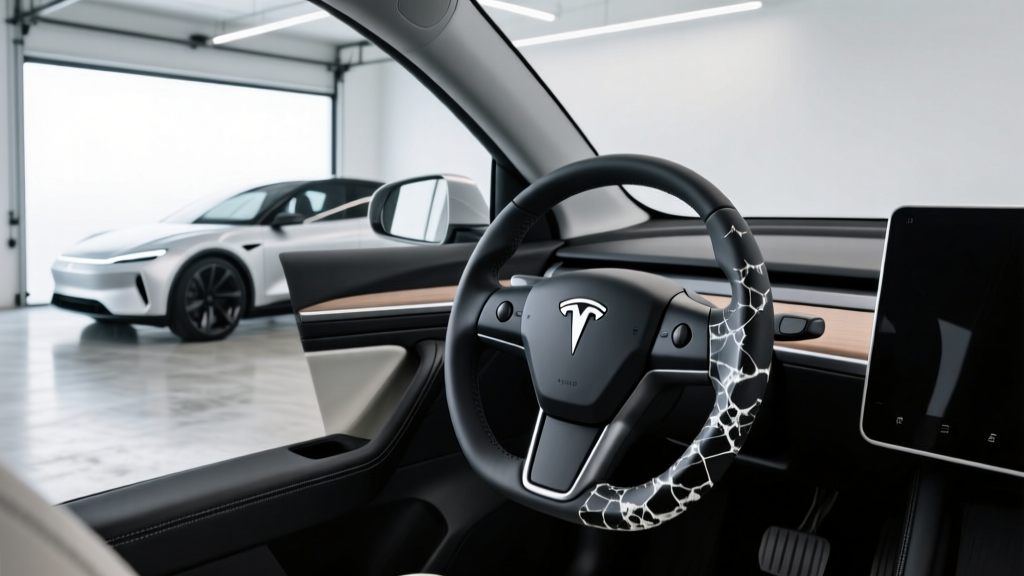
If you've searched for answers about Tesla steering wheel peeling, you're not alone. Across Tesla forums, Reddit threads, and owner groups, reports of synthetic leather delaminating, bubbling, or flaking off the steering wheel rim have become one of the most common interior complaints for Model 3 and Model Y owners — particularly on vehicles built between 2020 and 2024. The issue tends to surface between 18 and 36 months of ownership, often in warmer climates or among drivers who frequently use hand sanitizer.
But the steering wheel material is just one part of the ownership picture. If you're weighing whether to buy a 2026 Tesla Model Y — or wondering how this issue factors into your decision — this guide covers the peeling problem in detail and delivers a complete spec-by-spec review of the current Model Y lineup, including range, charging, pricing, and tax credit eligibility.
Why Tesla Steering Wheels Peel: The Root Cause
Tesla uses a synthetic polyurethane (PU) leather wrap on its steering wheels across all current models. Unlike genuine leather, which develops a patina over time, PU leather consists of a fabric base coated with a thin polymer layer. When that bond fails, the coating separates from the substrate — producing the bubbling, cracking, and flaking that owners describe as "peeling."
Several factors accelerate the failure:
- UV and heat exposure: Vehicles parked outdoors in direct sunlight, particularly in the Southwest US, experience faster polymer degradation. Dashboard and steering wheel surfaces can exceed 160°F in summer.
- Chemical exposure: Alcohol-based hand sanitizers, certain sunscreens, and harsh cleaning products (including some Tesla-recommended wipes) can break down the PU coating's adhesion over time.
- Friction and moisture: Repeated gripping at the same positions (10-and-2 or 9-and-3), combined with sweat and skin oils, wears through the topcoat layer.
- Manufacturing batch variance: The highest concentration of reports traces to Model 3 and Model Y vehicles built at Fremont between mid-2020 and early 2024, suggesting an adhesive or material supplier issue during that window.
Tesla has not issued a formal recall for steering wheel peeling. However, many owners have successfully obtained warranty replacements — particularly when the defect appears within the vehicle's 4-year/50,000-mile basic warranty. Service centers typically classify severe delamination as a material defect rather than wear-and-tear, though outcomes vary by location and service manager discretion.
Fixes: Warranty, Aftermarket, and Prevention
If your steering wheel is already peeling, here are your options ranked by cost and durability:
1. Warranty replacement (free if eligible): Open a service request through the Tesla app. Photograph the peeling clearly — show the delamination edge, not just surface wear. If your vehicle is within 4 years/50,000 miles and the damage isn't attributable to obvious chemical burns or abrasion, Tesla will typically replace the entire steering wheel assembly at no charge. Expect a 1–3 week lead time for parts.
2. Aftermarket rewrap ($150–$350): Several companies — including Abstract Ocean, Spigen, and various Etsy leather workers — offer snap-on or stitch-on covers in genuine leather, Alcantara, or carbon fiber. A professional rewrap by an automotive upholstery shop runs $200–$400 and can outlast the factory material.
3. DIY cover ($20–$60): A silicone or microfiber slip-on cover from Amazon halts further peeling and improves grip, though it doesn't address the cosmetic issue underneath.
Prevention for new owners: Avoid alcohol-based cleaners on the wheel. Use a damp microfiber cloth with mild soap. Park in shade or use a windshield sun shade. Apply a UV-protectant leather conditioner (even on PU leather, products like Chemical Guys Leather Conditioner slow UV degradation). Wash hands before driving if you've applied sunscreen or sanitizer.
2026 Tesla Model Y: Full Spec Review
The steering wheel issue is one data point. The bigger question for buyers is whether the 2026 Model Y delivers as a complete package. Here are the numbers that matter.
| Specification | Long Range RWD | Long Range AWD | Performance |
|---|---|---|---|
| EPA Range | 320 miles | 308 miles | 285 miles |
| Battery (usable) | ~75 kWh, NMC | ~75 kWh, NMC | ~75 kWh, NMC |
| MPGe (combined) | 123 MPGe | 119 MPGe | 111 MPGe |
| Efficiency | 27 kWh/100 mi | 28 kWh/100 mi | 30 kWh/100 mi |
| 0–60 mph | 5.8 sec | 4.8 sec | 3.5 sec |
| Horsepower | 346 hp | 384 hp | 456 hp |
| Drivetrain | Rear-Wheel Drive | Dual-Motor AWD | Dual-Motor AWD |
| Peak DC Charge Rate | 250 kW | 250 kW | 250 kW |
| 10–80% DC Fast Charge | ~25 min | ~25 min | ~27 min |
| Level 2 Home Charge (48A) | ~32 mi/hr | ~32 mi/hr | ~32 mi/hr |
| Cargo Volume | 76 cu ft (rear seats folded) / 34 cu ft (rear seats up) | ||
| Front Legroom | 41.8 in | ||
| Rear Legroom | 37.7 in | ||
| Base MSRP | $44,990 | $47,990 | $52,490 |
| Battery Warranty | 8 years / 120,000 miles (≥70% retention) | ||
Sources: fueleconomy.gov, Tesla.com Model Y design studio. Specs reflect 2026 model year.
The EPA estimates 308 miles for the Long Range AWD. In real-world highway driving at 70–75 mph, expect 250–275 miles in mild weather. In freezing temperatures (below 32°F), range can drop to 210–240 miles due to battery heating demands and cabin HVAC load. City driving with regenerative braking recovers closer to the EPA sticker. Always plan road trips around 200–230 miles of usable range for a comfortable buffer.
Charging Speed: DC Fast and Home Level 2
The 2026 Model Y retains a 250 kW peak DC fast-charging capability on Tesla's V3 and V4 Supercharger network. The charge curve is aggressive in the 10–50% state-of-charge (SoC) window, sustaining close to 240 kW, then tapering progressively above 60% to protect the NMC battery. The 10–80% session takes approximately 25 minutes — competitive with Hyundai Ioniq 5's 18-minute 10–80% time on its 350 kW architecture, though Tesla's Supercharger network reliability remains a decisive advantage.
| Level | Power (kW) | Miles Added per Hour | Typical Use Case |
|---|---|---|---|
| Level 1 (120V outlet) | ~1.4 kW | ~3–4 mi/hr | Emergency/top-off only |
| Level 2 (240V, 48A) | 11.5 kW | ~32 mi/hr | Home daily charging |
| DC Fast (Supercharger V3/V4) | Up to 250 kW | ~1,000+ mi/hr (peak) | Road trips, rapid top-up |
Home charging note: Tesla includes a Mobile Connector (Gen 2) with a NACS plug. For a dedicated home Level 2 setup, the Tesla Wall Connector ($420) delivers up to 48 amps (11.5 kW) on a 60-amp circuit. Professional installation by a licensed electrician typically runs $500–$2,000 depending on panel proximity and whether a service upgrade is needed. Most owners charge overnight, adding 200+ miles in 6–8 hours.
Pricing, Trims, and Federal Tax Credit Eligibility
The 2026 Model Y lineup is streamlined into three trims. Here's what you'll pay — and what you might save under the federal IRS §30D tax credit.
| Trim | Base MSRP | Est. §30D Credit | Effective Price |
|---|---|---|---|
| Long Range RWD | $44,990 | Up to $7,500* | ~$37,490 |
| Long Range AWD | $47,990 | Up to $7,500* | ~$40,490 |
| Performance | $52,490 | Up to $7,500* | ~$44,990 |
*Credit eligibility is NOT automatic. The following §30D requirements must all be met:
- MSRP cap: SUVs/vans/pickups must be ≤$80,000. All Model Y trims qualify.
- Buyer income cap: Adjusted gross income ≤$300,000 (joint filers), ≤$150,000 (single). Exceed this and the credit is $0.
- Battery sourcing: Critical minerals and battery components must meet escalating North American sourcing thresholds. As of 2026, the rules require a high percentage of components manufactured or assembled in North America. Tesla's US-built Model Y with Panasonic cells from the Nevada Gigafactory has historically qualified, but specific mineral sourcing can shift. Always verify current eligibility at fueleconomy.gov before purchasing.
- Point-of-sale transfer: As of 2024+, buyers can transfer the credit to the dealer at purchase, reducing the out-of-pocket price directly. Tesla supports this at delivery.
Technology, Driver Assistance, and Interior
The 2026 Model Y continues with Tesla's minimalist interior — a single 15.4-inch touchscreen controls virtually every function, from climate to mirrors to glovebox release. The "Juniper" refresh introduced in 2025 added ambient lighting, ventilated front seats, a rear-seat touchscreen, and improved acoustic glass, addressing long-standing refinement complaints.
Driver Assistance — SAE Level 2 (not self-driving):
Tesla Autopilot (standard) and Full Self-Driving Supervised ($8,000 option) are Level 2 driver-assist systems. The driver must remain fully engaged — eyes on the road, hands capable of steering — at all times. FSD Supervised can navigate on-ramps, city intersections, and parking, but it is not autonomous. Only Level 4 services like Waymo operate without a human driver. Misuse of Level 2 systems has resulted in NHTSA-documented crashes; never treat FSD as a substitute for attentive driving.
Standout tech features:
- Over-the-air (OTA) software updates continuously add features
- Sentry Mode (dashcam-based vehicle security recording)
- Tesla Supercharger network — 6,500+ stations in North America with NACS connectors
- Dog Mode, Camp Mode, and Theater Mode via touchscreen
- Phone-as-key with Bluetooth proximity unlock
Notable drawbacks:
- No physical buttons for climate, volume, or glovebox — all touchscreen-dependent
- No Apple CarPlay or Android Auto support
- Steering wheel peeling on pre-2025 models (largely addressed with updated PU material in Juniper refresh)
- Turn signal stalks removed in 2025 refresh — signals now on steering wheel buttons (divisive among owners)
- Ride quality firm on 20-inch wheels; road noise still noticeable at highway speeds
Who the 2026 Model Y Suits Best
Commuters and small families who want a single-vehicle solution for daily driving and occasional road trips. The 308-mile EPA range, 32 mi/hr home charging, and Supercharger network make it practical for 95% of American driving patterns. Cargo space (76 cu ft with seats folded) rivals compact SUVs like the Toyota RAV4.
Less ideal for: Large families needing three-across car seats (rear width is tight), buyers who prefer physical controls, or those in extreme-cold climates where range loss compounds. For heavy towing (3,500 lb max), consider the Ford F-150 Lightning or Rivian R1S instead.
Pros, Cons, and the Verdict
- Industry-leading Supercharger network (NACS standard)
- 308-mile EPA range with 250 kW fast charging
- OTA updates add features post-purchase
- Strong efficiency (27–30 kWh/100 mi)
- Class-leading cargo space for a crossover
- Juniper refresh improved refinement significantly
- Steering wheel peeling on 2020–2024 builds
- Touchscreen-only controls (no physical buttons)
- No Apple CarPlay / Android Auto
- FSD costs $8,000 and remains Level 2
- Turn signal stalk removal is controversial
- Insurance premiums 20–40% above segment average
Frequently Asked Questions
What is the real-world range of the 2026 Tesla Model Y?
The Long Range AWD is EPA-rated at 308 miles. In real-world highway driving at 70 mph in 65°F weather, expect 255–275 miles. In freezing conditions, plan for 210–240 miles. City driving with regen braking can match or slightly exceed the EPA figure.
How fast does the Model Y charge at home and on DC fast chargers?
On a Level 2 home charger (48A/11.5 kW), the Model Y adds approximately 32 miles of range per hour — a full overnight charge covers most daily needs. On a Tesla V3/V4 Supercharger (250 kW peak), 10–80% takes about 25 minutes, adding roughly 200 miles of range.
How much does the 2026 Model Y cost after tax credits?
The Long Range RWD starts at $44,990 and can drop to approximately $37,490 if you qualify for the full $7,500 §30D federal credit. Eligibility depends on income caps ($300K joint / $150K single), MSRP limits (Model Y qualifies as an SUV under the $80K cap), and battery sourcing requirements. Verify at fueleconomy.gov before purchase.
Is the 2026 Model Y worth buying vs. competitors?
Against the Hyundai Ioniq 5 (305 mi, 800V charging in 18 min), the Model Y wins on Supercharger access and cargo space but trails in charging speed and physical controls. Against the Ford Mustang Mach-E (320 mi Extended Range), the Model Y offers better efficiency and software but less engaging driving dynamics. If Supercharger reliability and OTA updates matter most, the Model Y remains the default choice. If you want faster DC charging or physical buttons, cross-shop the Ioniq 5.
Does the 2026 Tesla Model Y qualify for the federal EV tax credit?
As of 2026, the Model Y is expected to qualify for the full $7,500 credit, provided the buyer meets income thresholds and the vehicle's battery sourcing complies with current §30D rules. Tesla's US assembly and Panasonic battery partnership have historically met requirements, but annual sourcing changes mean you should confirm eligibility on the IRS-approved list at fueleconomy.gov at the time of purchase.
Does Tesla cover steering wheel peeling under warranty?
If the peeling occurs within the 4-year/50,000-mile basic warranty and isn't caused by chemical damage or abuse, Tesla service centers typically replace the steering wheel at no cost. Open a service request via the app with clear photos. Out-of-warranty replacement costs approximately $350–$600 at a Tesla service center.
How can I prevent my Tesla steering wheel from peeling?
Avoid alcohol-based hand sanitizers before driving, use a damp microfiber cloth (not chemical cleaners) for wiping, park in shade or use a windshield sun shade, and apply a UV-protectant conditioner quarterly. The 2025+ Juniper refresh uses an updated PU formulation that appears more resistant, based on early owner reports.