Rumors about a potential Tesla-SpaceX merger resurface every few years, and 2026 is no exception. With Elon Musk leading both companies — and increasingly intertwining their talent pools, supply chains, and public narratives — the question "is Tesla and SpaceX going to merge?" has real implications for EV shoppers, current owners, and investors alike.
This article cuts through the speculation. We'll examine the structural, financial, and regulatory realities of a merger, then ground the discussion in what actually matters to EV buyers: Tesla's current vehicle lineup, pricing, range, charging performance, and how corporate strategy could affect the cars on your driveway.
The Short Answer: No Merger Is Announced or Imminent
As of early 2026, Tesla, Inc. (TSLA) and SpaceX remain separate legal entities. Tesla is a publicly traded company on NASDAQ; SpaceX is privately held. Neither company has filed merger documents, announced a combination, or signaled a formal unification to shareholders or regulators.
The rumor persists for understandable reasons:
- Shared CEO: Elon Musk leads both companies and has floated the idea of "cross-pollination" in engineering talent.
- Starlink integration: Tesla vehicles increasingly use SpaceX's Starlink satellite internet for connectivity, creating a tangible product link.
- Optimus and robotics: Tesla's humanoid robot program shares aerospace-grade actuator research with SpaceX engineering teams.
- Musk's public statements: In various interviews, Musk has said a merger is "possible" someday but has never committed to a timeline or structure.
Why the Merger Rumor Won't Go Away
The Tesla-SpaceX merger question isn't just internet speculation — it reflects genuine strategic overlap between the two companies that has deepened since 2024.
Shared Technology Pipelines
SpaceX's advances in lightweight composite materials, thermal management systems, and high-reliability electronics have direct automotive applications. Tesla's battery cell manufacturing expertise (particularly 4680 cells) has potential aerospace energy-storage uses. Both companies invest heavily in AI-driven autonomous systems — Tesla for FSD (Supervised) and SpaceX for autonomous spacecraft docking and landing.
The Starlink Factor
Every new Tesla sold in 2026 ships with Starlink-compatible hardware for satellite-based connectivity, enabling navigation, streaming, and over-the-air updates in areas without cellular coverage. This isn't a casual partnership — it's a deep product integration that would be simpler under a single corporate umbrella.
Musk's Consolidation Track Record
Musk merged Tesla and SolarCity in 2016 (a controversial move that faced shareholder lawsuits). He folded Twitter into X Corp. He has shown willingness to combine entities when he sees strategic value. However, the scale difference here is orders of magnitude larger.
What a Merger Would Mean for Tesla Vehicle Buyers
Let's say a merger did happen. How would it affect the person shopping for a Model Y or Cybertruck today? Here's the practical breakdown:
Pricing and Production
A merger would not immediately change vehicle MSRP or production volumes. Tesla's Gigafactories operate on automotive manufacturing economics, not aerospace budgets. If anything, a combined company might increase R&D spending on next-generation platforms (the long-rumored sub-$25,000 Tesla), potentially accelerating — not delaying — new model introductions.
Software and Connectivity
This is where buyers might see tangible benefits. Deeper Starlink integration could mean truly global OTA update coverage, satellite-based emergency services, and off-grid navigation that doesn't depend on cellular networks. For overlanders and rural drivers, this is a meaningful differentiator.
FSD and Autonomy
SpaceX's experience with autonomous systems in safety-critical environments (spacecraft rendezvous, rocket landing) could theoretically inform Tesla's FSD neural networks. However, the operating domains are vastly different — orbital mechanics versus urban traffic — so direct technology transfer is limited.
Tesla's 2026 Lineup: What You Can Actually Buy Today
Regardless of corporate merger speculation, Tesla's current vehicle lineup is what matters for buyers right now. Here's a spec-driven look at the core models available in 2026:
| Spec | Model 3 Long Range AWD | Model Y Long Range AWD | Cybertruck AWD | Model S Long Range |
|---|---|---|---|---|
| EPA Range | 363 mi | 337 mi | 340 mi | 402 mi |
| Battery (usable) | ~79 kWh (NMC) | ~79 kWh (NMC) | ~123 kWh (NMC) | ~100 kWh (NMC) |
| Peak DC Charge | 250 kW | 250 kW | 250 kW | 250 kW |
| 10–80% Time | ~27 min | ~27 min | ~35 min | ~30 min |
| Level 2 Rate | 11.5 kW (~44 mi/hr) | 11.5 kW (~44 mi/hr) | 11.5 kW (~34 mi/hr) | 11.5 kW (~40 mi/hr) |
| 0–60 mph | 4.2 sec | 4.8 sec | 3.9 sec | 3.1 sec |
| Horsepower | 346 hp | 384 hp | 600 hp | 670 hp |
| Drivetrain | Dual-Motor AWD | Dual-Motor AWD | Dual-Motor AWD | Dual-Motor AWD |
| MPGe (combined) | 132 MPGe | 122 MPGe | 76 MPGe | 120 MPGe |
| Cargo (rear + frunk) | 23 + 3.1 cu ft | 34 + 4.1 cu ft | 67 + 7 cu ft (bed) | 28 + 3.1 cu ft |
| Base MSRP | $47,740 | $48,240 | $79,990 | $79,990 |
Source: fueleconomy.gov and Tesla.com. Specs reflect 2026 model year. Prices exclude destination fee.
Charging Speed and Infrastructure: Tesla's Biggest Moat
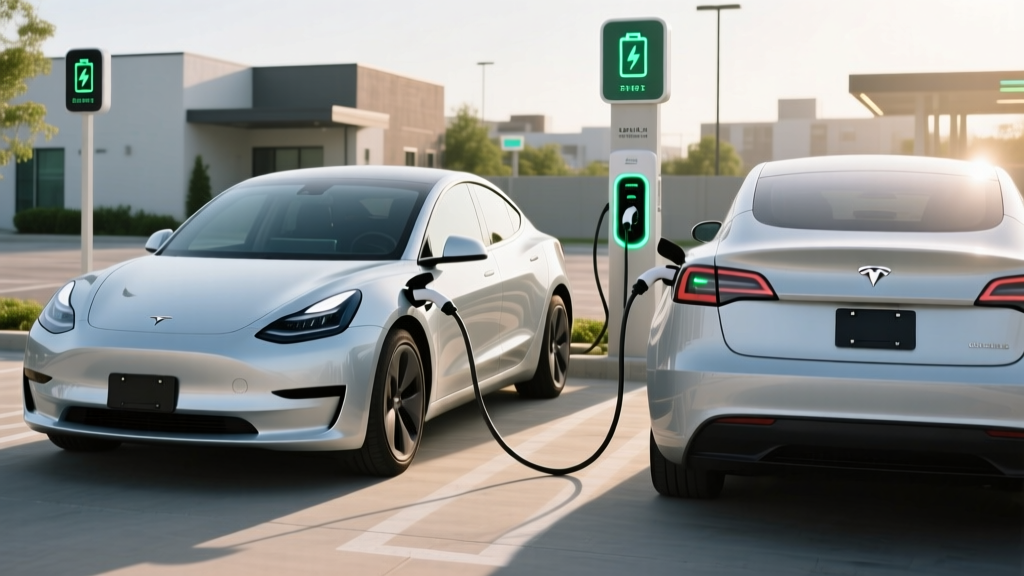
One reason merger speculation doesn't spook Tesla buyers is the Supercharger network — a tangible asset that no corporate restructuring would diminish.
| Charging Level | Power (kW) | Miles Added per Hour | Typical Use Case |
|---|---|---|---|
| Level 1 (120V household) | ~1.4 kW | ~3–5 mi/hr | Emergency / overnight trickle |
| Level 2 (240V home Wall Connector) | 11.5 kW | ~34–44 mi/hr | Daily home charging |
| DC Fast (V3 Supercharger) | 250 kW peak | ~180–220 mi in 15 min | Road trips |
| DC Fast (V4 Supercharger) | Up to 350 kW* | Varies by model | Next-gen road trips |
*V4 Supercharger peak rates depend on vehicle architecture. Current Tesla models are limited by their onboard charge electronics to ~250 kW acceptance.
The Charging Curve Reality
Tesla's 250 kW peak charge rate is not sustained across the full session. The battery management system tapers charging speed as State of Charge (SoC) rises to protect cell longevity. Expect:
- 10–50% SoC: Near-peak rates (~200–250 kW)
- 50–80% SoC: Progressive taper (~100–150 kW)
- 80–100% SoC: Dramatic taper (~20–50 kW) — avoid DC fast charging past 80% unless necessary
This is why Tesla quotes 10–80% times rather than 0–100%. Charging the final 20% on DC fast can take as long as the first 70%.
Federal Tax Credit Eligibility for Tesla Vehicles
The IRS §30D Clean Vehicle Credit remains a key factor in Tesla purchase decisions. Here's the 2026 eligibility landscape:
- Maximum credit: Up to $7,500 ($3,750 for critical minerals + $3,750 for battery components)
- MSRP caps: Vans/SUVs/pickups ≤ $80,000; sedans ≤ $55,000
- Buyer income caps: AGI ≤ $150,000 (single), $225,000 (head of household), $300,000 (joint)
- Battery sourcing: Increasing percentages of critical minerals and battery components must be sourced from the U.S. or FTA partners — this threshold tightens annually
- Point-of-sale transfer: Eligible buyers can transfer the credit to the dealer at purchase, reducing the upfront price rather than waiting for a tax refund
- FEOC restriction: Vehicles with battery components from a "foreign entity of concern" (primarily Chinese suppliers) are disqualified
| Model | Base MSRP | Under MSRP Cap? | Est. Credit* | After-Credit Price |
|---|---|---|---|---|
| Model 3 RWD | $40,240 | Yes (sedan ≤$55K) | Up to $7,500 | ~$32,740 |
| Model 3 Long Range AWD | $47,740 | Yes (sedan ≤$55K) | Up to $7,500 | ~$40,240 |
| Model Y Long Range AWD | $48,240 | Yes (SUV ≤$80K) | Up to $7,500 | ~$40,740 |
| Cybertruck AWD | $79,990 | Yes (truck ≤$80K) | Up to $7,500 | ~$72,490 |
| Model S Long Range | $79,990 | No (sedan cap $55K) | $0 | $79,990 |
*Credit amounts depend on battery-sourcing compliance, which changes annually. Verify current eligibility at fueleconomy.gov and consult a tax professional. Income caps apply.
Tesla vs. Key Competitors: Where the Lineup Stands
Whether or not a SpaceX merger ever happens, Tesla competes in an increasingly crowded EV market. Here's how the core models stack up:
Pros
- Supercharger network: 6,000+ U.S. stations, best-in-class reliability
- Class-leading efficiency (MPGe) across Model 3/Y
- OTA updates continuously add features post-purchase
- Strong resale value relative to most EV brands
- FSD (Supervised) offers the most widely deployed Level 2 ADAS
- Minimalist interior = fewer things to break
Cons
- No Apple CarPlay or Android Auto
- Build quality inconsistency still surfaces in delivery inspections
- Service center wait times remain long in many metro areas
- FSD (Supervised) is Level 2 — requires full driver attention, not autonomous
- Model S/X pricing exceeds tax credit caps
- Cybertruck polarizing design limits resale audience
Who Should Buy a Tesla in 2026?
Setting aside merger speculation entirely, here's a practical decision framework:
Choose Tesla if:
- You road-trip frequently and value the Supercharger network's reliability
- You want a tech-forward cabin with continuous OTA improvements
- Efficiency (kWh/100mi) is a top priority — Tesla leads most competitors
- You can charge at home (Level 2) and want minimal public charging dependency
- You're comfortable with a touchscreen-centric interface and no physical buttons
Look elsewhere if:
- You need Apple CarPlay/Android Auto for your daily workflow
- You want a traditional luxury interior with premium materials (consider BMW i4, Genesis Electrified G80)
- You need a 3-row SUV (Tesla has no current offering — consider Rivian R1S or Kia EV9)
- You live in an area with limited Tesla Service Center access
- You prefer physical controls for climate, volume, and driving modes
Tesla Warranty Coverage
Tesla's warranty structure is straightforward and competitive with the EV segment:
- Basic Vehicle Limited Warranty: 4 years / 50,000 miles
- Battery & Drive Unit Warranty (Model 3/Y): 8 years / 100,000 miles (Long Range AWD) or 120,000 miles (RWD)
- Battery & Drive Unit Warranty (Model S/X): 8 years / 150,000 miles
- Battery retention threshold: Tesla warrants minimum 70% capacity retention during the warranty period
The 70% retention floor is standard across the industry (Hyundai offers 70%, GM offers 60% on some models). Real-world data from high-mileage Tesla owners shows most NMC packs retain 85–90% capacity at 100,000 miles when DC fast charging is used judiciously and daily SoC is kept between 20–80%.
Frequently Asked Questions
Is Tesla and SpaceX going to merge in 2026?
No merger has been announced, filed with the SEC, or publicly committed to by either company. While Elon Musk has acknowledged the possibility in interviews, the regulatory, financial, and structural complexity of combining a ~$800B public company with a ~$350B private firm makes this unlikely in the near term.
Would a merger affect my Tesla warranty or Supercharger access?
No. Warranties are contractual obligations tied to the vehicle, not the parent company's corporate structure. Even in a merger scenario, existing warranties would be honored, and the Supercharger network would remain operational — it's a revenue-generating asset.
Does the Model Y still qualify for the $7,500 federal tax credit?
The Model Y Long Range AWD at $48,240 MSRP falls under the $80,000 SUV/truck cap. Eligibility for the full $7,500 depends on battery-sourcing compliance (which tightens annually), buyer income limits, and FEOC restrictions. Verify current status at fueleconomy.gov and consult a tax professional before purchasing.
What is the real-world range of the Tesla Model Y?
The Model Y Long Range AWD carries a 337-mile EPA estimate. In real-world mixed driving at moderate temperatures, expect 290–310 miles. Sustained highway driving at 75+ mph reduces this to roughly 270–290 miles. In sub-freezing conditions without preconditioning, expect 220–250 miles. Preconditioning the battery via the Tesla app before departure recovers a significant portion of cold-weather loss.
How does Tesla's charging speed compare to competitors?
Tesla's 250 kW peak DC fast-charge rate is competitive but not class-leading — the Hyundai Ioniq 5 and Kia EV6 can peak at 350 kW on compatible chargers. However, Tesla's advantage is network density and reliability: Superchargers consistently deliver near-rated speeds with minimal downtime, while third-party networks (Electrify America, EVgo) still experience higher failure rates at some locations.
Should I wait for a merger before buying a Tesla?
No. Corporate restructuring at this scale would take years to execute and would not meaningfully change the vehicle you drive, the software you use, or the Supercharger network you rely on. Buy based on the product, price, and tax credit eligibility that exist today.