The SolarCity Acquisition: Why It Matters for EV Owners in 2026
When Tesla Inc acquired SolarCity in 2016 for approximately $2.6 billion, the move was controversial — critics questioned whether an automaker should absorb a struggling solar installer. Nearly a decade later, the strategic logic is clearer: Tesla's ecosystem now spans vehicle, solar generation, battery storage, and charging hardware, all managed through a single app. For EV owners considering home solar, the Tesla Inc SolarCity legacy defines the most vertically integrated residential energy-plus-EV-charging package available in 2026.
This isn't a vehicle review — it's an evaluation of the solar-to-EV pipeline Tesla built on SolarCity's foundation. We'll examine whether the Tesla Solar Roof, Powerwall 3, and Wall Connector ecosystem delivers genuine value for EV owners, or whether piecing together third-party components remains the smarter play.
Tesla Solar Roof: 2026 Specs, Costs, and Energy Output
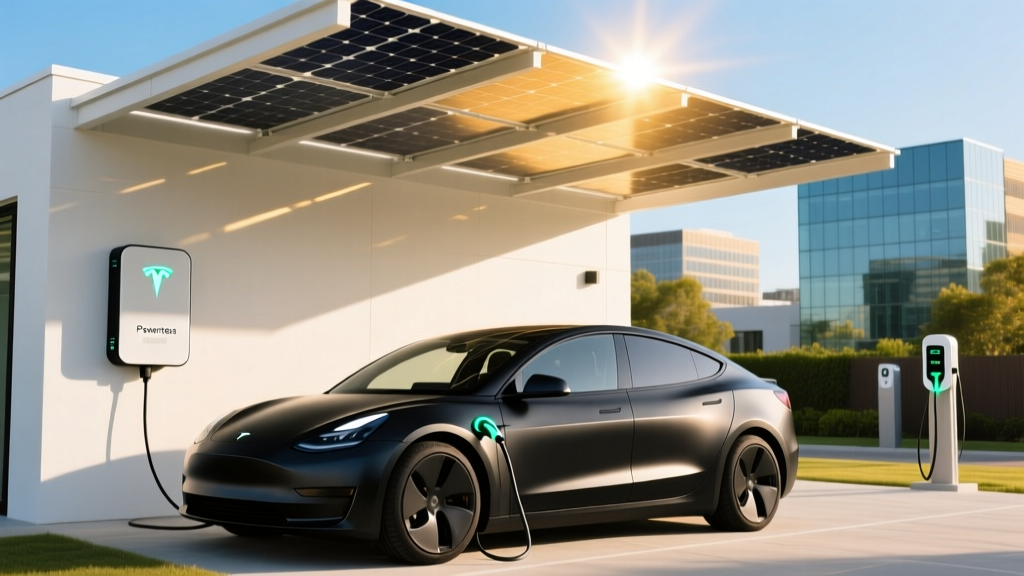
The Tesla Solar Roof (now in its fourth generation) replaces conventional roofing materials with active solar tiles and architectural-grade dummy tiles. Unlike rack-mounted panels, the tiles sit flush, mimicking slate or composite shingles.
| Spec | Value |
|---|---|
| Tile Efficiency | ~22% (active tiles) |
| Typical System Size (2,000 sq ft home) | 8–12 kW DC |
| Annual Production (avg US location) | 10,000–16,000 kWh |
| Warranty (tile & power) | 25 years |
| Wind Rating | Class F (110 mph) |
| Fire Rating | Class A |
| Installed Cost (before incentives, 10 kW avg) | $42,000–$68,000 |
The cost premium over conventional rack-mounted panels is substantial. A standard 10 kW panel system from a major installer typically runs $25,000–$32,000 before incentives. The Solar Roof's aesthetic integration commands roughly a 40–100% premium, though Tesla argues the comparison should include roof replacement cost — if your roof needs replacing anyway, the incremental solar cost narrows.
Powerwall 3: The Bridge Between Solar and Your EV
Generation alone doesn't solve EV charging — timing does. Solar production peaks midday; most EV owners charge overnight. The Tesla Powerwall 3 bridges this gap with integrated DC coupling and a built-in bidirectional inverter.
| Spec | Value |
|---|---|
| Usable Capacity | 13.5 kWh |
| Continuous Power Output | 11.5 kW |
| Peak Power | 15 kW (short burst) |
| Round-Trip Efficiency | ~90% |
| Warranty | 10 years, unlimited cycles |
| Installed Cost (single unit, 2026) | $9,200–$12,500 |
| Stackability | Up to 10 units |
For EV charging, one Powerwall 3 provides enough stored energy to add roughly 35–45 miles of range to a Tesla Model Y (at ~3.5 mi/kWh real-world efficiency) before accounting for inverter and charging losses. Two units extend that to 70–90 miles — adequate for most daily commutes without drawing grid power.
Charging Integration: Wall Connector, NACS, and Solar Scheduling
Tesla's Wall Connector (Gen 3) is the endpoint of the solar-to-EV chain. Hardwired to a 60A circuit, it delivers up to 11.5 kW (48A continuous), adding roughly 44 miles of range per hour to a Model 3 Long Range.
| Circuit | Max Power | Miles/Hour (Model Y LR) | Full Charge (10–80%) |
|---|---|---|---|
| 60A breaker / 48A continuous | 11.5 kW | ~44 mi/hr | ~6.5 hours |
| 50A breaker / 40A continuous | 9.6 kW | ~37 mi/hr | ~8 hours |
| 30A breaker / 24A continuous | 5.8 kW | ~22 mi/hr | ~13 hours |
The Tesla app's "Charge on Solar" feature (introduced in 2023 and refined through 2025 OTA updates) dynamically modulates charge rate to match excess solar production. If your panels produce 5 kW above household load, the car charges at ~5 kW. Production drops from cloud cover? Charge rate throttles down. This eliminates grid draw during solar hours but means charging speed fluctuates — a full solar-only charge may take all day.
Federal Tax Credits and Incentives for Solar + Storage + EV
The incentive landscape in 2026 involves three separate federal credits that can stack — but each has distinct eligibility rules under IRS code.
- Residential Clean Energy Credit (IRC §25D): 30% of solar and battery storage cost through 2032. No income cap. Applies to Solar Roof and Powerwall. A $55,000 Solar Roof yields a $16,500 credit.
- New EV Credit (IRC §30D): Up to $7,500 for qualifying new EVs. Subject to MSRP caps ($55,000 sedans / $80,000 SUVs/trucks), buyer income limits ($150K single / $300K joint AGI), and critical mineral + battery component sourcing requirements. Check current IRS guidance — sourcing rules tighten annually.
- Used EV Credit (IRC §25E): Up to $4,000 (30% of sale price, max $4,000) for qualifying pre-owned EVs. Income caps apply ($75K single / $150K joint). Vehicle must be under $25,000.
The critical nuance: solar/storage credits and EV credits are separate code sections with separate caps. A household installing a Solar Roof, Powerwall, and purchasing a new Model Y can potentially claim both the 30% residential energy credit and the $7,500 EV credit in the same tax year — but consult a tax professional, as AMT and carry-forward rules vary.
Total System Cost: Solar Roof + Powerwall + EV Charging in 2026
| Component | Cost Range |
|---|---|
| Tesla Solar Roof (10 kW, 2,000 sq ft) | $42,000–$58,000 |
| Powerwall 3 (single, installed) | $9,200–$12,500 |
| Wall Connector (hardware + install) | $1,200–$2,800 |
| Electrical panel upgrade (if needed, 200A) | $1,500–$4,000 |
| Permitting & inspection | $800–$2,500 |
| Total Before Incentives | $54,700–$79,800 |
| Less: 30% Residential Clean Energy Credit | –$16,410 to –$23,940 |
| Net Cost After Federal Credit | $38,290–$55,860 |
Compare this to a conventional rack-mounted 10 kW system with a third-party battery (e.g., Enphase IQ 5P): roughly $35,000–$48,000 before incentives. The Tesla ecosystem premium is real — roughly $8,000–$15,000 net after credits — but includes unified app control, single-point warranty responsibility, and aesthetic integration.
Who Should Buy Into the Tesla Solar + EV Ecosystem?
- Your roof needs replacement within 2 years anyway — the incremental solar cost drops significantly
- You value single-app management and unified warranty over lowest cost
- You live in a time-of-use (TOU) rate area where stored solar offsets expensive evening grid power
- Aesthetics matter — HOA restrictions or personal preference against visible rack-mounted panels
- You want backup power capability (Powerwall provides whole-home or critical-loads backup)
- Your roof is in good shape and won't need replacement for 10+ years
- Minimizing cost per kWh is the primary goal
- You don't own a Tesla vehicle (NACS advantage is moot with CCS adapters)
- You want installer choice and competitive bidding
Pros and Cons: Tesla's Integrated Solar-EV Approach
Pros
- Single ecosystem: one app controls solar, storage, charging, and vehicle
- Solar Roof aesthetics superior to rack-mounted panels for most rooflines
- Charge on Solar feature dynamically matches charge rate to excess production
- Powerwall provides backup power during outages — dual benefit
- 25-year tile warranty matches typical roof lifespan
- 30% federal credit applies to full system cost (solar + battery)
Cons
- Solar Roof costs 40–100% more than conventional panels per installed watt
- Tesla's installation timeline can stretch 4–9 months depending on region
- Service calls require Tesla technicians — limited third-party repair options
- Solar production in northern/winter climates often insufficient for full daily driving needs
- Powerwall availability has historically faced supply constraints
- Charge on Solar modulates slowly — rapid cloud changes cause oscillation
Frequently Asked Questions
Can I charge my EV entirely from solar with a Tesla Solar Roof?
Partially. A 10 kW system in a high-insolation state produces enough daily energy for 100–140 miles of EV driving in summer. In winter or cloudy climates, production drops 50–70%, covering only 40–60 miles. Most owners still supplement with grid power, especially for road-trip charging.
Does the Tesla Solar Roof work with non-Tesla EVs?
Yes. The Wall Connector includes a NACS (North American Charging Standard) plug native to Teslas. For CCS-equipped vehicles (Ford, GM, Rivian, Hyundai, etc.), you'll need a NACS-to-CCS adapter — widely available in 2026 as most automakers have transitioned to NACS.
What's the payback period for a Tesla solar + storage system used to charge an EV?
With average US electricity rates ($0.16/kWh in 2026) and typical solar production, payback ranges from 8–14 years after the 30% federal credit. Higher electricity rates (California, Hawaii, Northeast) shorten payback to 6–9 years. Adding EV charging displaces gasoline — a driver spending $200/month on fuel saves $1,800–$2,400 annually, accelerating payback.
How does the SolarCity acquisition affect warranty and service today?
SolarCity's operations were fully absorbed into Tesla Energy by 2019. All Solar Roof and solar panel installations carry Tesla's standard warranty (25 years for tiles/power output, 10 years for Powerwall). Legacy SolarCity panel customers are serviced through Tesla's energy support. Per Tesla Energy Support, warranty claims are handled identically regardless of original installation date.
Do I need a Powerwall to charge my EV from solar?
No, but timing matters. Without a battery, you can only charge when the sun is producing (the "Charge on Solar" feature handles this). A Powerwall stores midday excess for evening/overnight charging — more convenient but adds $9,200–$12,500 to system cost. If you're home during the day, direct solar charging without storage works fine.