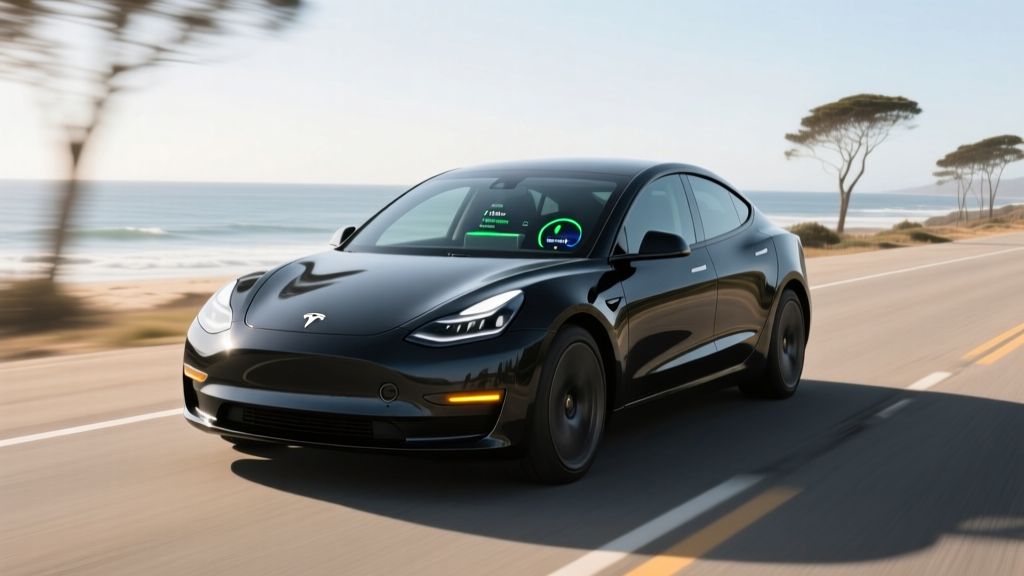
If you've ever searched "how does Tesla work," you're not alone. Tesla's ecosystem — from its proprietary charging network to its software-defined vehicle architecture — operates differently from legacy automakers. Rather than a generic overview, this guide answers that question by walking through the 2025 Tesla Model 3 Long Range AWD, the highest-volume variant and the one most buyers consider. We'll cover exactly what powers it, how far it really goes, how fast it charges, and what ownership actually costs.
Powertrain and Battery: What Actually Makes a Tesla Move
The 2025 Model 3 Long Range AWD uses a dual-motor all-wheel-drive setup: a permanent-magnet synchronous motor on the rear axle and an induction motor up front. Combined output is 346 horsepower and 389 lb-ft of torque. Unlike a gas car with a multi-speed transmission, Tesla uses a single-speed reduction gear — there are no gears to shift. Acceleration is linear and immediate because electric motors deliver peak torque from 0 RPM.
The energy source is a 75 kWh usable (approximately 82 kWh gross) lithium-ion battery pack. Tesla sources cells from multiple suppliers (CATL, Panasonic, LG Energy Solution) depending on production batch. The Long Range AWD variant typically uses NMC (nickel manganese cobalt) chemistry, which offers higher energy density than LFP — critical for maximizing range in this trim. The base Model 3 RWD, by contrast, uses an LFP (lithium iron phosphate) pack, which trades some range for lower cost and longer cycle life.
| Spec | Value |
|---|---|
| EPA Range | 363 miles |
| Battery (usable) | ~75 kWh, NMC chemistry |
| Drivetrain | Dual-motor AWD |
| Horsepower | 346 hp |
| 0-60 mph | 4.2 seconds |
| EPA Efficiency | 130 MPGe combined / 26 kWh/100 mi |
| Max DC Fast Charge | 250 kW (peak) |
| 10-80% DC Charge Time | ~25 minutes |
| Level 2 Home Charge | 11.5 kW (~44 mi/hr) |
| Base MSRP | $47,740 (incl. destination) |
| Battery Warranty | 8 years / 120,000 miles |
Real-World Range vs. the EPA Sticker
Real-World Expectation: ~300–320 miles at sustained highway speeds (70–75 mph); ~250–280 miles in freezing temperatures (below 32°F) with cabin heat. City driving with regenerative braking can match or slightly exceed the EPA figure.
The EPA's 363-mile rating for the Model 3 Long Range AWD is among the highest in its class, and fueleconomy.gov confirms this figure. But EPA tests use a mix of city and highway cycles at moderate speeds. In our experience and consistent third-party testing, sustained highway driving at 75 mph reduces range by roughly 12–17%. Cold weather compounds this: battery chemistry slows in freezing temperatures, and resistive cabin heating draws significant power (a heat pump is standard on the refreshed Model 3, which helps but doesn't eliminate the penalty).
For context, a 300-mile road trip in 40°F weather at 70 mph will likely require a brief charging stop — plan accordingly. The in-car navigation's trip planner accounts for elevation, temperature, and speed, and is generally accurate within 5–8% when you precondition the battery.
Charging Speed: DC Fast, Level 2, and the Supercharger Advantage
Understanding how Tesla charges requires distinguishing kW (power — the rate of energy flow) from kWh (energy — the battery's capacity). Think of kW as the width of a hose and kWh as the size of the bucket.
| Level | Power | Miles Added per Hour | Use Case |
|---|---|---|---|
| Level 1 (120V household) | ~1.4 kW | ~4–5 mi/hr | Emergency / trickle |
| Level 2 (240V home Wall Connector) | 11.5 kW | ~44 mi/hr | Daily overnight charging |
| DC Fast (Tesla Supercharger V3/V4) | 250 kW peak | ~200 mi in 15 min | Road trips |
DC fast charging reality: The 250 kW peak rate applies only between roughly 10–30% state of charge (SoC). The charge curve tapers significantly above 50%, and by 80% you're pulling under 60 kW. A 10–80% session takes about 25 minutes. Charging from 80–100% can add another 20+ minutes — which is why Tesla and most EV owners recommend stopping at 80% on road trips unless you need the full battery for the final leg.
Tesla's NACS (North American Charging Standard) connector is now the industry standard, with Ford, GM, Rivian, and others adopting it. The Model 3 charges natively on all Tesla Superchargers without an adapter. For non-Tesla DC networks (Electrify America, EVgo), you'd need a NACS-to-CCS adapter, though Tesla's navigation routes you to Superchargers by default.
Home charging: The Tesla Wall Connector ($420) on a 60-amp circuit delivers 11.5 kW, adding roughly 44 miles of range per hour. A full overnight charge (8 hours) replenishes about 350 miles — more than enough for daily use. Installation costs vary: expect $500–$1,500 if your electrical panel has capacity, or $2,000–$4,000+ if you need a panel upgrade to 200 amps.
Pricing, Tax Credits, and Total Cost
The 2025 Model 3 Long Range AWD starts at $47,740 (including $1,250 destination). The base RWD model starts at $38,990, while the Performance trim is $54,990. Options like Ultra Red paint ($2,000), 19" Nova wheels ($1,500), and Full Self-Driving (Supervised) capability ($8,000) can push a Long Range build past $58,000.
- MSRP cap: Sedans must be ≤$55,000 (Model 3 qualifies at base; loaded builds may exceed the cap)
- Buyer income cap: AGI ≤$150,000 (single) / ≤$300,000 (joint)
- Battery sourcing: Critical minerals and battery components must meet phased-in domestic/FtA-country thresholds — the Model 3's eligibility has varied by build date and cell source
- Point-of-sale transfer: Eligible buyers can apply the credit as an instant discount at delivery (requires dealer/manufacturer participation)
Check current eligibility at IRS.gov before ordering — sourcing rules shift periodically.
If you qualify for the full $7,500 credit, the effective price of a base Long Range AWD drops to approximately $40,240. Combined with lower fuel and maintenance costs, the Model 3's 5-year total cost of ownership is competitive with a BMW 3 Series or Audi A4, especially in states with cheap electricity (under $0.15/kWh).
Interior Space, Tech, and Driver Assistance
The refreshed "Highland" Model 3 interior is minimalist: a single 15.4-inch touchscreen handles all infotainment, climate, and vehicle controls. There is no instrument cluster — speed and navigation appear in the upper-left corner of the screen. A rear 8-inch screen now serves back-seat passengers for climate and media.
Cargo and passenger dimensions:
- Front legroom: 42.2 inches
- Rear legroom: 35.3 inches (tighter than a Camry; tall rear passengers will notice)
- Trunk: 23 cu ft (including the rear sub-trunk)
- Frunk (front trunk): 3.1 cu ft — enough for a charging cable bag and small items
Autopilot and FSD (Supervised): Every Model 3 ships with basic Autopilot (Traffic-Aware Cruise Control + Autosteer). FSD (Supervised) adds automatic lane changes, traffic-light recognition, and city-street navigation. However, this is an SAE Level 2 system — the driver must remain fully attentive, with hands on or near the wheel at all times. It is not self-driving. Tesla's camera-only "Tesla Vision" approach lacks LiDAR or radar redundancy, which some competitors use.
How It Compares: Model 3 vs. Key Rivals
| Spec | Tesla Model 3 LR AWD | Hyundai Ioniq 6 SEL AWD | BMW i4 xDrive40 |
|---|---|---|---|
| EPA Range | 363 mi | 316 mi | 287 mi |
| Battery | ~75 kWh (NMC) | 77.4 kWh | 83.9 kWh |
| Peak DC Charge | 250 kW | 235 kW | 200 kW |
| 10-80% Time | ~25 min | ~18 min | ~31 min |
| 0-60 mph | 4.2 sec | 5.1 sec | 4.6 sec |
| MPGe (combined) | 130 | 117 | 98 |
| Base MSRP | $47,740 | $46,700 | $58,100 |
| Charging Network | Supercharger (native) | NACS adapter / CCS | NACS adapter / CCS |
The Model 3 wins on efficiency (MPGe), range, and charging-network access. The Ioniq 6 charges faster in the 10–80% window thanks to its 800V architecture and offers a more traditional interior with physical buttons. The BMW i4 delivers superior ride quality and materials but costs significantly more and trails on range. If Supercharger access is a priority for road trips, Tesla still holds a reliability advantage over third-party CCS networks — though that gap is narrowing as Ford and GM vehicles gain Supercharger access via NACS adapters.
Warranty and Long-Term Battery Health
Tesla covers the Model 3 battery and drive unit for 8 years or 120,000 miles, whichever comes first, with a guaranteed minimum 70% capacity retention during that period. The basic vehicle limited warranty is 4 years / 50,000 miles.
Real-world data from Tesla's own impact reports and third-party fleet analyses (Tessie, Recurrent Auto) suggest NMC packs in the Model 3 typically degrade 8–12% over the first 100,000 miles, with the steepest loss occurring in the first 20,000 miles before leveling off. For daily-use owners charging to 80% and avoiding frequent DC fast charging, the battery should outlast the vehicle's practical lifespan. A full battery replacement (rare) currently costs approximately $12,000–$16,000 out of warranty.
Pros, Cons, and Who Should Buy
- Class-leading 363-mi EPA range and 130 MPGe efficiency
- Supercharger network access — still the most reliable DC network
- Over-the-air updates continuously add features
- Low maintenance: no oil changes, minimal brake wear (regen)
- Strong resale value relative to most EVs
- Minimalist interior polarizing; no physical buttons or stalks
- Rear seat legroom (35.3") trails midsize competitors
- FSD ($8,000) remains Level 2 — not autonomous
- No Apple CarPlay or Android Auto
- Insurance premiums run 15–30% higher than comparable gas sedans
Best for: Daily commuters with home charging access, tech-forward buyers who value software integration, and road-trippers who rely on the Supercharger network. The Model 3 Long Range AWD is a strong primary vehicle for a household that needs one EV to do everything — commute, errands, and cross-country trips.
Look elsewhere if: You prioritize rear-seat comfort for adults, want physical climate controls, need Apple CarPlay, or want a true Level 3+ hands-off driving system (currently only Mercedes Drive Pilot in limited markets offers this).
Frequently Asked Questions
What is the real-world range of the Tesla Model 3 Long Range?
The EPA rates it at 363 miles. Expect roughly 300–320 miles at highway speeds (70–75 mph) in mild weather, and 250–280 miles in freezing conditions. City driving with regenerative braking can approach or match the EPA figure.
How fast does the Model 3 charge at home and on the road?
At home on a Level 2 Tesla Wall Connector (11.5 kW), you gain about 44 miles of range per hour — a full charge overnight. On a Tesla V3/V4 Supercharger, the peak rate is 250 kW, and a 10–80% session takes approximately 25 minutes. Charging slows significantly above 80% due to the battery's charge-curve taper.
Does the Model 3 qualify for the $7,500 federal EV tax credit?
It can — but eligibility depends on the buyer's adjusted gross income (≤$150K single / ≤$300K joint), the vehicle's MSRP (≤$55K for sedans), and battery-sourcing requirements that shift periodically. Always verify current status at IRS.gov before ordering. The credit can be applied as a point-of-sale discount.
Is the Tesla Model 3 worth buying over a Hyundai Ioniq 6 or BMW i4?
If range, efficiency, and Supercharger reliability are your top priorities, yes — the Model 3 leads all three. If you prefer a more traditional interior, faster 10–80% charging (Ioniq 6), or premium materials and ride quality (BMW i4), those are worthy alternatives. Test-drive all three before deciding.
How long will the Tesla Model 3 battery last?
Tesla warranties the battery for 8 years / 120,000 miles with a 70% minimum capacity retention guarantee. Real-world fleet data shows 8–12% degradation over 100,000 miles for NMC packs. With sensible charging habits (daily limit of 80%, minimize DC fast charging), the battery should last well beyond 150,000 miles before approaching the warranty threshold.
Is Tesla's Full Self-Driving actually self-driving?
No. FSD (Supervised) is an SAE Level 2 driver-assist system. It can navigate city streets, handle lane changes, and recognize traffic signals, but the driver must remain fully engaged and ready to take over at any moment. It does not make the car autonomous.