When homeowners search for roof tiles tesla, they're usually trying to answer one expensive question: Can Tesla's Solar Roof actually power an electric vehicle at home while looking better than traditional panels? The short answer is yes — but the economics, installation timelines, and energy math are far more complex than Tesla's configurator suggests. This guide breaks down the 2026 Tesla Solar Roof system, its Powerwall battery integration, and what it realistically means for EV owners who want to charge off the sun.
What Tesla Solar Roof Tiles Actually Are (And Aren't)
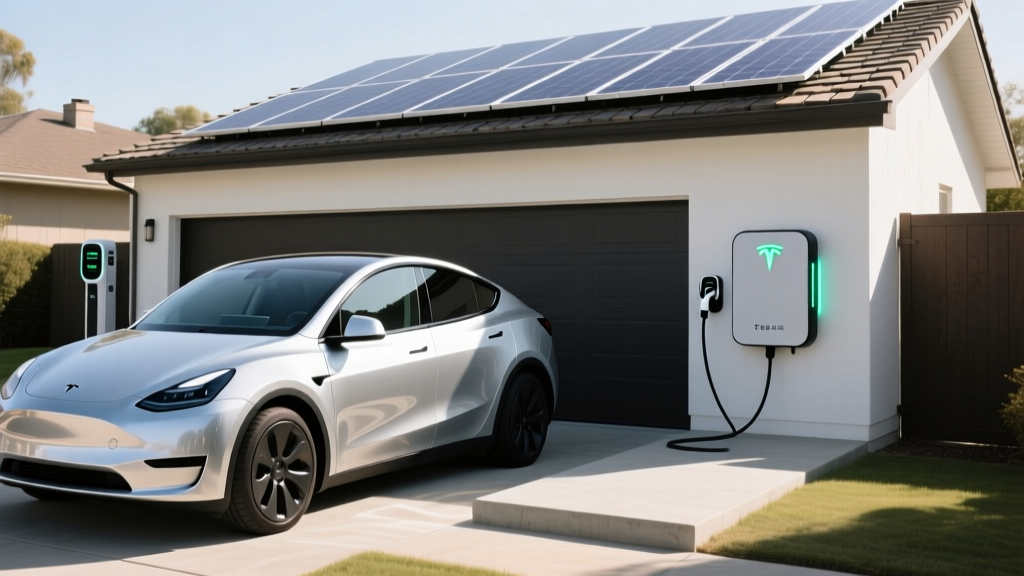
Tesla's Solar Roof replaces your existing roofing material with tempered glass tiles that either contain photovoltaic cells (active tiles) or mimic the look of roofing without generating power (inactive tiles). Unlike rack-mounted solar panels bolted on top of shingles, these tiles are the roof. For EV owners, the appeal is clear: a seamless aesthetic that generates electricity to offset Level 2 home charging costs.
As of 2026, Tesla offers the Solar Roof in a single product tier with integrated Powerwall 3 battery storage. The system is designed primarily for whole-home energy, not dedicated EV charging infrastructure — an important distinction that affects how you plan your electrical setup.
Tesla Solar Roof: System Specs at a Glance
| Specification | 2026 Tesla Solar Roof |
|---|---|
| Tile Material | Tempered glass with integrated PV cells |
| Active Tile Efficiency | ~22-23% cell efficiency |
| System Size Range | 4 kW to 20+ kW (roof-dependent) |
| Average Residential System | ~8-12 kW DC |
| Estimated Annual Production | ~10,000–18,000 kWh (climate/size dependent) |
| Tile Warranty | 25 years (weatherization & power) |
| Powerwall 3 Capacity | 13.5 kWh usable per unit |
| Powerwall 3 Continuous Output | 11.5 kW per unit |
| Powerwall Warranty | 10 years |
| Typical Installed Cost (10 kW + 1 Powerwall) | $55,000–$75,000 before incentives |
| Federal Tax Credit (30% ITC) | Reduces cost by ~$16,500–$22,500 |
Source: Tesla Solar Roof product pages and U.S. Department of Energy ITC guidance.
Can a Tesla Solar Roof Actually Charge Your EV?
Yes — but let's do the energy math that most marketing materials skip. A typical 10 kW Tesla Solar Roof system in a sunbelt state (Arizona, Texas, Southern California) produces roughly 14,000–16,000 kWh per year. In the Northeast or Pacific Northwest, expect 9,000–12,000 kWh from the same system size due to fewer peak sun hours.
Now consider EV charging demand. A Tesla Model Y Long Range with a ~75 kWh usable battery driven 12,000 miles per year at 3.5 miles/kWh consumes approximately 3,429 kWh annually just for driving. A larger vehicle like the Ford F-150 Lightning or Rivian R1T might consume 4,500–5,500 kWh per year at the same mileage.
The Net Metering Factor
In states with favorable net metering (where your utility credits you at retail rates for excess solar sent to the grid), your Solar Roof effectively uses the grid as a free battery. You export surplus daytime solar and draw from the grid at night to charge your EV. Your annual solar production offsets your annual consumption, including EV charging. In states with reduced export compensation (California's NEM 3.0 being the most prominent example), on-site battery storage becomes far more economically important.
Cost Breakdown: Tesla Solar Roof + EV Charging Setup
| Component | Estimated Cost (2026) |
|---|---|
| Solar Roof (10 kW system, ~1,500 sq ft roof) | $40,000–$55,000 |
| Powerwall 3 (1 unit, installed) | $12,000–$16,000 |
| Electrical Panel Upgrade (if needed, 200A) | $2,000–$4,000 |
| Tesla Wall Connector (Level 2 EV charger) | $450–$500 (hardware) |
| EV Charger Installation (electrician, conduit, wiring) | $1,500–$3,500 |
| Permits & Inspection | $500–$1,500 |
| Total Before Incentives | $56,450–$80,500 |
| 30% Federal ITC (solar + battery) | -$16,935 to -$24,150 |
| Total After Federal ITC | $39,515–$56,350 |
Important: The 30% federal Investment Tax Credit (ITC) applies to solar and battery storage — this is separate from the IRS §30D EV purchase credit. You can claim both in the same tax year if you buy an EV and install solar, as they are different tax code sections. Consult a tax professional for your specific situation. Reference: IRS Residential Clean Energy Credit.
How This Compares to Traditional Solar Panels + EV Charger
A conventional rack-mounted solar panel system (10 kW with a 250W/microinverter setup) typically costs $25,000–$35,000 installed before incentives — roughly 40-50% less than Tesla's Solar Roof for equivalent energy production. The trade-off is aesthetics: traditional panels sit on top of your existing roof, while Solar Roof tiles replace the roofing material entirely. If your roof is near end-of-life and needs replacement anyway, the cost gap narrows because you'd be paying for a new roof regardless.
Powerwall 3 and EV Charging: What You Need to Know
The Powerwall 3 is a critical component for EV owners because it determines whether your solar energy is available when your car is actually plugged in (typically evenings and overnight). Here are the key specs:
- Usable capacity: 13.5 kWh per unit
- Continuous power output: 11.5 kW (sufficient to run a Level 2 charger at ~48A/11.5 kW simultaneously with moderate home loads)
- Peak power: ~15 kW briefly
- Round-trip efficiency: ~90% (meaning ~10% energy loss in the charge/discharge cycle)
- Chemistry: Lithium-ion (NMC-based cathode)
- Warranty: 10 years with unlimited cycles when paired with solar
For context, a Tesla Model 3 or Model Y charging at a Wall Connector set to 48 amps draws approximately 11.5 kW — right at the Powerwall 3's continuous output limit. This means a single Powerwall can technically support Level 2 charging, but it will deplete the battery in roughly 1 hour and 10 minutes (13.5 kWh ÷ 11.5 kW), adding approximately 45-55 miles of range to a Model Y. For a full overnight charge, you'd need multiple Powerwalls or to rely on grid power supplemented by net metering credits.
Tesla Solar Roof: Pros and Cons for EV Owners
Pros
- Integrated aesthetics — no visible panels or racks
- 25-year tile warranty covers weatherization and power output
- Doubles as a full roof replacement (if your roof needs it)
- Powerwall enables backup power during outages — keeps EV charged when grid is down
- Offsets EV charging costs significantly in sunny climates with net metering
- 30% federal ITC applies to both solar roof and battery
- Tesla app integrates solar, battery, and EV charging monitoring
Cons
- Significantly more expensive than traditional panels for equivalent energy output
- Installation timelines historically long (months, not weeks) due to custom tile manufacturing
- Single Powerwall insufficient for full overnight EV charging from stored solar
- Roof complexity can complicate future repairs or modifications
- Lower energy density per square foot vs. high-efficiency traditional panels in some configurations
- Not available in all markets; installation dependent on Tesla-certified crews
- Reduced export compensation in some states (CA, others) diminishes grid-as-battery economics
Who Should Consider Tesla Solar Roof Tiles for EV Charging?
Best for: Homeowners who need a full roof replacement AND want integrated solar, have high electricity rates ($0.25+/kWh), drive an EV with moderate daily mileage (30-50 miles), live in a state with favorable net metering or have the budget for multiple Powerwalls, and value aesthetics highly.
Not ideal for: Homeowners with a newer roof in good condition (traditional panels make more financial sense), those on a tight solar budget, renters, or anyone expecting the Solar Roof to serve as a dedicated high-speed EV charging station. The solar roof offsets energy costs — your actual charging speed depends on your Wall Connector amperage, your electrical panel capacity, and your vehicle's onboard charger acceptance rate.
Frequently Asked Questions
Does the Tesla Solar Roof qualify for the same $7,500 tax credit as buying a Tesla vehicle?
No. These are two separate credits. The Solar Roof qualifies for the 30% Residential Clean Energy Credit (IRS §25D/IRC 48), which has no dollar cap — a $65,000 system yields a $19,500 credit. The EV purchase qualifies for the §30D Clean Vehicle Credit (up to $7,500), which has MSRP caps ($55,000 for sedans, $80,000 for SUVs/trucks/vans), buyer income limits, and battery-sourcing requirements. You can claim both in the same year if eligible. Always verify current rules at IRS.gov.
How long does Tesla Solar Roof installation take from order to completion?
Historically, Tesla Solar Roof installations have taken 6-18 months from order to completion, though timelines vary significantly by region and crew availability in 2026. The process includes site survey, engineering design, permitting, tile manufacturing (custom to your roof dimensions), old roof removal, installation, utility interconnection approval, and final inspection. Traditional panel installations typically complete in 4-12 weeks.
Can I charge my EV during a power outage with a Solar Roof and Powerwall?
Yes, but with limitations. During an outage, your Powerwall operates in island mode and can power your EV charger. A single Powerwall 3 (13.5 kWh) can add roughly 45-55 miles of range before depleting. During daytime outages with sun, the Solar Roof can continue producing and recharging the Powerwall, extending your effective charging capacity — but production depends on weather, season, and time of day.
Is a Tesla Solar Roof worth it compared to regular solar panels if I own an EV?
From a pure energy-production-per-dollar standpoint, traditional rack-mounted panels deliver the same electrons at 40-50% lower cost. The Solar Roof makes financial sense primarily when your existing roof needs full replacement (you'd pay $15,000-$30,000 for a premium roof anyway), when local HOA or aesthetic requirements prohibit visible panels, or when the integrated Tesla ecosystem (solar + Powerwall + Wall Connector + vehicle app) provides enough convenience value to justify the premium. For pure EV charging economics, traditional panels paired with a dedicated 240V circuit and quality Level 2 charger deliver faster ROI.
What size Tesla Solar Roof do I need to offset my EV charging?
For an EV driven 12,000 miles/year at 3.5 mi/kWh (typical for a Model Y or Ioniq 5), you consume roughly 3,400 kWh annually for driving. A 3-4 kW solar system can offset this in most U.S. climates. However, most homeowners size their Solar Roof to cover total household consumption (HVAC, appliances, lighting, EV) — typically 8-15 kW depending on home size and climate. Your Tesla consultant or independent solar installer should model your specific roof geometry, shading profile, and consumption data.