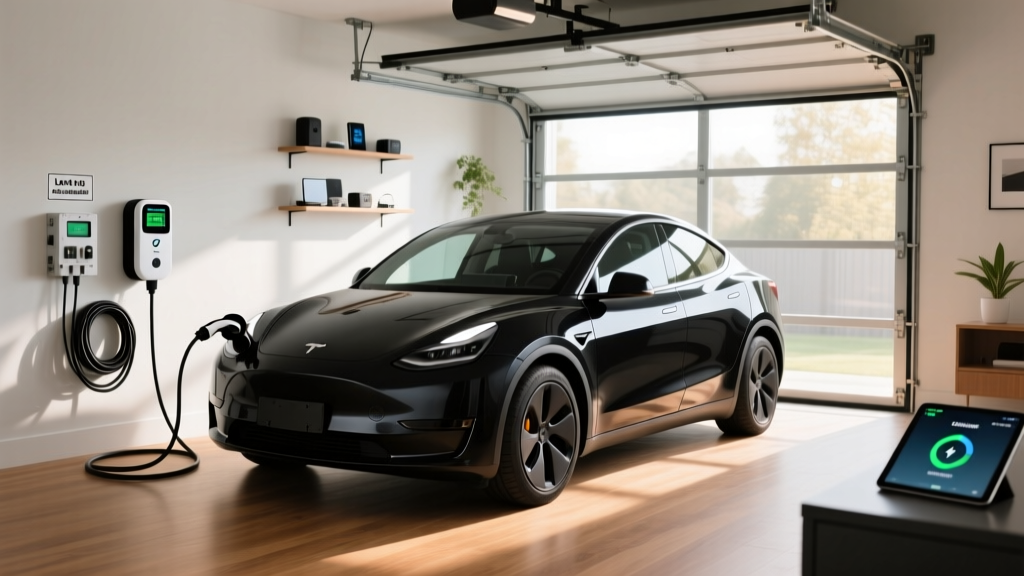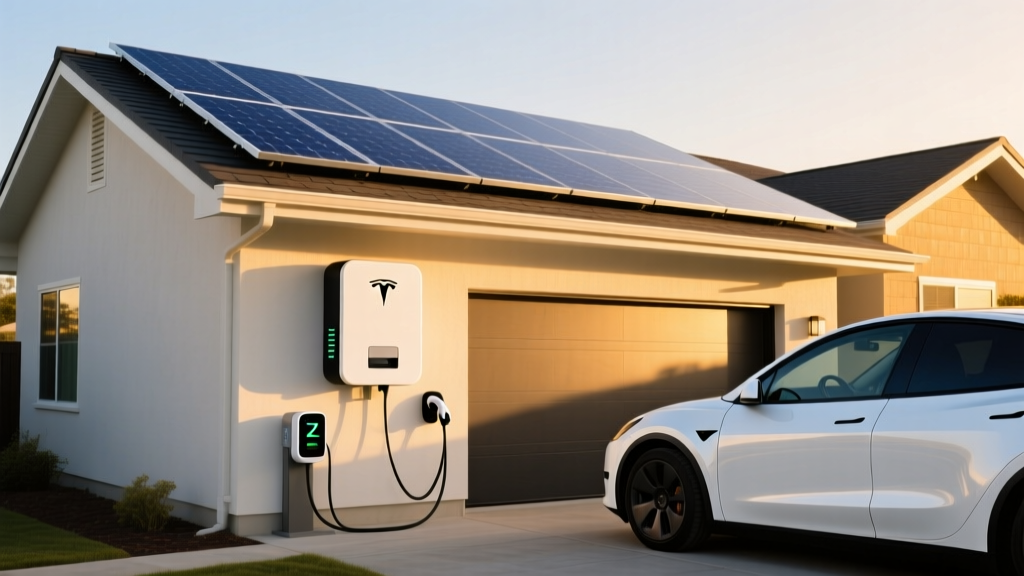
If you own or are shopping for a Tesla EV, the question of powering that car with sunshine is almost inevitable. That curiosity frequently lands on a single search: how much does the Tesla roof cost, and can it realistically cover the electricity an EV consumes? The answer is layered. Tesla's Solar Roof is not a conventional solar panel system bolted to existing shingles — it is a full roof replacement using integrated photovoltaic glass tiles paired with one or more Powerwall batteries. That distinction matters enormously for price, installation timeline, and whether the system makes financial sense for EV owners.
This guide breaks down current 2026 Tesla Solar Roof pricing, explains what's actually included, compares it to a traditional rack-mounted solar array, and models the math for offsetting home EV charging. We'll also clarify where the Tesla Model Y fits into the ownership picture for buyers who are evaluating both the roof and the car in one decision.
How Much Does the Tesla Solar Roof Actually Cost in 2026?
Tesla prices the Solar Roof per square foot of roof area, and the per-square-foot rate varies depending on roof complexity — number of stories, pitch, penetrations (vents, skylights, chimneys), and the ratio of active solar tiles to inactive (non-generating) look-alike tiles. A typical 2,000-square-foot single-story home with moderate complexity will see quotes in the $55,000 to $85,000 range before incentives, including one Powerwall 3. Larger or more complex roofs (multi-story, steep pitch, many dormers) can push well past $100,000.
Here is a realistic cost breakdown based on recent customer-reported quotes and Tesla's published estimator ranges:
| Component | Estimated Cost | Notes |
|---|---|---|
| Solar Roof tiles (active + inactive) | $35,000 – $65,000 | Varies by roof size, complexity, solar-to-inactive tile ratio |
| Powerwall 3 (13.5 kWh usable) | $9,000 – $12,000 | Includes integrated inverter; additional units ~$8,500 each |
| Installation labor & permitting | $8,000 – $15,000 | Roof tear-off, structural review, electrical tie-in |
| Electrical panel upgrade (if needed) | $2,000 – $4,500 | Required for some 200A+ homes adding Powerwall + EV charger |
| Total before incentives | $55,000 – $96,000+ | Highly dependent on home specifics |
| Federal solar ITC (30%) | –$16,500 – $28,800 | IRS §25D credit; applies to solar + battery |
| Net cost after federal credit | $38,500 – $67,200+ | State incentives may reduce further |
Tesla Solar Roof vs. Traditional Solar Panels: The Real Trade-Off
The most important comparison for EV owners isn't Solar Roof vs. nothing — it's Solar Roof vs. a conventional solar panel system on your existing roof. If your current roof is in good shape with 10+ years of life remaining, a rack-mounted array will almost always deliver better economics. If your roof needs replacement anyway, the calculus shifts somewhat, though conventional panels on a new roof still usually win on pure cost-per-watt.
| Factor | Tesla Solar Roof | Conventional Rack-Mounted Solar |
|---|---|---|
| Cost per watt (before incentives) | $4.00 – $6.50 | $2.80 – $3.80 |
| System efficiency (tile-level) | ~20–22% (comparable) | ~20–23% (tier-1 panels) |
| Aesthetics | Integrated, low-profile glass tile | Visible panels on racking |
| Installation timeline | 2–6 months (supply chain + complexity) | 1–3 months typical |
| Roof replacement included? | Yes — it IS the roof | No — existing roof must be sound |
| Battery pairing | Powerwall required for backup | Optional (any brand) |
| Warranty (tiles) | 25-year weatherization, 25-year power | 25-year panel performance typical |
For a homeowner planning to charge a Tesla Model Y or Model 3 at home nightly, both systems will offset charging costs similarly per kWh generated. The difference is upfront capital and payback period. A 10 kW conventional system might cost $30,000 before incentives ($21,000 after the 30% ITC), while a Solar Roof generating equivalent output could run $65,000+ before credits ($45,500 after). That's a $24,500 premium for the integrated look.
Can the Tesla Solar Roof Offset Your EV Charging Costs?
This is the core question for EV owners. Let's model it with a Tesla Model Y Long Range AWD, the most popular EV in the US:
- Model Y annual electricity consumption: ~3,600 kWh (based on 12,000 miles/year at 30 kWh/100mi, per EPA fueleconomy.gov)
- Solar system size needed: ~2.5–3.0 kW of capacity (in a favorable solar market like California or Texas) to cover that load
- Cost to cover EV charging with conventional solar: ~$7,500 – $11,400 before incentives (at $3.00–$3.80/W)
- Cost to cover EV charging with Solar Roof: ~$10,000 – $19,500 before incentives (at $4.00–$6.50/W)
The math shows that offsetting EV charging alone is a small fraction of a full Solar Roof installation. Most buyers size a Solar Roof to cover their entire home electricity load — HVAC, appliances, lighting — not just the car. A 10–15 kW Solar Roof system on a moderately efficient home can generate 14,000–20,000 kWh annually, easily covering a 3,600 kWh EV charging load with surplus for the household.
Powerwall 3: The Battery That Makes the System Work for EV Owners
The Tesla Powerwall 3 is now standard with new Solar Roof installations. Key specs:
- Usable capacity: 13.5 kWh (lithium-ion NMC chemistry)
- Continuous power output: 11.5 kW (integrated bidirectional inverter)
- Round-trip efficiency: ~90%
- Warranty: 10 years, unlimited cycles when paired with solar
- Stacking: Up to 4 Powerwalls for 54 kWh total
For EV charging, one Powerwall 3 holds enough energy to add roughly 40–45 miles of range to a Model Y (at ~3.0 mi/kWh). That's not a full charge, but it's meaningful for daily commuting. More importantly, the Powerwall enables time-of-use arbitrage — storing midday solar and deploying it during expensive evening peak hours, or during grid outages. If your utility charges $0.30+/kWh during peak and your solar cost-per-kWh is effectively $0.08–$0.12 after payback, the Powerwall accelerates savings.
For EV owners considering Level 2 home charging at 48 amps (11.5 kW), one Powerwall 3 can theoretically sustain that charge rate — but it would deplete in roughly 70 minutes. Most owners charge at lower amperage (32A / 7.7 kW) overnight, which better aligns with Powerwall capacity and solar recharge cycles.
Federal and State Incentives: What Actually Applies
The federal Residential Clean Energy Credit (IRS §25D) provides a 30% tax credit on solar and battery storage installations through 2032. This is distinct from the §30D EV tax credit — they are separate credits that can both be claimed in the same tax year. Per IRS guidelines, the §25D credit covers:
- Solar Roof tiles (both active and inactive tiles when part of a solar installation)
- Powerwall battery storage (must be 3 kWh+ capacity; Powerwall 3 qualifies at 13.5 kWh)
- Installation labor, permitting, and electrical work directly related to the system
Critical caveats:
- The credit is non-refundable — it can reduce your federal tax liability to zero but won't generate a refund beyond that. Unused credit carries forward to future tax years.
- There is no MSRP cap or income cap on §25D (unlike the §30D EV credit). High-income buyers benefit equally.
- The system must be installed on your primary or secondary US residence; rental properties have different rules.
- State incentives vary widely — consult your state energy office or the DSIRE database for local rebates, SRECs, and property tax exemptions.
Installation Timeline, Process, and Common Gotchas
Tesla Solar Roof installations have historically been the most common complaint among buyers. The process involves:
- Remote estimate: Satellite imagery and a brief virtual consultation produce an initial quote.
- Site survey: A technician visits to assess roof structure, electrical panel, and shading. This may revise the quote.
- Permitting: Tesla handles permits, but timelines vary by jurisdiction — 2 to 8 weeks is typical.
- Installation: The physical roof replacement takes 5–15 business days depending on size and complexity.
- Utility interconnection: Permission to operate (PTO) from your utility can add 2–6 weeks post-install.
Total timeline from contract to PTO: typically 3 to 8 months, though some complex projects stretch longer. Common gotchas include:
- Electrical panel upgrades: Homes with 100A or 150A service may need a 200A upgrade to accommodate Powerwall + EV charger simultaneously. Budget $2,000–$4,500.
- Roof complexity surcharges: Steep pitches (>35°), multi-story homes, and numerous penetrations increase labor costs substantially.
- Inactive tile ratio: Not every tile generates electricity. Shaded sections, ridges, and edges use non-generating look-alike tiles. A roof with heavy tree shading may have a low active-tile percentage, reducing output relative to roof area.
- HOA approvals: While the Solar Roof is more aesthetically neutral than rack-mounted panels, some HOAs still require architectural review.
Is the Tesla Solar Roof Worth It for EV Owners? A Decision Framework
Choose Tesla Solar Roof if:
- Your existing roof needs full replacement within 1–2 years anyway
- Aesthetics are a top priority (historic district, modern architecture, resale value in premium markets)
- You want a single-vendor ecosystem: Solar Roof + Powerwall + Tesla EV + Tesla app
- You plan to stay in the home 10+ years to recoup the premium
Choose conventional solar panels if:
- Your current roof has 10+ years of life remaining
- Pure financial return (shortest payback period) is the priority
- You want competitive installer bids and faster installation
- You're open to pairing any brand of battery (Enphase, Sonnen, Franklin) for potentially better economics
For most EV owners, the honest answer is that conventional solar panels paired with a Powerwall (or competing battery) deliver better economics. The Tesla Solar Roof's value proposition is primarily architectural — you're paying for a product that looks like a premium roof, not like a roof with panels on it. That's worth something, but quantify it against the $15,000–$30,000 premium you'll likely pay over a conventional system of equivalent output.
Frequently Asked Questions
Does the Tesla Solar Roof qualify for the same $7,500 tax credit as Tesla EVs?
No. The Solar Roof and Powerwall qualify for the federal §25D Residential Clean Energy Credit (30% of total system cost, uncapped), which is a separate credit from the §30D EV tax credit (up to $7,500 with MSRP, income, and battery-sourcing requirements). You can claim both in the same tax year if you purchase a qualifying EV and install solar, but they have different rules and forms (IRS Form 5695 for both, different lines).
How long does a Tesla Solar Roof last compared to a normal roof?
Tesla warrants the Solar Roof tiles for 25 years against weatherization defects and guarantees power output degradation within specified limits over that period. The glass tiles are rated for Class F wind (up to 130 mph) and Class 3 hail impact. Conventional asphalt shingle roofs typically last 20–25 years; premium architectural shingles can reach 30. The Solar Roof is designed to outlast a standard roof, which is part of the value argument when your existing roof is near end-of-life.
Can I charge my Tesla EV directly from the Powerwall during an outage?
Yes, but with capacity limitations. One Powerwall 3 holds 13.5 kWh usable — enough for roughly 40–45 miles of Model Y range. During an outage, the Powerwall prioritizes essential home circuits (refrigerator, lights, communication). You can configure charging priorities in the Tesla app, but heavy EV charging during an extended outage will deplete the battery rapidly. For reliable outage EV charging, consider stacking 2–3 Powerwalls (27–40.5 kWh).
How much does the Tesla roof cost for a smaller home?
For a 1,200–1,500 sq ft home with a simple roofline, Tesla Solar Roof quotes typically fall in the $40,000–$60,000 range before incentives (including one Powerwall 3). After the 30% federal credit, that's roughly $28,000–$42,000 net. Smaller homes benefit from lower total costs but may have limited roof area for active tiles, constraining total system output to 5–8 kW.
Is Tesla still installing Solar Roofs in 2026?
Yes. Tesla continues to sell and install Solar Roof systems in the US, though installation capacity and availability vary by region. Lead times and regional installer availability can be checked through Tesla's website. Tesla has streamlined some processes since the early years, but multi-month timelines from contract to operation remain common in many markets.