Overview: The Evolution of Tesla's Over-the-Air Updates
Tesla's ability to push over-the-air (OTA) software updates has long been one of its most compelling differentiators in the electric vehicle market. Unlike traditional automakers that require dealership visits for firmware updates, Tesla vehicles continuously evolve after purchase. As of 2026, the latest Tesla software version brings refinements to Full Self-Driving (FSD) Supervised, improved energy management, and enhanced user interface elements that directly impact real-world usability and efficiency.
This guide breaks down what the current Tesla software version delivers, how it affects range and charging behavior, and whether these updates shift the value proposition for current and prospective Tesla owners in 2026.
Latest Tesla Software Version Features
The 2026 Tesla software version (typically labeled with a build number like 2026.x.x) includes several key improvements:
- FSD Supervised enhancements: Improved lane-change decision-making, better handling of construction zones, and smoother acceleration/deceleration profiles in city driving. Tesla's neural network training on billions of real-world miles continues to reduce intervention frequency, though the system remains SAE Level 2 — requiring active driver supervision at all times.
- Energy management optimization: Refined thermal preconditioning algorithms that better predict charging stops and reduce battery conditioning energy use by approximately 3-5% in cold weather.
- Charging curve refinement: Updated battery management system (BMS) logic that slightly extends the sustained peak charging window on newer 4680-cell vehicles, particularly the Model Y Long Range and Cybertruck.
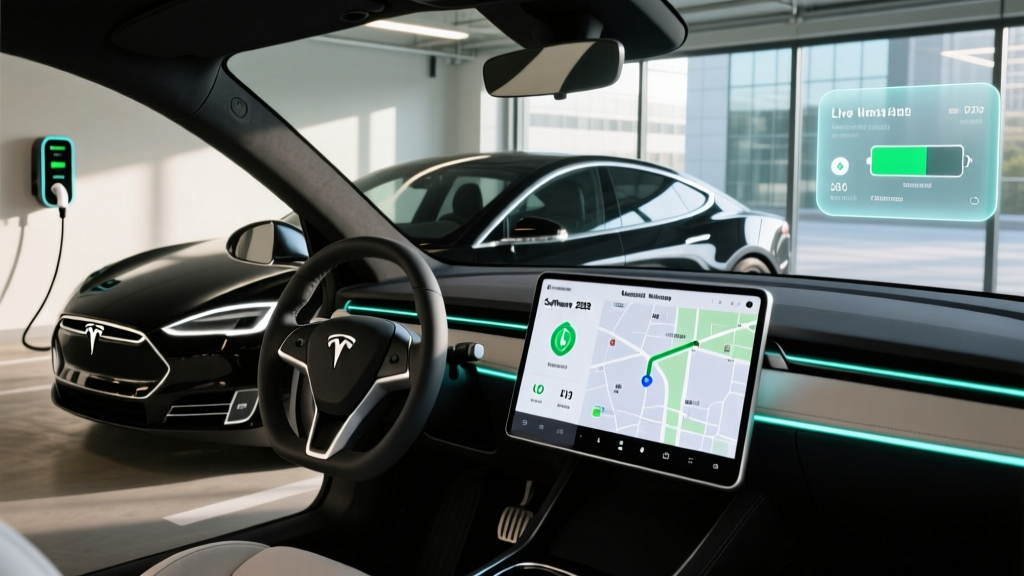
- User interface updates: Redesigned navigation with real-time Supercharger stall availability prediction, improved trip planner with more accurate arrival SoC estimates, and enhanced dashcam viewer with multi-camera timeline scrubbing.
- Climate control improvements: More aggressive heat pump utilization in moderate cold (30-45°F), reducing cabin heating energy draw by up to 8% compared to the previous software version.
How Software Updates Affect Range and Efficiency
EPA Estimated Range (2026 Model Y Long Range): 330 miles
Real-World Expectation: 270-290 miles highway (70-75 mph), 240-260 miles in cold weather (below 32°F), 300+ miles city driving with regenerative braking.
Software updates can marginally improve or degrade range depending on how they alter energy management. The 2026 Tesla software version's thermal management refinements translate to roughly 5-10 additional miles of real-world range in cold conditions compared to the 2025 software baseline. However, EPA ratings remain unchanged because the test cycle doesn't capture these edge-case improvements.
For Model 3 Long Range owners (EPA 358 miles), the latest software version's improved regenerative braking blending provides slightly smoother deceleration but no measurable range gain. The real benefit is reduced brake wear in stop-and-go traffic.
Charging Performance: What the Latest Software Changes
| Charging Level | Peak Power | Charging Speed | 10-80% Time |
|---|---|---|---|
| Level 1 (120V) | 1.4 kW | 3-5 miles/hour | N/A (overnight) |
| Level 2 (240V, 48A) | 11.5 kW | 44 miles/hour | 7-8 hours |
| DC Fast Charge (V3 Supercharger) | 250 kW | ~170 miles in 15 min | ~25-28 minutes |
| DC Fast Charge (V4 Supercharger) | 350 kW (4680 cells) | ~200 miles in 15 min | ~18-22 minutes |
The 2026 software version's BMS refinements primarily benefit vehicles with 4680-format cells (Model Y Austin-built, Cybertruck). These vehicles see a modest extension of the peak charging window — the BMS now holds peak kW slightly longer before tapering, shaving 1-2 minutes off 10-80% times under optimal thermal conditions. For older 2170-cell vehicles (Model 3, Model Y Fremont), charging curves remain unchanged.
Preconditioning logic is now more aggressive when navigating to a Supercharger. The vehicle begins heating the battery earlier and more precisely, arriving at the charger closer to the optimal temperature for peak charging speed. This is particularly noticeable in temperatures below 50°F.
FSD Supervised: Current Capabilities and Limitations
SAE Automation Level: Level 2 (Partial Automation)
The driver must remain engaged, monitor the driving environment, and be prepared to take over immediately. This is not a self-driving system.
Full Self-Driving (FSD) Supervised remains Tesla's most controversial and discussed feature. The 2026 software version continues Tesla's end-to-end neural network approach, which replaced the older rules-based code in late 2024. Real-world improvements include:
- Reduced intervention frequency: Tesla reports average miles between disengagements has improved, though independent testing shows significant variability based on road type, weather, and traffic density.
- Smoother urban driving: The system handles unprotected left turns and roundabouts with less hesitation than the 2025 version.
- Better construction zone handling: Cone detection and temporary lane line interpretation have improved, though complex work zones still require frequent takeovers.
FSD Supervised Limitations:
- Requires constant driver attention and hands-on-wheel (or torque-based monitoring)
- Performance degrades significantly in heavy rain, snow, or fog
- Struggles with unmapped roads, private driveways, and parking garages
- Not approved for hands-off or eyes-off driving in any US jurisdiction
- Insurance liability remains with the driver, not Tesla
FSD Supervised costs $8,000 as a one-time purchase or $99/month as of 2026. Whether it's worth the premium depends heavily on your commute complexity and tolerance for beta software. For highway-heavy commutes, basic Autopilot (included with all Teslas) handles lane centering and adaptive cruise control adequately. FSD's value proposition is strongest for urban drivers who frequently navigate complex intersections and parking scenarios.
Pricing, Tax Credits, and Value in 2026
| Model | Base MSRP | Federal Tax Credit (§30D) | Effective Price |
|---|---|---|---|
| Model 3 RWD | $38,990 | $7,500 (if eligible) | $31,490 |
| Model 3 Long Range AWD | $45,990 | $7,500 (if eligible) | $38,490 |
| Model Y Long Range AWD | $47,990 | $7,500 (if eligible) | $40,490 |
| Model Y Performance | $52,990 | $7,500 (if eligible) | $45,490 |
| Cybertruck AWD | $79,990 | $7,500 (if eligible) | $72,490 |
IRS §30D Tax Credit Eligibility Requirements (2026):
- Income caps: Modified adjusted gross income (MAGI) must not exceed $150,000 (single), $225,000 (head of household), or $300,000 (joint filers).
- MSRP caps: Vans, SUVs, and pickups must be under $80,000; sedans and other vehicles under $55,000.
- Battery sourcing: Increasing percentages of battery components and critical minerals must be sourced from the US or free-trade-agreement countries. Tesla's US-built vehicles generally meet these requirements, but verify current eligibility on IRS.gov before purchase.
- Point-of-sale transfer: As of 2024, buyers can transfer the credit to the dealer at purchase, reducing the upfront cost rather than waiting for tax filing.
All current Tesla models (Model 3, Model Y, Cybertruck) are assembled in the US and generally qualify for the full $7,500 credit, assuming the buyer meets income requirements and the vehicle MSRP is under the cap. The Model 3 Performance ($54,990) falls just under the $55,000 sedan cap, but options or price increases could push it over — always confirm the final MSRP before relying on credit eligibility.
Competitive Comparison: Tesla vs. Key Rivals
The latest Tesla software version maintains Tesla's lead in OTA update frequency and scope, but competitors have narrowed the gap:
- Hyundai Ioniq 5: Receives 2-3 major OTA updates per year, focused on infotainment and ADAS tuning. Lacks the scope of Tesla's powertrain and thermal management updates.
- Ford Mustang Mach-E: Ford's OTA capability improved significantly with BlueCruise updates, but still requires dealership visits for some firmware changes.
- Rivian R1T/R1S: Robust OTA platform with frequent updates, comparable to Tesla in scope. Rivian's software team delivers meaningful feature additions quarterly.
- BMW i4/iX: Limited OTA capability; most updates still require dealer service appointments.
Tesla's software advantage isn't just update frequency — it's the depth of vehicle integration. A Tesla software update can alter suspension damping (on equipped models), change regenerative braking behavior, optimize heat pump operation, and retrain the entire FSD neural network. Most competitors limit OTA to infotainment and basic ADAS calibration.
Who Should Buy a Tesla in 2026?
Choose Tesla if:
- You value continuous software improvements and OTA updates
- You have reliable home charging access (Level 2 strongly recommended)
- You frequently road-trip and want access to the Supercharger network (though it's now open to other brands via NACS adapters)
- You're interested in FSD Supervised and accept its beta nature and supervision requirements
- You want the most energy-efficient vehicles in their respective segments
Consider competitors if:
- You prefer traditional dealership service and support
- You need physical buttons and knobs for climate/audio controls
- You want more interior material variety and customization
- You're uncomfortable with Tesla's camera-only vision approach (no lidar or radar)
- You prioritize proven ADAS systems over cutting-edge but evolving ones
Frequently Asked Questions
How often does Tesla release software updates?
Tesla typically releases major software versions every 2-3 months, with minor patches and bug fixes rolling out more frequently. Not all vehicles receive updates simultaneously — Tesla staggers rollouts, and newer vehicles often get updates first.
Can I downgrade to a previous Tesla software version?
No. Tesla does not allow users to roll back to previous software versions. Once an update is installed, it's permanent. This is why Tesla recommends reviewing release notes before installing, though critical security and safety updates may install automatically.
Does the latest Tesla software version improve range?
Marginally, in specific conditions. The 2026 software version's thermal management refinements can add 5-10 miles in cold weather, but EPA ratings remain unchanged. Don't expect dramatic range gains from software alone — battery chemistry and physics dominate.
Is FSD Supervised worth $8,000 in 2026?
For most buyers, no. Basic Autopilot handles highway driving well, and FSD's urban performance, while improved, still requires frequent interventions. The $99/month subscription is a lower-risk way to test FSD on your typical routes before committing to a purchase. Consider FSD only if you drive in complex urban environments daily and accept the supervision burden.
Do Tesla software updates require Wi-Fi?
Yes, for most updates. Tesla vehicles use cellular connectivity for small patches and map data, but major software version updates require Wi-Fi to download the multi-gigabyte packages. Plan to connect your vehicle to home Wi-Fi regularly, or use a mobile hotspot during installation.
Will older Tesla models receive the 2026 software version?
Most Tesla vehicles from 2018 onward (with Hardware 3 or newer) receive current software updates. However, some features — particularly FSD neural network improvements — require Hardware 4 (introduced in 2023). Older vehicles may receive a subset of the latest software version's features.