The Software-Defined EV: Why Tesla Updates Matter More Than You Think
Unlike legacy automakers that lock in a vehicle's capabilities at the factory, Tesla treats its cars as rolling software platforms. A 2024 Model 3 Long Range purchased two years ago may perform, charge, and interface differently today thanks to over-the-air (OTA) updates. For 2026, Tesla's software update features span efficiency tweaks, FSD (Supervised) refinements, new infotainment capabilities, and charging-curve optimizations that can meaningfully alter the ownership experience. This review examines what the latest Tesla software update features mean for current and prospective owners across the Model 3, Model Y, Model S, and Model X lineup — grounded in hard specs, real-world data, and IRS tax-credit rules.
2026 Tesla Lineup: Specs at a Glance
Before diving into software changes, here are the baseline hardware specifications for the current 2026 Tesla lineup. These figures reflect the latest EPA data and manufacturer specifications as of early 2026.
| Spec | Model 3 LR AWD | Model Y LR AWD | Model S LR | Model X LR |
|---|---|---|---|---|
| EPA Range | 363 mi | 320 mi | 402 mi | 335 mi |
| Battery (usable) | ~75 kWh (LFP option / NMC) | ~75 kWh (NMC) | ~95 kWh (NMC) | ~95 kWh (NMC) |
| Drivetrain | Dual-Motor AWD | Dual-Motor AWD | Dual-Motor AWD | Dual-Motor AWD |
| Horsepower | ~346 hp | ~384 hp | ~670 hp | ~670 hp |
| 0–60 mph | 4.2 sec | 4.8 sec | 3.1 sec | 3.8 sec |
| Peak DC Fast Charge | 250 kW | 250 kW | 250 kW | 250 kW |
| 10–80% DC Time | ~25 min | ~27 min | ~30 min | ~32 min |
| Level 2 Home Rate | 11.5 kW (~44 mi/hr) | 11.5 kW (~44 mi/hr) | 11.5 kW (~34 mi/hr) | 11.5 kW (~34 mi/hr) |
| MPGe (combined) | 132 MPGe | 122 MPGe | 120 MPGe | 102 MPGe |
| Cargo (rear seats up) | 23 cu ft | 30 cu ft | 28 cu ft | ~88 cu ft (folded) |
| Base MSRP | $47,740 | $48,990 | $79,990 | $84,990 |
Sources: fueleconomy.gov, Tesla.com specifications (2026 model year). RWD Model 3 starts at $38,990 with ~363 mi EPA on LFP battery.
Real-World Range: What the EPA Sticker Doesn't Tell You
EPA vs. Reality: The Model 3 Long Range AWD carries a 363-mile EPA estimate. In real-world highway driving at 70–75 mph, expect ~290–310 miles. In sub-freezing winter conditions (20–30°F), range can drop to ~240–270 miles due to cabin heating demand and increased battery resistance. City driving with regenerative braking recovers closer to the EPA number, often reaching 330–350 miles in mild weather.
Tesla's 2026 software updates have introduced more aggressive thermal preconditioning routines. When navigation routes to a Supercharger, the battery management system (BMS) now begins heating or cooling the pack earlier and more precisely, reducing the efficiency penalty of cold-soak charging. Owners in northern climates report marginally better winter range retention compared to pre-2025 software builds — typically 5–8% improvement in cold-weather energy consumption, attributable to optimized heat-pump cycling logic.
For the Model Y Long Range, the 320-mile EPA figure translates to roughly 260–280 miles highway and 220–250 miles in deep cold. The larger-battery Model S (402 mi EPA) and Model X (335 mi EPA) suffer less percentage loss in cold weather due to their greater thermal mass, but absolute losses remain significant on long winter road trips.
Charging Speed and the Software-Curve Advantage
| Charging Level | Power | Model 3/Y Speed | Model S/X Speed | Notes |
|---|---|---|---|---|
| Level 1 (120V) | ~1.4 kW | ~3–5 mi/hr | ~3–4 mi/hr | Emergency/trickle only |
| Level 2 (240V home) | 11.5 kW | ~44 mi/hr | ~34 mi/hr | Full charge overnight |
| DC Fast (V3 Supercharger) | Up to 250 kW | 10–80% in ~25 min | 10–80% in ~30 min | Peak rate tapers above 55% |
| DC Fast (V4 Supercharger) | Up to 250+ kW | Similar or slightly faster | Similar | Rolling out at select corridors |
Tesla's 2026 software updates have refined the DC fast-charge curve. While peak power remains at 250 kW on V3 Superchargers, the sustained power delivery between 30–60% State of Charge (SoC) has improved. Earlier software builds saw a sharp taper from 250 kW down to ~150 kW around 50% SoC; current builds sustain closer to 180–200 kW through the 55% mark before tapering. This translates to shaving roughly 2–3 minutes off a 10–80% session in ideal thermal conditions.
One critical nuance: kW is power (charge rate), kWh is energy (battery capacity). A 75 kWh battery charging at 250 kW peak does not sustain that rate — the charge curve tapers as the battery fills, protecting cell longevity. Tesla's software manages this curve, and recent updates have optimized it without accelerating long-term degradation.
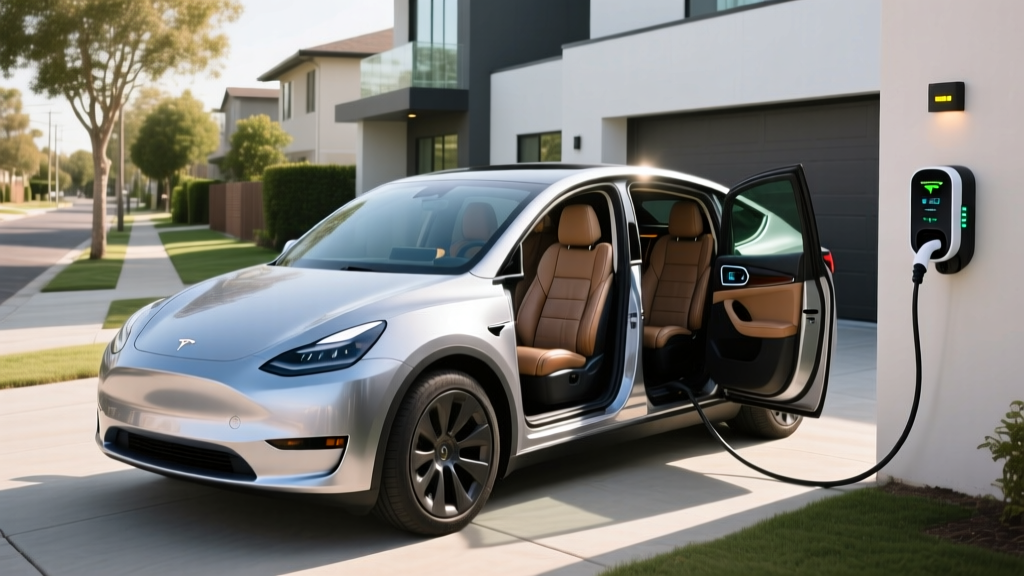
For home Level 2 charging, Tesla recommends a Wall Connector installed on a 60-amp circuit (48-amp continuous draw). Installation typically costs $800–$2,000 depending on panel proximity and whether a 200-amp panel upgrade is needed. A full Level 2 charge from 10–100% on a Model 3 takes roughly 7–8 hours — easily accomplished overnight.
FSD (Supervised) and ADAS: What 2026 Updates Actually Changed
SAE Level 2 — Not Self-Driving: Tesla's Autopilot and Full Self-Driving (Supervised) remain SAE Level 2 driver-assistance systems. The driver must remain attentive, hands on or near the wheel, and ready to intervene at all times. Tesla's FSD is not Level 4 autonomous — no consumer Tesla vehicle can drive itself without supervision. Only dedicated robotaxi services like Waymo operate at Level 4 in geofenced areas.
The most discussed Tesla software update features in 2026 center on FSD (Supervised). Tesla's shift to an end-to-end neural network architecture (first introduced in v12.x and refined through 2025–2026 builds) has replaced much of the hand-coded rules engine with learned driving behavior. Key changes in current FSD builds include:
- Smoother urban navigation: Fewer hard braking events and hesitation at unprotected left turns compared to 2024 builds.
- Improved construction-zone handling: Better cone and lane-merge recognition, though still imperfect in complex multi-lane work zones.
- Cabin camera monitoring refinement: The driver-monitoring system now issues fewer false inattention warnings while maintaining genuine engagement checks.
- Smart Summon improvements: Low-speed parking-lot navigation is more reliable, though still limited to private property and low-speed environments.
What FSD (Supervised) Does NOT Do: It does not drive autonomously without supervision. It does not handle all weather conditions (heavy rain, snow, fog degrade performance). It does not replace insurance liability — the driver remains responsible. It does not work identically in all regions; performance varies by road-marking quality and mapping coverage.
Standard Autopilot (included on all Teslas) continues to provide competent highway lane-centering and adaptive cruise control — among the best in the industry for SAE Level 2 systems, though GM's Super Cruise and Ford's BlueCruise offer hands-free operation on mapped highways (a feature Tesla still does not permit in the US).
Infotainment, UI, and Quality-of-Life Software Features
Beyond driving dynamics, Tesla's 2026 software updates have delivered meaningful infotainment and convenience improvements:
- Adaptive high-beams: Now standard via software on vehicles with the HW4 camera suite; the system dims individual LED segments around oncoming traffic.
- Improved dashcam and Sentry Mode: More efficient storage management and clip-saving logic reduce the frequency of overwritten footage.
- Streaming and gaming: Expanded app ecosystem with better integration for YouTube, Netflix, and Steam-based games while parked. The Model S/X rear screen now supports independent streaming for passengers.
- Trip planner refinements: Supercharger routing now factors in real-time stall availability more accurately and suggests alternative chargers when a station is congested.
- Voice commands: Expanded natural-language processing for climate, navigation, and media requests — still not class-leading versus Apple CarPlay ecosystems (which Tesla does not support), but meaningfully improved.
A notable drawback: Tesla still does not offer Apple CarPlay or Android Auto. For buyers deeply embedded in those ecosystems, this remains a friction point. Tesla's native navigation and media apps have improved, but the closed ecosystem is a deliberate choice that not all buyers prefer.
Pricing, Tax Credits, and Total Cost
| Model / Trim | Base MSRP | §30D Credit Potential | Effective Price | MSRP Cap Status |
|---|---|---|---|---|
| Model 3 RWD | $38,990 | Up to $7,500 | ~$31,490 | Under $55k cap ✓ |
| Model 3 LR AWD | $47,740 | Up to $7,500 | ~$40,240 | Under $55k cap ✓ |
| Model Y LR AWD | $48,990 | Up to $7,500 | ~$41,490 | Under $80k cap ✓ |
| Model Y Performance | $52,490 | Up to $7,500 | ~$44,990 | Under $80k cap ✓ |
| Model S LR | $79,990 | $0 (over cap) | $79,990 | Over $55k sedan cap ✗ |
| Model X LR | $84,990 | $0 (over cap) | $84,990 | Over $80k SUV cap ✗ |
Federal tax credit rules (IRS §30D, 2026): The $7,500 credit is available as a point-of-sale rebate, but eligibility depends on multiple factors:
- MSRP caps: Sedans (Model 3) must be under $55,000; SUVs/trucks (Model Y) under $80,000.
- Buyer income limits: Modified AGI ≤ $150,000 (single), ≤ $225,000 (head of household), ≤ $300,000 (joint).
- Battery sourcing: Critical minerals and battery components must meet phased-in percentages from US/FTA partners. Tesla's US-built LFP and NMC packs have largely met these thresholds for 2026, but exact eligibility can vary by build week and supply chain. Always verify at irs.gov or with your tax professional.
- Point-of-sale transfer: Buyers can transfer the credit to the dealer at purchase, reducing the upfront price rather than waiting for a tax refund.
The Model 3 RWD at ~$31,490 after the credit is one of the most affordable long-range EVs in the US market. The Model S and X, however, receive no federal credit due to MSRP caps — a significant factor for buyers cross-shopping against the Lucid Air or BMW iX.
Pros and Cons: The Honest Assessment
Pros
- Best-in-class Supercharger network reliability (17,000+ US stalls)
- Continuous OTA software improvements add value post-purchase
- Industry-leading efficiency (Model 3 at 132 MPGe combined)
- Strong resale value relative to non-Tesla EVs
- FSD (Supervised) neural-net architecture is measurably smoother in 2026
- Model 3 RWD at ~$31,490 after credit is exceptional value
Cons
- No Apple CarPlay / Android Auto support
- Model S/X ineligible for federal tax credit
- Build quality inconsistencies still reported (panel gaps, trim)
- FSD costs $8,000 extra or $99/mo — a significant upsell
- Insurance premiums 15–30% higher than comparable non-Tesla vehicles
- Service center wait times can stretch weeks in some metro areas
Who Should Buy a Tesla in 2026?
Choose a Tesla if: You prioritize charging-network reliability, want continuous software improvements, value efficiency and range per dollar, and are comfortable with a touchscreen-centric interface. The Model 3 RWD is ideal for budget-conscious commuters; the Model Y serves families needing cargo space; the Model S suits performance-oriented buyers who don't need the credit.
Look elsewhere if: You need Apple CarPlay, want hands-free highway driving (GM Super Cruise/Ford BlueCruise), prefer traditional dealership service, or need a vehicle eligible for the full tax credit above $55k sedan / $80k SUV price points.
Warranty coverage: All 2026 Teslas include a 4-year/50,000-mile basic warranty and an 8-year/100,000-mile battery and drive unit warranty (Model 3/Y) or 8-year/150,000-mile (Model S/X). Tesla guarantees the battery will retain at least 70% of its original capacity during the warranty period. Real-world degradation data from fleet sources suggests most Tesla NMC packs retain 88–92% capacity at 100,000 miles, with LFP packs showing even slower degradation curves.
Frequently Asked Questions
What is the real-world range of the 2026 Tesla Model 3 Long Range?
The EPA rates it at 363 miles. Real-world highway driving yields approximately 290–310 miles in mild weather and 240–270 miles in sub-freezing conditions. City driving with regenerative braking can approach 330–350 miles.
How fast does a Tesla charge at home and on the road?
On a home Level 2 charger (11.5 kW), expect roughly 44 miles of range per hour on the Model 3/Y — a full overnight charge. At a V3 Supercharger (250 kW peak), 10–80% takes approximately 25 minutes for the Model 3, with the charge curve tapering noticeably above 55% SoC.
Does the Tesla Model 3 qualify for the federal EV tax credit?
Yes — the Model 3 RWD ($38,990) and Model 3 Long Range ($47,740) are under the $55,000 sedan MSRP cap. Eligibility also depends on buyer income (≤$150k single / ≤$300k joint) and battery-sourcing compliance. The credit can be applied at point of sale. Verify current eligibility at irs.gov.
Is Tesla's FSD worth the $8,000 cost?
For most drivers, standard Autopilot (included) handles highway driving competently. FSD (Supervised) adds urban navigation capability that has improved significantly with the 2026 neural-net builds, but it remains SAE Level 2 — you must supervise at all times. The $99/month subscription is a lower-risk way to evaluate it before committing to the full purchase.
Is a Tesla worth buying vs. competitors like the Hyundai Ioniq 5 or BMW i4?
The Model 3/Y win on Supercharger network access, efficiency, and software-update cadence. The Ioniq 5 offers faster 800V charging architecture (~18 min 10–80%), CarPlay support, and a more conventional interior. The BMW i4 appeals to buyers wanting a luxury-badge driving experience. Cross-shop based on your priorities: network reliability and software (Tesla), charging speed and CarPlay (Hyundai), or driving dynamics and brand prestige (BMW).
How often does Tesla push software updates?
Tesla typically releases major software versions every 2–4 months, with minor patches in between. Vehicles connected to Wi-Fi receive updates faster than those relying on cellular. In 2026, Tesla has pushed approximately 4–5 significant updates, each containing a mix of driving, UI, and efficiency improvements.