If you've scrolled through Tesla owner forums or watched EV YouTube deep-dives, you've probably encountered the term Tesla Sloth Mode. It sounds like a joke — and in some ways, it started as one — but understanding what it actually does (and which Tesla models and software versions support it) matters for owners who want to squeeze every bit of customization out of their vehicle's drive settings.
This guide explains exactly what Sloth Mode is, how it interacts with Tesla's acceleration and drive profiles, and pairs that knowledge with a complete 2026 spec breakdown of the Tesla models where you're most likely to encounter it. Whether you're shopping for a Model 3, Model Y, or Cybertruck, you'll leave with the numbers you need to make a purchase decision.
What Is Tesla Sloth Mode?
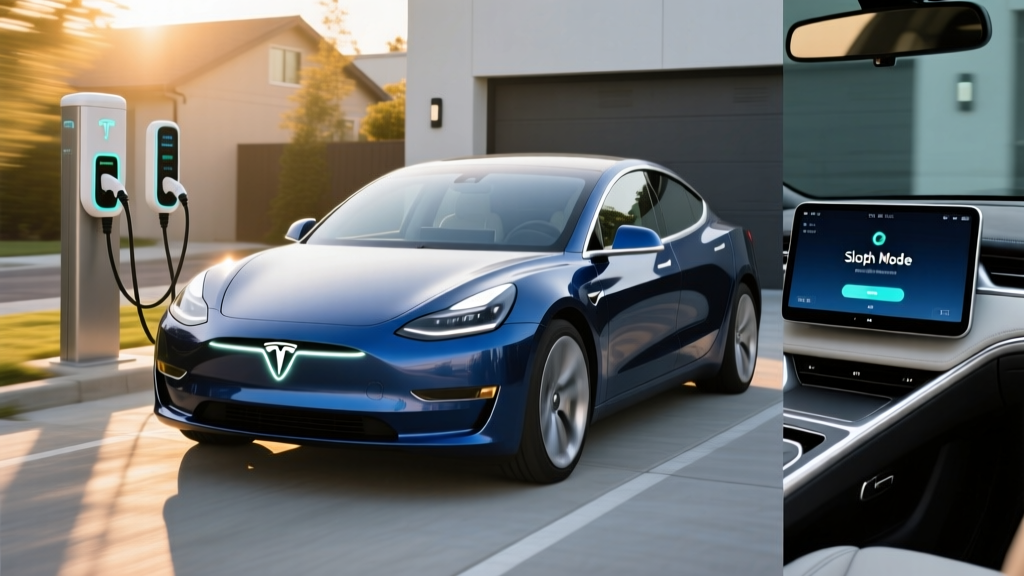
"Sloth Mode" is an unofficial, community-coined term referring to the lowest acceleration setting available in certain Tesla vehicles — specifically the "Chill" acceleration profile dialed to its most conservative throttle mapping. In some software builds, Tesla engineers included hidden or Easter-egg acceleration curves that further dampen throttle response beyond standard Chill, and owners dubbed this "Sloth Mode."
In practical terms, engaging the most conservative acceleration profile does the following:
- Limits peak torque delivery from the electric motors, making initial acceleration gentler.
- Softens throttle pedal sensitivity, so pressing the pedal halfway yields far less power than in Sport or Standard modes.
- Can marginally improve efficiency in stop-and-go city driving by preventing aggressive acceleration spikes that waste energy.
- Reduces wheelspin on low-traction surfaces like wet roads, snow, or gravel.
Tesla has never officially branded any setting "Sloth Mode" in release notes or the owner's manual. The name emerged organically from owners noticing that Chill mode in certain over-the-air (OTA) updates felt even more subdued than before. Some firmware versions introduced intermediate steps between Chill and Standard that the community labeled with humorous names like Sloth, Turtle, and Cheetah (the last being a reference to Tesla's actual maximum-acceleration unlock).
2026 Tesla Model 3: Range, Charging, and Performance Specs
The Model 3 remains Tesla's volume sedan and the model where most owners first experiment with acceleration profiles. Here are the 2026 specs for the most popular trims:
| Spec | Long Range RWD | Long Range AWD | Performance |
|---|---|---|---|
| EPA Range | 363 mi | 341 mi | 315 mi |
| Battery (usable) | 79 kWh (NMC) | 79 kWh (NMC) | 79 kWh (NMC) |
| MPGe (combined) | 132 MPGe | 125 MPGe | 118 MPGe |
| kWh/100 mi | 25 | 27 | 29 |
| 0-60 mph | 5.8 sec | 4.2 sec | 2.9 sec |
| Horsepower | 346 hp | 440 hp | 510 hp |
| Drivetrain | RWD | Dual-Motor AWD | Dual-Motor AWD |
| Peak DC Charge | 250 kW | 250 kW | 250 kW |
| 10-80% DC Time | ~25 min | ~25 min | ~25 min |
| Level 2 (11.5 kW) | ~44 mi/hr | ~44 mi/hr | ~44 mi/hr |
| Base MSRP | $44,130 | $49,130 | $55,130 |
| Cargo (trunk + frunk) | 23 cu ft | 23 cu ft | 23 cu ft |
| Rear Legroom | 35.2 in | 35.2 in | 35.2 in |
| Battery Warranty | 8 yr / 120,000 mi | 8 yr / 120,000 mi | 8 yr / 120,000 mi |
According to fueleconomy.gov, the Model 3 Long Range remains one of the most efficient EVs in its class, and the Chill acceleration profile (what owners call Sloth Mode) can improve real-world city efficiency by 3–5% by smoothing out throttle inputs.
2026 Tesla Model Y: The Family SUV Breakdown
The Model Y is the best-selling EV in the U.S. and the vehicle most likely to be shared among multiple drivers — making its acceleration profiles especially relevant.
| Spec | Long Range RWD | Long Range AWD | Performance |
|---|---|---|---|
| EPA Range | 320 mi | 308 mi | 285 mi |
| Battery (usable) | 79 kWh (NMC) | 79 kWh (NMC) | 79 kWh (NMC) |
| MPGe (combined) | 123 MPGe | 119 MPGe | 111 MPGe |
| 0-60 mph | 6.5 sec | 4.8 sec | 3.5 sec |
| Horsepower | 346 hp | 440 hp | 510 hp |
| Peak DC Charge | 250 kW | 250 kW | 250 kW |
| 10-80% DC Time | ~27 min | ~27 min | ~27 min |
| Base MSRP | $46,380 | $49,380 | $54,380 |
| Cargo (behind 2nd row) | 30 cu ft | 30 cu ft | 30 cu ft |
| Cargo (seats folded) | 72 cu ft | 72 cu ft | 72 cu ft |
| Rear Legroom | 36.5 in | 36.5 in | 36.5 in |
| Battery Warranty | 8 yr / 120,000 mi | 8 yr / 120,000 mi | 8 yr / 120,000 mi |
The Model Y's higher curb weight means Chill/Sloth acceleration profiles are particularly useful in winter conditions. Limiting torque to the wheels reduces the chance of traction-control intervention on icy on-ramps.
Charging Speed and Infrastructure: What You Need to Know
Tesla's Supercharger network remains the gold standard for DC fast charging reliability. Here's what charging looks like across all current Tesla models using the NACS (North American Charging Standard) connector:
| Charging Level | Power | Rate / Time | Typical Use Case |
|---|---|---|---|
| Level 1 (120V) | ~1.4 kW | ~3-5 mi/hr | Emergency / trickle top-up |
| Level 2 (240V, 48A) | 11.5 kW | ~44 mi/hr | Overnight home charging |
| DC Fast (Supercharger V3) | Up to 250 kW | 10-80% in ~25 min | Road trips, highway corridors |
| DC Fast (Supercharger V4) | Up to 350 kW* | 10-80% in ~18 min* | Next-gen stations (limited rollout) |
*V4 Supercharger 350 kW capability depends on vehicle architecture. Current Model 3/Y peak at 250 kW even on V4 posts; Cybertruck's 800V-class architecture can leverage higher rates.
At a V3 Supercharger, the charge curve peaks at 250 kW up to roughly 40% State of Charge (SoC), then tapers. From 60-80%, you'll see rates drop to 60-90 kW. This is why the 10-80% metric matters more than peak kW — it captures the taper that every EV experiences.
For home charging, Tesla's Wall Connector at $420 (hardwired, 48A) delivers the full 11.5 kW that the onboard charger supports. A full overnight session from 20% to 80% takes roughly 4-5 hours, which covers any daily driving need.
Federal Tax Credit Eligibility (IRS §30D) for 2026 Teslas
The federal EV tax credit under IRS §30D remains complex. Here's how it applies to Tesla's 2026 lineup:
| Model | MSRP Cap Met? | Battery Sourcing | Max Credit | Point-of-Sale Transfer? |
|---|---|---|---|---|
| Model 3 RWD | Yes (under $55K sedan cap) | Partial — varies by batch | $3,750–$7,500 | Yes |
| Model 3 Long Range | Yes (under $55K) | Partial — varies | $3,750–$7,500 | Yes |
| Model Y LR AWD | Yes (under $80K SUV cap) | Partial — varies | $3,750–$7,500 | Yes |
| Cybertruck | Yes (under $80K truck cap) | Limited qualification | $3,750 (partial) | Yes |
Critical caveats:
- Income caps apply: Modified adjusted gross income must not exceed $150K (single), $225K (head of household), or $300K (joint).
- Battery sourcing rules tighten annually. The critical-minerals and battery-component requirements under the Inflation Reduction Act phase in stricter percentages each year. A Model 3 built in January 2026 may qualify differently than one built in June 2026.
- Point-of-sale transfer is available — meaning the dealer (Tesla direct) can apply the credit as a down-payment reduction at purchase rather than waiting for tax filing.
- Always verify current eligibility on the IRS clean vehicle credit page and Tesla's own checkout flow before committing.
Driver Assistance: Autopilot and FSD (Supervised)
Current Tesla driver-assist features include:
- Basic Autopilot (included): Traffic-Aware Cruise Control and Autosteer on marked highways.
- Enhanced Autopilot ($6,000): Adds Navigate on Autopilot, Auto Lane Change, Autopark, and Summon.
- FSD (Supervised) ($8,000 or $99/mo): Adds traffic light and stop sign recognition, city street Autosteer. Requires constant supervision.
The relationship to Sloth Mode: when Chill acceleration is active, both Autopilot and FSD (Supervised) adjust their acceleration behavior to match. Lane changes and merges become more conservative, which some owners find more comfortable for passengers.
Who Should Buy a Tesla — And Who Should Look Elsewhere
- You want access to the Supercharger network — still the most reliable DC fast-charging ecosystem in the U.S.
- You value frequent OTA software updates that add features post-purchase.
- You want the most conservative acceleration profiles (like Sloth/Chill) for shared driving or winter conditions.
- You prioritize efficiency (kWh/100 mi) in the sedan segment.
- You need a traditional instrument cluster or HUD (Tesla uses a single center screen for everything).
- You want Apple CarPlay / Android Auto (not supported on Tesla).
- You prefer physical buttons and stalks — the refreshed Model 3/Y moved turn signals to the steering wheel and gear selection to the screen.
- You need a third row — the Model Y's optional third row is extremely tight; consider the Rivian R1S or Kia EV9 instead.
Pros and Cons at a Glance
- Best-in-class efficiency (25 kWh/100 mi on Model 3 LR RWD)
- Supercharger network reliability
- Granular acceleration profiles including ultra-conservative Chill/Sloth
- Strong over-the-air update cadence
- Competitive 0-60 across all trims
- Point-of-sale tax credit transfer
- No Apple CarPlay or Android Auto
- Screen-only controls frustrate some drivers
- Turn-signal buttons on steering wheel take adaptation
- FSD (Supervised) requires $8K+ and still demands full attention
- Insurance premiums run 15-25% above segment average
- Battery sourcing rules may limit tax credit to $3,750 on some builds
Frequently Asked Questions
Is Tesla Sloth Mode an official feature?
No. "Sloth Mode" is a community nickname for the most conservative end of Tesla's Chill acceleration profile. Tesla does not use this term in any official documentation or release notes. However, the underlying throttle-mapping behavior is real and measurable.
Does Sloth Mode actually save range?
Marginally. By reducing aggressive acceleration events, Chill/Sloth can improve city efficiency by roughly 3-5%. On the highway at steady speeds, the difference is negligible since cruising draw is dominated by aerodynamic drag, not throttle mapping.
Can I enable Sloth Mode on any Tesla?
The Chill acceleration setting is available on most Model 3, Model Y, Model S, Model X, and Cybertruck vehicles running recent firmware. The degree of throttle dampening varies by software version and model. Performance trims include Chill as a configurable option; non-Performance trims may have it as the default or only acceleration mode.
What is the real-world range of the 2026 Tesla Model 3 Long Range?
EPA-rated at 363 miles, but expect 290-315 miles on sustained highway driving at 70-80 mph, and 250-290 miles in sub-freezing weather with cabin heating. Preconditioning while plugged in recovers some of this loss.
How fast does a 2026 Tesla charge at home?
Using a Tesla Wall Connector (hardwired, 48A, 240V), you'll get approximately 11.5 kW or about 44 miles of range per hour of charging. A 20-80% session takes roughly 4-5 hours overnight.
Does the 2026 Model Y qualify for the full $7,500 federal tax credit?
It depends on the specific vehicle's battery component and critical-mineral sourcing at time of manufacture, plus your income eligibility. Some Model Y builds qualify for the full $7,500; others qualify for $3,750. Verify at purchase via Tesla's checkout and the IRS clean vehicle credit page.
Is Tesla Autopilot self-driving?
No. Autopilot and FSD (Supervised) are SAE Level 2 systems requiring constant driver attention. They assist with steering, acceleration, and braking but do not replace the driver.