Love it or hate it, the Tesla shifter — or more accurately, the absence of a traditional gear lever — is one of the most talked-about design decisions in modern electric vehicles. Since the launch of the refreshed Model 3 "Highland" in late 2023 and carried forward into the 2025+ Model Y "Juniper" refresh, Tesla has eliminated the physical column-mounted shift stalk entirely, replacing it with a touchscreen-based gear selector supplemented by a roof console and backup buttons. For shoppers researching the "Tesla shifter" before buying, the questions are predictable: Is it safe? Is it intuitive? Does it slow you down in a three-point turn? And what does it mean for the overall ownership experience?
This guide dissects exactly how the Tesla screen-based gear selector works, why Tesla made the change, what backup systems exist, and how it factors into the broader ownership equation — including the full 2026 Model 3 and Model Y specs, range, charging, pricing, and tax-credit eligibility you need before signing a purchase agreement.
What Is the Tesla Shifter, Exactly?
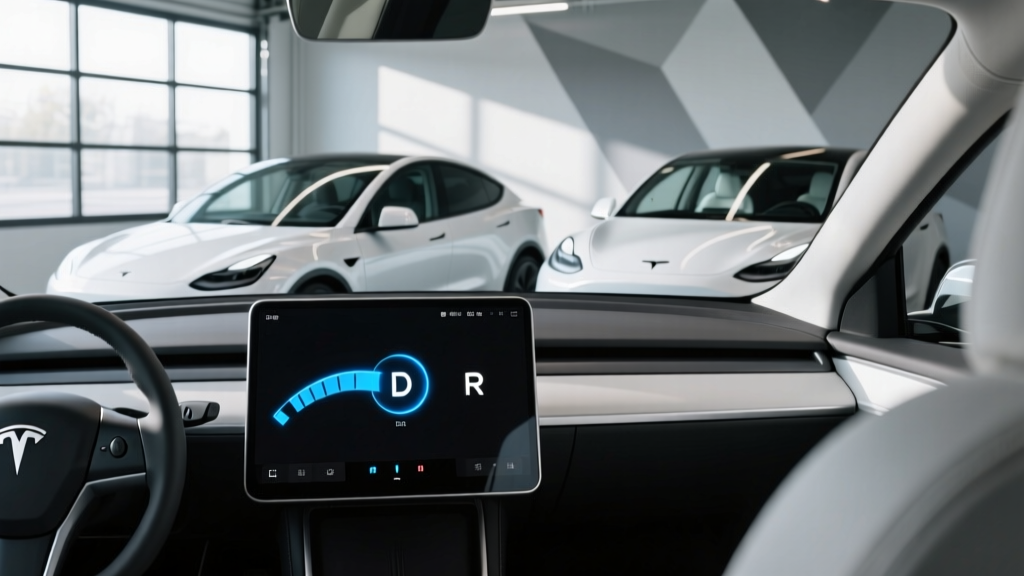
On pre-2024 Tesla vehicles, gear selection was handled by a physical stalk on the right side of the steering column — push down for Drive, push up for Reverse, press the end button for Park. That stalk is gone on the current Model 3 (since the 2024 refresh) and the current Model Y (since the 2025 Juniper refresh). In its place, Tesla uses a three-layer gear-selection system:
- Primary: Touchscreen swipe selector. On the left edge of the central 15.4-inch display, a thin vertical bar shows P, R, N, D icons. Swipe up for Drive, swipe down for Reverse, tap P for Park.
- Secondary: Roof console buttons. Above the rearview mirror, a small overhead console houses physical P, R, N, D buttons — primarily intended as a backup and for passengers.
- Automatic Park logic. The vehicle defaults to Park when you unbuckle, open the door, or walk away with the key/phone. Auto-Shift out of Park (part of the FSD Supervised suite) can also select D or R based on surroundings when enabled.
This approach aligns with Tesla's broader interior-minimalism philosophy — removing physical controls to reduce parts count, cost, and visual clutter. Whether you find it elegant or infuriating depends largely on how quickly you build the muscle memory, which for most drivers takes roughly 30 to 90 minutes of cumulative driving time.
2026 Tesla Model 3: Full Specs at a Glance
The screen-based shifter debuted on the Model 3 Highland, so this sedan is ground zero for the experience. Here are the exact numbers for the 2026 model year.
| Spec | Long Range RWD | Long Range AWD | Performance |
|---|---|---|---|
| EPA Range | 363 mi | 341 mi | 315 mi |
| Battery (usable) | ~75 kWh (NMC) | ~75 kWh (NMC) | ~75 kWh (NMC) |
| Drivetrain | Rear-Wheel Drive | Dual-Motor AWD | Dual-Motor AWD |
| Horsepower | 271 hp | 346 hp | ~510 hp |
| 0–60 mph | 5.8 sec | 4.2 sec | 2.9 sec |
| Max DC Fast Charge | ~250 kW (peak) | ~250 kW (peak) | ~250 kW (peak) |
| 10–80% DCFC Time | ~25 min | ~25 min | ~25 min |
| Level 2 Home Rate | 11.5 kW (~44 mi/hr) | 11.5 kW (~44 mi/hr) | 11.5 kW (~44 mi/hr) |
| EPA Efficiency | 132 MPGe (25 kWh/100mi) | 124 MPGe (27 kWh/100mi) | 115 MPGe (29 kWh/100mi) |
| Cargo (trunk + frunk) | 23.1 cu ft trunk / 3.1 cu ft frunk | 23.1 / 3.1 cu ft | 23.1 / 3.1 cu ft |
| Base MSRP | $44,130 | $47,130 | $55,130 |
Sources: fueleconomy.gov, Tesla.com. Pricing excludes destination and before any incentives.
How the Screen Shifter Feels in Daily Driving
After extended seat time in both the Model 3 Highland and Model Y Juniper, the screen-based shifter reveals a clear pattern: it's fine for 95% of driving and genuinely annoying for the other 5%.
The 95%: Normal Commuting and Errands
For the typical flow — get in, swipe up for Drive, go — the system works without friction. The swipe zone is large, haptic and audio feedback confirm selection, and the roof-console backup is there if your hands are full. Most owners report the action becomes subconscious within a week.
The 5%: Three-Point Turns, Tight Parking, Valet
Where the Tesla shifter shows its seams is rapid direction-switching. A tight driveway requiring three or four D-to-R-to-D cycles demands you glance at the screen each time to confirm selection. There's no tactile "detent" your fingers can memorize the way a column stalk provides. Similarly, handing the car to a valet or a less-Tesla-familiar friend requires a 30-second orientation. Tesla partially mitigates this with automatic Park-on-exit and Auto-Shift, but neither eliminates the learning curve for new drivers.
2026 Tesla Model Y Juniper: What Changes
The Model Y Juniper refresh (arriving in the U.S. for the 2025 model year and continuing into 2026) adopted the same screen-based shifter architecture as the Model 3 Highland. Here's how the SUV's numbers stack up.
| Spec | Long Range AWD | Performance |
|---|---|---|
| EPA Range | 327 mi | 298 mi |
| Battery (usable) | ~75 kWh (NMC) | ~75 kWh (NMC) |
| Drivetrain | Dual-Motor AWD | Dual-Motor AWD |
| Horsepower | 384 hp | ~510 hp |
| 0–60 mph | 4.8 sec | 3.5 sec |
| Max DC Fast Charge | ~250 kW (peak) | ~250 kW (peak) |
| 10–80% DCFC Time | ~27 min | ~27 min |
| Level 2 Home Rate | 11.5 kW (~44 mi/hr) | 11.5 kW (~44 mi/hr) |
| EPA Efficiency | 119 MPGe (28 kWh/100mi) | 111 MPGe (30 kWh/100mi) |
| Cargo (behind 2nd row) | 34.3 cu ft (76.2 cu ft folded) | 34.3 cu ft |
| Base MSRP | $49,630 | $56,630 |
The Model Y's taller SUV packaging gives it a clear cargo advantage over the Model 3, and its Juniper interior adds ventilated front seats, a rear touchscreen for passengers, and ambient lighting — but the shifter experience is identical.
Charging Speed, Home Setup, and the Supercharger Advantage
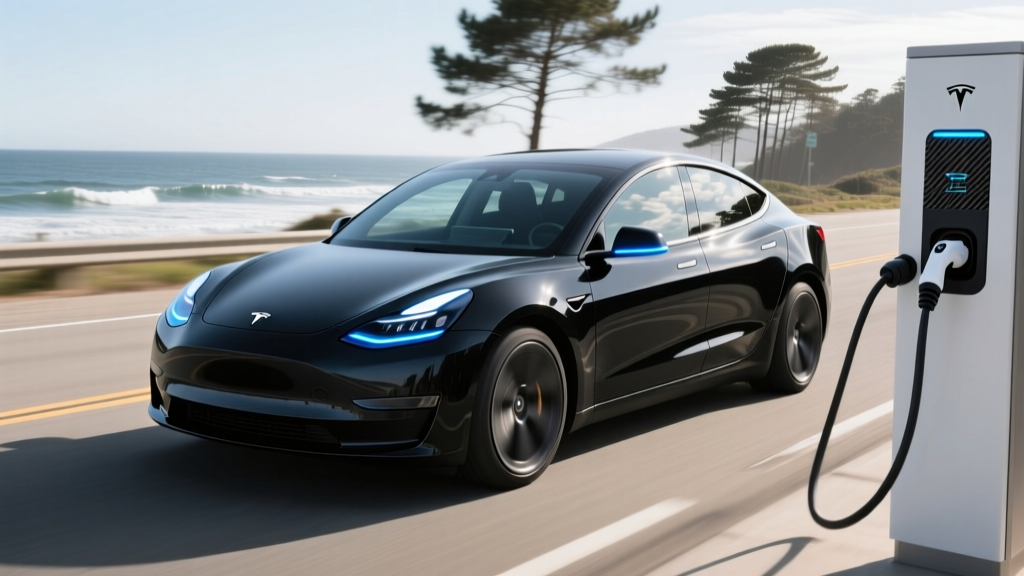
Charging is where Tesla still holds a structural edge, regardless of how you feel about the shifter. Both the Model 3 and Model Y use the North American Charging Standard (NACS) connector natively, giving them plug-and-charge access to the entire Supercharger network — over 6,500 U.S. stalls as of early 2026 — without an adapter.
| Level | Power (kW) | Miles Added per Hour | Notes |
|---|---|---|---|
| Level 1 (120V outlet) | ~1.4 kW | ~4–5 mi/hr | Emergency/trickle only |
| Level 2 (240V home) | 11.5 kW | ~44 mi/hr | Full charge in ~7–8 hours |
| DC Fast (Supercharger V3) | Peak 250 kW | ~170 mi in 15 min | 10–80% in ~25 min |
| DC Fast (Supercharger V4) | Peak 250+ kW | Similar to V3 | CCS adapter no longer needed |
Charging-curve reality: The 250 kW peak is sustained only roughly between 10–35% State of Charge. Above 50%, the rate tapers to ~120 kW, and above 80% it drops further to ~50 kW — typical behavior for NMC lithium-ion chemistry to protect cell longevity. For road trips, plan stops around 10–80% for the best time efficiency.
For home Level 2 charging, Tesla's Wall Connector ($420 hardware) on a 60-amp circuit delivers the full 11.5 kW / 44 mi per hour. Installation costs vary widely: expect $800–$2,200 for a standard run from a 200-amp panel, or $3,000–$5,000+ if a panel upgrade to 200A is needed. Always get a quote from a licensed electrician before committing.
Pricing, Trims, and Federal Tax Credit Eligibility
Tesla's pricing shifts frequently, but as of early 2026, here is the current MSRP structure and how the federal §30D tax credit applies.
| Trim | MSRP | Potential §30D Credit | Effective Price |
|---|---|---|---|
| Model 3 Long Range RWD | $44,130 | Up to $7,500 | As low as ~$36,630 |
| Model 3 Long Range AWD | $47,130 | Up to $7,500 | As low as ~$39,630 |
| Model 3 Performance | $55,130 | Up to $7,500 | As low as ~$47,630 |
| Model Y Long Range AWD | $49,630 | Up to $7,500 | As low as ~$42,130 |
| Model Y Performance | $56,630 | Up to $7,500 | As low as ~$49,130 |
Critical caveats on the §30D credit: The $7,500 figure is not automatic. Under current IRS rules, eligibility depends on:
- Buyer income caps: AGI must not exceed $300,000 (married filing jointly), $225,000 (head of household), or $150,000 (single).
- MSRP caps: Sedans (Model 3) must be ≤$55,000; SUVs/trucks (Model Y) must be ≤$80,000. Both currently qualify.
- Battery sourcing: At least a percentage of critical minerals and battery components must be sourced from the U.S. or FTA partners. Tesla's shifting supply chain means eligibility can change quarter to quarter — verify on fueleconomy.gov before purchasing.
- Point-of-sale transfer: Since 2024, the credit can be applied at purchase as a down-payment reduction rather than claimed on your tax return, effectively lowering your out-of-pocket cost immediately.
Consult a tax professional for your specific situation — this is general guidance, not tax advice.
Pros, Cons, and Who Should Buy
Pros
- Class-leading Supercharger network access (NACS native)
- Excellent real-world efficiency (25–30 kWh/100 mi)
- Over-the-air updates add features post-purchase
- Strong safety ratings (IIHS Top Safety Pick+ for Model 3)
- Minimal interior with premium materials post-Highland/Juniper
- Low running costs vs. comparable gas sedans/SUVs
Cons
- Screen-based shifter requires learning curve and visual check
- No Apple CarPlay or Android Auto
- No physical turn-signal stalk on Highland Model 3 (buttons on wheel)
- Rear visibility in Model 3 is limited (no rear wiper)
- Insurance costs above segment average
- FSD Supervised ($8,000 or $99/mo) is Level 2, not autonomous
Who This EV Suits Best
- Daily commuters with home Level 2 charging who value low per-mile energy costs and minimal maintenance.
- Tech-forward buyers who want OTA updates, a strong app, and integrated navigation with live Supercharger routing.
- Small families (Model Y especially) needing 300+ miles of range and fast DC charging for road trips.
- Not ideal for: Drivers who share the vehicle frequently with non-Tesla-experienced users, or those who strongly prefer tactile physical controls.
Warranty and Battery Longevity
Tesla's warranty structure for 2026:
- Basic Vehicle: 4 years / 50,000 miles
- Battery & Drive Unit: 8 years / 120,000 miles (Long Range); 8 years / 100,000 miles (RWD Standard Range when offered)
- Capacity retention threshold: Tesla warrants the battery will retain at least 70% of original capacity during the warranty period.
Real-world data from Tesla's annual impact reports and independent fleet studies show NMC packs in the Model 3/Y typically lose roughly 8–12% capacity over 150,000 miles, with degradation leveling off afterward. The chemistry is proven, though not as cycle-durable as the LFP packs Tesla uses in some Standard Range variants (which tolerate 100% daily charging without accelerated wear).
Frequently Asked Questions
What is the real-world range of the 2026 Tesla Model 3 and Model Y?
Model 3 Long Range RWD: EPA 363 mi, expect ~300–320 mi highway, ~250–280 mi in freezing weather. Model Y Long Range AWD: EPA 327 mi, expect ~275–295 mi highway, ~230–260 mi in cold conditions.
How fast does the Tesla Model 3/Y charge?
On a V3/V4 Supercharger, peak 250 kW, 10–80% in ~25–27 minutes. At home on a 60A Level 2 circuit, 11.5 kW adds roughly 44 miles per hour — enough for a full overnight charge.
Does the Tesla Model 3 or Model Y qualify for the federal EV tax credit?
Both currently qualify for up to $7,500 under §30D, subject to buyer income caps ($150k single / $300k joint), MSRP caps (both under limits), and battery-sourcing rules that can change. Always verify on fueleconomy.gov and consult a tax professional.
Is the Tesla screen shifter safe?
NHTSA has not issued a recall on the system. Tesla's backup roof-console buttons and automatic Park-on-exit provide redundancy. That said, the shifter does require a brief visual confirmation, which some safety advocates argue is a slight distraction increase versus a tactile stalk. Allow yourself a week of acclimation before judging.
Is it worth buying a Tesla vs. competitors in 2026?
For charging infrastructure and efficiency, Tesla still leads — the Supercharger network is meaningfully more reliable than third-party CCS networks in most U.S. regions. For interior luxury, ride comfort, and physical controls, the Hyundai Ioniq 6, BMW i4, and Ford Mustang Mach-E make strong cases. Test-drive both ecosystems before deciding.
Can I add a physical shift stalk to a new Tesla?
No. There is no factory option or Tesla-sanctioned retrofit. Aftermarket solutions exist but void portions of the electrical warranty and are not recommended.