Why the Tesla Semi–Uber Partnership Matters in 2026
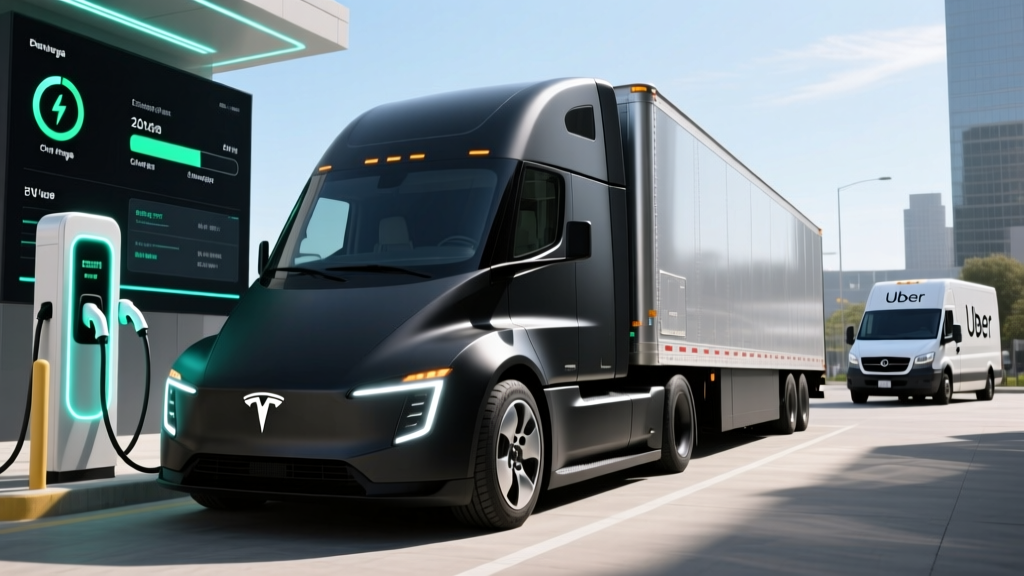
When Uber Freight announced its first large-scale battery-electric truck deployment with the Tesla Semi, it signaled a shift from pilot programs to real revenue-hauling routes. This isn't a concept reveal — Uber Freight carriers began taking delivery of Tesla Semi units in late 2025, with routes concentrated in California's Inland Empire, the Central Valley, and the Dallas–Fort Worth metroplex. The partnership pairs Tesla's Class 8 battery-electric tractor with Uber Freight's load-matching network, targeting drayage and regional-haul lanes under 400 miles round-trip.
This review covers the Tesla Semi's real-world specs as operated in the Uber Freight fleet: range under load, charging infrastructure requirements, energy costs, and whether the economics work for owner-operators or only mega-fleets. If you're searching for tesla uber semi partnership details, this is the technical breakdown.
Tesla Semi Specifications: Battery, Range, and Efficiency
| Parameter | Value |
|---|---|
| Battery Capacity (usable) | ~900 kWh (NMC chemistry) |
| EPA Estimated Range (loaded, 82,000 lb GCW) | 500 miles |
| Real-World Range (highway 65 mph, 80°F) | ~390–440 miles |
| Real-World Range (cold, 30°F, loaded) | ~300–350 miles |
| Energy Consumption (loaded) | ~1.7–2.0 kWh/mile |
| MPGe Equivalent | ~11 MPGe (diesel-gallon equivalent) |
| Drivetrain | Tri-motor AWD (rear axle tandem) |
| Peak Horsepower | ~1,000+ hp (combined tri-motor) |
| 0–60 mph (loaded, 82,000 lb) | ~20 seconds |
| 0–60 mph (unloaded/bobtail) | ~5 seconds |
| GVWR / GCW Rating | Class 8 / 82,000 lb |
The ~900 kWh battery pack uses nickel-manganese-cobalt (NMC) chemistry — chosen for energy density over cycle life, since Tesla's thermal management system and Megacharger integration prioritize route completion over LFP's longevity advantage. For a Class 8 truck running 120,000+ miles/year, NMC's higher specific energy (Wh/kg) keeps the battery weight manageable — though the pack still adds roughly 8,000–10,000 lb compared to a diesel tractor's fuel tanks.
Charging: Megacharger Speeds and Depot-Level 2 Requirements
The Tesla Semi cannot charge on standard CCS or NACS connectors at consumer stations. It requires Tesla's proprietary Megacharger infrastructure, delivering up to 1.2 MW (1,200 kW) of DC fast-charging power. This is roughly 4× the peak rate of a consumer Supercharger V4 stall.
| Charging Method | Power (kW) | Time / Range Added |
|---|---|---|
| Tesla Megacharger (DC) | Up to 1,200 kW peak | 10–80% in ~30 min; ~70% in 30 min (PepsiCo data) |
| Depot Level 2 (J1772/Type 2 AC) | ~40–80 kW (3-phase) | ~20–40 miles/hr; full overnight charge in 12–18 hrs |
| Standard 480V Industrial | ~20–30 kW | Emergency/trickle only; 24+ hrs for full charge |
The charge curve on the Megacharger peaks near 1.2 MW up to approximately 40% state of charge, then tapers progressively. The 10–80% session takes roughly 30 minutes under optimal thermal conditions — meaning the battery is preconditioned via the truck's thermal management system before arrival. In cold weather without preconditioning, that session can stretch to 45+ minutes.
For Uber Freight carriers, depot charging is the backbone: trucks return to a yard with 480V 3-phase infrastructure and top up overnight at 40–80 kW. Megachargers are deployed at strategic mid-route locations (currently concentrated along I-10, I-5, and I-35 corridors) for opportunity charging during driver rest breaks — aligning with federal hours-of-service mandates that require 30-minute breaks.
Uber Freight Integration: How the Partnership Operates
The Tesla Semi–Uber Freight partnership isn't a consumer product you can order online. It's a fleet procurement and logistics arrangement structured as follows:
- Carrier-owned model: Uber Freight partner carriers purchase or lease Tesla Semi units directly from Tesla. Uber Freight does not own the trucks.
- Load matching: Uber Freight's algorithm prioritizes electric-capable loads for Tesla Semi carriers — typically shorter-haul, high-frequency routes with predictable schedules.
- Infrastructure support: Tesla provides Megacharger access; some large carriers (e.g., Schneider, J.B. Hunt) are co-investing in depot charging.
- Premium freight rates: Shippers with ESG mandates (Walmart, Target, PepsiCo) pay a rate premium for zero-tailpipe-emission hauls, partially offsetting the Semi's higher acquisition cost.
As of early 2026, roughly 200–300 Tesla Semi units are operating under Uber Freight load-matching, with the largest concentration in Southern California's drayage market (port-to-warehouse runs under 150 miles).
Pricing, Operating Cost, and Tax Credit Eligibility
| Item | Value |
|---|---|
| Base MSRP (300-mi range variant) | ~$150,000 |
| Base MSRP (500-mi range variant) | ~$180,000 |
| As-Tested (500-mi + sleeper delete + fleet telematics) | ~$185,000–$195,000 |
| Comparable Diesel Class 8 Tractor | ~$140,000–$170,000 |
| Federal Commercial Clean Vehicle Credit (§45W) | Up to $40,000 (trucks >16,000 lb GVWR) |
| Effective Price After §45W Credit | ~$140,000–$155,000 |
| Energy Cost per Mile (electricity @ $0.12/kWh) | ~$0.20–$0.24/mile |
| Diesel Cost per Mile (avg $4.00/gal, 6.5 mpg) | ~$0.62/mile |
| Estimated Annual Fuel Savings (120,000 mi/yr) | ~$48,000–$50,000 |
The operating-cost math is where the Semi makes its case. At $0.20–$0.24 per mile for electricity versus $0.60+ for diesel, a truck running 120,000 miles per year saves roughly $48,000 annually on energy alone. Add reduced maintenance (no diesel particulate filter, no oil changes, no DEF fluid, far fewer brake replacements thanks to regen) and the total cost of ownership can break even with diesel within 2–3 years — assuming reliable charging access.
Driver Experience, Tech, and Autopilot in a Class 8 Context
The Tesla Semi's cab is a radical departure from conventional Class 8 tractors. The driver sits center-mounted (like the original McLaren F1), with dual 15-inch touchscreens flanking the steering position. There is no traditional instrument cluster.
Standout tech features:
- Enhanced Autopilot (SAE Level 2): Adaptive cruise, lane-centering, and automatic emergency braking tuned for 80,000-lb combinations. This is a driver-assist system — the driver must remain fully engaged and hands-on at all times. It is not autonomous driving.
- Regenerative braking tuning: Three regen levels; maximum regen enables near-one-pedal driving on flat terrain, recovering up to 30% of energy on downhill grades.
- Over-the-air updates: Fleet managers receive telematics dashboards; route optimization, battery preconditioning, and efficiency coaching push via OTA.
- Sentry Mode for cargo security: Cameras monitor the trailer connection and surroundings during rest stops — a genuine anti-theft feature in high-cargo-theft corridors.
- Jackknife prevention: Torque-vectoring across the tri-motor rear axle actively counters trailer swing, a safety feature no diesel tractor offers.
Notable drawbacks:
- Visibility: The center-mount driving position and massive A-pillars create blind spots that require camera reliance — some veteran drivers report discomfort during the adjustment period.
- No sleeper berth: The current Semi is a day-cab configuration only. Long-haul team operations requiring overnight sleeper accommodations are not supported.
- Trailer connection: Standard 7-pin RV-style connector; some older trailers require adapter harnesses for full lighting/brake integration.
- Service network: Tesla's commercial service footprint is still thin outside California, Texas, and Nevada. A breakdown in rural Montana means a long wait for a mobile technician.
Warranty, Battery Degradation, and Fleet Longevity
Tesla warranties the Semi's battery and drive unit for 8 years or 1,000,000 miles (whichever comes first), with a guaranteed minimum of 70% capacity retention over that period. This is extraordinary by consumer-EV standards but more in line with commercial expectations — a diesel engine is typically overhauled at 750,000–1,000,000 miles.
Early data from PepsiCo's fleet (the Semi's launch customer, operating since late 2022) suggests degradation of approximately 5–8% over the first 200,000 miles of heavy use. At that rate, a 900 kWh pack would retain roughly 810–855 kWh by the 500,000-mile mark — still sufficient for 400+ loaded miles. Battery replacement cost, should it be needed out of warranty, is estimated at $150,000–$200,000+ — essentially a second truck purchase. This is the single largest long-term risk factor.
The tri-motor drive unit carries the same 8-year/1,000,000-mile warranty. Electric motors have far fewer wear components than diesel powertrains, but inverter and reduction-gear failures have been reported in early units — Tesla has addressed most via OTA software derating and hardware revisions in 2025+ production.
Competitor Comparison: Tesla Semi vs. Class 8 Alternatives
| Spec | Tesla Semi (500 mi) | Freightliner eCascadia | Volvo VNR Electric |
|---|---|---|---|
| EPA Range (loaded) | 500 mi | ~230 mi | ~275 mi |
| Battery (kWh) | ~900 (NMC) | ~440 (NMC) | ~565 (NMC) |
| Peak DC Charge (kW) | 1,200 | ~250 | ~250 |
| 10–80% Charge Time | ~30 min | ~90 min | ~70 min |
| Horsepower | ~1,000+ | ~400 | ~455 |
| Base MSRP | ~$180,000 | ~$270,000 | ~$250,000 |
| Best Use Case | Regional haul (200–400 mi) | Drayage / short-haul | Regional / delivery |
The Semi's range and charging-speed advantages are massive on paper — but the Freightliner eCascadia and Volvo VNR Electric benefit from established dealer/service networks and compatibility with public CCS charging infrastructure (the Semi requires Tesla Megachargers exclusively). For an Uber Freight carrier operating in a Megacharger-served corridor, the Semi is the clear efficiency winner. For carriers needing flexibility across diverse geographies, the eCascadia's service network may outweigh its range deficit.
Who the Tesla Semi–Uber Freight Model Suits Best
- Regional or drayage carrier running 150–350 mile round-trip routes
- Operating in California, Texas, or I-5/I-10/I-35 corridors with Megacharger access
- Hauling for shippers with ESG/sustainability mandates willing to pay rate premiums
- Fleet size of 5+ trucks to justify depot-charging infrastructure investment ($50,000–$150,000+ per site)
- Access to state incentive programs (CA HVIP, TX TERP, NY Truck Voucher) stacking with §45W
- Long-haul OTR operators running 800+ mile lanes
- Owner-operators without access to 480V depot charging
- Carriers operating primarily in regions without Megacharger infrastructure
- Teams requiring sleeper-cab configurations
Frequently Asked Questions
What is the real-world range of the Tesla Semi under Uber Freight loads?
With a full 82,000 lb gross combination weight on highway routes at 65 mph, expect 390–440 miles in moderate weather and 300–350 miles in freezing conditions. Uber Freight's load-matching algorithm accounts for this by capping single-leg assignments at ~200 miles with charging buffers.
How fast does the Tesla Semi charge at a Megacharger?
At peak 1.2 MW, the Semi adds roughly 70% charge (10–80%) in about 30 minutes when the battery is preconditioned. This aligns with federal driver-rest-break requirements. Depot Level 2 charging at 40–80 kW requires 12–18 hours for a full cycle — designed for overnight turnaround.
Does the Tesla Semi qualify for the $7,500 consumer EV tax credit?
No. The Semi is a commercial Class 8 vehicle and falls under IRS §45W, which provides up to $40,000 in commercial clean vehicle credits. The consumer §30D credit (up to $7,500) applies only to light-duty vehicles under 14,000 lb GVWR. §45W eligibility depends on business tax liability, battery sourcing, and domestic-content requirements — consult a tax professional.
How much does the Tesla Semi cost after incentives?
The 500-mile variant lists at ~$180,000 MSRP. After the $40,000 §45W federal credit, the effective price drops to ~$140,000. In California, stacking the HVIP voucher (up to $120,000 for drayage applications) can bring the net cost below $60,000 — cheaper than a diesel tractor. Incentive availability varies by state and program funding status.
Is the Tesla Semi worth it vs. the Freightliner eCascadia?
If your routes fall within Megacharger-served corridors and you prioritize range and charging speed, the Semi is the superior truck — 500 vs. 230 miles EPA, and 30-minute vs. 90-minute charging. If you need established dealer service in rural areas or CCS public-charging compatibility, the eCascadia remains the pragmatic choice in 2026.
Can an independent owner-operator buy a Tesla Semi through Uber Freight?
Uber Freight does not sell trucks. Owner-operators must purchase directly from Tesla and then access loads via the Uber Freight platform. The barrier is infrastructure: without access to 480V 3-phase power for overnight charging (a $30,000–$80,000 electrical upgrade in most cases), operating a Semi as a solo owner-operator is impractical in most markets.