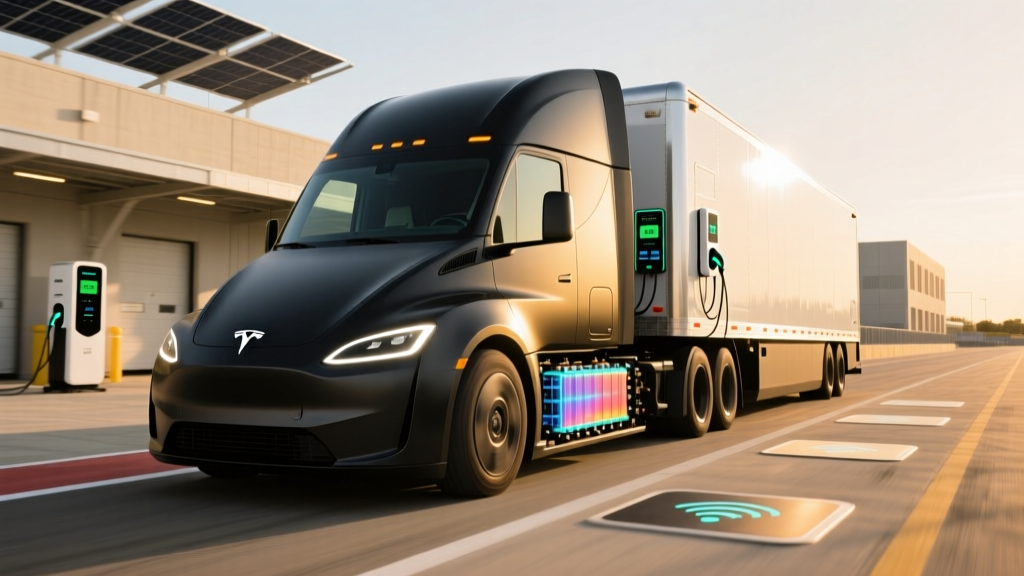
If you've seen a Tesla Semi pulling an unusual trailer through Nevada or Texas and wondered what it was, you're not alone. The term Tesla training trailers has circulated among EV enthusiasts and trucking forums, referring to the instrumented test trailers Tesla uses during Semi validation, driver onboarding, and fleet-delivery training. These aren't consumer products — they're rolling laboratories that help Tesla prove the Semi's real-world efficiency, train fleet operators, and refine regenerative-braking behavior under load.
This profile covers the Tesla Semi platform that these training trailers attach to: its range, battery architecture, MegaCharger network, cab design, pricing, and whether it makes sense for your fleet in 2026.
What Are Tesla Training Trailers?
Tesla training trailers are heavily instrumented flatbed or dry-van trailers used internally and with early fleet customers to:
- Validate payload-specific energy consumption across routes
- Train fleet drivers on regen-braking techniques with varying axle loads
- Test thermal management under sustained grade climbing (e.g., I-5 Tejon Pass, Donner Summit)
- Calibrate the Semi's torque-vectoring across three rear-axle motors
Unlike production freight trailers, training units often carry adjustable ballast systems, strain gauges, and CAN-bus data loggers. Tesla has used them extensively at its Nevada test track and during PepsiCo's early deployment in California. The phrase "training trailer" also surfaces at fleet-driver orientation events where new Semi operators practice coupling, pre-trip inspection, and charge-in procedures specific to the MegaCharger connector.
Tesla Semi Core Specifications
| Attribute | 300-Mile Variant | 500-Mile Variant |
|---|---|---|
| EPA-Estimated Range | ~300 mi (loaded) | ~500 mi (loaded, 82,000 lb GCW) |
| Usable Battery Capacity | ~500 kWh (est., NMC) | ~900 kWh (est., NMC) |
| Peak DC Charge Rate | ~1.2 MW (MegaCharger) | ~1.2 MW (MegaCharger) |
| 10–80% Charge Time | ~35 min | ~40 min (claimed); ~50 min real-world |
| Energy Efficiency | < 2 kWh/mi (loaded, flat terrain) | |
| 0–60 mph (loaded) | ~20 sec (80,000 lb) | |
| 0–60 mph (unladen) | ~5 sec | |
| Drivetrain | Tri-motor AWD (1 steer, 2 drive axles) | |
| Horsepower (peak combined) | ~1,000+ hp | |
| GVWR | Class 8 — up to 82,000 lb GCW | |
Unlike passenger EVs, the Semi's battery chemistry is NMC (nickel manganese cobalt), chosen for energy density required to hit the 500-mile target under full gross-combined-weight. LFP chemistry, common in the Model 3 RWD, would add prohibitive weight at this capacity.
Real-World Range: What Fleets Actually See
EPA-published: 500 miles (loaded, 82,000 lb GCW, mixed cycle)
Real-world highway (flat, 65 mph, moderate climate): ~420–460 miles
Mountain routes (Tejon Pass, 6% sustained grade): ~280–340 miles
Cold weather (20°F, cabin + battery heating): expect 25–35% range reduction vs mild-weather baseline
PepsiCo's Frito-Lay division, one of the Semi's earliest and most vocal fleet operators, has reported real-world efficiency figures near 1.7 kWh/mi on regional California routes — better than Tesla's 2 kWh/mi claim, but those routes are largely flat and below 60 mph. Long-haul operators running I-10 or I-80 at 70 mph with full loads should plan conservatively around 400 usable miles before mandatory charge stops.
Regenerative braking plays a larger role in Class 8 than in passenger EVs. A loaded Semi descending a 5-mile grade can recover 15–25 miles of range — a significant operational variable that Tesla's training trailers are specifically designed to teach drivers to exploit.
Charging: The MegaCharger Network
| Level | Power | Rate | Notes |
|---|---|---|---|
| MegaCharger (DC) | Up to 1.2 MW (1,200 kW) | ~70% in 30 min (claimed) | Proprietary connector; CCS2-compatible adapters emerging for fleet depots |
| Depot DC (CCS2) | 350–500 kW | ~10–80% in 90–120 min | Requires fleet-installed infrastructure; typical for overnight hub charging |
| Level 2 (AC depot) | 40–80 kW | ~6–10 hours full charge | Suitable only for scheduled downtime / weekend layovers |
The Semi does not use the NACS connector found on Tesla's passenger vehicles. Instead, it relies on the high-amperage MegaCharger standard, which delivers up to 1.2 MW — roughly five times the peak rate of a V3 Supercharger. Tesla has installed MegaChargers at its own facilities and at select fleet partner depots (PepsiCo Sacramento, JB Hunt corridors), but public MegaCharger infrastructure remains extremely limited as of 2026.
The charge curve matters enormously here: the Semi sustains peak MW only between ~10–50% state of charge, then tapers aggressively to protect the NMC cells. Operators planning tight schedules should budget 45–55 minutes for a 10–80% session, not the marketing-friendly 30-minute claim.
Cab Design, Tech, and Driver Experience
The Semi's center-seated driving position — borrowed from Formula 1 and racing prototypes — gives exceptional forward visibility and symmetric mirror sightlines. Two flanking 15-inch touchscreens handle navigation, energy monitoring, camera feeds, and fleet telematics. Tesla's Autopilot hardware (HW4) is standard, supporting SAE Level 2 lane-keep and adaptive cruise; this is not autonomous driving, and drivers must remain engaged at all times.
Notable cab features:
- Standing-height interior with full walk-through to sleeper area (day-cab and sleeper configurations)
- Regenerative braking intensity adjustable via touchscreen — critical for training-trailer exercises
- Over-the-air updates that have added route-optimization and predictive thermal preconditioning
- No traditional instrument cluster; all data rendered on dual touchscreens
The most common driver complaint: the touchscreen-dependent HVAC and mirror controls add cognitive load during coupling maneuvers — exactly the scenario training trailers drill repeatedly.
Pricing, Tax Credits, and Fleet Economics
| Variant | Base MSRP (est.) | As-Tested / Fully Loaded |
|---|---|---|
| 300-Mile Range | ~$250,000 | ~$275,000 |
| 500-Mile Range | ~$290,000 | ~$320,000 |
Note: The IRS §30D clean vehicle credit caps at $40,000 for commercial clean vehicles under §45W, with battery-sourcing and critical-mineral requirements that shift annually. Fleet buyers should consult a tax professional — eligibility is not guaranteed, and the MSRP/income rules that apply to passenger vehicles differ materially for Class 8 commercial purchases.
Diesel savings are the Semi's core economic argument. At 1.7 kWh/mi and $0.14/kWh industrial electricity, operating cost is ~$0.24/mi vs ~$0.65/mi for a comparable diesel rig at 6.5 mpg and $4.20/gal. Over 100,000 miles/year, that's roughly $41,000 annual fuel savings — but only if depot charging is available. Public DC charging at $0.50+/kWh erases most of the advantage.
Who the Tesla Semi Is For (and Not For)
The Semi fits a narrow but growing operational profile:
- Best for: Regional drayage, dedicated hub-to-hub routes under 400 miles, port operations, fleet operators with depot-charging infrastructure and predictable schedules
- Not ideal for: Long-haul OTR (over-the-road) operators lacking MegaCharger corridor access, teams running time-sensitive loads where 45-minute charge stops add unacceptable delay, owner-operators without capital for depot buildout
- Class-leading energy efficiency (~1.7 kWh/mi real-world)
- Tri-motor torque and acceleration unmatched by diesel
- Dramatically lower per-mile fuel cost with depot charging
- Center-seat visibility and quiet cab reduce driver fatigue
- OTA updates continuously improve route planning
- MegaCharger network still sparse outside key corridors
- ~$290K+ entry price requires high utilization to justify
- Battery weight reduces payload capacity vs diesel (~2,000 lb penalty)
- Cold-weather range loss significant on northern routes
- Touchscreen-dependent controls frustrate some veteran drivers
Competitive Landscape: Semi vs the Class 8 Field
The Semi competes against a small but growing field of Class 8 battery-electric trucks:
- Freightliner eCascadia: ~230-mile range, widely available, strong dealer network, but lower range and efficiency
- Volvo VNR Electric: ~275-mile range (6-battery pack), proven European platform, good fleet support
- Peterbilt 579EV / Kenworth T680E: PACCAR platforms, ~150–200 mile range, focused on drayage
Tesla's advantage is range and efficiency; its weakness is service infrastructure. Legacy OEMs have thousands of Class 8 service bays nationwide — Tesla's commercial service footprint is still measured in dozens. For fleets that prioritize uptime certainty over per-mile efficiency, the eCascadia or VNR may still be the safer 2026 buy.
Warranty and Battery Longevity
Tesla warrants the Semi's battery and drive units for 1 million miles — a figure Elon Musk publicly committed to and that Tesla's commercial documentation has reaffirmed. The battery pack is designed for a 1-million-mile service life before reaching 70% retained capacity, though independent long-term fleet data is still limited given the Semi's 2022 production start.
For context, a diesel Class 8 engine typically requires an in-frame overhaul around 750,000–900,000 miles, and a full rebuild near 1.2 million. The Semi's warranty is genuinely competitive with diesel TCO when measured on a lifecycle basis — assuming MegaCharger access doesn't force costly route compromises.
Frequently Asked Questions
What exactly is a Tesla training trailer?
An instrumented test or ballast trailer Tesla uses during Semi validation, fleet-driver onboarding, and route-efficiency calibration. They're not sold to the public and aren't freight-carrying production units.
What is the real-world range of the Tesla Semi?
The 500-mile variant delivers roughly 420–460 miles on flat highway at 65 mph with a full load. Mountain routes and cold weather reduce this to 280–340 miles.
How fast does the Semi charge?
Peak rate is ~1.2 MW at a Tesla MegaCharger, with 10–80% in roughly 35–55 minutes depending on thermal conditions and charge-curve taper. Depot CCS2 at 350–500 kW takes 90–120 minutes for the same window.
Does the Tesla Semi qualify for federal EV tax credits?
Commercial clean vehicles fall under IRC §45W (up to $40,000), not the passenger-vehicle §30D credit. Battery-sourcing and critical-mineral rules apply and change annually. Consult a tax professional and review current IRS guidance.
Is the Tesla Semi worth buying vs a diesel Class 8?
For high-utilization regional fleets with depot charging, yes — per-mile fuel savings can exceed $40,000 annually. For long-haul OTR or operators without charging infrastructure, diesel remains the pragmatic 2026 choice.
Can I buy a Tesla Semi as an owner-operator?
Tesla prioritizes fleet orders. Solo buyers face long waitlists and must demonstrate charging-infrastructure plans before order confirmation.