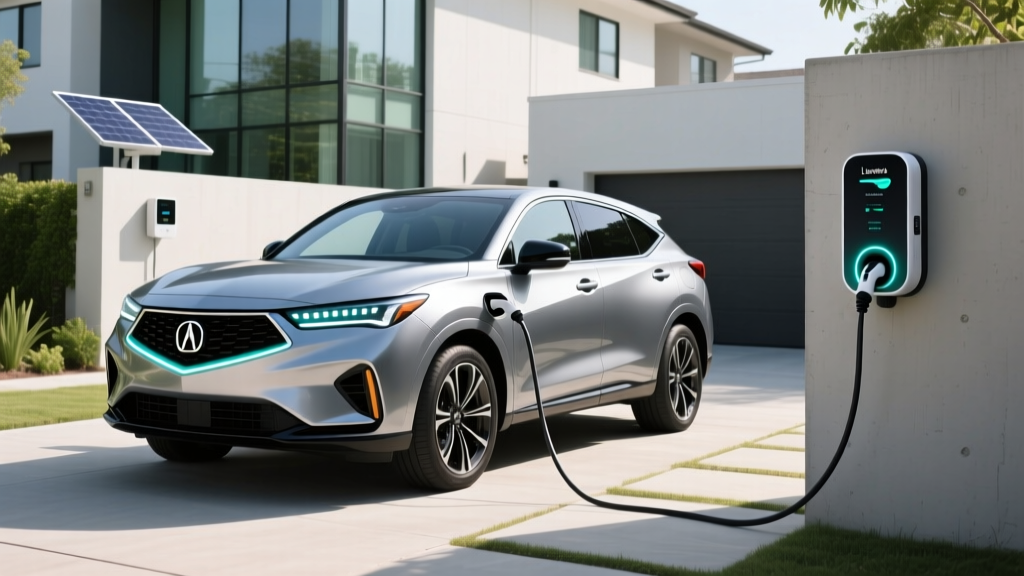
The 2024 Acura ZDX marks a pivotal moment for Honda's luxury brand: it's the first Acura built on a dedicated battery-electric platform, co-developed with General Motors on the Ultium architecture. Sharing its bones with the Cadillac Lyriq, the ZDX arrives as a midsize luxury electric SUV aimed squarely at buyers who want premium comfort, solid range, and access to the expanding Supercharger network — all wrapped in Acura's design language. But does the execution match the ambition? We break down every number that matters.
Quick Verdict: Who Should Consider the 2024 Acura ZDX
The ZDX fits a specific buyer: someone stepping from a gas-powered Acura MDX or RDX into an electric SUV who values ride comfort, a well-insulated cabin, and a proven 102 kWh battery pack over sporty handling dynamics. It's a commuter-friendly luxury hauler, not a track weapon. If you want the most engaging drive in this segment, the BMW iX or Porsche Macan EV will serve you better. If you want 300+ miles of EPA range, a plush interior, and straightforward ownership, the ZDX makes a compelling case — especially with the Type S variant's 500-hp punch.
Range and Efficiency: EPA Numbers vs. the Real World
The 2024 ZDX comes in three trims, and range varies significantly depending on which one you choose and whether you opt for all-wheel drive.
| Trim | Drivetrain | EPA Range | Real-World Estimate |
|---|---|---|---|
| A-Spec (RWD) | Rear-Wheel Drive | 325 miles | ~270–290 mi highway; ~245 mi in cold weather |
| A-Spec (AWD) | Dual-Motor AWD | 304 miles | ~255–275 mi highway; ~230 mi in cold weather |
| Type S | Dual-Motor AWD | 278 miles | ~235–255 mi highway; ~210 mi in cold weather |
Real-world estimates reflect sustained highway driving at 70+ mph and winter temperatures below 32°F. City driving with regenerative braking typically returns closer to EPA figures. Source: fueleconomy.gov
The 102 kWh usable battery capacity (NMC lithium-ion chemistry, part of GM's Ultium family) is one of the largest in this class. That gives the RWD A-Spec an EPA-rated efficiency of roughly 89 MPGe combined, or about 36 kWh per 100 miles. The heavier, more powerful Type S drops to approximately 77 MPGe combined. These are respectable figures for a 5,000+ lb luxury SUV, though the BMW iX xDrive50 achieves slightly better efficiency thanks to more aggressive aero and silicon-carbide inverters.
One thing to note: the ZDX's large battery means cold-weather range loss hits harder in absolute terms. A 20–25% reduction on a 325-mile EPA figure still leaves you with ~245 miles — adequate for most commutes but something to plan around on winter road trips.
Charging: DC Fast, Level 2, and the Supercharger Advantage
Charging capability is where the GM Ultium platform shows both its strengths and its current-generation limitations.
| Charging Level | Power / Rate | What You Get |
|---|---|---|
| Level 1 (120V household) | ~1.4 kW | ~3–4 miles of range per hour |
| Level 2 (240V home/work) | 11.5 kW (max onboard) | ~27 miles of range per hour; full charge in ~9 hours |
| DC Fast Charge (CCS) | Up to 190 kW peak | 10–80% in approximately 42 minutes |
| DC Fast Charge (NACS adapter) | Up to 190 kW peak | Access to Tesla Supercharger network (adapter included for 2024+ models) |
The 190 kW peak DC charge rate is adequate but not class-leading. Competitors like the Hyundai Ioniq 5 (peaking at 240 kW on 800V architecture) can hit 10–80% in roughly 18 minutes. The ZDX's 42-minute 10–80% time means longer stops on road trips. The charge curve tapers noticeably above 60% state of charge, which is typical for NMC batteries but worth factoring into trip planning — you'll spend more time at the charger if you regularly need to fill past 80%.
The big practical win is NACS adapter compatibility. Acura confirmed that 2024 ZDX owners can use a CCS-to-NACS adapter to access Tesla Supercharger stalls, which dramatically expands reliable DC fast-charging coverage, particularly in rural corridors where Electrify America and EVgo footprints are thinner.
For home charging, the 11.5 kW onboard charger is a strong point. A properly installed Level 2 home station (48-amp circuit on a 60-amp breaker) will replenish the full 102 kWh battery overnight in roughly 9 hours. That's faster than some rivals limited to 9.6 kW onboard charging.
Performance and Driving Dynamics
| Specification | A-Spec RWD | A-Spec AWD | Type S |
|---|---|---|---|
| Horsepower | 358 hp | 490 hp | 500 hp |
| 0–60 mph | ~6.0 sec | ~4.7 sec | ~4.2 sec |
| Drivetrain | Single-motor RWD | Dual-motor AWD | Dual-motor AWD |
| Battery (usable) | 102 kWh (NMC) | 102 kWh (NMC) | 102 kWh (NMC) |
| Curb Weight | ~5,640 lbs | ~5,840 lbs | ~5,940 lbs |
The Type S delivers genuinely quick acceleration at 4.2 seconds to 60 mph, and the dual-motor AWD system provides confident grip in wet and snowy conditions. However, the ZDX's 5,800+ lb curb weight is felt in corners. Body roll is well-managed by the adaptive dampers on the Type S, but this is a luxury cruiser first. Steering feel is light and somewhat detached — fine for highway commuting, less engaging on a canyon road.
Ride quality is a genuine strength. The Ultium platform's low center of gravity and Acura's tuning produce a composed, quiet ride that absorbs highway expansion joints and potholes with minimal fuss. Cabin noise levels are impressively low, aided by acoustic laminated glass and active noise cancellation.
Interior, Cargo, and Technology
The cabin is where Acura differentiates the ZDX from its Cadillac Lyriq sibling. Acura's design language brings a cleaner, more driver-focused layout with higher-quality materials on touchpoints.
- Infotainment: 11.3-inch touchscreen with Google Built-In (Google Maps, Google Assistant, Play Store), wireless Apple CarPlay and Android Auto
- Instrument cluster: 11.0-inch digital display
- Audio: 18-speaker Bang & Olufsen premium system (standard on all trims)
- Seating: Heated and ventilated front seats standard; heated rear seats on Type S
- Panoramic roof: Fixed glass roof standard across all trims
Cargo and passenger space:
| Dimension | Measurement |
|---|---|
| Cargo (behind 2nd row) | 26.3 cu ft |
| Cargo (2nd row folded) | 56.6 cu ft |
| Front legroom | 41.0 inches |
| Rear legroom | 37.2 inches |
| Front headroom | 39.3 inches |
| Rear headroom | 37.8 inches |
The cargo area is adequate for the class but not generous — the Tesla Model X offers significantly more with its available third row, and even the Rivian R1S edges it out. There is no front trunk (frunk), which is a missed opportunity given the Ultium platform's packaging flexibility. Rear seat space accommodates adults comfortably on shorter trips, though taller passengers may wish for more legroom on long hauls.
Pricing, Trims, and Federal Tax Credit Eligibility
| Trim | Base MSRP | Est. Federal Credit* | Effective Price |
|---|---|---|---|
| A-Spec (RWD) | $59,950 | Up to $7,500 | ~$52,450 |
| A-Spec (AWD) | $63,950 | Up to $7,500 | ~$56,450 |
| Type S | $70,950 | Up to $7,500 | ~$63,450 |
*Federal EV tax credit eligibility under IRS §30D is subject to multiple requirements. See checklist below. Credit is applied at point of sale for eligible buyers starting 2024. Verify current eligibility at irs.gov.
- MSRP cap: SUVs/vans/pickups must be ≤ $80,000 — all ZDX trims qualify
- Buyer income cap: Modified AGI ≤ $150,000 (single) / $300,000 (joint) / $225,000 (head of household)
- Battery sourcing: Critical minerals and battery components must meet phased-in percentage thresholds from US/FTA countries — Acura/GM have indicated compliance, but verify per VIN at the IRS portal or with your dealer
- Point-of-sale transfer: Eligible buyers can transfer the credit to the dealer at purchase, reducing the purchase price directly rather than waiting for a tax refund
- One credit per VIN: Cannot have been previously claimed for this vehicle
The ZDX's MSRP places it firmly in the premium luxury EV SUV segment. After the potential $7,500 credit, the A-Spec RWD at roughly $52,450 becomes competitive with a well-equipped Tesla Model Y Long Range or a base BMW iX. However, state incentives vary — check your local DMV and energy office for additional rebates that could further reduce cost.
Warranty, Reliability, and Ownership Costs
| Coverage | Term |
|---|---|
| Basic bumper-to-bumper | 4 years / 50,000 miles |
| Powertrain | 6 years / 70,000 miles |
| Battery pack | 8 years / 100,000 miles (capacity retention ≥ 70%) |
| Corrosion | 5 years / unlimited miles |
| Roadside assistance | 4 years / 50,000 miles |
The 8-year/100,000-mile battery warranty with a 70% capacity retention threshold is industry standard, matching what GM offers on the Lyriq and what most competitors provide. NMC chemistry in the Ultium pack has shown promising early degradation data from GM's fleet testing, but long-term real-world data for the ZDX specifically will take several more years to mature. The thermal management system — active liquid cooling and heating — is designed to minimize degradation from extreme temperatures and fast charging.
Insurance costs for the ZDX tend to run 15–25% higher than a comparable gas Acura MDX, based on early quotes. Get quotes from your provider before committing — luxury EV SUVs carry higher premiums due to repair costs for aluminum body panels and high-voltage components.
Driver Assistance: AcuraWatch Plus
AcuraWatch Plus is a Level 2 driver-assistance system. The driver must remain fully engaged, hands on or near the wheel, eyes on the road at all times. This is NOT autonomous or self-driving. Features include adaptive cruise control, lane-centering assist, blind-spot monitoring, rear cross-traffic alert, and traffic-sign recognition. Acura has not announced a hands-free highway system comparable to GM's Super Cruise for the ZDX at this time.
The omission of a hands-free driving feature is a notable gap. The Cadillac Lyriq offers Super Cruise (hands-free on compatible highways), and the BMW iX offers Highway Assistant. Acura's system works competently in stop-and-go traffic and highway cruising, but requiring constant hand contact feels behind the curve for a 2024 luxury EV at this price point.
Pros and Cons: The Honest Assessment
- Class-leading 325-mile EPA range on RWD A-Spec
- Large 102 kWh Ultium battery provides genuine road-trip confidence
- 11.5 kW Level 2 onboard charger — faster home replenishment than many rivals
- NACS adapter access to Tesla Supercharger network
- Quiet, well-insulated cabin with premium B&O audio standard
- Google Built-In infotainment with native Google Maps navigation
- Comfortable, compliant ride quality ideal for daily commuting
- Type S variant delivers 500 hp and genuine performance
- DC fast charging peaks at 190 kW — slower than 800V rivals (10–80% in ~42 min)
- No front trunk (frunk) despite dedicated EV platform
- Heavy curb weight (5,800+ lbs) hurts handling agility
- No hands-free driving system (AcuraWatch is Level 2 only)
- Rear cargo space (26.3 cu ft) is modest for the class
- Starting price above $60K puts it in competitive territory
- Rear visibility limited by thick C-pillars and small rear window
How the ZDX Stacks Up Against Key Competitors
- You want maximum EPA range in a luxury electric SUV (325 mi RWD)
- You prioritize ride comfort and cabin quiet over sporty handling
- You value Google Built-In and the B&O audio system
- You want Supercharger network access without switching to Tesla
- You're an existing Acura owner who trusts the brand and dealer network
- Fastest DC charging matters — consider the Hyundai Ioniq 5 or Kia EV6 (800V, 240–350 kW)
- You need three rows of seating — consider the Rivian R1S or Tesla Model X
- Hands-free highway driving is a priority — the Cadillac Lyriq with Super Cruise is a closer sibling with that feature
- You want the most engaging driving dynamics — BMW iX or Porsche Macan EV
Frequently Asked Questions
What is the real-world range of the 2024 Acura ZDX?
The RWD A-Spec is EPA-rated at 325 miles. In real-world highway driving at 70+ mph, expect approximately 270–290 miles. In cold weather (below 32°F), range can drop to around 245 miles. The AWD A-Spec (304 EPA) and Type S (278 EPA) deliver proportionally less. Plan charging stops conservatively until you learn your driving pattern's impact on consumption.
How fast does the ZDX charge at home and on the road?
At home on a Level 2 (240V, 48-amp) charger, the ZDX accepts up to 11.5 kW, adding roughly 27 miles of range per hour and fully charging in about 9 hours. On DC fast chargers, it peaks at 190 kW, achieving 10–80% in approximately 42 minutes. The charge curve tapers above 60% SoC, so fills past 80% take significantly longer.
Does the 2024 Acura ZDX qualify for the $7,500 federal EV tax credit?
All ZDX trims fall under the $80,000 MSRP cap for SUVs, so they pass that threshold. However, full eligibility under IRS §30D also depends on your modified adjusted gross income (≤ $300K joint / ≤ $150K single), battery-critical-mineral sourcing requirements, and whether the credit has been previously claimed on the VIN. The credit can be transferred at point of sale. Confirm your eligibility at irs.gov or with a tax professional before purchasing.
Is the ZDX worth buying over the Cadillac Lyriq?
They share the Ultium platform and 102 kWh battery, but the ZDX commands a premium for Acura's interior materials, standard B&O audio, and Google Built-In. The Lyriq offers available Super Cruise (hands-free driving) which the ZDX lacks. If hands-free highway capability matters to you, the Lyriq is the stronger pick. If you prefer Acura's design and dealer experience, the ZDX justifies its price — but test-drive both before deciding.
Does the ZDX have a frunk or third-row seating?
No to both. There is no front trunk, which is a packaging miss on a dedicated EV platform. There is also no third-row option — the ZDX is strictly a two-row, five-passenger SUV. If you need three rows, look at the Rivian R1S or Tesla Model X.
What's the towing capacity?
The 2024 ZDX is not currently rated for towing. If towing is a requirement, consider the Rivian R1S (up to 7,700 lbs) or the Tesla Model X (up to 5,000 lbs).