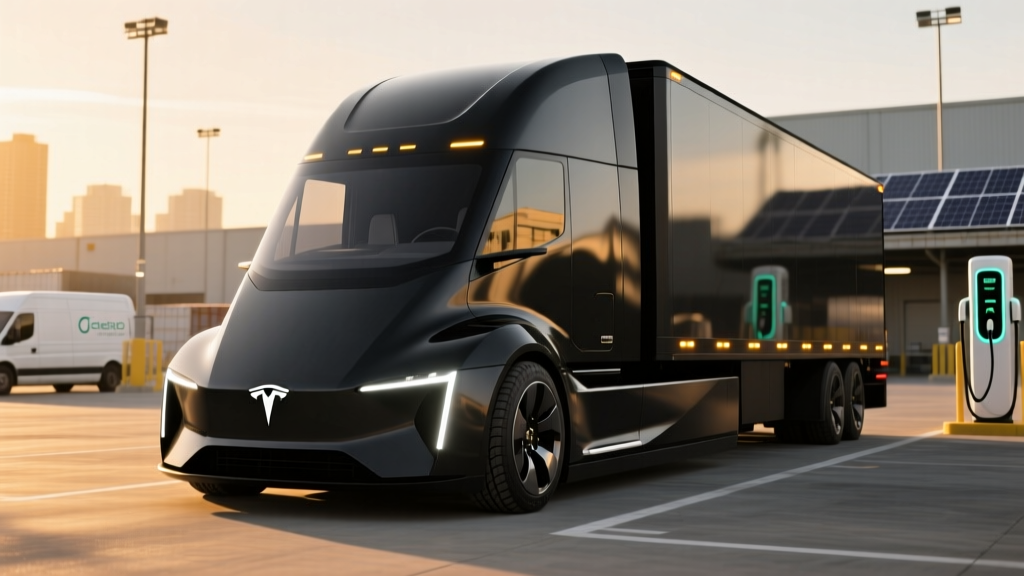
The idea of a 2 bedroom sleeper Tesla Semi truck captures the imagination of long-haul owner-operators and fleet managers alike — a zero-emission Class 8 rig with the living quarters to match a cross-country diesel sleeper. But as Tesla Semi production scales through 2026, the reality of the sleeper configuration requires separating confirmed engineering from internet speculation. This review covers what Tesla has officially disclosed about the Semi's cab layout, range, charging architecture, and pricing, while clearly flagging what remains preliminary or aftermarket-dependent.
What the Tesla Semi Sleeper Cab Actually Offers
Let's address the keyword directly: Tesla does not currently offer a factory "2 bedroom" sleeper configuration for the Semi. The production Tesla Semi, as delivered to PepsiCo, Schneider, and other fleet partners since late 2022 and scaling through 2026, features a day-cab and single-sleeper layout with a center-mounted driver position and a single bunk behind the seats. The cab is notably spacious — wider and taller than a conventional Freightliner Cascadia day cab — but it is designed for one driver resting during mandatory 10-hour off-duty periods, not two separate sleeping compartments.
That said, the Semi's cab dimensions and flat-floor architecture have attracted third-party coachbuilders exploring extended sleeper conversions. Some specialty upfitters have shown concepts for twin-bunk or partitioned sleeper modules, which is likely where the "2 bedroom" search interest originates. These are aftermarket modifications, not Tesla factory options, and any such conversion would affect warranty coverage, weight distribution, and energy consumption.
Tesla Semi Specifications at a Glance
| Specification | 300-Mile Variant | 500-Mile Variant |
|---|---|---|
| EPA-Estimated Range | 300 miles (loaded) | 500 miles (loaded) |
| Battery Capacity (estimated) | ~540 kWh (NMC) | ~900 kWh (NMC) |
| Drivetrain | Tri-motor AWD (3 independent motors on rear axles) | |
| Horsepower | ~1,000+ hp (combined peak output) | |
| 0-60 mph (loaded, 80,000 lb GCW) | ~20 seconds | |
| 0-60 mph (unloaded) | ~5 seconds | |
| Max DC Fast Charge | ~1.2 MW (Megacharger, CCS-derived) | |
| Energy Efficiency | < 2 kWh/mile (Tesla claim, loaded) | |
| GVWR / GCW | 82,000 lb (with federal EV weight exemption) | |
| Base MSRP (announced) | $250,000 | $290,000 |
| Battery Warranty | Estimated 8 years / 1,000,000 miles (not yet finalized) | |
Note: Tesla has not published a formal EPA certification for the Semi as of early 2026. Range figures above reflect Tesla's stated targets at 80,000 lb gross combination weight. The Tesla Semi product page lists these as expected specifications. Battery kWh figures are industry estimates based on the stated <2 kWh/mile efficiency target.
Real-World Range: What 500 Miles Actually Looks Like
500-Mile Variant — Tesla Stated: 500 miles at 80,000 lb GCW
Expected Highway (70 mph, flat terrain, 75°F): ~400–450 miles
Expected Cold Weather (30°F, mountainous): ~300–350 miles
300-Mile Variant — Real-World Highway: ~230–270 miles
Tesla's 500-mile claim for the Semi assumes a specific duty cycle: a mix of highway cruising at moderate speeds with regenerative braking opportunities on downgrades. In practice, sustained 70–75 mph interstate running at full gross weight will draw more energy than the test cycle suggests. Independent testing by fleet operators like PepsiCo has shown the Semi performing well on regional routes under 300 miles, but the 500-mile variant's real-world ceiling on long, flat highway segments at full load is likely closer to 400–450 miles in ideal conditions.
Cold weather compounds the challenge. Battery thermal management in a ~900 kWh pack requires significant energy for preconditioning, and cabin heating in a large sleeper cab draws additional load. Expect a 20–30% range reduction in sub-freezing conditions, bringing the 500-mile variant down to roughly 300–350 miles of usable range — still viable for many regional routes but requiring careful planning for long-haul corridors without established Megacharger infrastructure.
Efficiency is where the Semi shines against diesel. Tesla claims energy consumption under 2 kWh per mile loaded. At $0.12/kWh (a reasonable commercial electricity rate), that's roughly $0.24 per mile in energy cost — compared to $0.60–$0.80 per mile for diesel at current prices. Over 100,000 miles annually, that's a $36,000–$56,000 annual fuel savings.
Charging Architecture: Megacharger Speeds and Infrastructure Reality
| Level | Power (kW) | Miles Added per Hour | Notes |
|---|---|---|---|
| Level 2 (J1772/CCS depot) | 19.2–40 kW | ~10–20 mi/hr | Overnight depot charging; 10+ hours for full charge |
| CCS DC Fast (350 kW) | Up to 350 kW | ~175 mi/hr | Available at some public truck stops; 10–80% in ~90 min |
| Tesla Megacharger | Up to 1,200 kW (1.2 MW) | ~600 mi/hr | 10–80% in ~30 min; depot-only, limited availability |
The Semi's charging story is both impressive and frustrating. At a Tesla Megacharger — the proprietary 1.2 MW (1,200 kW) DC fast-charging system designed specifically for the Semi — Tesla claims the 500-mile variant can recover 70% of range in approximately 30 minutes. That translates to roughly 350 miles of range added during a driver's mandatory 30-minute rest break, which elegantly aligns with Hours of Service (HOS) regulations.
The problem: Megacharger infrastructure is extremely limited as of 2026. Tesla has installed Megachargers at select fleet depots (notably PepsiCo's Sacramento facility and Schneider's El Paso terminal) and along a handful of corridor routes, but there is no nationwide Megacharger network comparable to the Supercharger network for passenger vehicles. Each Megacharger installation requires utility-grade power delivery — often a dedicated medium-voltage feed and on-site transformer — making public deployment slow and capital-intensive.
For operators without depot Megachargers, the Semi can use CCS-compatible DC fast chargers at up to ~350 kW (with appropriate adapter or future native CCS port). At 350 kW, the 900 kWh pack will take roughly 90 minutes from 10–80% — feasible during a longer rest stop but not ideal for time-sensitive freight. Level 2 depot charging at 19.2 kW requires 40+ hours for a full charge on the 500-mile variant, making it practical only for overnight top-offs between shifts.
Performance, Drivetrain, and Cab Features
The Semi's tri-motor powertrain is a showcase of electric torque delivery. Three independent motors on the rear axles (one on each drive axle, with a third for redundancy and peak power) produce an estimated 1,000+ combined horsepower. At 80,000 lb gross combination weight, the Semi hits 60 mph in approximately 20 seconds — not sports-car territory, but dramatically quicker than a loaded diesel Class 8 (typically 35–45 seconds). Unloaded, the Semi's ~5-second 0-60 time is genuinely startling for a vehicle with a 10,000+ lb curb weight.
The single-speed transmission eliminates the 10- or 12-speed automated manual transmissions found in diesel trucks, removing a major maintenance item and simplifying drivability. Regenerative braking is aggressive enough to enable near-one-pedal driving on moderate grades, significantly reducing brake wear — a meaningful cost savings for fleet operators spending $3,000–$5,000 annually on brake service per truck.
Cab Interior and Technology
The Semi's cab is its most visually distinctive feature. The center-mounted driver seat provides symmetrical visibility and easy curb-side exit on either side. Dual 15-inch touchscreens flank the driver — one for vehicle controls and navigation, one for cameras, media, and fleet management integration. The cab includes:
- Full-height standing room (interior height approximately 78 inches)
- Single bunk/sleeper compartment behind the seats (approximately 78" x 36")
- No traditional mirrors — camera-based digital mirror system
- HEPA cabin air filtration
- Tesla's Enhanced Autopilot (SAE Level 2 driver assistance) with adaptive cruise, lane centering, and automatic emergency braking
- Over-the-air software updates
- Fleet telematics API integration
The "2 bedroom" concept would require aftermarket coachwork to partition the sleeper area into two separate resting compartments. Given the cab's ~90-inch interior width and flat floor, a twin-bunk layout is physically feasible, but any structural modification to the cab would need to comply with FMVSS standards and could void Tesla's warranty on affected systems.
Pricing, Total Cost of Ownership, and Tax Credits
| Cost Factor | Tesla Semi (500-mi) | Diesel Class 8 (new) |
|---|---|---|
| Base MSRP | $290,000 | $180,000–$220,000 |
| Federal Commercial Clean Vehicle Credit (§45W) | Up to $40,000 | $0 |
| Net Purchase Price (after credit) | ~$250,000 | $180,000–$220,000 |
| Annual Fuel/Energy (100k mi/yr) | ~$24,000 | ~$70,000 |
| Annual Maintenance | ~$5,000–$8,000 | ~$15,000–$20,000 |
| 5-Year Total Operating Cost | ~$395,000–$440,000 | $605,000–$720,000 |
The Tesla Semi's upfront cost is significantly higher than a comparable diesel — but the operating economics tell a different story. The IRA's §45W Commercial Clean Vehicle Credit provides up to $40,000 for qualifying commercial EVs over 14,000 lb GVWR (the Semi qualifies). Note: this is a commercial credit under §45W, not the consumer §30D credit, which caps at $7,500 and applies only to vehicles under 14,000 lb. Fleet buyers should consult the IRS §45W guidance for eligibility requirements including domestic content and tax-exempt entity rules.
At 100,000 miles per year, the Semi's energy cost advantage of ~$46,000 annually means the purchase-price premium is recovered in approximately 1.5–2 years of operation, after which every mile driven represents net savings versus diesel. Over a 5-year ownership period, total cost of ownership can be $200,000–$300,000 lower than diesel — assuming reliable charging access and route compatibility.
State-level incentives can further improve the equation. California's HVIP voucher program has offered up to $120,000+ per Class 8 zero-emission truck, though funding availability varies by year and fleet size. Always verify current incentive availability with your state air quality district.
Who Should Consider the Tesla Semi?
- Regional fleet operators with routes under 300–400 miles and depot charging access
- Drayage and port operations where zero-emission mandates (e.g., California's Advanced Clean Fleets rule) require electrification
- High-mileage fleets (80,000+ miles/year) where fuel savings rapidly offset the purchase premium
- Brand-conscious shippers with sustainability commitments requiring zero-emission logistics
- Long-haul OTR (over-the-road) operators running 600+ mile daily routes without corridor Megacharger access
- Independent owner-operators without depot charging infrastructure or capital for a $290,000+ truck
- Cold-climate northern routes where range reduction and charging logistics are still maturing
Pros, Cons, and the Sleeper Question
- Up to 500 miles range (stated) — best-in-class for electric Class 8
- < 2 kWh/mile efficiency — dramatically lower fuel cost vs diesel
- 1.2 MW Megacharging enables 30-min break charging
- Tri-motor AWD with 1,000+ hp — exceptional grade performance
- Minimal maintenance (no engine oil, DEF, DPF, transmission fluid)
- Regenerative braking extends brake life 3–5x
- Center-drive position with exceptional visibility
- OTA updates continuously improve performance
- "2 bedroom sleeper" is not a factory option — aftermarket only
- Megacharger infrastructure is extremely limited in 2026
- $290,000 base price is 30–60% above diesel equivalent
- ~900 kWh battery pack adds significant curb weight (~20,000+ lb)
- Long-haul viability depends entirely on charging corridor development
- No public EPA certification data yet — range claims are manufacturer-stated
- Cold-weather range loss of 20–30% impacts winter operations
- Aftermarket sleeper modifications may void warranty
Competitive Landscape: Semi vs. Electric Class 8 Rivals
The Tesla Semi doesn't exist in a vacuum. By 2026, several established truck OEMs offer competitive electric Class 8 models:
- Freightliner eCascadia: ~230-mile range, ~450 kWh battery, widely available, strong dealer/service network. Better for regional routes where Tesla's range advantage isn't needed.
- Volvo VNR Electric: ~275-mile range (6-battery pack), established support infrastructure, proven in drayage and regional applications.
- Peterbilt 579EV / Kenworth T680E: ~150–230 mile range, targeted at vocational and regional haul. PACCAR dealer network advantage.
- Nikola Tre BEV: ~330-mile range, but Nikola's financial instability and service network gaps make it a higher-risk bet.
The Semi's range and efficiency advantages are real, but Tesla's lack of a commercial service network is a significant concern for fleet operators accustomed to 500+ dealer locations. If a Semi goes down on a route, roadside service options are far more limited than with a Freightliner or Volvo. This is the Semi's biggest competitive vulnerability for conservative fleet buyers.
Frequently Asked Questions
Does a 2 bedroom sleeper Tesla Semi exist from the factory?
No. Tesla offers a single-sleeper cab configuration with one bunk. The "2 bedroom" concept exists only as an aftermarket conversion idea. Tesla has not announced any dual-sleeper or extended-cab factory option as of 2026.
What is the real-world range of the Tesla Semi?
Tesla states 500 miles for the long-range variant at 80,000 lb GCW. Real-world highway running at 70 mph in moderate temperatures should yield approximately 400–450 miles. In cold weather (below 32°F) or mountainous terrain, expect 300–350 miles. The 300-mile variant delivers roughly 230–270 real-world highway miles.
How fast does the Tesla Semi charge?
At a Tesla Megacharger (1.2 MW / 1,200 kW), the 500-mile variant can recover approximately 70% of range (~350 miles) in about 30 minutes. At a standard 350 kW CCS DC fast charger, expect 10–80% in roughly 90 minutes. Level 2 depot charging at 19.2 kW adds only about 10 miles of range per hour.
Does the Tesla Semi qualify for the federal EV tax credit?
The Semi qualifies for the §45W Commercial Clean Vehicle Credit (up to $40,000 for vehicles over 14,000 lb GVWR), not the consumer §30D credit. Eligibility depends on business use, domestic content requirements, and tax liability. Consult a tax professional and review IRS §45W guidance before purchasing.
Is the Tesla Semi worth buying vs. a diesel Class 8?
For high-mileage regional fleets with depot charging, the math strongly favors the Semi: the $46,000+ annual fuel savings recovers the purchase premium in under 2 years. For long-haul OTR without corridor charging access, diesel remains more practical in 2026. The decision hinges on your route profile and charging infrastructure.
What battery chemistry does the Tesla Semi use?
Tesla has not officially confirmed the Semi's cell chemistry, but industry analysis and the pack's energy density requirements point to NMC (nickel manganese cobalt) cells, likely the same 4680-format cells used in Tesla's passenger vehicles. LFP chemistry, while cheaper and longer-lasting, lacks the energy density needed for a 500-mile Class 8 pack within acceptable weight limits.
Can I install a Megacharger at my depot?
Yes, but it's a major infrastructure project. A 1.2 MW Megacharger typically requires a dedicated medium-voltage utility connection, on-site transformer, switchgear, and potentially a utility service upgrade costing $150,000–$400,000+ depending on existing site capacity. Work with Tesla's commercial energy team and your local utility for a site assessment.
Sources: Tesla Semi Official Page, IRS Commercial Clean Vehicle Credit (§45W), EPA Heavy-Duty EV Overview