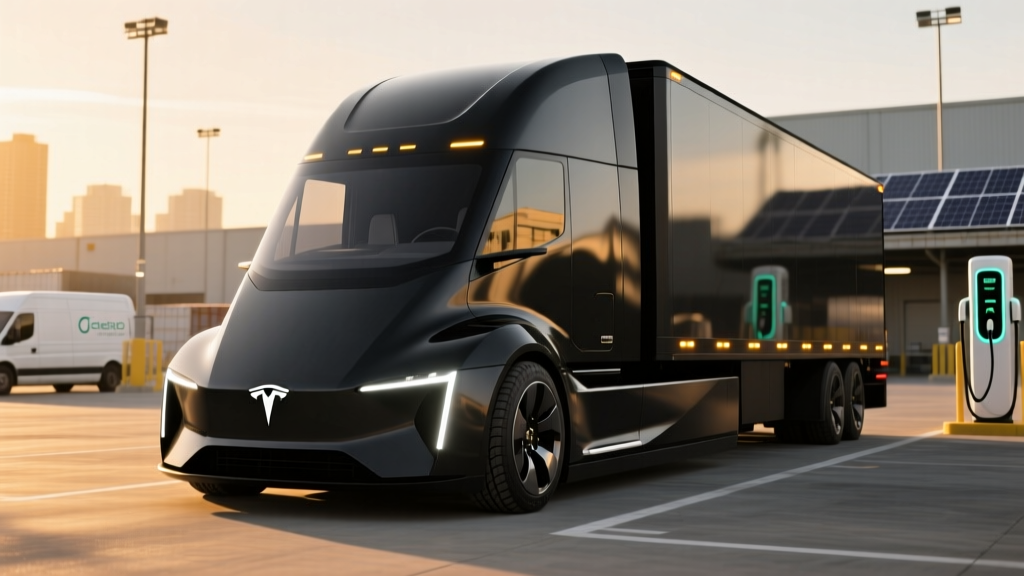
The Tesla Semi has been the most anticipated — and most delayed — electric vehicle in the commercial trucking industry. First unveiled in 2017 with a promised $150,000 price tag, the Class 8 electric truck has finally entered limited production as of late 2025, with broader deliveries ramping through 2026. But the original pricing is long gone, and fleet operators are now asking the critical question: how much will the Tesla Semi truck cost in today's market, and does the math work for real-world freight operations?
This profile breaks down every number we have — from confirmed and estimated MSRP by range variant, to battery capacity, megawatt-class charging speeds, real-world range expectations under load, and the federal commercial EV tax credit landscape that fundamentally changes the total cost of ownership equation.
Tesla Semi Pricing: What Fleets Will Actually Pay
Tesla has not published a consumer-facing sticker price the way it does for the Model Y or Cybertruck. The Semi is sold through direct fleet engagement, and pricing has shifted substantially since the original 2017 reservation announcement. Based on confirmed fleet order disclosures, industry reporting, and Tesla's own communications through 2025–2026, here is the current pricing picture:
| Variant | Est. Range (Loaded) | Est. Base MSRP | Target Market |
|---|---|---|---|
| Semi 300 | ~300 miles | $250,000 | Regional haul, drayage, last-mile |
| Semi 500 | ~500 miles | $290,000 | Long-haul corridor, intermodal |
| Founder Series (limited) | ~500 miles | $290,000+ | Early reservation holders |
For comparison, a new diesel Class 8 day cab from Freightliner, Volvo, or Kenworth typically runs $140,000–$180,000 in 2026, meaning the Tesla Semi carries a substantial upfront premium — roughly $70,000–$140,000 more than its diesel equivalent before incentives. That gap is where the total cost of ownership (TCO) analysis becomes essential, and where the federal commercial clean vehicle credit enters the picture.
Does the Tesla Semi Qualify for the Federal EV Tax Credit?
The Tesla Semi does not qualify for the consumer §30D clean vehicle credit, which applies only to light-duty vehicles under 14,000 lbs GVWR. Instead, fleet buyers look to the §45W Commercial Clean Vehicle Credit, which is the relevant federal incentive for heavy-duty electric trucks.
§45W Commercial Clean Vehicle Credit — Key Rules
- Credit amount: Up to $40,000 for vehicles over 14,000 lbs GVWR (the Semi qualifies)
- Eligibility: Must be purchased for business use and placed in service in the U.S.
- Battery sourcing: Subject to critical mineral and battery component requirements that phase in through 2026–2027 — consult a tax professional for current-year compliance
- No MSRP cap: Unlike §30D, the commercial credit has no vehicle price ceiling
- No income cap: Business entity income limits do not apply as they do for consumer credits
- Transferability: As of 2024+, eligible taxpayers may elect to transfer the credit to the seller for a point-of-sale price reduction
Source: IRS §45W Commercial Clean Vehicle Credit. Rules are subject to change — always confirm with a qualified tax advisor.
| Line Item | Semi 300 | Semi 500 |
|---|---|---|
| Est. Base MSRP | $250,000 | $290,000 |
| §45W Federal Credit | −$40,000 | −$40,000 |
| Est. Net Price (Before State Incentives) | $210,000 | $250,000 |
| Diesel Class 8 Comparable | $150,000–$170,000 | $150,000–$170,000 |
| Remaining Upfront Premium | $40,000–$60,000 | $80,000–$100,000 |
Many states — notably California (via CARB's HVIP program), New York, and New Jersey — offer additional incentives of $50,000–$120,000+ for zero-emission Class 8 trucks, which can bring the net Semi price close to or even below a diesel equivalent. Check your state's clean truck program for current availability, as funding pools are allocated annually and can be exhausted quickly.
Range, Battery, and Real-World Efficiency
The Tesla Semi's headline range figures — 300 and 500 miles — were announced at the 2017 unveiling and have been referenced in Tesla's earnings calls through 2025. These numbers represent the estimated range at full gross combined weight (82,000 lbs GCWR), which is a far more demanding standard than the EPA's light-duty testing protocol. The Semi does not receive a traditional EPA fuel economy sticker, as EPA ratings apply to light-duty vehicles under 8,500 lbs GVWR.
Range Reality Check: Sticker vs. Real Freight
Claimed range (loaded, 82K lbs): 300 mi / 500 mi by variant
Real-world expectation: Tesla's 500-mile claim was demonstrated in a 2022 PepsiCo delivery run at near-GCWR weight, but that route included favorable terrain and moderate speeds. In practice, fleet operators should plan for:
- Highway at 70 mph, full load: ~260–290 mi (Semi 300) / ~430–470 mi (Semi 500)
- Cold weather (below 32°F): Expect 15–25% range reduction due to battery chemistry, cabin heating, and increased rolling resistance
- Mountain grades (e.g., I-70 through Colorado): Significant energy draw uphill; regen recovery on descents partially offsets
- Empty or light load: Range extends substantially — possibly 20–30% beyond loaded figures
| Specification | Detail |
|---|---|
| Battery Capacity (est.) | ~500 kWh (Semi 300) / ~900 kWh (Semi 500) |
| Battery Chemistry | NMC (nickel manganese cobalt) — high energy density required for Class 8 range |
| Efficiency (claimed) | < 2 kWh/mile (loaded at highway speed) |
| Motor Configuration | Tri-motor AWD (3 independent motors on rear axles) |
| Peak Horsepower (est.) | ~1,000+ hp combined output |
| 0–60 mph (loaded, 80K lbs) | ~20 seconds (claimed) |
| 0–60 mph (unloaded) | ~5 seconds (claimed, 2017 reveal) |
| GCWR (max) | 82,000 lbs |
| Grade Capability | Sustained 65 mph on 5% grade (claimed) |
The Semi's efficiency claim of under 2 kWh per mile is remarkable for a Class 8 truck. For context, a diesel truck at 6.5 mpg burning diesel at roughly 36.4 kWh per gallon equivalent translates to about 5.6 kWh/mile. The Semi's electric drivetrain is roughly 2.5–3x more energy efficient per mile under load, which is the core of the TCO argument.
Charging: Megawatt-Class Speeds and Infrastructure Reality
The Tesla Semi uses the Megawatt Charging System (MCS), a connector and protocol standard designed specifically for heavy-duty electric vehicles. This is distinct from the NACS (Tesla passenger vehicles) and CCS1 (light-duty EVs) connectors. MCS supports charging at up to 1.2 megawatts (1,200 kW) — roughly four to five times the peak rate of the fastest passenger EV chargers available today.
| Charging Method | Max Power | Estimated Speed / Time |
|---|---|---|
| MCS DC Fast Charge (Tesla Megacharger) | Up to 1,200 kW (1.2 MW) | ~70% range in 30 min (Semi 500: ~350 mi added) |
| MCS DC Fast Charge (third-party) | 600–1,200 kW (varies by site) | 10–80% in ~35–50 min depending on station output |
| Depot CCS/MCS (lower-power DC) | 150–350 kW | Full charge in 3–6 hours (overnight depot charging) |
| Level 2 AC (depot) | 40–80 kW AC | Trickle/overnight top-off; not practical for full charge |
Charging curve reality: Like all lithium-ion batteries, the Semi will not sustain its peak 1.2 MW rate for the entire session. Expect peak power between roughly 10–40% state of charge, tapering significantly above 70%. Tesla's claim of "70% in 30 minutes" is consistent with this curve behavior — the first 30% charges fastest, while the final 20% is deliberately slow to protect battery health.
Infrastructure bottleneck: MCS charging stations are still extremely rare as of early 2026. Tesla has deployed Megachargers at select customer sites (notably PepsiCo's Modesto, CA facility and a growing network along key freight corridors in California and Texas). Third-party providers like WattEV, TeraWatt Infrastructure, and Greenlane are building public MCS corridors, but coverage is measured in dozens of stations — not thousands. Fleet operators must plan depot charging infrastructure as a prerequisite to Semi deployment.
Drivetrain, Performance, and Cab Technology
The Semi's tri-motor configuration provides all-wheel drive with independent torque vectoring across the rear axles. The center driver position — carried over from the 2017 concept — gives exceptional forward visibility and symmetrical sight lines, a design choice borrowed from racing that works surprisingly well for highway freight.
Notable technology features:
- Dual touchscreen displays: Flanking the central steering wheel, handling navigation, telematics, camera feeds, and vehicle controls
- Tesla Semi-specific Autopilot: Enhanced lane-keeping, adaptive cruise, and automatic emergency braking tuned for Class 8 mass and stopping distances — this is SAE Level 2 driver assistance, not autonomous operation; the driver must remain fully engaged
- Jackknife prevention: Independent motor torque control actively detects and corrects trailer swing before it becomes uncontrollable — a safety feature diesel trucks cannot match with a single driveline
- Regenerative braking: Aggressive regen significantly reduces service brake wear, potentially extending brake service intervals by 2–3x vs. diesel
- OTA updates: Over-the-air software updates for performance, efficiency, and feature improvements — standard Tesla practice
- Fleet telematics integration: Real-time energy monitoring, route optimization, and driver scoring via Tesla's fleet management portal
⚠️ Autopilot Limitations for Class 8
Tesla's Autopilot in the Semi is SAE Level 2 — an advanced driver-assistance system, not a self-driving system. The driver must keep hands on the wheel and eyes on the road at all times. Stopping distances at 80,000 lbs are dramatically longer than a passenger car; Autopilot's reaction-time advantage is meaningful but does not eliminate the physics of heavy freight. Tesla has not announced any Level 4 autonomous trucking capability for the Semi.
Battery Warranty, Longevity, and Replacement Cost
Tesla has confirmed a battery and drive unit warranty of 1 million miles for the Semi — a figure Elon Musk cited at the 2017 reveal and that Tesla has reaffirmed in subsequent communications. This is a landmark warranty for the trucking industry, where powertrain warranties on diesel trucks typically cover 5 years / 500,000–700,000 miles on major components.
| Component | Warranty |
|---|---|
| Battery Pack | 1,000,000 miles (capacity retention threshold not publicly specified — expect ~70% minimum) |
| Drive Unit(s) | 1,000,000 miles |
| Vehicle (bumper-to-bumper) | Estimated 5 years / 600,000 miles (not officially published as of early 2026) |
Degradation and replacement reality: NMC chemistry at the Semi's scale will experience gradual capacity loss. Industry consensus is that Tesla's 1-million-mile claim is achievable with active thermal management (which the Semi uses) and controlled charge/discharge cycles. If a battery pack replacement is needed out of warranty, the cost for a ~900 kWh pack would be substantial — likely in the $150,000–$250,000 range at current cell pricing, though costs are declining annually. The million-mile warranty is designed to make this a non-issue for the truck's first operational life.
Who the Tesla Semi Is For — and Who Should Wait
Choose the Tesla Semi If:
- You operate regional or drayage routes under 300 miles round-trip with predictable depot charging
- Your fleet operates in California or other states with substantial HVIP-style incentives that close the price gap with diesel
- You have high annual mileage (80,000–120,000 mi/yr) where the per-mile energy savings compound rapidly
- Fuel cost volatility is a budget risk you want to eliminate
- Corporate sustainability mandates or customer requirements (e.g., Amazon, Walmart zero-emission logistics commitments) demand electrification
Wait or Consider Alternatives If:
- Your routes regularly exceed 500 miles with no mid-route MCS charging available
- You operate in regions with no state incentives and limited MCS infrastructure
- Your fleet is small (under 10 trucks) and cannot justify depot charging infrastructure investment
- You need proven multi-year reliability data before committing — as of 2026, the Semi has limited fleet operational history
Tesla Semi vs. Key Competitors
The Class 8 electric truck market is no longer a Tesla monopoly. Several serious competitors are in production or advanced pilot stages:
| Model | Est. Range (Loaded) | Est. Price | Charging Standard | Status |
|---|---|---|---|---|
| Tesla Semi 500 | ~500 mi | $290,000 | MCS (1.2 MW) | Limited production, ramping |
| Freightliner eCascadia | ~230 mi | $250,000–$280,000 | CCS (up to 350 kW) | In production, widely deployed |
| Volvo VNR Electric | ~275 mi | $250,000–$300,000 | CCS (up to 250 kW) | In production, 2nd generation |
| Peterbilt 579EV | ~150 mi | $230,000–$260,000 | CCS (up to 350 kW) | In production, regional focus |
The Semi's range advantage is significant — no competitor currently offers a loaded range above ~275 miles. However, the Freightliner eCascadia and Volvo VNR Electric have a substantial head start in production volume, dealer service networks, and fleet operational data. Tesla's direct-sales model also means no legacy dealer support infrastructure, which matters when a truck is down and needs service in a city where Tesla has no commercial service center.
✅ Pros
- Best-in-class range (500 mi loaded) — 2x nearest competitor
- 1.2 MW MCS charging — fastest in class when infrastructure is available
- 1-million-mile battery/drive unit warranty
- Tri-motor AWD with jackknife prevention
- Energy cost ~$0.20–$0.35/mile vs. $0.60–$0.90/mile for diesel (varies by electricity rate and diesel price)
- OTA updates and integrated fleet telematics
❌ Cons
- $250K–$290K MSRP — significant premium over diesel even after credits
- MCS charging infrastructure is extremely limited outside select corridors
- No established commercial dealer/service network — Tesla direct model is unproven at scale for Class 8
- Limited production volume — long wait times and allocation uncertainty
- NMC battery chemistry is heavier than LFP, reducing payload capacity vs. theoretical LFP designs
- Real-world reliability data is thin — only ~2 years of limited fleet operation
Frequently Asked Questions
How much will the Tesla Semi truck cost after all incentives?
After the $40,000 federal §45W credit, the Semi 300 drops to roughly $210,000 and the Semi 500 to $250,000. In states like California, additional HVIP incentives of $50,000–$120,000+ can bring the net cost to $90,000–$160,000 — potentially below a comparable diesel truck. Always verify current state incentive availability and federal sourcing compliance with a tax professional.
What is the real-world range of the Tesla Semi?
Tesla claims 300 and 500 miles for its two variants at full 82,000-lb GCWR. Real-world highway operation at 70 mph with a full load will likely yield ~260–290 miles (Semi 300) and ~430–470 miles (Semi 500). Cold weather can reduce range by 15–25%. Light loads and moderate speeds extend range meaningfully.
How fast does the Tesla Semi charge?
At a Tesla Megacharger (MCS connector, up to 1.2 MW), the Semi can recover approximately 70% of its range in 30 minutes. Full 10–80% charging takes an estimated 35–50 minutes depending on station output and battery temperature. Depot-level DC charging at 150–350 kW fills the pack overnight in 3–6 hours.
Is the Tesla Semi worth buying vs. diesel or competitors?
For high-mileage regional routes with depot charging access and state incentives, the Semi's energy savings (~$0.25/mile vs. ~$0.75/mile for diesel) can recover the upfront premium in 2–4 years while offering dramatically lower maintenance costs (no oil changes, fewer brake replacements, no emissions systems). Against competitors like the eCascadia, the Semi wins on range and charge speed but loses on dealer network maturity and production availability.
Does the Tesla Semi qualify for the $7,500 federal EV tax credit?
No. The §30D consumer credit applies only to light-duty vehicles under 14,000 lbs GVWR. The Semi qualifies for the §45W Commercial Clean Vehicle Credit worth up to $40,000, with different eligibility rules (no MSRP cap, no income cap, but battery sourcing requirements apply). See IRS guidelines for details.
What is the Tesla Semi's payload capacity?
Exact curb weight and payload figures have not been officially published as of early 2026. Industry estimates place the Semi's tractor weight at ~22,000–26,000 lbs (heavier than a diesel tractor at ~17,000–19,000 lbs due to the massive battery pack), which reduces available payload by roughly 4,000–8,000 lbs under the 80,000-lb federal gross weight limit. Tesla has petitioned for weight exemptions available to electric trucks under federal law (an additional 2,000 lbs is permitted for EVs under 23 U.S.C. §127), partially offsetting this penalty.
When can I actually order and receive a Tesla Semi?
Tesla began limited Semi production at its Nevada Gigafactory in late 2025, with initial deliveries to reservation holders like PepsiCo, Sysco, and UPS. Broader production ramp is expected through 2026–2027, but Tesla has a history of production timeline delays. Contact Tesla's commercial sales team directly for allocation status — there is no public order configurator as of this writing.