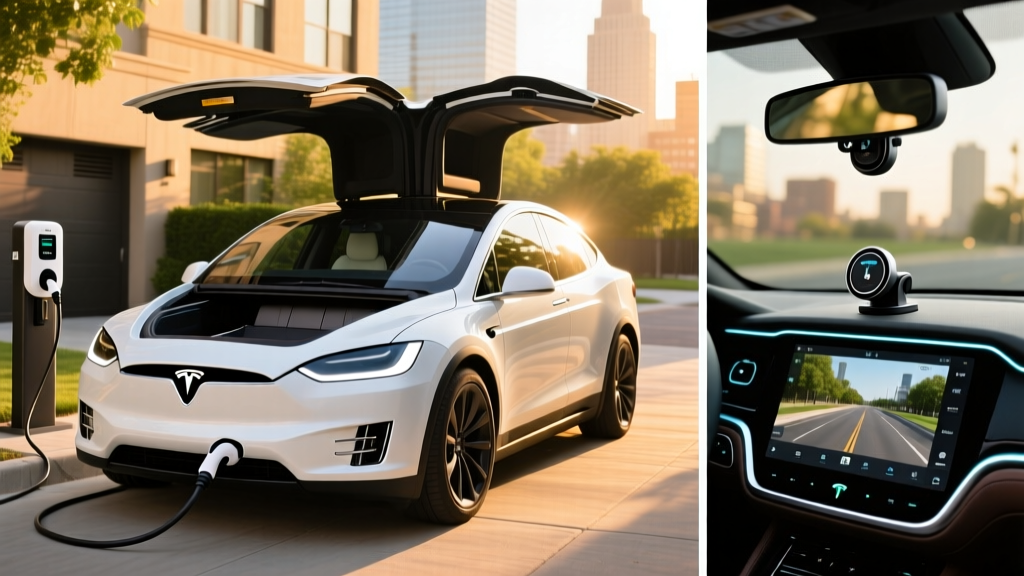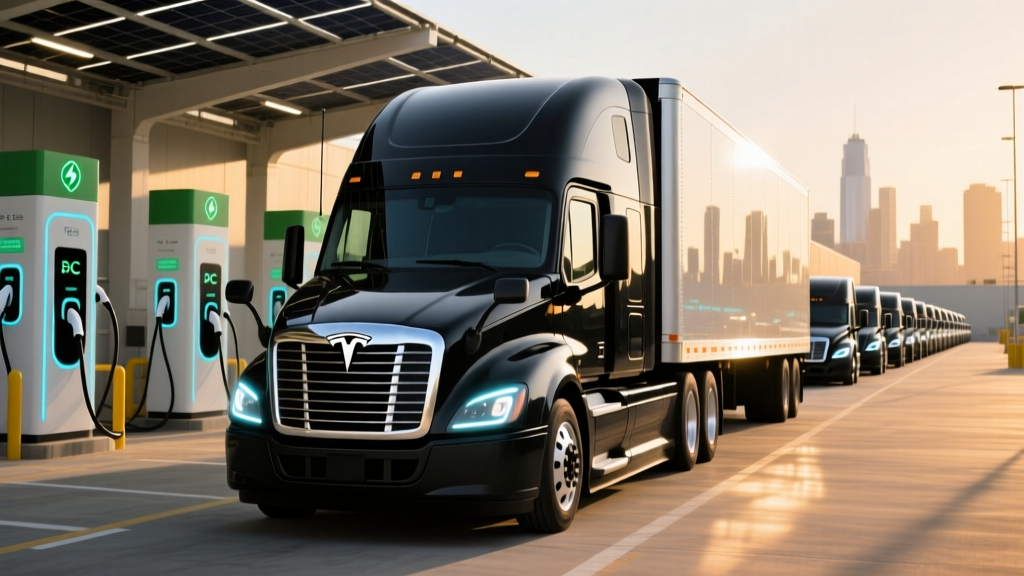
The Tesla Semi has been one of the most anticipated — and most delayed — vehicles in the commercial electric truck space since its 2017 unveiling. Now, with Tesla Semi sales expanding beyond early pilot programs into broader fleet deployments through 2025 and 2026, operators are finally getting hard data on what this Class 8 electric semi-truck delivers in real-world hauling. This profile covers everything fleet managers and owner-operators need to know: range under load, megawatt-class charging infrastructure, battery chemistry, pricing, and whether the Semi actually pencils out against diesel incumbents and emerging competitors like the Freightliner eCascadia and Volvo VNR Electric.
Range Reality Check
EPA-estimated range: 300 miles (300-mile variant) / 500 miles (500-mile variant) — both at 82,000 lbs GVW.
Real-world expectation: Expect 240–270 miles for the 300 variant and 400–440 miles for the 500 variant under typical highway loads (65–70 mph, moderate terrain, 60,000–70,000 lbs payload). Cold-weather operation (below 32°F) can reduce range by 15–25%, bringing the 500-mile variant down to roughly 325–375 miles. Regenerative braking on descent routes can partially offset losses.
Tesla Semi Specifications at a Glance
| Specification | 300-Mile Variant | 500-Mile Variant |
|---|---|---|
| EPA Estimated Range | 300 miles | 500 miles |
| Battery Capacity (estimated) | ~500 kWh (NMC/NCA) | ~900 kWh (NMC/NCA) |
| Energy Consumption | ~1.7 kWh/mile (Tesla) | ~1.7 kWh/mile |
| Drivetrain | Tri-motor AWD (1 steer + 2 drive axles) | Tri-motor AWD |
| Horsepower | ~1,000+ hp (combined peak) | ~1,000+ hp (combined peak) |
| 0-60 mph (loaded, 80k lbs) | ~20 seconds | ~20 seconds |
| 0-60 mph (unloaded) | ~5 seconds | ~5 seconds |
| Max DC Fast Charge Rate | ~1 MW+ (Megacharger) | ~1 MW+ (Megacharger) |
| 10-80% Charge Time (est.) | ~30 minutes (at 1 MW+) | ~45 minutes (at 1 MW+) |
| GVWR | 82,000 lbs | 82,000 lbs |
| Base MSRP (announced) | $250,000 | $290,000 |
| Warranty (battery/drivetrain) | Estimated 8 yr / 1,000,000 mi | Estimated 8 yr / 1,000,000 mi |
Note: Tesla has not published a complete EPA certification document for the Semi as of early 2026. Range and consumption figures are based on Tesla's stated targets and early fleet operator reports. Battery capacities are estimated from consumption × range calculations and industry analysis. Final certified specs may differ.
Charging Infrastructure: Megachargers and Fleet Depot Reality
The Tesla Semi's charging story is inseparable from the infrastructure required to support it. This is not a truck you plug into a standard Level 2 wall connector overnight and expect a full charge.
| Charging Level | Power (kW) | Approximate Rate | Notes |
|---|---|---|---|
| Tesla Megacharger (DC) | 1,000+ kW (1 MW+) | ~400+ miles in 30 min | Proprietary connector; Tesla-deployed at fleet depots and along select corridors |
| CCS2/MCS DC Fast (adapter) | 350–600 kW | ~200–350 miles in 30 min | Depends on station output; MCS (Megawatt Charging System) standard emerging |
| Depot Level 2 (AC) | 40–80 kW | ~25–50 miles per hour | Overnight charging; 10+ hours for full charge on 500-mi variant |
The critical insight for fleet buyers: kW is power (how fast energy flows); kWh is energy (battery capacity). The Semi's ~900 kWh battery in the long-range variant means even at a sustained 1 MW charge rate, a full 10–80% charge requires managing significant thermal loads. Tesla's Megacharger network uses liquid-cooled cables to sustain high power delivery, but real-world charge curves taper above 80% State of Charge (SoC) — expect the final 20% to add 15–20 minutes.
Fleet depot installation of Megachargers or equivalent MCS chargers requires utility coordination, potential transformer upgrades, and significant capital expenditure. Tesla has been bundling Megacharger deployment with Semi purchase agreements for large fleet customers, but smaller operators should budget $150,000–$300,000+ per high-power charging stall including utility upgrades and installation.
Battery Chemistry, Degradation, and Longevity
Tesla has not publicly confirmed the exact cell chemistry in production Semi units, but industry consensus and supply chain reporting point to nickel-based chemistry (NMC or NCA) — chosen for the energy density required to hit 500 miles of range under an 82,000-lb load. This differs from the LFP (lithium iron phosphate) chemistry Tesla uses in standard-range Model 3/Y vehicles.
LFP vs NMC trade-offs for a Class 8 truck:
- NMC/NCA: Higher energy density (critical for range at heavy loads), proven in Tesla's long-range vehicles, but more expensive and slightly faster degradation at high SoC. Better suited for the Semi's range requirements.
- LFP: Lower cost, longer cycle life, safer thermal profile, but heavier for equivalent kWh — a weight penalty that directly cuts into payload capacity on a Class 8 truck.
For fleet operators, the battery warranty is the key financial safeguard. Tesla announced an 8-year / 1,000,000-mile warranty target for the Semi's battery and drivetrain — far exceeding typical Class 8 diesel powertrain warranties. If honored at those terms, this covers most first-owner fleet lifecycles. Battery replacement cost for a ~900 kWh pack would likely exceed $100,000 at current cell pricing, making warranty coverage essential for total cost of ownership (TCO) modeling.
Pricing, Tax Credits, and Total Cost of Ownership
| Item | 300-Mile Variant | 500-Mile Variant |
|---|---|---|
| Base MSRP (announced) | $250,000 | $290,000 |
| Federal Tax Credit (§30D / §45W) | Up to $40,000 (commercial) | Up to $40,000 (commercial) |
| Estimated Net Price (after credit) | ~$210,000 | ~$250,000 |
| Comparable Diesel Class 8 (new) | $150,000–$200,000 | $150,000–$200,000 |
The Tesla Semi does not qualify for the standard §30D consumer clean vehicle credit (which caps at $7,500 and applies to light-duty vehicles under 14,000 lbs GVWR). Instead, commercial fleet buyers should look to IRC §45W (Commercial Clean Vehicle Credit), which offers up to $40,000 for qualified heavy-duty commercial EVs. Per IRS guidelines, eligibility depends on vehicle qualification, battery sourcing requirements, and the buyer's tax liability. Always consult a tax professional for your specific fleet situation.
Additionally, many states and air quality management districts (particularly California's HVIP program) offer supplemental incentives of $50,000–$120,000+ per electric truck, which can bring the effective purchase price close to or below diesel equivalents. These programs vary by jurisdiction and are subject to funding availability.
TCO advantage: At $0.12–$0.18/kWh for depot charging versus $4.00–$5.00/gallon diesel, and with the Semi consuming ~1.7 kWh/mile, the per-mile energy cost is roughly $0.20–$0.31/mile electric vs. $0.68–$0.85/mile diesel (at 6 mpg). Over 100,000 miles/year, that's $38,000–$54,000 in annual fuel savings — potentially paying back the price premium in 2–4 years before factoring in reduced maintenance (no oil changes, no DPF, no transmission fluid, fewer brake replacements due to regen).
Who Should Buy the Tesla Semi?
Choose the Tesla Semi 300-Mile if:
- Your routes are regional/last-mile (under 200 miles round-trip with buffer)
- You have depot charging infrastructure or can invest in it
- You operate in California or states with strong EV truck incentives
- Lower per-mile operating cost is your primary financial driver
Choose the Tesla Semi 500-Mile if:
- Your routes are long-haul regional (300–400 miles between charging stops)
- Megacharger or MCS corridor charging is available on your lanes
- You need the range buffer for cold-weather or mountainous operations
- You're willing to accept higher upfront cost for operational flexibility
Consider a diesel or competitor if:
- Your routes exceed 500 miles without reliable high-power charging en route
- You lack depot charging access and cannot invest in infrastructure
- Your operation requires immediate nationwide route flexibility without corridor planning
Tesla Semi vs. Key Competitors
| Specification | Tesla Semi (500 mi) | Freightliner eCascadia | Volvo VNR Electric |
|---|---|---|---|
| EPA Range | 500 miles (claimed) | ~230 miles | ~275 miles |
| Battery Capacity | ~900 kWh (est.) | ~475 kWh | ~565 kWh |
| Max DC Charge Rate | 1 MW+ | ~250 kW | ~250 kW |
| 10-80% Charge Time | ~45 min (at 1 MW) | ~90 min | ~90 min |
| Base Price (approx.) | $290,000 | $300,000+ | $280,000+ |
| GVWR | 82,000 lbs | 82,000 lbs | 82,000 lbs |
The Tesla Semi's primary advantage over the Freightliner eCascadia and Volvo VNR Electric is range and charging speed — both critical for operators looking beyond drayage and short-haul routes. However, Freightliner and Volvo have established dealer service networks and decades of fleet support infrastructure that Tesla is still building out. Fleet buyers must weigh the performance advantage against service and parts availability in their operating regions.
Standout Technology and Notable Drawbacks
Standout features:
- Tri-motor AWD drivetrain: Two independent motors on the drive axles plus a steer-axle motor provide exceptional traction and torque vectoring — no mechanical differential locks needed.
- Regenerative braking: Aggressive regen significantly reduces service brake wear; some operators report 50%+ reduction in brake replacement intervals.
- Integrated fleet telematics: Tesla's fleet management software provides real-time energy monitoring, route optimization, and remote diagnostics without third-party add-ons.
- Autopilot (SAE Level 2): Adaptive cruise, lane-keeping, and automatic emergency braking. This is a driver-assist system — the driver must remain fully engaged at all times. It is not autonomous driving.
- Aerodynamic design: The Semi's drag coefficient is significantly lower than conventional Class 8 trucks, directly contributing to its range advantage at highway speeds.
Notable drawbacks:
- Charging infrastructure dependency: Without Megacharger or MCS access, the Semi's range advantage is limited to depot-return operations.
- Service network: Tesla's commercial truck service footprint is still growing; downtime risk is higher in regions without dedicated Tesla Semi service centers.
- Payload penalty: The large battery pack adds significant weight, potentially reducing legal payload by 2,000–4,000 lbs compared to diesel — a real revenue concern for weight-sensitive freight.
- Production volume: Tesla Semi sales remain supply-constrained. Lead times for new orders are substantial, and Tesla has not committed to the production volumes needed to serve the broader Class 8 market.
Pros
- Best-in-class range (500-mi variant) among production electric semi-trucks
- Fastest DC charging capability (1 MW+ Megacharger)
- Lowest per-mile energy cost vs. diesel
- Minimal maintenance (no fluids, reduced brake wear)
- Strong regenerative braking and hill descent control
- Up to $40,000 federal commercial EV credit + state incentives
Cons
- Charging infrastructure requires major depot investment
- Service network still limited vs. legacy OEMs
- Battery weight reduces payload capacity
- Long lead times; production still ramping
- Unproven long-term battery degradation at 1M+ miles
- No public CCS/MCS adapter widely available yet
Frequently Asked Questions
What is the real-world range of the Tesla Semi?
Under typical highway conditions (65–70 mph, 60,000–70,000 lbs payload, moderate terrain), fleet operators report 400–440 miles from the 500-mile variant and 240–270 miles from the 300-mile variant. Cold weather (below freezing) reduces range by 15–25%. Mountain routes with significant elevation gain consume more energy on climbs but recover some via regenerative braking on descents.
How fast does the Tesla Semi charge?
At a Tesla Megacharger (1 MW+), the 500-mile variant can charge from 10–80% in approximately 45 minutes, adding roughly 400+ miles of range. At a 350 kW CCS/MCS station, expect roughly 200–250 miles added in 30 minutes. Depot Level 2 charging (40–80 kW) adds 25–50 miles per hour — suitable for overnight top-ups but not for mid-shift replenishment of the large battery.
How much does the Tesla Semi cost after tax credits?
The 300-mile variant lists at $250,000 and the 500-mile variant at $290,000. The federal commercial clean vehicle credit (§45W) can provide up to $40,000, bringing net prices to approximately $210,000 and $250,000 respectively. State incentives (especially California HVIP) can stack on top, potentially reducing effective cost by an additional $50,000–$120,000 depending on jurisdiction and program availability. Eligibility rules apply — consult IRS guidelines and a tax professional.
Does the Tesla Semi qualify for the federal EV tax credit?
Not the consumer §30D credit (which is limited to light-duty vehicles under 14,000 lbs GVWR). The Semi qualifies under §45W (Commercial Clean Vehicle Credit) for up to $40,000. Eligibility depends on battery component sourcing, critical minerals requirements, and the purchasing entity's tax situation. Rules evolve — verify current-year requirements at irs.gov.
Is the Tesla Semi worth buying vs. diesel or competitors?
For regional and corridor-haul fleets with depot charging access and available incentives, the Semi's per-mile energy savings ($0.20–$0.31 vs. $0.68–$0.85 for diesel) can deliver payback in 2–4 years, with a 1,000,000-mile battery warranty reducing long-term risk. For long-haul OTR (over-the-road) operations without reliable en-route charging, diesel remains more practical today. vs. the eCascadia and VNR Electric, the Semi wins on range and charge speed but loses on established service networks.
What is the Tesla Semi's battery warranty?
Tesla has targeted an 8-year / 1,000,000-mile warranty on the battery and drivetrain. This is exceptional for Class 8 and covers most first-owner fleet lifecycles. Final warranty terms should be confirmed in the purchase agreement, as Tesla has historically adjusted warranty details between announcement and delivery.
Can the Tesla Semi use non-Tesla charging networks?
The Semi uses Tesla's proprietary Megacharger connector. CCS/MCS adapter availability has been limited. As the Megawatt Charging System (MCS) standard deploys more broadly, interoperability should improve, but fleet buyers should plan charging infrastructure around Tesla's ecosystem for the near term.