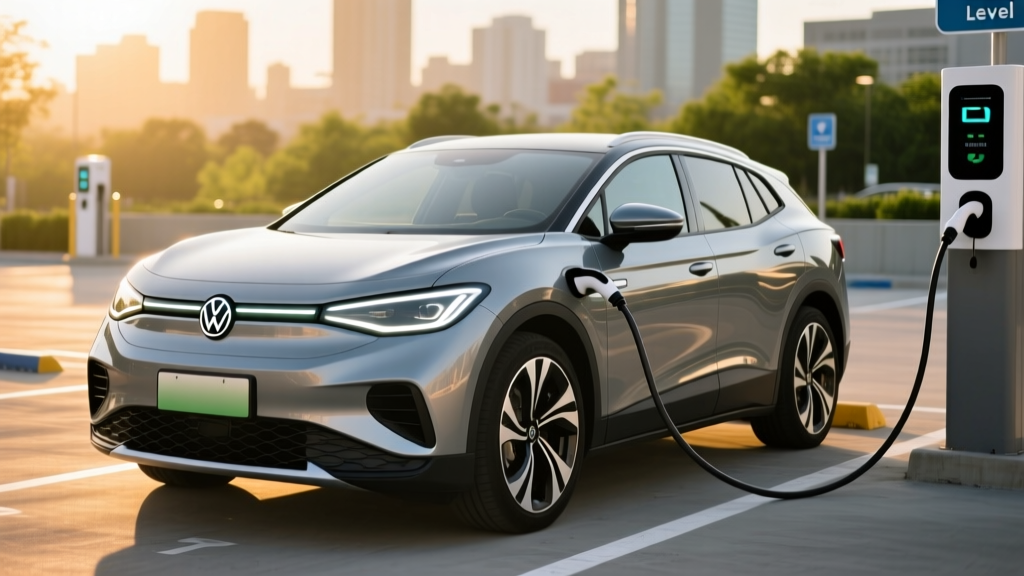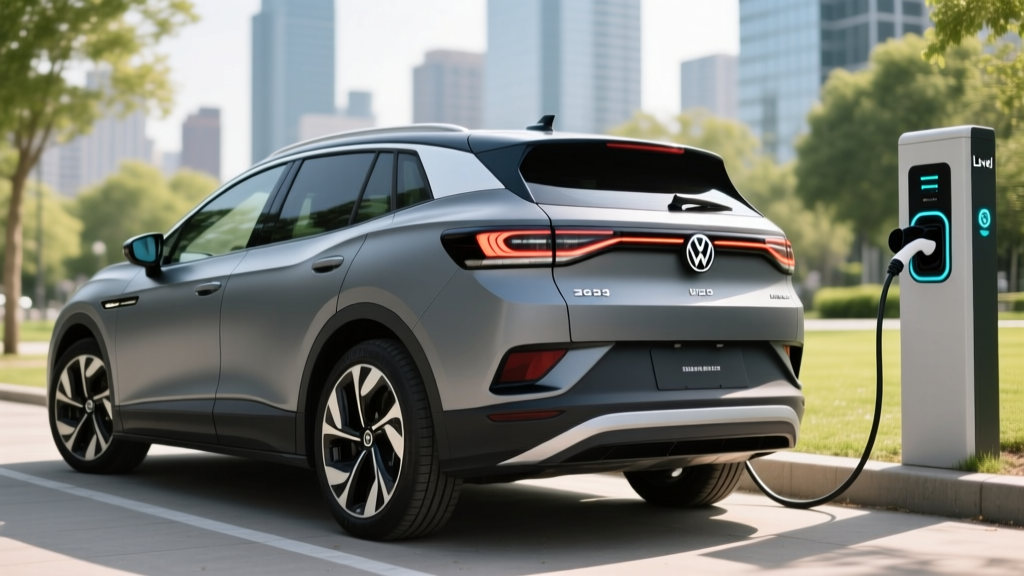
The 2025 Volkswagen ID.4 Pro occupies a specific niche in the electric SUV market: a practical, no-nonsense compact crossover that prioritizes cabin space and comfort over headline-grabbing performance numbers. After spending time with the ID.4 Pro and analyzing its spec sheet against real-world driving data, it's clear this is Volkswagen's most accessible long-range EV offering — one that trades 0-60 bragging rights for everyday livability. But with the EV market more competitive than ever, does the ID.4 Pro's formula still hold up?
2025 Volkswagen ID.4 Pro at a Glance
| Specification | Value |
|---|---|
| Base MSRP (Pro RWD) | $39,735 |
| EPA Range | 291 miles |
| Battery (Usable / Gross) | 77 kWh usable / 82 kWh gross |
| Battery Chemistry | NMC (Nickel Manganese Cobalt) |
| Drivetrain | Rear-Wheel Drive (single motor) |
| Horsepower / Torque | 282 hp / 339 lb-ft |
| 0-60 mph | 7.7 seconds |
| Max DC Fast Charge Rate | 170 kW |
| 10-80% DC Charge Time | ~28 minutes |
| Level 2 Home Charge Rate | 11 kW (AC) |
| EPA Efficiency | 107 MPGe combined (29 kWh/100 mi) |
| Cargo Volume (rear seats up / down) | 30.3 cu ft / 64.2 cu ft |
| Battery Warranty | 8 years / 100,000 miles |
| Limited Vehicle Warranty | 4 years / 50,000 miles |
Range and Efficiency: EPA vs. the Real World
The ID.4 Pro's 77 kWh usable battery (from an 82 kWh gross pack) delivers an EPA-estimated 291 miles on a full charge. That's a competitive figure in the compact EV SUV segment, landing between the Hyundai Ioniq 5 (303 mi on its Long Range RWD) and the Ford Mustang Mach-E Select (250 mi with standard battery).
The EPA's 291-mile figure is a blended estimate. In our experience and consistent with third-party testing, expect the following in real-world conditions:
- City/suburban driving (65 mph or below, mild weather): 280–300+ miles — the ID.4's regen and thermal management shine at lower speeds
- Sustained highway driving (70-80 mph): 240–260 miles — aerodynamic drag cuts range roughly 10-15%
- Cold weather (below 32°F): 200–230 miles — battery chemistry and cabin heating draw significant energy; preconditioning helps but doesn't eliminate the loss
- Cold + highway combined: As low as 190–210 miles — plan charging stops accordingly on winter road trips
According to fueleconomy.gov, the ID.4 Pro RWD achieves 107 MPGe combined, translating to approximately 29 kWh per 100 miles. That's middle-of-the-pack efficiency — not as lean as the Tesla Model Y (28 kWh/100 mi) but respectable for a vehicle with the ID.4's cabin volume.
One practical note: Volkswagen includes a usable buffer above and below the displayed state of charge to protect long-term battery health. When the dash reads 0%, there's still roughly 2-3 kWh in reserve — enough to limp to a charger, but not something to plan around regularly.
Charging Speed: DC Fast Charging and Home Setup
Charging is where the ID.4 Pro shows both its strengths and its limitations compared to segment leaders.
DC Fast Charging
The ID.4 Pro maxes out at 170 kW on a DC fast charger using its CCS1 connector. Volkswagen quotes a 10-80% charge time of approximately 28 minutes under optimal conditions (battery preconditioned, ambient temperature 65-80°F, charger capable of delivering sustained 170 kW).
Here's what the charge curve actually looks like in practice:
- 10-30% SoC: Peaks near 170 kW — this is where you see the headline number
- 30-60% SoC: Sustains roughly 130-150 kW — still strong
- 60-80% SoC: Tapers to 80-100 kW — typical NMC behavior to manage cell temperature
- Above 80% SoC: Drops sharply below 50 kW — avoid charging past 80% on road trips unless necessary
Compared to the Hyundai Ioniq 5's 350 kW peak (on an 800V architecture) or the Tesla Model Y's ~250 kW on V3 Superchargers, the ID.4's 170 kW ceiling is noticeably slower. On a 300-mile road trip with two charging stops, expect to spend roughly 10-15 extra minutes total versus those competitors. It's not a dealbreaker, but it's a factor for frequent travelers.
Home Level 2 Charging
The ID.4 Pro accepts up to 11 kW on Level 2 AC (48 amps on a 240V circuit). At this rate, you'll add approximately 33-36 miles of range per hour, or fully recharge the 77 kWh usable battery from empty in roughly 7.5-8 hours. This is adequate for overnight charging and matches most competitors in the segment.
| Charging Level | Power | Speed / Time | Use Case |
|---|---|---|---|
| Level 1 (120V household) | ~1.4 kW | ~4 mi/hr | Emergency / trickle top-up |
| Level 2 (240V, 48A) | 11 kW | ~33-36 mi/hr; full in ~7.5 hr | Daily home charging |
| DC Fast (CCS1) | Peak 170 kW | 10-80% in ~28 min | Road trip stops |
Home charging installation note: A 48-amp Level 2 charger requires a dedicated 60-amp circuit. Installation costs typically range from $800 to $2,500 depending on your electrical panel's capacity and the distance from panel to charger location. If your home has a 100-amp main panel, a panel upgrade to 200 amps may be required, adding $1,500-$3,000. Always consult a licensed electrician for a site-specific quote.
Performance and Driving Impressions
The ID.4 Pro's single rear-mounted motor produces 282 horsepower and 339 lb-ft of torque, delivering a 0-60 mph time of 7.7 seconds. This is adequate for highway merging and daily driving, but it won't win stoplight races against the Tesla Model Y Long Range (4.8 seconds) or even the Mach-E Premium RWD (6.1 seconds).
Where the ID.4 Pro earns its keep is ride quality. The MEB platform delivers a composed, comfortable ride that absorbs road imperfections better than most competitors. Steering is light and predictable — this is a cruiser, not a canyon carver. The turning circle of 31.5 feet is surprisingly tight for a compact SUV, making it genuinely easy to maneuver in parking structures and urban environments.
Regenerative braking offers multiple modes, accessible via steering-wheel paddles. You can select from coasting (D mode with minimal regen) through progressively stronger regen levels, though Volkswagen doesn't offer true one-pedal driving with a complete stop-and-hold function like Nissan or Chevrolet do. This is a recurring complaint from EV enthusiasts who prefer maximum regen for city driving.
Drivetrain Options
The Pro trim is available exclusively with rear-wheel drive. If you need all-wheel drive, you'll step up to the Pro S or Pro S Plus AWD trims, which add a front motor for a combined 335 hp and a 0-60 of roughly 5.4 seconds — at the cost of approximately 20 miles of EPA range.
Interior, Cargo, and Technology
Passenger and Cargo Space
The ID.4 Pro's cabin is one of its strongest selling points. Rear-seat legroom measures 37.6 inches — genuinely comfortable for adults on longer trips. Front legroom is 41.1 inches. Cargo volume behind the rear seats is 30.3 cubic feet, expanding to 64.2 cubic feet with the 60/40 split rear seats folded. That's competitive with the Toyota RAV4 and slightly less than the Model Y (76 cu ft max).
Notably, the ID.4 does not have a front trunk (frunk). The space under the hood is occupied by power electronics. For buyers who rely on frunk storage for charging cables or groceries, this is a genuine omission.
Infotainment and Tech
The 2025 ID.4 Pro features a 12.9-inch touchscreen running Volkswagen's ID. Software 4.0, a significant improvement over the sluggish ID. Software 3.x that plagued early 2021-2023 models. Response times are faster, the interface is more intuitive, and wireless Apple CarPlay and Android Auto are standard.
However, Volkswagen persists with capacitive-touch sliders for volume and climate control — a choice that continues to frustrate owners who prefer physical knobs. The touch-sensitive steering wheel controls also draw criticism for accidental inputs.
Driver Assistance
Standard IQ.DRIVE includes adaptive cruise control with stop-and-go, lane-keeping assist, front assist with automatic emergency braking, and travel assist (which combines adaptive cruise and lane centering). These features operate at SAE Level 2, meaning the driver must remain fully engaged with hands on the wheel and eyes on the road at all times.
Volkswagen's IQ.DRIVE and Travel Assist are SAE Level 2 driver-assistance systems. They are not self-driving. The driver is responsible for all vehicle control and must continuously monitor the road. The system may disengage unexpectedly in construction zones, faded lane markings, or adverse weather. Hands-on-wheel detection is enforced.
Pricing, Trims, and Federal Tax Credit
The 2025 Volkswagen ID.4 Pro RWD starts at $39,735 (including destination). Key trim levels include:
- ID.4 Pro (RWD): $39,735 — 291 mi range, 12.9" display, IQ.DRIVE, heated front seats
- ID.4 Pro S (RWD): ~$44,235 — adds panoramic roof, power liftgate, upgraded interior
- ID.4 Pro S Plus (AWD): ~$49,235 — dual-motor AWD, 335 hp, ~271 mi range
- ID.4 Pro S Plus (RWD): ~$46,735 — premium features, single-motor, ~291 mi range
Federal Tax Credit Eligibility (§30D)
The 2025 ID.4 Pro's eligibility for the $7,500 federal EV tax credit under IRS §30D depends on several factors that buyers must verify before purchase:
- MSRP cap: The ID.4 qualifies as an SUV under IRS rules, so the MSRP cap is $80,000 — all ID.4 trims clear this threshold easily
- Buyer income limits: Modified adjusted gross income must not exceed $150,000 (single), $225,000 (head of household), or $300,000 (joint filers)
- Battery sourcing requirements: For 2025, the vehicle must meet critical minerals and battery component sourcing thresholds set by the IRS. Volkswagen has confirmed that the US-built ID.4 (Chattanooga, Tennessee) qualifies for the full $7,500 credit when purchased new, but buyers should verify current eligibility on the IRS clean vehicle credit page at irs.gov before finalizing a purchase
- Point-of-sale transfer: As of 2024, buyers can elect to transfer the credit to the dealer at point of sale, effectively reducing the purchase price by $7,500 at the dealership rather than waiting for a tax refund
| Trim | MSRP | After $7,500 Credit* |
|---|---|---|
| Pro (RWD) | $39,735 | $32,235 |
| Pro S (RWD) | $44,235 | $36,735 |
| Pro S Plus (RWD) | $46,735 | $39,235 |
| Pro S Plus (AWD) | $49,235 | $41,735 |
*Assumes buyer meets all §30D income, sourcing, and MSRP requirements. State and local incentives may further reduce cost — check your jurisdiction's rules. Consult a tax professional for personal eligibility. Credit rules are subject to legislative change.
Warranty and Long-Term Ownership
Volkswagen provides an 8-year / 100,000-mile battery warranty that guarantees the high-voltage battery will retain at least 70% of its original capacity during that period. If degradation drops below this threshold, Volkswagen will repair or replace the battery to restore it above 70%.
The limited vehicle warranty covers 4 years / 50,000 miles, which is average for the segment. Volkswagen also includes 2 years of complimentary Electrify America DC fast charging (typically 800 kWh total), which is a meaningful perk for new owners who road-trip regularly.
NMC battery chemistry (as used in the ID.4) typically shows 8-12% degradation over the first 100,000 miles based on industry data from similar packs. This means most owners will see range settle around 255-265 miles after several years — still well above the 70% warranty threshold (which would be ~204 miles). LFP chemistry, used by some competitors, generally degrades more slowly but is not available in the ID.4 lineup.
Pros, Cons, and the Competition
- Spacious cabin with excellent rear legroom (37.6 in)
- Comfortable, composed ride quality — best-in-class for comfort
- Strong EPA range (291 mi) for the price point
- US-built (Chattanooga, TN) — supports tax credit eligibility
- IQ.DRIVE suite is well-calibrated and standard
- Improved ID. Software 4.0 infotainment
- Tight turning circle for urban driving
- 2 years free Electrify America charging included
- 170 kW DC fast charging is slower than Ioniq 5, Model Y
- No frunk (front trunk) for cable/accessory storage
- Capacitive-touch climate/volume sliders frustrate many drivers
- No true one-pedal driving with complete stop-hold
- 7.7-second 0-60 is leisurely for the segment
- Touch-sensitive steering wheel controls prone to accidental inputs
- Cold-weather range loss is significant (up to 30%)
How It Stacks Up Against Key Competitors
Against the Tesla Model Y Long Range (~$44,990, 310 mi, 250 kW charging, 4.8s 0-60), the ID.4 Pro trails on performance and charging speed but wins on ride comfort, build quality perception, and price after the tax credit. The Model Y's Supercharger network remains a significant advantage for road-trip-heavy buyers, though VW's Electrify America access has improved substantially.
The Hyundai Ioniq 5 SEL (~$42,600, 303 mi, 350 kW peak charging, 5.1s 0-60) is the ID.4's closest rival on specs. The Ioniq 5 charges dramatically faster thanks to its 800V architecture and offers a more engaging drive, but its rear seat is slightly tighter and its ride is firmer. If fast charging matters to you, the Ioniq 5 wins this matchup.
The Ford Mustang Mach-E Select RWD (~$38,995, 250 mi standard range) undercuts on price but delivers significantly less range. The extended-range Mach-E closes the gap but pushes the price above the ID.4 Pro.
Who Should Buy the 2025 Volkswagen ID.4 Pro?
- You prioritize ride comfort and cabin quietness over acceleration
- Your daily commute is under 80 miles round-trip (charging once or twice a week at home)
- You regularly carry adult passengers in the rear seat
- You want a mainstream-brand EV with a familiar dealership service experience
- You qualify for the full $7,500 federal tax credit, bringing effective price below $33,000
- You road-trip frequently and want the fastest possible DC charging (consider Ioniq 5 or Model Y)
- You live in a region with harsh winters and need maximum range buffer (consider AWD trims or larger-battery alternatives)
- You want one-pedal driving or sporty acceleration
- You rely on a frunk for charging cable storage
Frequently Asked Questions
What is the real-world range of the 2025 Volkswagen ID.4 Pro?
The EPA rates the ID.4 Pro RWD at 291 miles. In real-world driving, expect approximately 240-260 miles on sustained highway trips, 280-300 miles in city and suburban conditions, and 200-230 miles in freezing temperatures. Cold weather combined with highway speeds can reduce range to around 190-210 miles.
How fast does the ID.4 Pro charge at home and on the road?
On a DC fast charger, the ID.4 Pro peaks at 170 kW and charges from 10-80% in approximately 28 minutes under optimal conditions. At home on a Level 2 (240V, 48A) charger, it accepts up to 11 kW, adding roughly 33-36 miles of range per hour and fully recharging overnight in about 7.5-8 hours.
Does the 2025 ID.4 Pro qualify for the federal EV tax credit?
The US-built 2025 ID.4 Pro qualifies for the full $7,500 federal tax credit under §30D, provided the buyer meets income caps ($150K single / $300K joint) and the vehicle meets battery sourcing requirements (which Volkswagen has confirmed for the Chattanooga-built ID.4). The credit can be transferred at point of sale to reduce the purchase price directly. Always verify current eligibility at irs.gov before purchasing.
How much does the 2025 ID.4 Pro cost after tax credits?
The ID.4 Pro RWD starts at $39,735 MSRP. After the $7,500 federal tax credit (assuming full eligibility), the effective price drops to $32,235. State and local incentives may reduce this further. An as-tested Pro S with popular packages typically lands around $37,000-$38,000 after the federal credit.
Is the 2025 ID.4 Pro worth buying over the Tesla Model Y or Hyundai Ioniq 5?
It depends on your priorities. The ID.4 Pro offers the best ride comfort and a strong value proposition after the tax credit (effectively ~$32,235). The Model Y wins on performance (4.8s 0-60), Supercharger network access, and tech features. The Ioniq 5 wins on DC charging speed (350 kW peak) and driving engagement. If comfort, space, and value matter most, the ID.4 Pro is a strong choice. If charging speed or performance is paramount, look at the alternatives.
What battery chemistry does the ID.4 Pro use, and how long will it last?
The ID.4 Pro uses NMC (nickel manganese cobalt) lithium-ion cells. NMC offers strong energy density but typically shows 8-12% degradation over 100,000 miles. Volkswagen warrants the battery for 8 years / 100,000 miles at a minimum of 70% capacity retention. Most owners report healthy battery performance well beyond 50,000 miles with normal charging habits (avoiding frequent 100% charges and DC fast charging exclusively).
Does the ID.4 Pro have all-wheel drive?
The ID.4 Pro trim is available only with rear-wheel drive. For all-wheel drive, you'll need to move to the Pro S Plus AWD trim, which adds a front motor for a combined 335 hp and approximately 271 miles of EPA range.