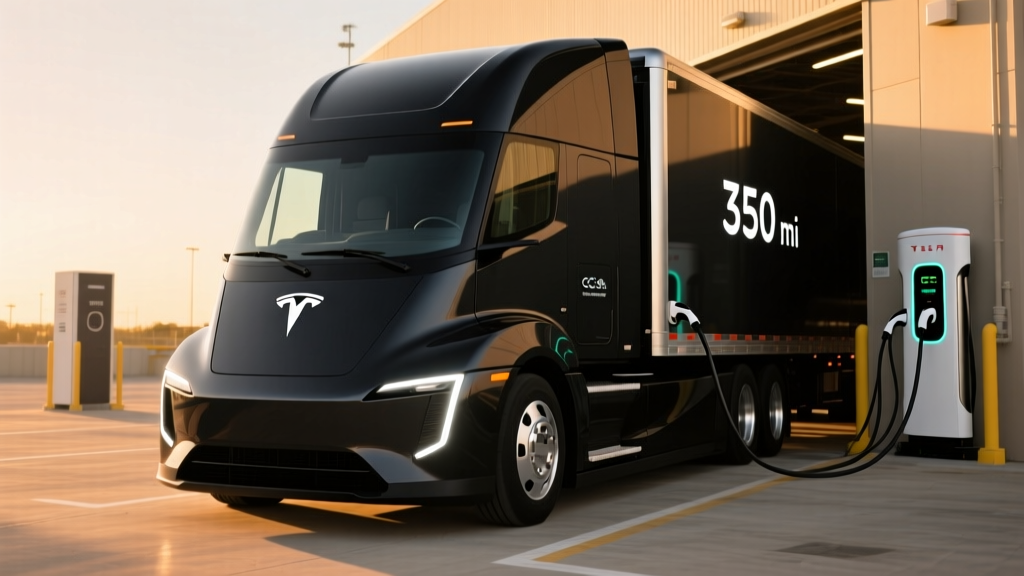
The Tesla Semi Enters Real Fleet Service
When PepsiCo took delivery of the first Tesla Semi units in late 2022, it marked the beginning of a prolonged real-world validation phase rather than a traditional product launch. Now in 2026, the Tesla Semi first customer deployments have expanded beyond early adopters like PepsiCo and Sysco to include a growing roster of regional and national fleets. These trucks are logging hundreds of thousands of miles across diverse routes, and the data from these early operators is finally giving the industry a concrete picture of what the Semi delivers outside of controlled demo events.
This profile synthesizes what we know from fleet operator reports, Tesla's published specifications, and EPA heavy-duty efficiency data to give fleet managers and industry watchers a grounded look at the Semi's capabilities, limitations, and total-cost-of-ownership proposition.
| EPA-Estimated Range | 500 miles (loaded, 82,000 lb GCW) / 300-mile variant available |
| Battery Capacity | ~900 kWh usable (500-mi variant); NMC chemistry |
| Max DC Fast Charge | ~1,000 kW (1 MW) via MCS connector; 10-80% in ~30 min (est.) |
| Level 2 / Depot Charging | ~250 kW AC/DC depot chargers; ~6-8 hr full charge at depot |
| 0-60 mph (loaded) | ~20 seconds (80,000 lb payload) |
| Horsepower | ~1,000+ hp combined (tri-motor AWD) |
| Drivetrain | Tri-motor AWD (1 steer axle motor, 2 drive axle motors) |
| Efficiency | ~1.7 kWh/mile (loaded); ~0.5 kWh/mile (bobtail) |
| Base MSRP (300-mi) | $250,000 (estimated fleet pricing) |
| Base MSRP (500-mi) | $290,000 (estimated fleet pricing) |
| Battery/Powertrain Warranty | Expected 8 years / 1,000,000 miles (not yet finalized) |
Range: What the EPA Number Means in Practice
EPA-Estimated Range: 500 miles (82,000 lb GCW, flat terrain, moderate climate)
Real-World Expectation: Fleet operators report 325-420 miles on loaded highway routes with elevation changes and HVAC load. In cold-weather testing (below 32°F), expect a 25-35% reduction, bringing effective loaded range to approximately 220-310 miles. Bobtail (unloaded) range can exceed 600 miles.
Tesla's claimed 500-mile figure was demonstrated in a controlled 500-mile drive with a full 82,000-pound load, but that test was conducted in favorable conditions on relatively flat terrain in Nevada and California. Real fleet routes involve grade changes, stop-and-go urban segments, headwinds, and temperature extremes that all draw from the ~900 kWh battery pack.
PepsiCo's early route data, shared at industry conferences, indicated that regional routes of 150-250 miles round-trip were easily handled with substantial charge remaining. The 500-mile variant shines on dedicated lane routes where the truck can return to a depot for overnight charging. For longer-haul applications exceeding 400 miles, en-route Megacharger stops become necessary — and that infrastructure remains the Semi's biggest bottleneck in 2026.
Charging Infrastructure: Megachargers and Depot Solutions
The Tesla Semi requires an entirely different charging paradigm compared to passenger EVs. At roughly 900 kWh of usable battery capacity, even a 250 kW DC fast charger would need over three hours for a full charge. Tesla's solution is the Megacharger network, purpose-built for the Semi and capable of delivering up to 1 MW (1,000 kW) of power.
| Charging Method | Max Power (kW) | Miles Added per Hour | 10-80% Time |
|---|---|---|---|
| Tesla Megacharger (1 MW DC) | ~1,000 kW | ~550 mi/hr | ~30 minutes |
| CCS / MCS Public DC (350 kW) | ~350 kW | ~190 mi/hr | ~90 minutes |
| Depot DC Fast (250 kW) | ~250 kW | ~140 mi/hr | ~2.5 hours |
| Depot AC (Level 2, 48 kW) | ~48 kW | ~27 mi/hr | ~15+ hours (overnight) |
Most first-customer fleets have installed dedicated depot charging infrastructure rather than relying on public Megachargers. A typical depot installation involves 250-500 kW DC chargers shared among multiple Semi units, with smart load management to avoid utility demand charges. According to NREL fleet electrification studies, depot charging infrastructure for a fleet of 10 Semis can cost $1.5-3 million including transformers, switchgear, and trenching — a capital expense that must be factored into total cost of ownership.
The Megacharger public network remains limited in 2026, with stations concentrated along key freight corridors in California, Nevada, and Texas. Fleets operating outside these corridors are largely restricted to depot-based charging, which limits the Semi to routes within approximately 200-250 miles of the home base (round trip) unless mid-route charging partnerships are arranged.
Performance and Drivetrain Engineering
The Tesla Semi uses a tri-motor configuration: one motor on the steer axle and two on the drive axle. Combined output exceeds 1,000 horsepower, which is competitive with or exceeds most Class 8 diesel powertrains. The torque delivery is instantaneous, which gives the Semi a decisive advantage in merging, grade climbing, and stop-and-go urban freight.
With a full 80,000-pound payload, Tesla demonstrated a 0-60 mph time of approximately 20 seconds — roughly half the time of a comparable diesel Class 8 truck. Bobtail (unloaded), the Semi hits 60 mph in about 5 seconds, which is sports-car territory and requires drivers to recalibrate their expectations.
The tri-motor AWD system also provides regenerative braking across all driven axles. On downhill grades, the regen system can maintain speed without service brake application, reducing brake wear dramatically. Multiple fleet operators have reported that brake pad replacement intervals have extended by 3-5x compared to their diesel counterparts — a meaningful maintenance savings over a million-mile service life.
Battery Technology and Longevity Outlook
The Semi's battery pack is the largest Tesla has ever put into production, at approximately 900 kWh of usable capacity (500-mile variant). Tesla has not published the exact cell chemistry breakdown, but industry analysis and supply chain reporting indicate the pack uses a mix of NMC (nickel manganese cobalt) cells optimized for energy density and cycle life, given the weight and range requirements of a Class 8 application.
For fleet buyers, the critical question is degradation over a million-mile service life. Tesla's battery management system employs active liquid thermal management across the pack, and the Semi's large battery means that typical daily usage represents a relatively shallow depth of discharge compared to passenger EVs. A 250-mile daily route uses roughly 25-30% of the 500-mile pack — a cycle depth that NMC chemistry handles well over thousands of cycles.
Tesla has not yet finalized the production battery warranty, but pre-order documentation referenced an 8-year / 1,000,000-mile battery and drive unit warranty with a minimum 70% capacity retention threshold. For fleets, this is critical: at 70% capacity, a 500-mile Semi would still deliver ~350 miles of loaded range — sufficient for most regional routes.
Pricing, Tax Credits, and Fleet Economics
The Tesla Semi's pricing has been a moving target since its 2017 unveiling. As of 2026, estimated fleet pricing places the 300-mile variant at approximately $250,000 and the 500-mile variant at approximately $290,000. These figures are before any incentives and represent a significant premium over a new diesel Class 8 truck, which typically costs $140,000-$180,000.
| Variant | Est. MSRP | Federal §30D / 45W Credit | Est. Net Price |
|---|---|---|---|
| 300-Mile Range | $250,000 | Up to $40,000 (Commercial Clean Vehicle, §45W) | ~$210,000 |
| 500-Mile Range | $290,000 | Up to $40,000 (Commercial Clean Vehicle, §45W) | ~$250,000 |
Important tax credit note: The Tesla Semi is a commercial vehicle, so it falls under IRS §45W (Commercial Clean Vehicle Credit) rather than the consumer §30D credit. The §45W credit for vehicles over 14,000 lb GVWR is up to $40,000 per vehicle, subject to business tax liability, critical mineral sourcing requirements, and domestic assembly rules. Fleet buyers should consult a tax professional — credit eligibility depends on the purchasing entity's tax situation and the vehicle's battery component sourcing, which Tesla has not fully disclosed for the Semi.
Additionally, many states and air quality management districts offer supplemental incentives for zero-emission heavy-duty trucks. California's Hybrid and Zero-Emission Truck and Bus Voucher Incentive Project (HVIP), for example, has offered vouchers of $60,000-$120,000 per Class 8 BEV, which can dramatically reduce the effective purchase price. These programs vary by jurisdiction and funding availability — check your state's clean fleet programs.
Total Cost of Ownership: The Fleet Math
The Semi's value proposition is not purchase price — it's operating cost. At ~1.7 kWh/mile loaded and an average commercial electricity rate of $0.12-$0.18/kWh (varies heavily by utility and time-of-use), the Semi's fuel cost is roughly $0.20-$0.31 per mile. A comparable diesel truck at 6.5 mpg and $4.50/gallon diesel burns $0.69 per mile. Over 100,000 annual miles, that's a fuel savings of $38,000-$49,000 per year.
Combine that with dramatically reduced brake wear, no oil changes, no DEF fluid, and fewer moving parts in the drivetrain, and fleet operators are reporting total operating cost reductions of 40-50% compared to diesel on comparable routes. At that rate, the Semi's price premium over diesel can be recovered in 2-4 years on high-utilization routes.
Tech, Driver Experience, and Autopilot
The Semi's cab is a radical departure from conventional Class 8 trucks. The driver sits in a centered position with dual 15-inch touchscreens flanking the steering wheel — one for vehicle controls and navigation, the other for cameras and media. The wraparound windshield provides exceptional visibility, and the absence of a transmission tunnel creates a spacious, flat-floor cabin.
Tesla's Autopilot driver-assistance suite is included, featuring adaptive cruise control, lane-keeping, and automatic emergency braking calibrated for the Semi's mass and braking distances. This is an SAE Level 2 system — the driver must remain fully engaged and responsible for the vehicle at all times. Tesla has not announced plans for a "Full Self-Driving" variant for the Semi, and regulatory approval for autonomous Class 8 operation on public highways remains distant.
SAE Automation Level: Level 2
The Tesla Semi's Autopilot is a driver-assistance system, not a self-driving system. The driver must keep hands on the wheel, monitor the road, and be prepared to take over at any moment. This is consistent with all current production Tesla driver-assist features.
Notable tech drawbacks include the lack of a conventional sleeper cab (the Semi is a day-cab design), limited aftermarket accessory compatibility compared to Freightliner or Volvo trucks, and dependence on Tesla's proprietary software ecosystem for fleet telematics — which may not integrate seamlessly with existing fleet management platforms.
Who the Tesla Semi Suits Best
Choose the Tesla Semi if:
- Your fleet runs dedicated regional lanes of 150-400 miles round-trip with depot return
- You operate in states with strong ZEV truck incentives (CA, NY, NJ, WA)
- Fuel cost per mile is a primary KPI and electricity rates are favorable
- You can invest in depot charging infrastructure ($1.5-3M for a 10-truck fleet)
- Driver recruitment is a challenge — the Semi's tech-forward cab attracts drivers
Look elsewhere (or wait) if:
- Your routes regularly exceed 450 miles without reliable mid-route charging
- You operate in regions with no Megacharger coverage and high electricity demand charges
- You need a sleeper cab for multi-day long-haul routes
- Your fleet size doesn't justify the depot charging infrastructure investment
- You need immediate delivery — Tesla Semi production ramp remains limited in 2026
Pros and Cons: The Fleet Operator Verdict
Pros
- Fuel cost savings of $0.38-$0.49/mile vs. diesel on loaded routes
- Dramatically reduced brake wear from regen (3-5x interval extension)
- 500-mile EPA range covers most regional freight without en-route charging
- 1,000+ hp tri-motor performance; 0-60 in ~20 sec loaded
- Center-seat cab with exceptional visibility and dual screens
- Zero tailpipe emissions — helps meet corporate sustainability mandates
- Up to $40,000 federal commercial clean vehicle credit (§45W)
Cons
- ~$250,000-$290,000 MSRP — 60-100% premium over diesel Class 8
- Depot charging infrastructure requires $1.5-3M+ capital investment
- Public Megacharger network remains sparse outside CA/NV/TX in 2026
- Day cab only — no sleeper option for long-haul multi-day routes
- Cold-weather range loss of 25-35% limits effective winter range
- Limited production volume; delivery timelines remain uncertain
- Proprietary Tesla ecosystem may not integrate with existing fleet telematics
Frequently Asked Questions
What is the real-world range of the Tesla Semi?
The 500-mile variant delivers an EPA-estimated 500 miles at 82,000 lb GCW. In real-world fleet operation, expect 325-420 miles on loaded highway routes and 220-310 miles in cold weather (below 32°F). The 300-mile variant delivers approximately 200-260 real-world loaded miles.
How fast does the Tesla Semi charge?
At a Tesla Megacharger (1 MW / 1,000 kW DC), the Semi can add roughly 550 miles of range per hour and charge from 10-80% in approximately 30 minutes. At a 250 kW depot charger, 10-80% takes roughly 2.5 hours. Overnight depot charging at 48 kW AC takes 15+ hours for a full charge.
How much does the Tesla Semi cost after tax credits?
The 300-mile variant is estimated at ~$250,000 MSRP and the 500-mile at ~$290,000. The federal §45W Commercial Clean Vehicle Credit can reduce the net cost by up to $40,000 per truck, bringing effective prices to roughly $210,000-$250,000. State incentives (e.g., California HVIP) can further reduce cost by $60,000-$120,000. Consult a tax professional for eligibility, as §45W depends on business tax liability, battery sourcing, and domestic assembly requirements.
Is the Tesla Semi worth buying vs. diesel or competing electric trucks?
For high-utilization regional routes (100,000+ miles/year), the Semi's operating cost advantage of 40-50% over diesel can recover the price premium in 2-4 years. Compared to competing Class 8 BEVs like the Freightliner eCascadia (~250-mile range) or Volvo VNR Electric (~275-mile range), the Semi offers nearly double the range, though at a higher price point and with limited public charging infrastructure. The right choice depends on your specific routes, utility rates, and incentive availability.
What are the biggest pros and cons of the Tesla Semi?
The biggest pro is operating cost: fuel savings of $38,000-$49,000/year per truck at 100,000 miles, plus drastically reduced brake and drivetrain maintenance. The biggest con is infrastructure: depot charging requires a $1.5-3M+ investment for a small fleet, and the public Megacharger network is still too sparse for flexible long-haul routing in most of the country.
Does the Tesla Semi qualify for the federal EV tax credit?
The Semi qualifies under the IRS §45W Commercial Clean Vehicle Credit, not the consumer §30D credit. The maximum credit for vehicles over 14,000 lb GVWR is $40,000, but eligibility depends on the purchasing entity's tax liability, critical mineral and battery component sourcing requirements, and final assembly in North America. Tesla manufactures the Semi in Nevada, satisfying the domestic assembly requirement, but battery sourcing compliance has not been publicly confirmed for all model years. Always verify current-year rules with a qualified tax advisor.
Who was the Tesla Semi's first customer?
PepsiCo was the Tesla Semi's first customer, taking delivery of the initial production units at Tesla's Nevada Gigafactory in December 2022. PepsiCo deployed the trucks on regional distribution routes in California and has since expanded its Semi fleet. Other early customers include Sysco, US Foods, and Martin Brower, all operating the Semi on regional food and beverage distribution lanes.