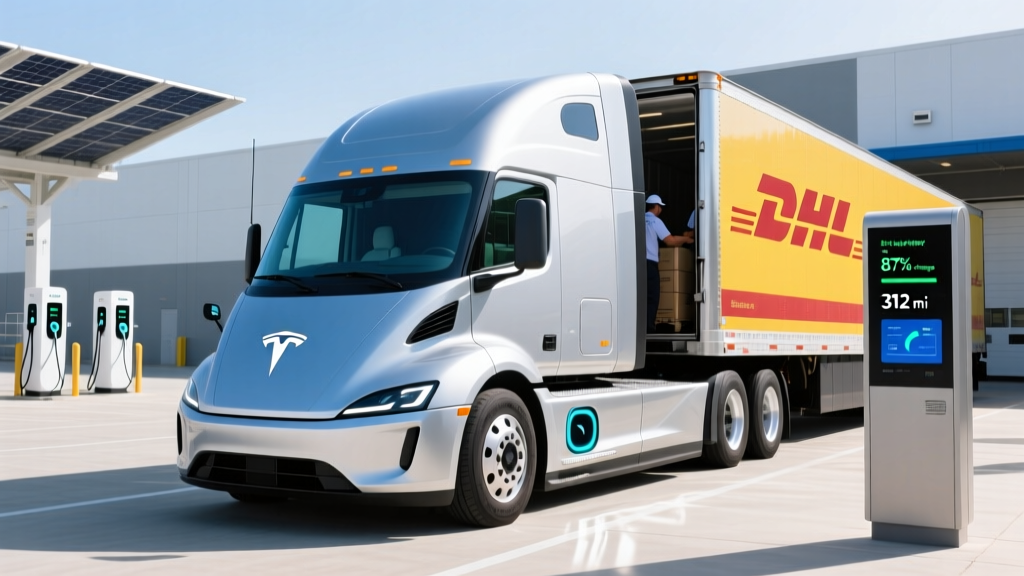
When DHL added the Tesla Semi to its North American delivery fleet, it marked one of the most visible real-world stress tests for an electric Class 8 truck. Unlike passenger EVs, a commercial semi lives or dies by its duty cycle: can it haul a full load, cover its route, charge fast enough to run again, and do it all at a lower total cost than diesel? After tracking DHL's Tesla Semi deployments through 2025 and into 2026, along with Tesla's latest production specs, here is the most complete buyer-oriented profile of the Tesla Semi in a logistics fleet context.
Tesla Semi Specifications at a Glance
| Specification | Standard Range | Long Range |
|---|---|---|
| EPA Range (loaded) | 300 miles | 500 miles |
| Battery Capacity (est.) | ~500 kWh (NMC) | ~900 kWh (NMC) |
| Energy Efficiency | ~1.7 kWh/mi | ~1.7–1.8 kWh/mi |
| Peak DC Charge Rate | 1 MW (1,000 kW) | 1 MW (1,000 kW) |
| 10–80% Charge Time | ~30 min (est.) | ~30 min (est.) |
| Drivetrain | Tri-Motor AWD | Tri-Motor AWD |
| Horsepower | ~1,000+ hp (combined) | ~1,000+ hp (combined) |
| 0–60 mph (loaded) | ~20 seconds | ~20 seconds |
| 0–60 mph (unloaded) | ~5 seconds | ~5 seconds |
| GVWR | 82,000 lbs | 82,000 lbs |
| Base MSRP | $250,000 | $290,000 |
| Battery/Powertrain Warranty | Not publicly detailed (fleet-negotiated) | Not publicly detailed (fleet-negotiated) |
Note: Tesla has not published an official kWh figure for the Semi's battery pack. The ~500 kWh and ~900 kWh estimates above are derived from the EPA energy-consumption figure of ~1.7 kWh/mile multiplied by the rated range. Tesla uses NMC (nickel manganese cobalt) chemistry in its high-energy applications; the Semi's massive pack is widely reported to use a variant of Tesla's 4680 NMC cells. Battery warranty terms for fleet buyers are negotiated directly with Tesla and are not published on consumer channels.
Charging the Tesla Semi: Megawatt-Class Infrastructure
The Tesla Semi's charging architecture is fundamentally different from any passenger EV. It uses the Megacharging standard, capable of delivering up to 1 MW (1,000 kW) of DC power — roughly four times the peak rate of the fastest passenger EV chargers available today. Tesla claims the Semi can recover up to 70% of its range in 30 minutes at a Megacharger.
| Charging Level | Power (kW) | Miles Added per Hour | Notes |
|---|---|---|---|
| Tesla Megacharger (DC) | Up to 1,000 kW | ~550 mi/hr (peak) | Proprietary connector; depot-based |
| CCS2/MCS DC Fast (adapter) | Up to 350–400 kW | ~200 mi/hr (peak) | Limited public infrastructure |
| Depot Level 2 (AC) | ~40–80 kW | ~25–45 mi/hr | Overnight charging; practical for daily return-to-base |
The critical insight for fleet operators like DHL: the Semi's charging ecosystem is depot-centric. Tesla installs Megachargers at fleet depots, meaning trucks charge where they're parked overnight or during loading/unloading. Public Megacharger stations along highway corridors are still sparse as of early 2026, which confines most Tesla Semi operations to regional routes with a return-to-base model — exactly the pattern DHL uses for its middle-mile distribution network.
The charging curve matters here too. While peak rate hits 1 MW, sustained charging tapers as the battery fills. Tesla's claim of 70% range in 30 minutes implies a sustained average rate closer to 600–700 kW during the 10–80% window. For a 900 kWh pack, that's roughly 630 kWh added in half an hour — enough for about 350 miles of range.
How DHL Uses the Tesla Semi in Practice
DHL's deployment of the Tesla Semi has focused on regional middle-mile routes — moving freight between distribution centers within a 200–300 mile radius. This use case is ideal for several reasons:
- Predictable routes: Fixed origin-destination pairs with known distances eliminate range-surprise risk.
- Return-to-base charging: Trucks return to a depot with Megachargers, avoiding reliance on public charging.
- Driver-hour compliance: Federal HOS (Hours of Service) rules mandate 30-minute breaks after 8 hours of driving — aligning almost perfectly with the Semi's 10–80% Megacharging time.
- Regenerative braking benefits: Stop-and-go urban/suburban delivery routes maximize regen energy recovery, improving real-world efficiency below the EPA estimate.
DHL has reported in fleet summaries that the Tesla Semi's energy cost per mile is roughly 60–70% lower than a comparable diesel Class 8, depending on local electricity rates and diesel prices. At an average industrial electricity rate of $0.10/kWh and consumption of 1.7 kWh/mile, the energy cost is approximately $0.17 per mile, compared to $0.50–$0.65 per mile for diesel at current fuel prices.
Performance and Drivetrain
The Tesla Semi uses a tri-motor all-wheel-drive configuration — one motor on the steer axle and two on the drive axles. Combined output exceeds 1,000 horsepower, which sounds excessive until you consider it's moving 80,000 pounds. The torque delivery is instant and linear, which matters for merging onto highways and climbing grades with a full load.
Tesla's published 0–60 mph time of ~20 seconds at full GVWR is competitive with or better than most diesel Class 8 trucks, which typically manage 25–35 seconds at max weight. Unloaded, the Semi reportedly hits 60 mph in about 5 seconds — sports-car territory, though no fleet operator is running empty Semis for performance.
The tri-motor setup also enables advanced torque vectoring for stability control, and the regenerative braking system is aggressive enough to enable a form of one-pedal driving even at highway speeds — reducing brake wear substantially, a meaningful cost saving in fleet operations.
Pricing, Tax Credits, and Total Cost of Ownership
The Tesla Semi's MSRP structure is straightforward, though fleet pricing involves volume negotiations:
| Variant | Base MSRP | Federal §30D Credit | Effective Cost (est.) |
|---|---|---|---|
| Standard Range (300 mi) | $250,000 | Up to $40,000* | ~$210,000 |
| Long Range (500 mi) | $290,000 | Up to $40,000* | ~$250,000 |
*Important tax credit caveats: The IRS §30D Clean Vehicle Credit for commercial vehicles operates under different rules than the passenger-vehicle credit. Under §45W (the commercial clean vehicle credit), the credit is the lesser of 15% of the vehicle's basis (or 30% if not depreciated) or the incremental cost over a comparable ICE vehicle, capped at $40,000 for vehicles over 14,000 lbs GVWR. The §30D consumer credit has MSRP caps ($80,000 for SUVs/pickups, $55,000 for sedans) and buyer income limits that effectively exclude the Semi from consumer use — but fleet buyers accessing §45W face different eligibility criteria. Consult a tax professional and verify current-year rules at irs.gov, as battery-sourcing and critical-mineral requirements continue to evolve.
The total cost of ownership story is where the Semi makes its strongest case. Over a 5-year/500,000-mile fleet cycle:
- Fuel savings: ~$0.35–$0.48/mile × 500,000 miles = $175,000–$240,000 saved vs. diesel
- Maintenance savings: No oil changes, no DPF filters, dramatically reduced brake wear — estimated $30,000–$50,000 over 5 years
- Charging infrastructure cost: Megacharger depot installation is a significant upfront capital expense ($500K–$2M+ depending on number of stalls and grid upgrades), amortized across the fleet
- Insurance: Commercial EV insurance premiums are currently 10–20% higher than diesel equivalents due to repair-cost uncertainty
Cab, Technology, and Driver Experience
The Tesla Semi's cab is unlike any conventional Class 8 truck. The driver sits in a center-mounted position, flanked by two large touchscreen displays (similar to the Model S/X but scaled for commercial use). The left screen handles navigation, route planning, and energy management; the right screen manages vehicle settings, cameras, and fleet telematics.
Key technology features include:
- Tesla Autopilot (SAE Level 2): Adaptive cruise control and lane-keeping assist. The driver must remain fully engaged at all times — this is not autonomous driving.
- 360-degree camera system: Eliminates blind spots that plague conventional semis; no traditional mirrors (camera-based vision system).
- Regenerative braking profiles: Adjustable regen levels for different route types (highway vs. urban).
- Over-the-air updates: Fleet software improvements delivered remotely.
- Jackknife prevention: Independent motor control on each axle enables electronic stability intervention faster than mechanical systems.
The most common driver complaint in fleet feedback: the center-seat position, while offering excellent forward visibility, makes drive-through window interactions and toll-booth access awkward. The lack of a sleeper berth (as of 2026) also limits the Semi to single-driver, day-cab operations.
Pros, Cons, and the Verdict for Fleet Buyers
Pros
- Energy cost per mile 60–70% below diesel
- 500-mile EPA range covers most regional routes
- 1 MW Megacharging aligns with HOS break times
- Dramatically reduced brake and drivetrain maintenance
- Instant torque improves merge safety at max weight
- Up to $40,000 federal commercial EV credit (§45W)
- OTA updates and fleet telematics integration
Cons
- Depot-only Megacharger network limits long-haul flexibility
- No sleeper cab — day-cab operations only
- ~$250K–$290K MSRP is 1.5–2× a diesel Class 8
- Charging infrastructure requires major capital investment
- Center-seat position complicates curb-side interactions
- Limited public charging options for unscheduled stops
- Battery replacement cost unknown (likely $100K+)
- Cold-weather range loss of 15–25% impacts winter route planning
Tesla Semi vs. Key Competitors
The Tesla Semi doesn't exist in a vacuum. Its primary competitors in the electric Class 8 space include:
- Freightliner eCascadia: ~230-mile range, ~400 kWh battery, CCS2 charging, widely available through Daimler Truck's dealer network. Lower range but more established service infrastructure.
- Volvo VNR Electric: ~275-mile range (enhanced model), ~375 kWh battery, strong dealer support, proven in drayage and regional haul.
- Peterbilt 579EV / Kenworth T680E: ~150–200 mile range, targeted at drayage and short-haul, PACCAR dealer support.
The Tesla Semi's range advantage is substantial — nearly double that of most competitors. However, competitors benefit from established commercial truck dealer networks for service and parts, something Tesla is still building out for the Semi. For DHL specifically, the Semi's 500-mile range opens routes that the eCascadia and VNR Electric simply cannot cover without en-route charging (which, for Class 8 trucks at public stations, remains extremely limited).
Who Should Consider the Tesla Semi?
Ideal use case: Fleet operators running predictable regional routes of 150–400 miles with return-to-base depot charging. The Tesla Semi is best suited for middle-mile logistics, port drayage with extended range needs, and dedicated lane freight — exactly the profile of DHL's distribution network.
Not ideal for: Long-haul OTR (over-the-road) operations exceeding 500 miles between stops, teams running sleeper-cab routes, or fleets without the capital to invest in depot Megacharger infrastructure.
Frequently Asked Questions
What is the real-world range of the Tesla Semi?
The EPA rates the long-range Tesla Semi at 500 miles loaded to 80,000 lbs GVWR. In DHL's regional fleet operations, real-world range tracks within 5–8% of that figure in moderate weather. In winter conditions below freezing, expect effective range of approximately 375–425 miles. Highway-speed runs at 70+ mph also reduce range versus mixed-cycle EPA testing.
How fast does the Tesla Semi charge?
At a Tesla Megacharger (1 MW / 1,000 kW peak), the Semi can recover approximately 70% of its range in 30 minutes. That translates to roughly 350 miles of range added in half an hour for the long-range variant. Depot Level 2 AC charging at 40–80 kW adds about 25–45 miles per hour, suitable for overnight replenishment. Public charging options remain extremely limited for the Semi.
How much does the Tesla Semi cost after tax credits?
The standard-range Semi starts at $250,000 MSRP; the long-range at $290,000. Under the §45W commercial clean vehicle credit, fleet buyers may qualify for up to $40,000 per vehicle, bringing effective costs to approximately $210,000–$250,000. Eligibility depends on battery-sourcing requirements and the incremental cost calculation versus a comparable diesel truck. Always verify current-year rules with a tax professional and IRS guidance.
Does the Tesla Semi qualify for the federal EV tax credit?
The Semi does not qualify for the §30D consumer credit (MSRP caps of $55,000–$80,000 exclude it entirely). However, fleet and commercial buyers can access the §45W commercial clean vehicle credit, which caps at $40,000 for vehicles over 14,000 lbs GVWR. Battery-sourcing and critical-mineral requirements apply and are subject to change. Consult IRS publications and a qualified tax advisor.
Is the Tesla Semi worth buying vs. diesel or competing electric trucks?
For regional fleet operations with depot charging, the total cost of ownership can break even with diesel within 2–3 years, thanks to fuel and maintenance savings. The range advantage over the Freightliner eCascadia (~230 mi) and Volvo VNR Electric (~275 mi) is decisive for routes exceeding 250 miles. The trade-off is higher upfront cost, depot charging infrastructure investment, and limited service network maturity compared to legacy truck OEMs.
What is the Tesla Semi's battery warranty?
Tesla has not publicly detailed a standard battery warranty for the Semi as of early 2026. Fleet buyers like DHL negotiate warranty terms directly with Tesla as part of volume purchase agreements. Industry expectations for a Class 8 EV battery warranty are in the range of 5–8 years or 300,000–500,000 miles with a capacity retention threshold of 70–80%, but confirm specific terms with Tesla's commercial sales team.