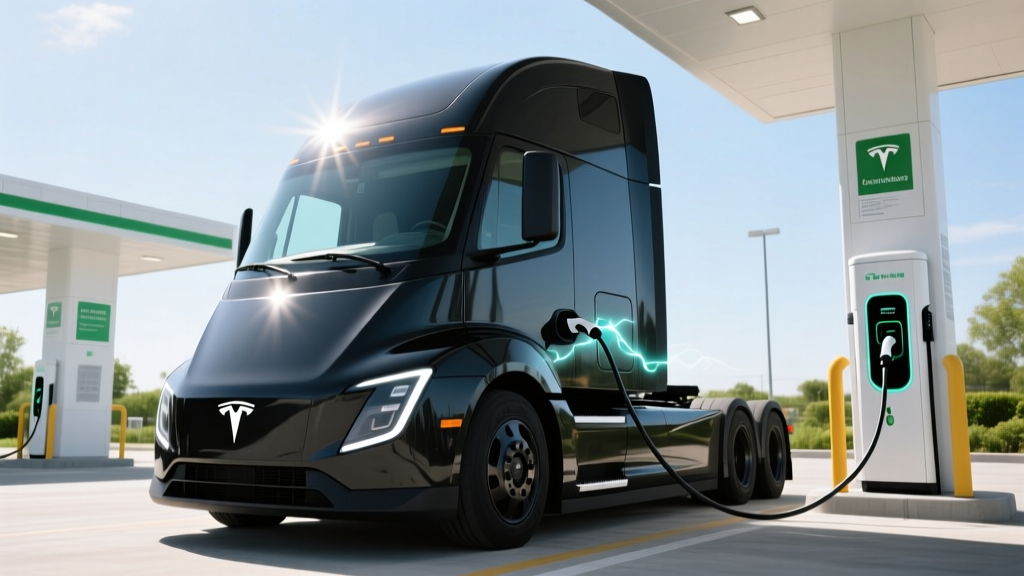
The Tesla Semi is the most talked-about electric Class 8 truck on the road, but for fleet operators and logistics planners, the conversation always comes back to one question: how long does it take to charge? With a battery pack roughly ten times the size of a long-range passenger EV, the Tesla Semi charge equation is unlike anything in the consumer EV world. This profile breaks down the Semi's range, charging infrastructure, energy consumption, and total cost picture as of the 2026 production ramp.
Tesla Semi Specifications at a Glance
| Specification | 300-Mile Variant | 500-Mile Variant |
|---|---|---|
| EPA-Estimated Range | ~300 miles (loaded) | ~500 miles (loaded) |
| Battery Capacity (est.) | ~600 kWh (LFP/NMC blend) | ~900–1,000 kWh |
| Energy Consumption | < 2 kWh/mile (EPA target, loaded) | |
| Max DC Fast Charge Rate | ~1 MW+ via Tesla Megacharger | |
| 10–80% Charge Time (est.) | ~30 minutes at Megacharger | |
| Motor Configuration | Tri-Motor AWD (1 steer, 2 drive axles) | |
| 0–60 mph (loaded, 80k lbs) | ~20 seconds | |
| 0–60 mph (unloaded) | ~5 seconds | |
| Base MSRP | $250,000 | $290,000 |
| Founders Series Price | $290,000 (limited) | |
| Federal Tax Credit (§30D / 45W) | Up to $40,000 (commercial clean vehicle credit) | |
| Drivetrain Warranty | Estimated 8 years / 1,000,000 miles (unconfirmed for production) | |
Note: Tesla has not published final EPA certification data for the Semi as of early 2026. Range and battery figures above reflect Tesla's announced targets and third-party fleet testing data. Specifications may shift as production scales.
Range Reality: What 500 Miles Actually Looks Like
Real-World Expectation: ~350–420 miles highway at 65 mph; ~250–320 miles in cold weather (below 32°F) or in mountainous terrain with sustained grades. City/drayage cycles with regenerative braking can approach or exceed the 500-mile target due to frequent energy recapture.
Tesla's 500-mile range claim is measured at full gross combined weight (80,000 lbs) under specific test cycles. In real-world long-haul operation, several factors compress that number:
- Aerodynamic drag at highway speed: Class 8 trucks consume energy roughly proportional to the cube of speed. Running at 70 mph versus 60 mph can reduce range by 15–20%.
- Cold-weather battery performance: Lithium-ion packs lose 15–30% of effective capacity in sub-freezing temperatures. Tesla's thermal management system mitigates this, but cabin heating and battery conditioning still draw from the pack.
- Terrain: Sustained 4–6% grades (common on I-70 through Colorado or I-5 through the Siskiyous) can spike consumption to 3+ kWh/mile, effectively halving range on those segments. Regenerative braking on descents partially recovers this.
- Payload variance: A truck running at 60,000 lbs GCW instead of 80,000 lbs will see meaningfully better range — potentially 550+ miles on the 500-mile variant.
For fleet route planning, the conservative figure is ~350 usable highway miles before requiring a charge stop, which aligns with the DOT's hours-of-service mandatory 30-minute break window after 8 hours of driving.
Tesla Semi Charge Speeds: Megacharger vs. Depot Charging
The Semi's massive battery demands charging infrastructure that simply doesn't exist on standard public networks. Tesla designed the Megacharger standard specifically for this vehicle.
| Charging Method | Power (kW) | Miles Added Per Hour | 10–80% Time | Use Case |
|---|---|---|---|---|
| Tesla Megacharger (DC) | ~1,000+ kW (1 MW+) | ~500–600 mi/hr | ~30 minutes | Highway corridor fast stops |
| CCS2 / MCS Adapter (DC) | 350–600 kW (varies) | ~200–350 mi/hr | ~60–90 minutes | Third-party DC networks |
| Depot Level 2 (AC, per truck) | 40–80 kW | ~25–50 mi/hr | 10–14 hours (full) | Overnight fleet depot charging |
| Standard J1772/CCS L2 | 19.2 kW | ~10–12 mi/hr | N/A (impractical) | Emergency/top-up only |
Understanding the Megacharger Network
The Tesla Megacharger is a DC fast-charging standard delivering over 1 megawatt (1,000 kW) of power. To put that in perspective: a Tesla Supercharger V4 delivers up to 350 kW to passenger vehicles. A single Megacharger stall pushes roughly 3x that power.
Key Megacharger realities for fleet planners:
- Charge curve taper: Like all lithium-ion packs, the Semi charges fastest between 10–50% State of Charge (SoC). Above 60%, the charge rate tapers significantly to protect cell health. The "30-minute" 10–80% claim assumes optimal pack temperature (preconditioned) and a dedicated Megacharger stall.
- Infrastructure density: As of early 2026, Megacharger stations remain sparse — primarily located along key freight corridors in California, Nevada, and Texas, often co-located with PepsiCo, Frito-Lay, or other early fleet-partner depots. This is not yet a national network comparable to Superchargers.
- Grid demand: A single Megacharger stall pulling 1 MW+ requires utility-grade grid connections. Multi-stall stations may require dedicated substations. Site energization timelines can stretch 12–24 months.
Depot Charging: Where Most Electrons Will Flow
Most Semi charging will happen at fleet depots overnight. A typical depot setup delivers 40–80 kW per truck via AC Level 2 or low-power DC, filling the pack over 10–14 hours. This works well for drayage and regional routes (under 300 miles daily) but requires significant electrical infrastructure investment — often $50,000–$150,000+ per depot for switchgear, transformers, and trenching.
Efficiency and Energy Consumption
Tesla claims the Semi achieves less than 2 kWh per mile when loaded — a figure that, if validated at scale, would represent a significant efficiency advantage over diesel equivalents.
- Tesla Semi (target): < 2 kWh/mile loaded (~1.7 kWh/mile claimed in some presentations)
- Diesel Class 8 (typical): ~6.0–6.5 mpg → ~5.5–6.0 kWh/mile equivalent energy
- Competing electric Class 8 (Freightliner eCascadia): ~2.0–2.5 kWh/mile real-world
At an industrial electricity rate of $0.10/kWh (a reasonable depot rate in many markets), the Semi's energy cost is approximately $0.17–$0.20 per mile. Compare this to diesel at $4.00/gallon and 6 mpg: $0.67 per mile. The per-mile energy savings are substantial, though they must be weighed against the Semi's higher acquisition cost and charging infrastructure investment.
Performance and Powertrain
The Semi uses a tri-motor all-wheel-drive configuration: one motor on the steer axle and two on the drive axles. Tesla claims the following:
- 0–60 mph (loaded at 80,000 lbs GCW): ~20 seconds
- 0–60 mph (bobtail/unloaded): ~5 seconds
- Grade capability: Maintains 65 mph on a 5% grade (loaded)
- Total system horsepower: Estimated 900–1,000+ hp across all three motors
The performance advantage over diesel isn't just about acceleration — it's about sustained hill-climbing without downshifting, and about regenerative braking on descents that reduces brake wear substantially. Fleet operators report significantly reduced brake maintenance costs on electric Class 8 trucks due to regen handling the majority of deceleration.
Cabin and Technology
The Semi's cab is a radical departure from conventional Class 8 designs:
- Center-mounted driver seat with dual 15-inch touchscreens flanking the steering wheel
- Standing-height interior with ~75 cu ft of cabin space
- No sleeper berth in the current production configuration — the Semi is designed for day-cab and regional-haul use cases, not long-haul team driving with overnight sleeper accommodations
- Standard Autopilot: Tesla's Level 2 driver-assistance system with automatic emergency braking, lane-keeping, and adaptive cruise control. This is not self-driving — the driver must remain fully engaged at all times.
- Camera-based visibility: No traditional mirrors; camera feeds display on the side screens, reducing blind spots and aerodynamic drag
The Semi's Autopilot system requires continuous driver supervision. It can manage steering and speed on highways but does not handle construction zones, unmapped roads, or adverse weather autonomously. The driver is legally and operationally responsible at all times.
Pricing, Tax Credits, and Fleet Economics
| Variant | Base MSRP | Est. Federal Credit (45W) | Effective Price |
|---|---|---|---|
| 300-Mile Range | $250,000 | Up to $40,000 | ~$210,000 |
| 500-Mile Range | $290,000 | Up to $40,000 | ~$250,000 |
| Founders Series (limited) | $290,000 | Up to $40,000 | ~$250,000 |
Tax Credit Nuances for Commercial Buyers
The Tesla Semi does not qualify for the consumer §30D Clean Vehicle Credit (which caps at $7,500 and applies to light-duty vehicles under 14,000 lbs GVWR). Instead, fleet buyers look to the IRC §45W Commercial Clean Vehicle Credit:
- Maximum credit: $40,000 for vehicles over 14,000 lbs GVWR (the Semi qualifies)
- Credit calculation: The lesser of 15% of the vehicle's basis (or 30% if not subject to depreciation limitations) or the incremental cost over a comparable diesel vehicle
- Transferability: As of 2024+, the credit can be transferred to the seller for a point-of-sale reduction, but commercial entity rules differ from consumer rules
- Battery sourcing: §45W does not have the same critical-mineral and battery-component sourcing restrictions as §30D, making it more accessible for commercial fleet purchases
Fleet operators should consult a tax professional to determine exact eligibility. State-level incentives (such as California's HVIP vouchers, which can reach $120,000+ per Class 8 electric truck) can stack on top of federal credits, dramatically reducing effective acquisition cost in certain jurisdictions.
Who the Tesla Semi Suits — and Who Should Wait
Pros
- Industry-leading energy efficiency (< 2 kWh/mile target)
- ~30-minute Megacharger stops align with HOS break requirements
- Massive regenerative braking reduces brake maintenance costs
- Tri-motor performance maintains highway speed on steep grades
- Significantly lower per-mile fuel cost vs. diesel ($0.17 vs. $0.67)
- Center-drive cab with camera-based visibility reduces blind spots
Cons
- Megacharger network remains extremely limited in 2026
- No sleeper berth — day-cab only limits long-haul team operations
- $250K–$290K MSRP is 2x a comparable diesel Class 8
- Depot charging infrastructure requires $50K–$150K+ investment per site
- Production volume still constrained; long lead times for new orders
- Real-world range in cold/highway conditions may fall to ~350 miles
- Camera-only mirror system requires driver adaptation
Best Use Cases
- Regional haul / drayage (150–300 mile daily routes): The Semi excels here. Depot charging overnight covers the daily cycle, and regenerative braking in stop-and-go port traffic boosts efficiency. PepsiCo's fleet deployment has validated this use case.
- Dedicated lane freight (predictable corridors): Routes between known distribution centers where Megacharger or depot infrastructure exists at both endpoints.
- Short-haul with heavy payloads: The tri-motor torque and grade-holding capability shine in applications like aggregate hauling or port drayage with steep access roads.
Wait If...
- You run OTR (over-the-road) long-haul routes exceeding 500 miles daily with no predictable charging endpoints
- You need sleeper-cab accommodations for team drivers
- Your operating region has no Megacharger or MCS-standard DC fast-charging access
- Your fleet's electrical service cannot support depot charging without a utility upgrade (12–24 month lead time)
Competitor Comparison
The Semi does not operate in a vacuum. Key Class 8 electric competitors include:
- Freightliner eCascadia: ~230-mile range, ~400 kWh battery, CCS charging at up to 250 kW, MSRP ~$300K+. More established dealer/service network. Less range, slower charging, but widely available now.
- Volvo VNR Electric: ~275-mile range (6-battery pack), ~375 kWh, CCS at 250 kW, MSRP ~$280K+. Strong dealer support, proven in fleet operations.
- Peterbilt 579EV / Kenworth T680E: Similar range/price profiles, CCS-based charging, established PACCAR service network.
The Semi's advantage is range and charge speed. Its disadvantage is infrastructure dependency and limited service network compared to legacy OEMs with thousands of Class 8 service bays nationwide.
Frequently Asked Questions
What is the real-world range of the Tesla Semi?
Tesla targets 500 miles at full load for the long-range variant. In real-world highway operation at 65 mph, expect 350–420 miles. Cold weather (below freezing) can reduce this to 250–320 miles. Drayage and city cycles with frequent regenerative braking may approach the 500-mile target.
How fast does the Tesla Semi charge?
At a Tesla Megacharger (1 MW+ DC), the Semi can add roughly 500–600 miles of range per hour, with a 10–80% charge taking approximately 30 minutes under optimal conditions (preconditioned battery, dedicated stall). At a fleet depot on 40–80 kW AC, a full charge takes 10–14 hours overnight.
How much does the Tesla Semi cost after tax credits?
The 500-mile variant lists at $290,000 MSRP. With the federal §45W Commercial Clean Vehicle Credit (up to $40,000) and potential state incentives like California's HVIP vouchers (up to $120,000+ in some cases), the effective price can drop to $130,000–$250,000 depending on jurisdiction. Consult a tax professional for your specific eligibility.
Does the Tesla Semi qualify for the $7,500 federal EV tax credit?
No. The consumer §30D Clean Vehicle Credit applies only to vehicles under 14,000 lbs GVWR. The Semi exceeds 80,000 lbs GCW and qualifies instead for the §45W Commercial Clean Vehicle Credit, which offers up to $40,000 for qualifying commercial vehicles. See IRS guidelines for details.
Is the Tesla Semi worth buying vs. diesel or competing electric trucks?
For regional-haul and drayage fleets with depot charging access and available state incentives, the Semi's per-mile energy savings ($0.17/mile vs. $0.67/mile diesel) can deliver payback within 3–5 years despite the higher upfront cost. For OTR long-haul without reliable en-route charging, diesel remains the pragmatic choice in 2026. Against competing electric Class 8 trucks, the Semi offers superior range and charge speed but a less mature service and charging network.
What is the Tesla Semi's battery chemistry?
Tesla has not officially confirmed the Semi's cell chemistry. Industry analysis and Tesla's broader strategy suggest a mix: the large pack likely uses a combination of NMC (nickel manganese cobalt) cells for energy density in the main pack and potentially LFP (lithium iron phosphate) for auxiliary systems. LFP cells offer longer cycle life and lower cost but less energy density — a trade-off that matters enormously in a 900+ kWh pack where weight is a direct payload penalty.
Can the Tesla Semi use public CCS or Supercharger stations?
No. The Semi uses the Megacharger connector, which is physically larger and rated for much higher power than CCS1, CCS2, or the NACS connector used by Tesla's passenger vehicles. Some CCS2-based high-power chargers (350–600 kW) may be usable via adapter for slower DC charging, but the Semi cannot use standard Supercharger or public CCS stalls designed for light-duty vehicles.