The Tesla Semi has been the most anticipated — and most delayed — electric vehicle in the commercial trucking industry since its 2017 unveiling. Now, with limited production ramping through 2025 and broader deliveries expected into 2026, fleet operators finally have enough real-world data to evaluate whether this Class 8 electric truck delivers on its promises. This review examines the Tesla Semi 2026 model year with the precision fleet managers need: exact range figures, megawatt charging logistics, total cost of ownership, and how it stacks up against the Freightliner eCascadia and Volvo VNR Electric.
Powertrain, Battery, and Performance Specifications
The Tesla Semi uses a tri-motor all-wheel-drive configuration, with one motor on the steer axle (primarily for regen and low-speed maneuvering) and two motors on the tandem drive axles. Tesla has not published an official battery capacity figure, but teardown analyses and energy consumption data point to a usable capacity of approximately 900 kWh for the 500-mile variant and approximately 500 kWh for the 300-mile variant. The chemistry is widely reported to be NMC (nickel manganese cobalt), chosen for its higher energy density — a critical factor when packaging nearly a megawatt-hour of storage into a day-cab tractor.
| Specification | Standard Range (300 mi) | Long Range (500 mi) |
|---|---|---|
| EPA Est. Range (82,000 lb GCW) | 300 miles | 500 miles |
| Estimated Battery Capacity | ~500 kWh (NMC) | ~900 kWh (NMC) |
| Drivetrain | Tri-motor AWD | Tri-motor AWD |
| Peak Power Output | ~1,000+ hp (combined) | ~1,000+ hp (combined) |
| 0-60 mph (loaded, 80k lb) | ~20 seconds | ~20 seconds |
| 0-60 mph (unloaded) | ~5 seconds (est.) | ~5 seconds (est.) |
| Energy Consumption | < 2 kWh/mi (Tesla claim) | < 2 kWh/mi (Tesla claim) |
| Max DC Charge Rate | ~1.2 MW (Megacharger) | ~1.2 MW (Megacharger) |
| Base MSRP | $150,000 | $200,000 |
| Founders Series MSRP | $250,000 | $250,000 |
The headline performance number remains the Semi's ability to accelerate to 60 mph in approximately 20 seconds while pulling a full 82,000-pound gross combination weight — roughly twice as fast as a comparable diesel Class 8 tractor. Unloaded, Tesla demonstrated 0-60 mph in about 5 seconds during the 2022 delivery event, though this is a novelty rather than an operational metric. The tri-motor setup also enables a 5% grade climb at highway speed without downshifting or power loss, a meaningful advantage on western interstate corridors like I-70 through Colorado or I-80 over the Sierra Nevada.
Charging Infrastructure: The Megawatt Reality
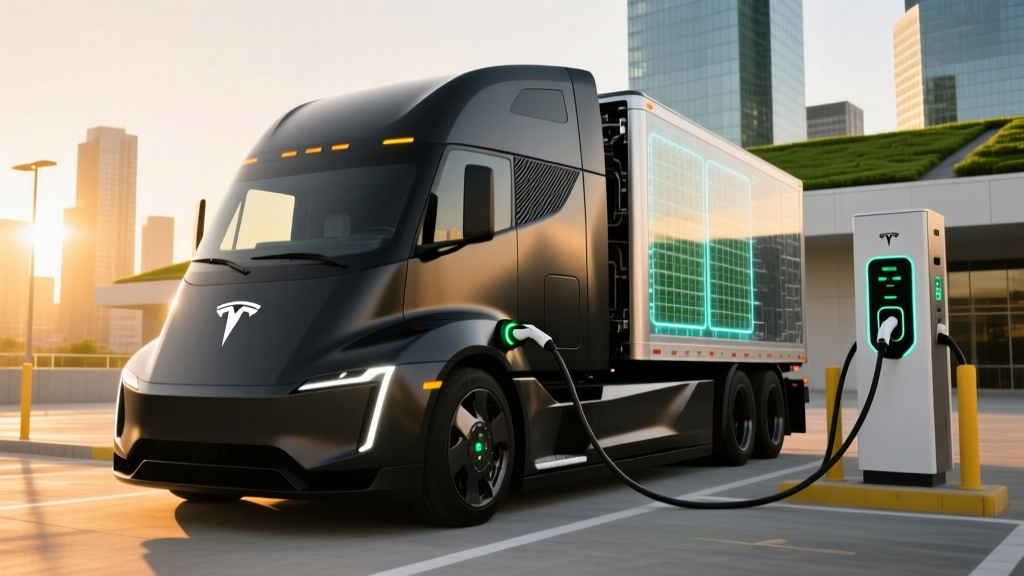
Charging a ~900 kWh battery is not a matter of plugging into a standard DC fast charger. The Tesla Semi requires Tesla's proprietary Megacharger network, which delivers up to approximately 1.2 MW (1,200 kW) of DC power. Tesla claims the Semi can recover up to 70% of its range in 30 minutes at a Megacharger. For the 500-mile variant, that translates to roughly 350 miles of range in 30 minutes, or a 10–80% charge in approximately 40–50 minutes under optimal conditions.
| Charging Method | Max Power | Miles Added per Hour | 10–80% Time (500-mi) |
|---|---|---|---|
| Tesla Megacharger (DC) | ~1,200 kW | ~600+ mi/hr | ~40–50 minutes |
| Third-party CCS/MCS DC (where available) | ~350–600 kW | ~175–300 mi/hr | ~90–180 minutes |
| Depot AC charging (480V, 3-phase) | ~40–80 kW | ~20–40 mi/hr | Overnight (10–18 hrs) |
The critical bottleneck for Semi adoption is not the truck itself but the charging infrastructure. Megachargers require dedicated utility connections capable of delivering megawatt-level power — often requiring new transformers, switchgear, and medium-voltage service drops. Fleet depot installations routinely cost $500,000 to $2 million+ for a bank of 4–8 Megachargers, including utility upgrades. Tesla has been installing Megachargers along key freight corridors in California and Nevada (the I-5 and I-80 corridors where PepsiCo and other early adopters operate), but the network remains extremely limited compared to the Supercharger passenger network. For depot-based operations where trucks return nightly, overnight AC charging at 40–80 kW is practical and avoids the Megacharger dependency — but it requires 10–18 hours for a full charge of the 500-mile battery.
Efficiency and Operating Economics
Tesla's claim of less than 2 kWh per mile energy consumption has been broadly validated by early fleet operators. PepsiCo's deployment in California reported consumption in the range of 1.7–2.1 kWh/mi depending on route profile and payload. At an average industrial electricity rate of $0.12/kWh, that translates to approximately $0.20–$0.25 per mile in energy cost — compared to $0.65–$0.85 per mile for a diesel Class 8 at $4.00/gallon and 6.5 mpg.
The per-mile fuel savings of $0.40–$0.60 are substantial, but they must be weighed against the Semi's significantly higher acquisition cost and infrastructure investment. Maintenance savings are real — no diesel engine oil changes, no DEF fluid, no diesel particulate filter regeneration, no transmission fluid — but tire wear may increase due to the instant torque delivery and heavier curb weight from the battery pack. The Semi's regenerative braking system significantly reduces brake wear, a cost factor that fleet operators on stop-heavy routes will appreciate.
The MPGe equivalent for the Semi is approximately 7–8 MPGe (based on 2 kWh/mi and the EPA's 33.7 kWh/gallon equivalence factor). This compares favorably to the 6–8 mpg typical of diesel Class 8 trucks under load, but the meaningful comparison is cost-per-mile, not energy-per-mile equivalence.
Pricing, Tax Credits, and Fleet Incentives
Tesla's announced pricing structure for the Semi places the standard-range 300-mile variant at $150,000 and the long-range 500-mile variant at $200,000. A limited "Founders Series" was priced at $250,000 for early reservation holders. These prices are significantly above a comparable diesel Class 8 tractor, which typically runs $120,000–$160,000 depending on spec.
| Item | 300-Mile Variant | 500-Mile Variant |
|---|---|---|
| Base MSRP | $150,000 | $200,000 |
| Federal §30D Commercial Clean Vehicle Credit | Up to $40,000* | Up to $40,000* |
| Estimated Net Price After Federal Credit | ~$110,000 | ~$160,000 |
| CARB HVIP Voucher (CA, varies) | $60,000–$120,000 | $60,000–$120,000 |
*Important tax credit note: The Tesla Semi is a Class 8 commercial vehicle with a GVWR well above 14,000 lbs. It is not eligible for the consumer §30D Clean Vehicle Credit (which applies to vehicles under 14,000 lbs GVWR). Instead, fleet buyers may qualify for the §45W Commercial Clean Vehicle Credit, which provides up to $40,000 for qualifying commercial vehicles over 14,000 lbs GVWR. Eligibility depends on battery sourcing requirements, domestic content rules, and the buyer's tax situation. Always consult a tax professional and reference current IRS guidance on §45W before making purchase decisions.
State-level incentives dramatically change the equation, particularly in California. The California Air Resources Board (CARB) Hybrid and Zero-Emission Truck and Bus Voucher Incentive Project (HVIP) has historically offered vouchers of $60,000–$120,000+ for Class 8 zero-emission trucks, depending on fleet size and disadvantaged-community criteria. Combined with the federal credit, a 500-mile Semi could effectively cost $40,000–$100,000 after incentives — potentially below the cost of a diesel equivalent. However, these programs are oversubscribed, have application windows, and change annually. Fleets outside California have access to fewer incentives, though states like New York, New Jersey, and Oregon offer their own ZEV truck programs.
Cab Design, Technology, and Driver Experience
The Semi's cab is unlike any conventional Class 8 tractor. The centered driving position (reminiscent of the McLaren F1, oddly enough) provides exceptional forward visibility, flanked by two large touchscreen displays that handle all instrumentation, navigation, and fleet management functions. There is no traditional instrument cluster — everything routes through the screens. The flat floor and stand-up height interior (in the sleeper-adjacent day cab configuration) offer unusual spaciousness, though it is important to note this is a day cab — there is no integrated sleeper berth in the current production configuration.
On the driver-assistance front, the Semi comes equipped with Tesla's Enhanced Autopilot, which provides adaptive cruise control, lane-keeping assist, and automatic emergency braking. This is an SAE Level 2 driver-assistance system — the driver must remain fully engaged and attentive at all times. It is not autonomous driving. The system is well-suited to highway cruising on interstate corridors but does not replace an active, licensed CDL holder. Tesla's camera-based vision system replaces traditional mirrors with camera feeds displayed on the interior screens, reducing aerodynamic drag but requiring an adjustment period for drivers accustomed to conventional mirrors.
The Semi's regenerative braking system is aggressive enough to enable near-one-pedal driving in many scenarios, significantly reducing service brake usage. Tesla reports that fleet operators have seen brake pad life extend well beyond 500,000 miles in some cases. The truck's stability control system uses individual motor torque vectoring to prevent jackknifing — a feature Tesla demonstrated by attempting to induce a jackknife during the launch event, with the truck maintaining stability.
Competitive Landscape: Semi vs. eCascadia vs. VNR Electric
The Tesla Semi does not exist in a vacuum. Daimler's Freightliner eCascadia and Volvo's VNR Electric are both in broader production with established dealer and service networks. The eCascadia offers approximately 230 miles of range with a ~475 kWh battery and charges via standard CCS at up to 250 kW — slower but compatible with existing public charging networks. The VNR Electric provides roughly 275 miles of range (with the 6-battery package) and also uses CCS. Both competitors benefit from decades of Class 8 service infrastructure, parts availability, and fleet familiarity.
The Semi's advantages are range (500 miles crushes the competition), performance, and energy efficiency. Its disadvantages are equally stark: proprietary Megacharger dependency, no established third-party service network, limited production volume, and an unproven long-term reliability track record compared to legacy OEMs with millions of trucks in the field. Fleet operators choosing the Semi are making a bet on Tesla's technology trajectory — and accepting the risk that comes with a first-generation product from a company whose primary expertise is in passenger vehicles.
Battery Warranty, Degradation, and Long-Term Ownership
Tesla has not published detailed warranty terms specific to the Semi's battery pack as of early 2026. Based on Tesla's commercial vehicle warranty precedent and industry expectations, the anticipated coverage is 8 years or 1,000,000 miles for the battery and drive unit, with a minimum capacity retention threshold of approximately 70%. For a truck expected to accumulate 100,000–125,000 miles annually, the 1,000,000-mile warranty covers roughly 8–10 years of operation — aligning with a typical first-owner lifecycle before resale or rebuild.
NMC battery chemistry, while offering the energy density needed for the Semi's range targets, degrades faster than LFP under high-cycle, high-charge-rate usage. Fleet operators who Megacharge daily at 1.2 MW will see accelerated degradation compared to depot-based overnight AC charging. Tesla's thermal management system (a liquid-cooled pack with active heating and cooling) is designed to mitigate this, but real-world 10-year degradation data for a ~900 kWh pack under commercial cycling simply does not exist yet. Replacement cost for the battery pack is estimated in the range of $150,000–$250,000+, making warranty coverage a critical financial factor.
Who the Tesla Semi Suits — and Who Should Wait
✓ Pros
- Class-leading 500-mile EPA range (loaded)
- ~$0.40–$0.60/mile fuel cost savings vs. diesel
- Extreme performance: 0-60 in 20 sec at full GCW
- Minimal maintenance: no engine, transmission, or DEF
- Regen braking extends brake life dramatically
- Potential to match diesel acquisition cost after incentives
- Over-the-air updates improve truck over time
✗ Cons
- Megacharger network extremely limited; proprietary connector
- $150K–$250K MSRP; far above diesel without incentives
- Depot charging infrastructure costs $500K–$2M+
- No sleeper cab; limits long-haul applicability
- Unproven long-term battery degradation at 1.2 MW charging
- No established third-party service/parts network
- Limited production volume; long wait times for orders
- Battery replacement cost estimated $150K–$250K+
Best fit: The Tesla Semi 2026 is best suited for high-mileage regional and drayage fleets operating predictable routes under 400 miles round-trip, particularly in California where incentive stacking can bring the effective purchase price below a diesel equivalent. Fleets with depot charging capability and routes that align with existing Megacharger corridors (I-5, I-80 in California/Nevada) will see the strongest ROI. PepsiCo's early deployment on short-haul beverage distribution routes exemplifies the ideal use case.
Wait if: You operate long-haul OTR routes exceeding 500 miles, need sleeper-cab capability, operate outside states with strong ZEV truck incentives, or require the service-network security of a legacy OEM. The Freightliner eCascadia or Volvo VNR Electric may offer lower range but come with established dealer support and standard CCS charging compatibility.
Frequently Asked Questions
What is the real-world range of the Tesla Semi?
The EPA-estimated range is 500 miles (long-range) and 300 miles (standard-range) at 82,000 lbs GCW. Real-world highway operation with a full payload typically yields 380–430 miles for the 500-mile variant. Cold weather below freezing can reduce this by 20–30%. Route topography, speed, and HVAC load further affect results.
How fast does the Tesla Semi charge?
At a Tesla Megacharger (~1,200 kW), the 500-mile variant can recover approximately 70% of range in 30 minutes, with a 10–80% charge taking roughly 40–50 minutes. Depot AC charging at 40–80 kW takes 10–18 hours for a full charge, suitable for overnight turnaround.
How much does the Tesla Semi cost after incentives?
Base MSRP ranges from $150,000 (300-mi) to $200,000 (500-mi), with the Founders Series at $250,000. The federal §45W Commercial Clean Vehicle Credit provides up to $40,000. In California, CARB HVIP vouchers can add $60,000–$120,000, potentially bringing the net cost to $40,000–$100,000 — competitive with diesel. Incentive availability varies by state, fleet size, and program funding.
Does the Tesla Semi qualify for the federal EV tax credit?
Not the consumer §30D credit — the Semi exceeds the 14,000-lb GVWR cap. It may qualify for the §45W Commercial Clean Vehicle Credit (up to $40,000 for vehicles over 14,000 lbs), subject to battery sourcing, domestic content, and buyer tax-liability requirements. Consult a tax professional and review current IRS §45W guidance.
Is the Tesla Semi worth buying vs. diesel or competing electric trucks?
For qualifying fleets on eligible routes with access to incentives and charging infrastructure, the Semi offers compelling per-mile economics and performance. The fuel savings of $0.40–$0.60/mile add up quickly at 100,000+ miles/year. However, the infrastructure investment, proprietary charging dependency, and unproven long-term reliability make it a calculated bet rather than a no-brainer. Legacy OEM electric trucks offer lower range but greater service-network security.
What are the biggest drawbacks of the Tesla Semi?
The three largest concerns are: (1) Megacharger infrastructure scarcity and the $500K–$2M+ cost of depot installation, (2) the proprietary charging connector that limits use of third-party networks, and (3) the lack of an established service and parts network comparable to Freightliner or Volvo dealers. Secondary concerns include no sleeper cab, unproven battery longevity at megawatt charge rates, and limited production availability.
Sources: Tesla Semi official page, IRS Commercial Clean Vehicle Credit (§45W), CARB HVIP program.