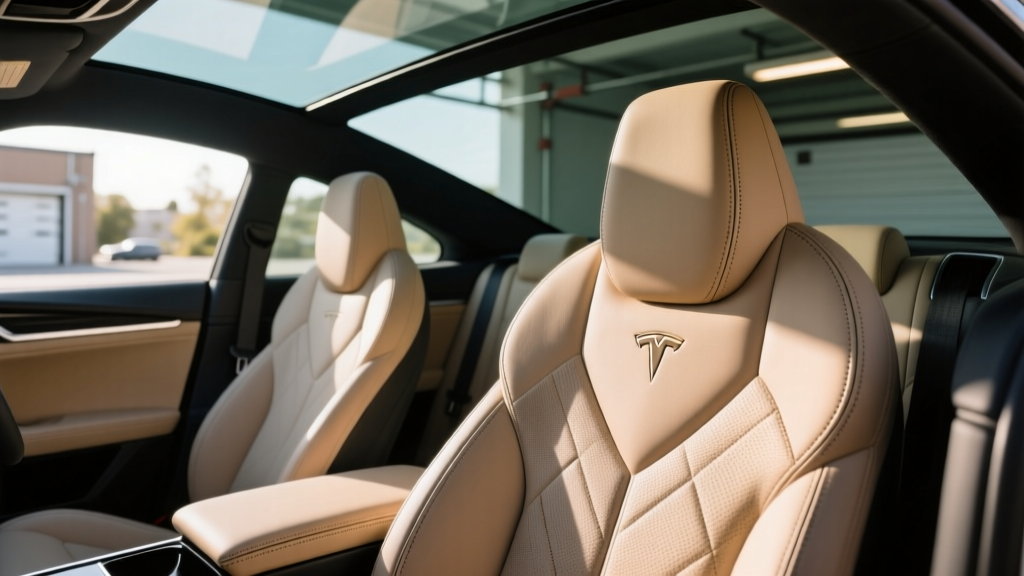
If you've shopped for a Tesla in the last several years, you've probably noticed there's no leather option — not even on the top-trim Model S. Every Tesla sold today uses what the company calls "vegan leather," a synthetic upholstery that has become one of the most debated interior choices in the EV market. So what are Tesla seats made of exactly, how do they hold up over years of ownership, and does the material choice affect anything beyond aesthetics?
This guide breaks down the material science behind Tesla's seat upholstery, compares it to traditional automotive leather and competitor vegan alternatives, and pairs that analysis with the full spec profile of the 2026 Model 3 and Model Y — the two vehicles where most buyers will actually encounter these seats.
The Material Science: What Tesla's Vegan Leather Actually Is
Tesla's seats are upholstered in a polyurethane (PU)-based synthetic leather, not a PVC (polyvinyl chloride) material. This distinction matters for both durability and environmental impact. Polyurethane synthetic leather is a multi-layer construction:
- Base layer: A woven polyester or polyamide fabric backing that provides tensile strength and dimensional stability
- Foam intermediate layer: A micro-cellular PU foam that gives the material its cushion and hand-feel
- Surface layer: A PU coating embossed with a grain pattern, treated with UV inhibitors and abrasion-resistant topcoats
Tesla transitioned entirely to synthetic leather across its lineup starting with the Model 3 in 2017, and eliminated all animal-derived leather — including from the steering wheel — by late 2021. The company has not publicly named a specific supplier, but the material is consistent with high-grade automotive PU synthetics produced by manufacturers such as Ultrafabrics or Benecke-Kaliko, which supply multiple premium OEMs.
Why Tesla Ditched Real Leather
The decision was driven by three converging factors: supply chain simplification (one material for all trims, no animal-sourcing variability), weight reduction (PU synthetic is typically 15–25% lighter per square meter than top-grain hides), and brand alignment with Tesla's sustainability-oriented buyer base. The elimination also removed the need for leather-specific conditioning products and simplified the manufacturing process at Gigafactories.
How Tesla's Vegan Leather Compares to the Competition
Tesla isn't alone in moving to synthetic upholstery. Here's how its PU material stacks up against the vegan options from key competitors in the 2026 model year:
| Brand | Material Name | Base Chemistry | Bio-Content | Available On |
|---|---|---|---|---|
| Tesla | Vegan Leather (unbranded) | Polyurethane (PU) | Low / undisclosed | All models, all trims |
| BMW | Sensafin | PU with recycled backing | Moderate | i4, i5, iX (standard) |
| Mercedes-Benz | Artico / MB-Tex | PU/PVC blend | Low | EQE, EQS (standard) |
| Volvo | Nordico | Recycled PET + bio-based PU | High (~70% recycled/bio) | EX30, EX90 (standard) |
| Hyundai | Eco-Processed Leather (H-Tex) | PU with recycled content | Moderate | Ioniq 5, Ioniq 6 |
| Ford | ActiveX | PU synthetic | Low | Mustang Mach-E (optional) |
Tesla's material sits in the mainstream of premium PU synthetics. It doesn't have the bio-content marketing story of Volvo's Nordico, but in owner durability surveys it has performed comparably to Sensafin and ActiveX in abrasion resistance and color retention over 3+ years of use.
Durability & Long-Term Ownership Reality
Based on aggregated owner reports from Tesla forums, Reddit communities, and third-party durability assessments through the 2023–2025 model years, here's what real-world wear looks like:
What Holds Up Well
- Color retention: White seats resist UV yellowing effectively; black seats show no meaningful fading at 4+ years
- Surface abrasion: Bolster wear at the driver's entry-side edge is minimal compared to older PVC-based synthetics
- Stain resistance: The PU topcoat repels most common stains (coffee, denim dye transfer) with prompt cleaning
- Temperature tolerance: No cracking reported in sub-zero climates; surface doesn't become brittle down to at least -30°F
Known Wear Patterns
- Seat cushion compression: Some owners report driver-seat cushion softening at 40,000–60,000 miles, particularly on 2021–2023 Model 3 builds. This is a foam-density issue, not a surface material failure
- Creasing at stitch lines: Minor cosmetic creasing appears at high-flex zones (seat-back folds) around year 3–4, purely aesthetic
- White seat dye transfer: Dark raw-denim jeans can leave faint blue tint on white seats; removable with isopropyl alcohol or dedicated PU-leather cleaner
2026 Tesla Model 3: Full Spec Profile
The Model 3 remains Tesla's entry point and the vehicle where most first-time Tesla buyers will evaluate these seats. Here are the complete 2026 specifications:
| Specification | Model 3 RWD | Model 3 Long Range AWD | Model 3 Performance |
|---|---|---|---|
| EPA Range | 272 mi | 341 mi | 315 mi |
| Battery (usable) | ~60 kWh (LFP) | ~79 kWh (NMC) | ~79 kWh (NMC) |
| Horsepower | 271 hp | 346 hp | 510 hp |
| 0–60 mph | 5.8 sec | 4.2 sec | 2.9 sec |
| Drivetrain | RWD, single motor | AWD, dual motor | AWD, dual motor |
| Peak DC Fast Charge | 170 kW | 250 kW | 250 kW |
| 10–80% DCFC Time | ~30 min | ~22 min | ~22 min |
| Level 2 Home Charge Rate | 7.6 kW (~30 mi/hr) | 11.5 kW (~44 mi/hr) | 11.5 kW (~44 mi/hr) |
| MPGe (combined) | 132 MPGe | 125 MPGe | 113 MPGe |
| Efficiency | 26 kWh/100mi | 27 kWh/100mi | 30 kWh/100mi |
| Cargo Volume | 23 cu ft (trunk + frunk) | 23 cu ft | 23 cu ft |
| Rear Legroom | 35.3 in | 35.3 in | 35.3 in |
| Base MSRP | $38,990 | $44,990 | $52,990 |
| Battery Warranty | 8 yr / 100,000 mi | 8 yr / 120,000 mi | 8 yr / 120,000 mi |
2026 Tesla Model Y: Full Spec Profile
The Model Y is Tesla's highest-volume seller and the crossover where families will spend the most time evaluating seat comfort, material durability, and practicality. The 2026 "Juniper" refresh brought updated seat bolsters, improved cushion density, and revised PU surface texturing.
| Specification | Model Y RWD | Model Y Long Range AWD | Model Y Performance |
|---|---|---|---|
| EPA Range | 259 mi | 320 mi | 293 mi |
| Battery (usable) | ~60 kWh (LFP) | ~79 kWh (NMC) | ~79 kWh (NMC) |
| Horsepower | 295 hp | 384 hp | 510 hp |
| 0–60 mph | 6.5 sec | 4.8 sec | 3.5 sec |
| Drivetrain | RWD, single motor | AWD, dual motor | AWD, dual motor |
| Peak DC Fast Charge | 170 kW | 250 kW | 250 kW |
| 10–80% DCFC Time | ~32 min | ~23 min | ~23 min |
| Level 2 Home Charge Rate | 7.6 kW (~30 mi/hr) | 11.5 kW (~44 mi/hr) | 11.5 kW (~44 mi/hr) |
| MPGe (combined) | 127 MPGe | 119 MPGe | 111 MPGe |
| Efficiency | 27 kWh/100mi | 28 kWh/100mi | 30 kWh/100mi |
| Cargo Volume (behind 2nd row) | 30 cu ft | 30 cu ft | 30 cu ft |
| Cargo Volume (seats folded) | 72 cu ft | 72 cu ft | 72 cu ft |
| Rear Legroom | 37.0 in | 37.0 in | 37.0 in |
| Base MSRP | $44,990 | $47,990 | $52,490 |
| Battery Warranty | 8 yr / 100,000 mi | 8 yr / 120,000 mi | 8 yr / 120,000 mi |
The Juniper-refreshed seats use a revised foam density that addresses the most common pre-2025 complaint — driver-seat cushion compression over time. The surface PU material is also slightly more textured, reducing the "slippery" feel some owners noted on 2021–2024 builds.
Pricing, Trims & Federal Tax Credit Eligibility
Under IRS §30D rules for the 2026 tax year, the federal clean vehicle credit provides up to $7,500 for qualifying new EVs — but eligibility depends on three intersecting requirements that catch many buyers off guard:
| Requirement | 2026 Rule | Tesla Model 3 Status | Tesla Model Y Status |
|---|---|---|---|
| MSRP Cap | Sedans ≤ $55,000; SUVs/trucks ≤ $80,000 | All trims qualify (sedan cap) | All trims qualify (SUV cap) |
| Buyer Income Cap (AGI) | $150K single / $225K HoH / $300K joint | Buyer must meet threshold | Buyer must meet threshold |
| Battery Component Sourcing | North America assembly threshold (phasing in annually) | Verify on IRS eligible list at purchase | Verify on IRS eligible list at purchase |
| Critical Minerals | Sourcing threshold (phasing in annually) | Verify on IRS eligible list at purchase | Verify on IRS eligible list at purchase |
| Point-of-Sale Transfer | Buyer can transfer credit to dealer for instant discount | Available at Tesla checkout | Available at Tesla checkout |
Example effective pricing for a Model 3 Long Range AWD with full credit eligibility: $44,990 MSRP minus $7,500 credit = $37,490 effective price before destination, taxes, and registration. Add common options like Ultra Red paint ($2,500) or 19" Nova wheels ($1,500) and the calculus shifts quickly.
Tech, Driver Assistance & Standout Features
The seat material discussion is inseparable from the overall interior philosophy. Tesla's cabin is deliberately minimal — no physical instrument cluster, no traditional HVAC vents visible, and all vehicle controls routed through the 15.4" center touchscreen (Model 3) or 16.2" display (Model Y Juniper). The seats themselves integrate:
- Ventilation (front seats): Standard on all 2026 trims — a significant upgrade from pre-2024 models where this was absent
- Heating (all seats): Front and rear heated seats standard across all trims
- Power adjustment: 12-way power driver, 8-way power passenger (Model 3); 12-way both front seats (Model Y)
- Seat memory: Linked to driver profiles, including mirror, steering wheel, and climate preferences
Autopilot & FSD (Supervised)
Standard Autopilot includes Traffic-Aware Cruise Control and Autosteer (lane centering). The $8,000 FSD (Supervised) package adds automatic lane changes, Navigate on Autopilot (highway on-ramp to off-ramp), traffic light and stop sign recognition, and Autopark. As of early 2026, FSD remains a supervised system requiring constant driver attention.
Who Should Buy — And Who Should Look Elsewhere
Buy a Tesla If:
- You value Supercharger network access for road trips (17,000+ stalls in North America)
- You want over-the-air updates that add features post-purchase
- You prefer a minimalist interior with no leather
- Software integration and app-based vehicle control are priorities
- You want competitive efficiency (kWh/100mi) in the segment
Look Elsewhere If:
- You want genuine leather or premium natural-material interiors (consider BMW i4 or Volvo EX90)
- You need physical buttons, knobs, or a traditional instrument cluster
- You want a dealership service experience (Tesla uses mobile service + limited service centers)
- You need more than 30 cu ft of cargo without folding seats (consider Rivian R1S or Kia EV9)
- You want Apple CarPlay / Android Auto (Tesla uses proprietary infotainment only)
Frequently Asked Questions
Are Tesla seats real leather?
No. Every Tesla sold since late 2021 uses 100% synthetic vegan leather, including the steering wheel wrap. The material is a polyurethane (PU) composite with a polyester fabric backing. Tesla does not offer genuine leather on any current model.
Do Tesla white seats stain easily?
The white PU material is more stain-resistant than many owners expect, thanks to a factory-applied topcoat. However, dark denim jeans can transfer dye onto white seats over time, particularly in warm weather. Prompt cleaning with a PU-safe cleaner or diluted isopropyl alcohol removes most transfer. Applying a ceramic coating designed for synthetic leather adds an extra hydrophobic barrier.
How long do Tesla seats last?
The PU surface material itself shows minimal degradation at 5+ years based on owner reports. The more common wear issue is foam compression in the driver's seat cushion, which some owners notice at 40,000–60,000 miles. The 2025+ Juniper-refreshed Model Y uses revised foam density to address this. Tesla's vehicle limited warranty covers seat defects for 4 years / 50,000 miles.
Can I get aftermarket leather seats for my Tesla?
Several third-party upholstery shops offer genuine leather or Alcantara re-trimming for Tesla seats, typically costing $3,000–$5,000 for a full interior. However, this voids any Tesla warranty coverage on seat components and may interfere with the seat occupancy sensor and heating elements. It's a modification most owners don't pursue.
Is the vegan leather in a Tesla the same as "Tesla Synthetic Material"?
Yes. Tesla has used various marketing terms — "vegan leather," "synthetic leather," and "Tesla Synthetic Material" — but they refer to the same class of PU-based composite upholstery. The exact formulation has been revised over model years (notably the Juniper refresh for Model Y), but the base chemistry remains polyurethane.
Does the seat material affect Tesla's resale value?
There's no measurable resale-value penalty for vegan leather vs. genuine leather in the Tesla market specifically, because Tesla buyers self-select for the material. Among luxury EVs broadly, vehicles with premium vegan options (Volvo Nordico, BMW Sensafin) are holding value comparably to leather-equipped counterparts as the industry shifts in this direction.