Why Tesla Seat Material Matters More Than You Think
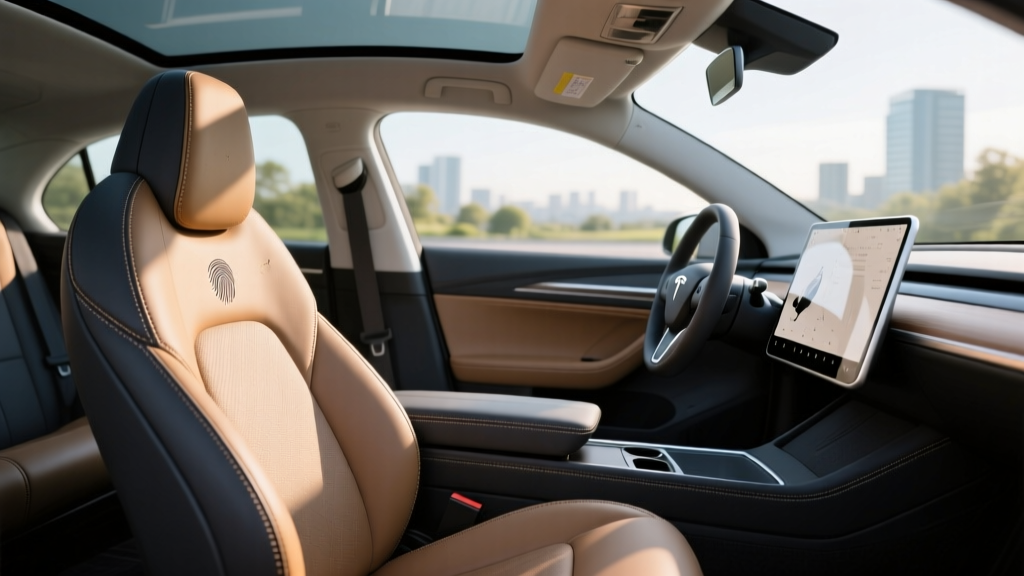
When buyers research their next EV, they obsess over range and charging speed — and rightly so. But the interior surfaces you touch every single mile matter too. Tesla's seat material has evolved significantly since the brand eliminated all animal-derived components in 2017, moving to a proprietary synthetic leather (often called "vegan leather") across the entire lineup. In 2026, that material has matured into something that rivals premium Nappa leather in feel while outperforming it in durability and stain resistance.
This guide examines Tesla's seat material across the current 2026 Model 3, Model Y, Model S, and Model X lineup — pairing the interior story with the hard performance, range, charging, and pricing data you need to make an informed purchase decision.
Tesla's Vegan Leather: What It Actually Is
Tesla's current seat upholstery is a polyurethane-based synthetic material engineered to replicate the grain, suppleness, and breathability of traditional leather without any animal products. The material is marketed simply as "Tesla Premium Interior" on the company's configurator, but owners and detailers commonly refer to it as vegan leather.
Unlike early-generation synthetic seats in the 2016–2018 Model S, the 2026 formulation features:
- Improved micro-perforation for better airflow on ventilated seats (standard on Model S/X, available on refreshed Model 3/Y)
- UV-stabilized top coat that resists cracking and color fading — a common complaint with older Teslas parked outdoors
- Lower VOC off-gassing compared to earlier iterations, reducing that "new car chemical smell" that plagued 2019–2021 builds
- Stain-resistant surface treatment that handles coffee spills, denim dye transfer, and child-seat marks with simple wipe-downs
Tesla offers two primary interior colorways in 2026: All Black and Black and White (the latter featuring white seat bolsters with a black dashboard and carpet). The Model S and Model X additionally offer a Cream interior. All use the same base synthetic material with different pigment and top-coat applications.
2026 Tesla Lineup: Seat Material, Range, and Specs at a Glance
The table below covers the core specifications for every current Tesla model. Note that seat material is identical in composition across all four vehicles — the difference is in seat structure, adjustability, and available features like ventilation and massage.
| Spec | Model 3 RWD | Model 3 Long Range AWD | Model Y Long Range AWD | Model S LR | Model X LR |
|---|---|---|---|---|---|
| EPA Range | 272 mi | 341 mi | 310 mi | 402 mi | 348 mi |
| Battery (usable, chemistry) | 57.5 kWh (LFP) | 78.1 kWh (NMC) | 78.1 kWh (NMC) | 95 kWh (NMC) | 95 kWh (NMC) |
| 0–60 mph | 5.8 sec | 4.2 sec | 4.8 sec | 3.1 sec | 3.8 sec |
| Horsepower | 271 hp | 384 hp | 384 hp | 670 hp | 670 hp |
| Drivetrain | RWD | Dual-Motor AWD | Dual-Motor AWD | Dual-Motor AWD | Dual-Motor AWD |
| Max DC Fast Charge | 170 kW | 250 kW | 250 kW | 250 kW | 250 kW |
| 10–80% DCFC Time | ~25 min | ~22 min | ~22 min | ~25 min | ~26 min |
| Level 2 Home Rate | 7.6 kW (30 mi/hr) | 11.5 kW (44 mi/hr) | 11.5 kW (44 mi/hr) | 11.5 kW (44 mi/hr) | 11.5 kW (44 mi/hr) |
| MPGe (combined) | 132 MPGe | 125 MPGe | 117 MPGe | 120 MPGe | 109 MPGe |
| Efficiency (kWh/100 mi) | 25 kWh | 27 kWh | 29 kWh | 28 kWh | 31 kWh |
| Cargo (rear seats up) | 23 cu ft | 23 cu ft | 30 cu ft | 28 cu ft | 88 cu ft (5-seat) |
| Rear Legroom | 35.2 in | 35.2 in | 37.0 in | 35.4 in | 37.1 in |
| Seat Ventilation | Optional | Optional | Optional | Standard | Standard |
| Base MSRP | $38,990 | $45,990 | $48,990 | $79,990 | $84,990 |
| Battery Warranty | 8 yr / 100,000 mi | 8 yr / 120,000 mi | 8 yr / 120,000 mi | 8 yr / 150,000 mi | 8 yr / 150,000 mi |
Source: fueleconomy.gov and Tesla's official specifications page.
Real-World Range: What the EPA Number Doesn't Tell You
Tesla's efficiency remains a class-leading advantage. The Model 3 RWD at 25 kWh/100 mi extracts more miles per kilowatt-hour than nearly any competing sedan, thanks to its low drag coefficient (0.219 Cd), heat pump standard across the lineup, and aggressive regenerative braking calibration.
For the LFP-equipped Model 3 RWD, there's an important ownership nuance: Tesla recommends charging LFP batteries to 100% regularly (at least once per week) to maintain cell balancing accuracy. This means the 272-mile EPA range is more practically usable than an NMC vehicle where daily charging is capped at 80% — effectively giving the LFP Model 3 a ~272-mile daily range versus ~273 miles (80% of 341) for the Long Range. The real-world gap is narrower than the spec sheet suggests.
Charging Speed: Supercharger Network and Home Setup
Tesla's Supercharger network remains the gold standard for public DC fast charging — over 6,500 stalls in North America as of early 2026, with near-universal reliability and seamless plug-and-charge billing. Here's how each model charges:
| Charging Level | Model 3 RWD (LFP) | Model 3 LR / Model Y LR | Model S / Model X |
|---|---|---|---|
| Level 1 (120V, 12A) | 1.4 kW — ~4 mi/hr | 1.4 kW — ~3 mi/hr | 1.4 kW — ~3 mi/hr |
| Level 2 (240V, 48A) | 7.6 kW — ~30 mi/hr | 11.5 kW — ~44 mi/hr | 11.5 kW — ~44 mi/hr |
| DC Fast (peak) | 170 kW | 250 kW | 250 kW |
| 10–80% DCFC Time | ~25 min | ~22 min | ~25–26 min |
| Connector | NACS (native) | NACS (native) | NACS (native) |
Charging curve reality: The 250 kW peak on Long Range and Model S/X is not sustained. Expect peak rates between 10–30% SoC, tapering to ~150 kW by 50%, and ~75 kW above 80%. The 10–80% time of ~22 minutes reflects this taper. If you're road-tripping and charging to 90%+ at Superchargers, add 10–15 minutes beyond the 80% mark — the curve flattens significantly.
With NACS now adopted by Ford, GM, Rivian, Volvo, and others, Tesla Superchargers are opening to non-Tesla vehicles via Magic Dock adapters. This increases stall competition at popular corridors but also validates Tesla's connector as the North American standard. For Tesla owners, the native NACS port means no adapter is needed — a tangible convenience advantage at third-party CCS stations that require a NACS-to-CCS adapter.
For home charging, Tesla's Wall Connector ($420) on a 60A circuit delivers the full 48A/11.5 kW rate on Long Range and premium models, adding roughly 44 miles of range per hour of charging. A typical overnight session (8 hours) fully replenishes even the 95 kWh Model S/X battery. Installation costs range from $500 to $2,500 depending on panel capacity and conduit run distance — budget for a possible $1,500–$3,000 panel upgrade if your home has a 100A service.
Interior Comfort, Tech, and the Seat Experience
The 2026 Tesla interior is minimalist by design — a single 15.4-inch touchscreen (17-inch tilt display on Model S/X) controls everything from climate to mirror adjustment. There is no instrument cluster, no physical buttons for HVAC, and no traditional stalks (turn signals are on the steering wheel). This approach polarizes buyers, but the material quality has improved substantially since the Model 3's 2017 debut.
Seat Comfort by Model
Model 3 (Highland refresh): The refreshed Model 3 seats are a major step up from the pre-2024 design. Bolstering is firmer and more supportive on long drives, the cushion length has been extended for better thigh support, and ventilated front seats are now available as a factory option. The vegan leather surface feels closer to mid-grade Nappa than the plasticky material of early builds. Rear seats remain the weak point — the floor-mounted battery raises the floor height, creating a "knees-up" seating position that compromises comfort for adults on longer trips.
Model Y (Juniper refresh): The 2025–2026 Juniper update brought ventilated front seats, improved rear cushion angle, and ambient lighting integrated into the door panels. The synthetic leather quality matches the Model 3 Highland. The Model Y's higher roofline and longer wheelbase translate to genuinely usable rear seating for adults — a key advantage over the Model 3 for families.
Model S: The flagship sedan offers the most complete seat package: standard ventilation, 16-way power adjustment, and available massaging. The vegan leather here uses a slightly different top-coat formulation that feels noticeably softer. Rear seats accommodate three adults comfortably, and the 28 cu ft trunk plus front trunk (frunk) provide ample cargo room for a luxury sedan.
Model X: The Model X is available in 5-, 6-, and 7-seat configurations. The second-row captain's chairs (6-seat) or bench (5- or 7-seat) use the same vegan leather, with standard ventilation for the front row. Falcon Wing rear doors are a signature feature but add mechanical complexity — a known source of rattles and seal leaks in earlier model years, though 2026 builds have improved sealing.
Standout Tech and Notable Drawbacks
Every 2026 Tesla includes:
- Autopilot (SAE Level 2): adaptive cruise + lane centering — requires hands on the wheel and active driver supervision at all times
- Over-the-air updates that regularly add features, improve efficiency, and refine the UI
- Sentry Mode dashcam recording when parked
- Tesla app integration with preconditioning, location tracking, and remote climate control
- HEPA air filtration (Model S/X) or standard cabin air filter with available HEPA upgrade (Model 3/Y)
Full Self-Driving (Supervised) remains a $8,000 add-on or $99/month subscription. Despite the name, FSD is still an SAE Level 2 system — the driver is legally and practically responsible for all vehicle operation. It handles city streets, stop signs, and highway interchanges with increasing competence but requires constant vigilance.
Pricing, Tax Credits, and Ownership Economics
| Model | Base MSRP | As-Tested (typical config) | §30D Credit Eligible? | Effective Price (with credit) |
|---|---|---|---|---|
| Model 3 RWD | $38,990 | $39,990 | Yes — up to $7,500 | ~$32,490 |
| Model 3 Long Range AWD | $45,990 | $48,490 | Yes — up to $7,500 | ~$40,990 |
| Model Y Long Range AWD | $48,990 | $51,990 | Yes — up to $7,500 | ~$44,490 |
| Model S Long Range | $79,990 | $84,990 | No (exceeds $55K sedan cap) | $79,990+ |
| Model X Long Range | $84,990 | $89,990 | No (exceeds $80K SUV cap) | $84,990+ |
Federal tax credit rules (§30D) — key caveats for 2026:
- Income caps: Modified AGI must not exceed $150,000 (single), $225,000 (head of household), or $300,000 (joint filing)
- MSRP caps: $55,000 for sedans (Model 3), $80,000 for SUVs/trucks (Model Y)
- Battery sourcing: The full $7,500 requires meeting both critical-mineral and battery-component sourcing requirements. Tesla's US-assembled vehicles with LFP batteries (Model 3 RWD) have historically qualified, but specific mineral-sourcing compliance can change — verify current eligibility on IRS.gov before purchasing
- Point-of-sale transfer: Eligible buyers can transfer the credit to the dealer at purchase, reducing the out-of-pocket cost immediately rather than waiting for tax filing
The Model 3 RWD at roughly $32,490 after the federal credit is one of the most affordable new EVs in America — and the seat material, interior tech, and Supercharger access make it a compelling value proposition against rivals costing $10,000+ more.
How Tesla Seats Compare to Key Competitors
- Animal-free with no quality compromise vs mid-grade leather
- Excellent stain resistance — wipes clean easily
- No cracking after 3+ years of sun exposure (2024+ formulations)
- Consistent across all trims — no "leather package" upsell
- Ventilated seats now available across the lineup
- White seats show denim dye transfer — requires prompt cleaning
- No genuine leather option for buyers who prefer it
- Seat cushion firmness is polarizing — some find it too hard
- Rear seats (Model 3) remain compromised for tall adults
- No massage available on Model 3/Y (only Model S/X)
Against the BMW i4 (available with genuine Vernasca leather and a more traditional luxury interior), Tesla's seats lack the plush, pillowy character of a German luxury sedan but offer comparable or better long-term durability. Against the Hyundai Ioniq 5 and Kia EV6, which use eco-friendly recycled PET fabric and H-Tex synthetic leather, Tesla's vegan leather feels slightly more premium to the touch but the Korean competitors offer more interior color and material variety.
Who Should Buy a Tesla in 2026?
Choose a Tesla if:
- You value Supercharger network access for hassle-free road trips
- You want over-the-air updates that genuinely improve the car over time
- You prefer a minimalist interior with best-in-class efficiency
- You want the strongest resale value in the EV segment
- You need a vegan/animal-free interior without sacrificing quality
Look elsewhere if:
- You want physical buttons, a traditional instrument cluster, or Apple CarPlay/Android Auto
- You need a plush, quiet luxury-cabin experience (consider BMW i5 or Mercedes EQE)
- You frequently carry rear-seat adults on long trips (Model 3 specifically)
- You want to choose from multiple interior material options (cloth, leather, Alcantara)
Frequently Asked Questions
Is Tesla's vegan leather actually durable?
Yes. The 2024+ formulation has proven highly resistant to cracking, peeling, and UV damage. Owners with 60,000+ miles on Highland/Juniper interiors report minimal wear on seat bolsters. The material cleans easily with a damp microfiber cloth and mild soap. Avoid harsh chemical cleaners — they can degrade the top-coat over time.
Do Tesla white seats stain easily?
More than black seats, yes. New dark denim can transfer dye onto white bolsters, especially in warm weather. Most transfers wipe off with isopropyl alcohol or a dedicated vinyl/leather cleaner if addressed promptly. Leaving stains for weeks makes removal significantly harder. If you wear raw denim regularly, the All Black interior is the pragmatic choice.
Does the Model 3 RWD qualify for the full $7,500 federal tax credit?
As of early 2026, the Model 3 RWD qualifies for the full $7,500 credit under IRS §30D, provided the buyer meets income caps and the vehicle's battery components and critical minerals meet domestic-sourcing thresholds. Tesla confirms eligibility on its website, and the credit can be transferred at point of sale. Always verify current status at IRS.gov — sourcing rules can shift with supply-chain changes.
How does Tesla's seat material hold up in extreme heat or cold?
The synthetic leather handles temperature extremes better than genuine leather, which can crack in dry heat and stiffen in deep cold. Tesla's ventilated seats (standard on Model S/X, optional on Model 3/Y) use the perforated surface effectively. In sub-zero weather, the heated seats warm quickly — typically reaching comfortable temperature within 2–3 minutes thanks to the resistive heating elements embedded in the cushion and backrest.
Can I get cloth seats in a Tesla?
No. Tesla discontinued the cloth interior option for the Model 3 in 2019. All 2026 Teslas ship with the vegan leather (synthetic) material. If cloth is a priority, the Hyundai Ioniq 5, Kia EV6, and Volkswagen ID.4 offer fabric seat options.
What's the real-world range of the Model Y Long Range?
The EPA rates the 2026 Model Y Long Range AWD at 310 miles. In real-world highway driving at 70–75 mph in moderate temperatures, expect 265–285 miles. In winter conditions (below 32°F), that drops to 220–250 miles depending on cabin heat usage and whether you precondition the battery. The heat pump mitigates cold-weather losses better than resistive heating systems found in older EVs.
For the latest EPA ratings, visit fueleconomy.gov. For NHTSA safety ratings across the Tesla lineup, see nhtsa.gov.