Living in Santa Barbara, California, puts you in one of the most EV-friendly microclimates in the country. Mild winters, a dense Supercharger network along the 101 corridor, and some of the highest gas prices in the nation make the case for going electric compelling. But which Tesla model makes the most sense for Central Coast driving, and what does ownership actually look like when you factor in range, charging logistics, and current incentives?
This guide focuses primarily on the 2026 Tesla Model Y Long Range AWD — the best-selling Tesla and the most practical choice for Santa Barbara drivers balancing daily commuting, PCH road trips, and occasional runs up to San Luis Obispo or down to Los Angeles. We'll cover exact specs, real-world range expectations for the Central Coast, home charging setup in Santa Barbara's older housing stock, and the current state of federal and California incentives.
2026 Tesla Model Y: The Specs That Matter
| Specification | Model Y Long Range AWD | Model Y Performance |
|---|---|---|
| EPA Range | 320 miles | 298 miles |
| Battery Capacity | 78.1 kWh usable (NMC) | 78.1 kWh usable (NMC) |
| Drivetrain | Dual Motor AWD | Dual Motor AWD |
| Horsepower | 384 hp | 510 hp |
| 0–60 mph | 4.8 seconds | 3.5 seconds |
| Peak DC Fast Charge | 250 kW | 250 kW |
| 10–80% DC Charge Time | ~25 minutes | ~25 minutes |
| Level 2 Home Charging | 11.5 kW (44 mi/hr) | 11.5 kW (44 mi/hr) |
| Efficiency | 122 MPGe / 28 kWh/100mi | 111 MPGe / 30 kWh/100mi |
| Cargo Volume (rear seats up) | 30.2 cu ft | 30.2 cu ft |
| Cargo Volume (rear seats folded) | 72.1 cu ft | 72.1 cu ft |
| Base MSRP | $48,990 | $53,990 |
Tesla updated the Model Y for the 2025 refresh (sometimes called the "Juniper" update), and those changes carry into the 2026 model year with improved cabin quietness, a ventilated-seat option, a rear touchscreen for passengers, and revised suspension tuning. The Long Range AWD remains the sweet spot: you get over 300 miles of EPA-rated range, capable dual-motor traction for the rare rainy day on San Marcos Pass, and a price point that still clears the federal tax credit MSRP cap.
Real-World Range on the Central Coast
Real-World Expectation: 280–305 miles in Santa Barbara's mild climate; 250–270 miles on sustained 75+ mph highway runs up the 101; 240–260 miles in colder mountain passes or headwind-heavy coastal stretches.
Santa Barbara's Mediterranean climate is one of the best environments for EV range retention. You won't see the 25–30% cold-weather range loss that EV owners in the Midwest or Northeast endure. In typical daily driving — commuting along State Street, running errands from the Mill Street shopping center to upper State — expect to achieve 90–95% of the EPA sticker.
The scenario that will cost you range is sustained highway driving north toward Solvang or San Luis Obispo. Highway speeds above 70 mph increase aerodynamic drag substantially, and the elevation gain over the Santa Ynez Mountains on Highway 154 or the Cuesta Grade on the 101 will draw extra energy on the way up (though regenerative braking recovers a meaningful portion on the way back down).
According to data from fueleconomy.gov, the Model Y Long Range AWD achieves 122 MPGe combined. In practical terms, that's roughly 28 kWh consumed per 100 miles of mixed driving — among the most efficient vehicles in its class.
Charging Infrastructure: Santa Barbara and Beyond
| Charging Level | Power | Speed | Best For |
|---|---|---|---|
| Level 1 (120V outlet) | ~1.4 kW | ~4–5 miles/hour | Emergency top-offs; low-mileage drivers |
| Level 2 (240V home) | 11.5 kW | ~44 miles/hour | Daily overnight charging at home |
| DC Fast Charge (Supercharger) | Up to 250 kW | 10–80% in ~25 min | Road trips; rapid top-ups |
Home Charging in Santa Barbara
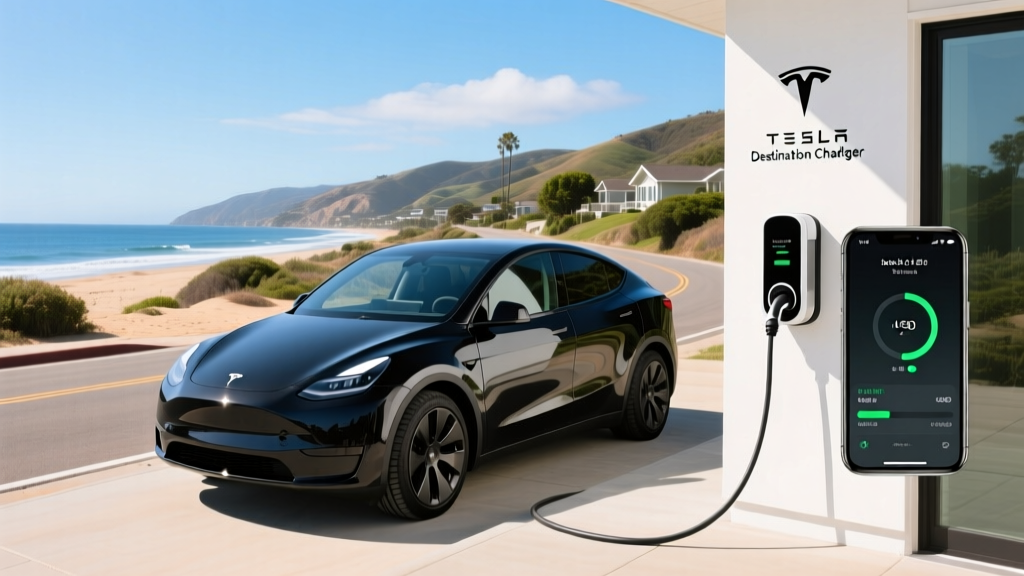
Most Santa Barbara Tesla owners install a Level 2 home charger — either the Tesla Wall Connector ($420 for the unit) or a third-party J3472/NACS-compatible unit. The Model Y's onboard charger accepts up to 11.5 kW on Level 2, which adds roughly 44 miles of range per hour. A full overnight charge from 20% to 100% takes about 7–8 hours.
The challenge in Santa Barbara is housing stock. Many homes, particularly in the Mesa, West Beach, and older parts of the East Side, have 100-amp electrical panels that may not support a 60-amp circuit dedicated to EV charging without a panel upgrade. A panel upgrade from 100A to 200A typically costs $1,800–$3,500 in the Santa Barbara area, on top of the $500–$1,500 for the charger installation itself. Always get a licensed electrician to assess your panel before committing to equipment.
If you live in a condo or apartment complex — common in the Funk Zone and lower State Street corridor — your options may be limited to shared parking garage chargers or public stations. SB 610 and California's Right to Charge law provide some legal framework for installing chargers in multi-unit dwellings, but practical access remains a pain point.
Public Charging and Supercharger Access
Santa Barbara is well-served by Tesla's Supercharger network. Key stations include:
- La Cumbre Plaza — V3 Superchargers (250 kW), convenient for shopping while charging
- El Paseo / Downtown — Destination chargers at hotels and restaurants (Level 2, slower)
- Carpinteria (southbound 101) — V3 Superchargers for quick top-ups before heading to Ventura or LA
- Buellton (Hwy 101/246) — Critical stop before the stretch to Santa Maria and SLO
With Tesla's NACS connector now adopted as the North American standard, and Tesla opening select Supercharger stalls to non-Tesla EVs, the network remains the gold standard for reliability. On a V3 stall, the Model Y peaks at 250 kW and can add up to 175 miles of range in 15 minutes. However, the charge curve tapers significantly above 80% — going from 80% to 100% can take nearly as long as the 10–80% sprint. For road trips, plan stops around 10–80% intervals.
Pricing, Tax Credits, and California Incentives
| Trim | Base MSRP | Est. Federal Credit (§30D) | Est. CA CVRP Rebate | Effective Price |
|---|---|---|---|---|
| Model Y Long Range AWD | $48,990 | Up to $7,500* | Up to $2,000** | ~$39,490 |
| Model Y Performance | $53,990 | Up to $7,500* | Up to $2,000** | ~$44,490 |
| Model 3 Long Range AWD | $47,740 | Up to $7,500* | Up to $2,000** | ~$38,240 |
* Federal §30D credit eligibility depends on buyer income caps ($150K single / $300K joint), vehicle MSRP cap ($80K for SUVs), and battery critical-mineral and component sourcing requirements that shift annually. Check the latest rules at irs.gov or consult a tax professional. The credit can now be transferred at point of sale as an instant discount.
** California Clean Vehicle Rebate Project (CVRP) availability and amounts vary based on funding cycles and income eligibility. Check cleanvehiclerebate.org for current status.
Santa Barbara County also participates in the Central Coast Community Energy (3CE) program, which has periodically offered additional EV rebates for residents in the service area. Combined with SCE or 3CE's time-of-use electricity rates, overnight home charging can cost as little as $0.12–$0.18 per kWh — making a full Model Y "tank" roughly $9–$14 compared to $60–$80 in gasoline for equivalent range at current Santa Barbara pump prices ($5.20+/gallon for regular).
Tech, Autopilot, and the FSD Conversation
The refreshed Model Y comes standard with Basic Autopilot (traffic-aware cruise control and lane-centering on highways). The optional FSD (Supervised) package ($8,000 one-time or $99/month) adds automated lane changes, Navigate on Autopilot, traffic light and stop sign recognition, and the controversial city-street driving capability.
On the 101 through Santa Barbara, Basic Autopilot handles the well-marked highway competently — it's a genuine fatigue reducer on longer drives. FSD's city-street performance has improved markedly, but it still makes occasional errors at complex intersections, construction zones, and the roundabouts popping up around Goleta. Treat it as an assistive tool, not a replacement for attention.
Other tech highlights: the 15.4-inch front touchscreen (improved brightness in the refresh), rear 8-inch passenger screen, HEPA air filtration (a genuine benefit during wildfire smoke season, which affects Santa Barbara periodically), Sentry Mode dashcam surveillance, and the Tesla app's preconditioning feature — critical for optimizing battery temperature before fast charging or departure.
How It Stacks Up Against Competitors
- Class-leading Supercharger network reliability
- 320-mile EPA range covers most Central Coast trips without charging
- Low per-mile energy cost vs. $5+ Santa Barbara gas
- Strong software ecosystem and OTA updates
- Spacious cargo area (72.1 cu ft folded) for a compact SUV
- Excellent HEPA cabin filtration for wildfire season
- No Apple CarPlay or Android Auto
- Minimalist interior feels sparse at this price point
- FSD costs extra and still requires full driver attention
- Insurance premiums in Santa Barbara County run 15–25% above average for the segment
- Service center nearest to SB is in Ventura or Oxnard (~40 min drive)
- Panel upgrades may be needed for older SB homes
The Model Y's most direct competitors in 2026 are the Hyundai Ioniq 5 (318-mile range, 800V architecture for faster 10–80% charging at ~18 minutes, but a smaller CCS/NACS adapter ecosystem), the Ford Mustang Mach-E Extended Range (320-mile range, more conventional interior feel), and the Kia EV6 (310-mile range, sportier driving dynamics). None match Tesla's Supercharger network seamlessness, though the gap is narrowing as other OEMs gain NACS access.
For Santa Barbara specifically, the Tesla advantage is infrastructure. The Supercharger density along the 101 and in town means you're never more than 20 minutes from a reliable fast charger. Competitors relying on Electrify America or EVgo in the area face more variability in uptime and plug availability.
Who Should Buy a Tesla in Santa Barbara?
- You commute daily within Santa Barbara/Goleta/Santa Ynez (40–80 mi round trip) and can charge at home overnight
- You take regular road trips up the 101 to SLO/Bay Area or down to LA/SD and value Supercharger reliability
- You want cargo versatility for bikes, surfboards, or farmers-market hauls from the Saturday Santa Barbara market
- You qualify for the §30D federal credit and CA rebates, bringing effective price under $40K
- You need Apple CarPlay/Android Auto integration (Hyundai Ioniq 5, Kia EV6)
- You want a more traditional dealership/service experience locally
- Your home electrical panel can't support Level 2 charging without an expensive upgrade and you lack public charging access
- You need a third row — look at the Model X, Kia EV9, or a PHEV minivan instead
Warranty and Long-Term Ownership
Tesla covers the Model Y with a 4-year/50,000-mile basic vehicle warranty and an 8-year/120,000-mile battery and drive unit warranty (Long Range/Performance). The battery warranty guarantees retention of at least 70% of original capacity during the coverage period.
Real-world degradation data for Tesla's NMC batteries shows an average capacity loss of approximately 10–12% over 100,000 miles, with most of that loss occurring in the first 20,000 miles before stabilizing. Santa Barbara's mild temperatures are favorable for battery longevity — extreme heat and extreme cold accelerate degradation, and the Central Coast avoids both.
One ownership note: Tesla's insurance, offered directly in California, can sometimes undercut traditional carriers for clean-record drivers. Rates are usage-based and can be competitive in Santa Barbara. Get quotes from both Tesla Insurance and at least two traditional carriers before deciding.
Frequently Asked Questions
What is the real-world range of a Tesla Model Y in Santa Barbara?
Expect 280–305 miles in typical mixed driving around Santa Barbara thanks to the mild climate. Sustained highway driving at 75+ mph on the 101 reduces that to roughly 250–270 miles. You won't see the severe cold-weather range loss experienced in colder states.
How fast does the Model Y charge at home and on the road?
At home on a 240V Level 2 charger (11.5 kW), the Model Y adds about 44 miles of range per hour — a full overnight session restores the battery completely. On a Tesla V3 Supercharger (250 kW peak), a 10–80% charge takes approximately 25 minutes. The charge curve tapers sharply above 80%.
Does the Tesla Model Y qualify for the federal EV tax credit?
The Model Y Long Range AWD and Performance are eligible for up to $7,500 under IRS §30D, provided the buyer meets income caps ($150K single / $300K joint), the vehicle MSRP stays under the $80K SUV cap, and the battery meets critical-mineral and component sourcing requirements for the current tax year. The credit can be applied at point of sale. Always verify current eligibility at irs.gov.
Is a Tesla worth it vs. competitors in Santa Barbara?
For Santa Barbara specifically, Tesla's Supercharger network density along the 101 and in town gives it a practical edge over competitors still building out NACS access. If you prioritize charging convenience and software integration, the Model Y is hard to beat locally. If you prefer CarPlay, a more traditional interior, or local dealership service, the Hyundai Ioniq 5 or Ford Mach-E are strong alternatives.
What does it cost to charge a Tesla at home in Santa Barbara?
Using 3CE or SCE time-of-use rates, overnight charging costs roughly $0.12–$0.18/kWh. A full charge of the Model Y's 78.1 kWh battery costs approximately $9–$14. Compare that to $60–$80 in gasoline for equivalent range at current local pump prices.
Where is the nearest Tesla Service Center to Santa Barbara?
The closest full Tesla Service Centers are in Ventura and Oxnard, approximately 35–45 minutes south via the 101. Tesla also operates mobile service for many repairs, which can come to your home or workplace in Santa Barbara. For major bodywork, you may be referred to a Tesla-approved collision center in the region.