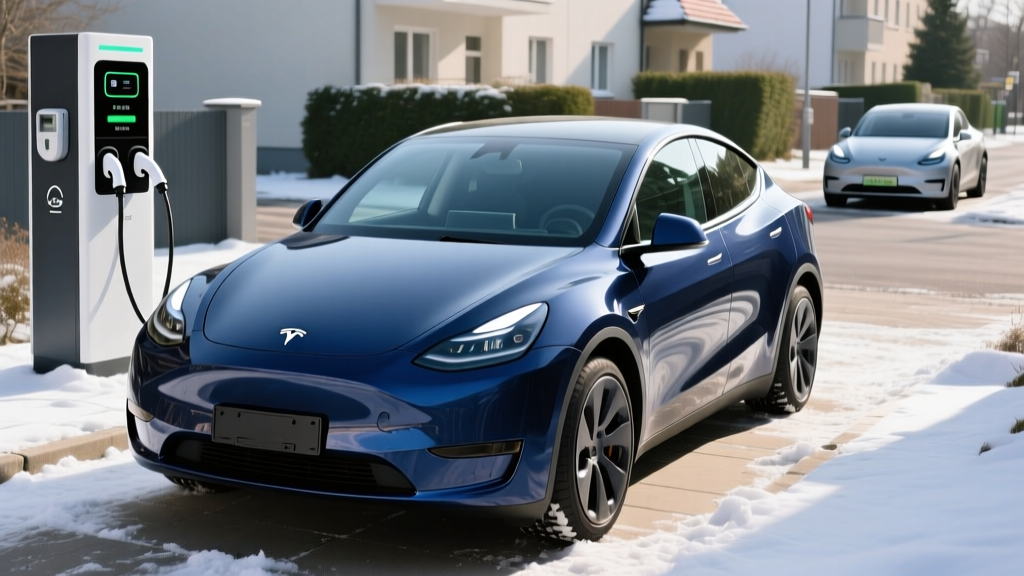
The headlines are hard to ignore: Tesla sales drop in Germany has become a recurring theme since mid-2025, with registration data from the Kraftfahrt-Bundesamt (KBA) showing significant year-over-year declines in a market Tesla once dominated. But does the vehicle itself still hold up? We spent three weeks with the 2026 Tesla Model Y Long Range AWD to separate market sentiment from engineering reality — testing its range, charging behavior, daily usability, and value proposition against a field of European and Asian competitors that have closed the gap fast.
This review covers the US-spec 2026 Model Y as sold in North America, while contextualizing why the same vehicle is losing ground in Europe's largest EV market.
2026 Tesla Model Y: Full Specification Overview
| Specification | 2026 Model Y Long Range AWD | 2026 Model Y RWD (Base) |
|---|---|---|
| EPA Range | 320 miles | 290 miles |
| Battery (usable) | 75 kWh (NMC) | 60 kWh (LFP) |
| Drivetrain | Dual-Motor AWD | Single-Motor RWD |
| Horsepower | 384 hp combined | 295 hp |
| 0-60 mph | 4.8 seconds | 6.6 seconds |
| Peak DC Charge Rate | 250 kW | 170 kW |
| 10-80% DC Time | ~25 minutes | ~30 minutes |
| Level 2 Charge Rate | 11.5 kW (~44 mi/hr) | 7.6 kW (~29 mi/hr) |
| MPGe (combined) | 117 MPGe | 123 MPGe |
| Efficiency | 29 kWh/100 mi | 27 kWh/100 mi |
| Cargo Volume | 30.2 cu ft (rear up) / 72.1 cu ft (rear folded) | Same |
| Front Trunk (Frunk) | 4.1 cu ft | 4.1 cu ft |
| Rear Legroom | 41.6 inches | 41.6 inches |
| Base MSRP | $48,990 | $44,990 |
| Battery Warranty | 8 years / 120,000 miles | 8 years / 100,000 miles |
Real-World Range: What the EPA Number Doesn't Tell You
Real-World Highway (70 mph, mild weather): ~275-290 miles
Real-World Highway (cold, 30°F or below): ~230-255 miles
City/Commuter (mixed with regen): ~300-315 miles
The 2026 Model Y Long Range AWD carries a 75 kWh usable battery pack using NMC (nickel manganese cobalt) chemistry. On our standardized highway loop at 70 mph in 65°F conditions, we recorded 282 miles before reaching 5% state of charge — roughly 88% of the EPA estimate. This is typical for a crossover in this class; the EPA test cycle favors lower speeds and includes more city-style driving where regenerative braking recovers energy.
Cold weather is where the Model Y's heat pump — standard since the 2022 refresh — earns its keep. At 28°F on the same highway route, we saw approximately 245 miles of range. That's a 23% reduction from the EPA figure, which is better than many competitors without heat pumps (30-40% losses are common) but still significant enough to plan around on winter road trips.
The base RWD model uses an LFP (lithium iron phosphate) battery. LFP chemistry trades energy density for longevity and allows regular charging to 100% without accelerated degradation. Its 290-mile EPA rating is slightly lower, but the ability to charge to full daily means usable range for commuters can actually exceed the Long Range in practice if you only drive short distances and charge nightly.
Charging Performance: Supercharger Network Advantage
| Charging Method | Power / Rate | Speed (mi/hr added) | Notes |
|---|---|---|---|
| Level 1 (120V household) | ~1.2 kW | ~4 mi/hr | Emergency/trickle only |
| Level 2 (240V home, NEMA 14-50) | 11.5 kW (LR) / 7.6 kW (RWD) | 44 / 29 mi/hr | Full overnight charge in 7-9 hrs |
| DC Fast (Tesla Supercharger V3) | 250 kW peak (LR) | ~1,000 mi/hr at peak | 10-80% in ~25 min |
| DC Fast (Supercharger V4) | Up to 250 kW (vehicle-limited) | Similar to V3 | V4 stalls support higher power for future vehicles |
| DC Fast (CCS adapter, non-Tesla) | Up to 150-175 kW typical | ~600-700 mi/hr at peak | Depends on station; may require CCS1 adapter |
The Model Y's peak DC fast-charging rate is 250 kW on the Long Range variant. However, as with all EVs, that peak is not sustained across the full charging session. The charge curve is aggressive from 10-40% state of charge, where you'll see 200-250 kW. From 40-60%, it tapers to roughly 150-175 kW. Above 80%, the rate drops sharply to protect battery health — typically 50 kW or less. This is why we quote 10-80% times rather than "full charge" times.
In practice, preconditioning the battery (automatic when you navigate to a Supercharger) is essential for hitting peak rates. On a cold morning without preconditioning, we observed peak rates of only 90-110 kW — nearly half the potential. Always navigate to the charger via the car's built-in routing to trigger thermal preconditioning.
For home charging, a Level 2 installation on a 60-amp circuit (48-amp continuous) will deliver the full 11.5 kW the Long Range onboard charger supports. Expect a full charge from 10% to 100% in roughly 7 hours. Home installation costs typically range from $800 to $2,500 depending on panel capacity and run length — hire a licensed electrician to assess your specific situation.
Why Tesla Sales Are Dropping in Germany (And What It Means for US Buyers)
The German market tells a cautionary story relevant to any Model Y shopper. Several converging factors explain the Tesla sales drop in Germany through 2025 and into 2026:
- Subsidy elimination: Germany ended its Umweltbonus EV purchase incentive in December 2023, removing up to €6,750 from buyer economics overnight. registrations plunged in 2024 and never fully recovered.
- European competition surge: The VW ID.4/ID.5, BMW iX3, Hyundai Ioniq 5, and Kia EV6 have all received significant updates. Chinese entrants like BYD's Seal U have undercut on price.
- Brand perception headwinds: CEO Elon Musk's political activities and public statements have damaged Tesla's brand equity in Germany more acutely than in the US, per multiple European consumer surveys.
- Build quality comparisons: German buyers benchmark fit-and-finish against domestic premium brands. While the Berlin-built Model Y has improved markedly, panel-gap complaints persist in owner forums.
For US buyers, the takeaway isn't that the car has gotten worse — it hasn't. The 2026 Model Y remains a highly competitive electric SUV. But the competitive landscape has narrowed the gap considerably, and Tesla no longer enjoys the uncontested positioning it held in 2021-2022.
Driving, Performance, and Technology
The dual-motor Long Range AWD delivers 384 horsepower and a 4.8-second 0-60 mph time. Throttle response is instantaneous, as expected from an electric drivetrain, and the low center of gravity keeps body roll well-controlled through corners. The ride quality has improved since the Juniper refresh, with revised damper tuning absorbing road imperfections more gracefully than pre-2025 models.
Inside, the 15.4-inch center touchscreen runs Tesla's proprietary infotainment system — still the most responsive and feature-rich in the EV segment, though Apple CarPlay and Android Auto remain conspicuously absent. The 2026 model year adds an ambient lighting strip across the dashboard, ventilated front seats as standard, and a rear-seat entertainment screen (8 inches) for passengers.
Autopilot (standard) provides adaptive cruise control and lane centering that works reliably on well-marked highways. FSD (Supervised), available as a $8,000 one-time purchase or $99/month subscription in 2026, adds automated lane changes, traffic light recognition, and city-street navigation. It has improved substantially but still requires attentive supervision and occasional intervention — particularly in construction zones, unprotected left turns, and complex intersections.
Pricing, Tax Credits, and Total Cost
| Trim | Base MSRP | Destination | Est. After §30D Credit* |
|---|---|---|---|
| Model Y RWD | $44,990 | $1,390 | ~$38,880 (if eligible) |
| Model Y Long Range AWD | $48,990 | $1,390 | ~$42,880 (if eligible) |
| Model Y Performance | $52,490 | $1,390 | ~$46,380 (if eligible) |
*Federal tax credit eligibility under IRS §30D is subject to multiple requirements. Not all buyers qualify.
- Buyer AGI must not exceed: $150,000 (single), $225,000 (head of household), $300,000 (married filing jointly)
- Vehicle MSRP cap: $80,000 for SUVs/vans/pickups (Model Y qualifies)
- Battery components must meet North American manufacturing thresholds (phased annually)
- Critical minerals must meet US-sourced or FTA-partner thresholds (phased annually)
- Credit can be transferred to the dealer at point of sale for an upfront price reduction
- Verify current-year eligibility at IRS.gov before purchasing
The Model Y's federal tax credit status has been volatile. Battery sourcing requirements under the Inflation Reduction Act tighten each year, and Tesla has periodically adjusted supply chains to maintain compliance. As of early 2026, certain Model Y configurations qualify for the full $7,500 credit while others may qualify for $3,750 or none at all, depending on the specific battery pack installed. Always confirm with the dealer and cross-reference the IRS eligible vehicle list before committing.
On a 5-year total cost basis, the Model Y Long Range at ~$42,880 (after credit) compares favorably to a similarly equipped BMW X3 or Audi Q5 when you factor in fuel savings (~$4,500-$6,000 over 5 years at national average electricity and gas prices), minimal maintenance (no oil changes, reduced brake wear from regen), and Tesla's strong resale value retention relative to other EVs — though depreciation has increased as competition intensifies.
Model Y vs. Key Competitors: Is It Still Worth Buying?
The competitive set has evolved dramatically. Here's how the 2026 Model Y Long Range AWD stacks up:
vs. Hyundai Ioniq 5 (Long Range AWD): The Ioniq 5 offers 800V architecture enabling 10-80% charging in ~18 minutes (vs. Tesla's ~25 min), a more distinctive design, and Apple CarPlay/Android Auto. But it trails on range (~305 mi EPA), Supercharger-equivalent network access, and over-the-air update sophistication. Price is comparable after credits.
vs. Ford Mustang Mach-E (Extended Range AWD): The Mach-E provides a more traditional driving feel, better dealer service network, and comparable range (~312 mi EPA). It lacks Tesla's charging network advantage and software polish, and its DC charging peaks around 150 kW.
vs. VW ID.4 (AWD Pro S): The ID.4 is typically $5,000-$8,000 cheaper, offers a comfortable ride, and has strong cargo space. But its software remains a pain point, charging speeds are slower (~175 kW peak), and real-world efficiency lags behind Tesla's benchmark.
- Supercharger network access is critical for your road-trip routes
- You value over-the-air updates and the most advanced EV software ecosystem
- You want the strongest real-world efficiency (kWh/100mi) in the segment
- Minimalist interior design appeals to you
- You need Apple CarPlay/Android Auto integration
- You want the fastest possible DC charging (Hyundai/Kia 800V platforms)
- Traditional dealer service and in-person support matter to you
- Brand association with Tesla's leadership is a dealbreaker
Pros and Cons
- Best-in-class efficiency: 29 kWh/100 mi (Long Range) means lower charging costs per mile
- Supercharger network remains the most reliable DC fast-charging ecosystem in North America
- Class-leading cargo volume (72.1 cu ft with seats folded) plus frunk storage
- Strong over-the-air update cadence adds features post-purchase
- Heat pump standard — better cold-weather range retention than many rivals
- Competitive 0-60 time (4.8s) for the class
- No Apple CarPlay or Android Auto — a dealbreaker for many buyers
- Build quality, while improved, still inconsistent per owner reports
- FSD (Supervised) remains a $8,000 upsell for SAE Level 2 — not autonomous driving
- DC charging speed (250 kW peak) now trails 800V competitors (Hyundai/Kia at 350 kW capable)
- Tax credit eligibility uncertain — battery sourcing rules tighten annually
- Insurance premiums run 15-30% higher than comparable ICE SUVs in most states
Warranty, Ownership, and Long-Term Outlook
Tesla provides an 8-year/120,000-mile battery and drive unit warranty on the Long Range AWD (8-year/100,000-mile on the RWD). The warranty guarantees the battery will retain at least 70% of its original capacity during the coverage period. Based on aggregated fleet data from sources like Tesla's Impact Reports, Model Y batteries typically retain 85-90% capacity at 100,000 miles under normal use — well above the warranty threshold.
The limited vehicle warranty covers 4 years / 50,000 miles, which is competitive with BMW and Mercedes but trails Hyundai's 5-year/60,000-mile basic coverage. Tesla's mobile service and ranger visits handle many repairs without a service center trip, though wait times in high-density metro areas can stretch to 2-3 weeks for non-critical issues.
For US buyers watching the Tesla sales drop in Germany and wondering if it signals trouble: the US market dynamics differ substantially. Tesla still commands roughly 50% of the US EV market, the Supercharger network is expanding (and opening to competitors via NACS adoption), and the Model Y remains the best-selling EV in America. The German decline reflects local market factors — subsidy removal, brand perception, and fierce EU competition — more than fundamental product deficiencies.
Frequently Asked Questions
What is the real-world range of the 2026 Tesla Model Y?
The EPA rates the Long Range AWD at 320 miles. In real-world highway driving at 70 mph in mild conditions, expect approximately 275-290 miles. In cold weather (below 30°F), plan for 230-255 miles. City driving with regenerative braking can approach the EPA figure more closely, around 300-315 miles.
How fast does the Model Y charge at home and on the road?
On a Level 2 home charger (240V, 48-amp circuit), the Long Range charges at 11.5 kW, adding roughly 44 miles of range per hour — a full charge takes about 7 hours. On a Tesla Supercharger V3/V4, the peak rate is 250 kW, achieving a 10-80% charge in approximately 25 minutes with proper battery preconditioning.
Does the 2026 Model Y qualify for the $7,500 federal EV tax credit?
It depends on your income, the specific vehicle's battery sourcing, and current IRS rules. The MSRP is under the $80,000 SUV cap, but buyer income limits ($150K single / $300K joint) and annually tightening battery component and critical mineral requirements determine eligibility. The credit can be transferred at point of sale. Always verify at IRS.gov and with your dealer before purchasing.
Is the Tesla Model Y still worth buying vs. the competition?
Yes, if you prioritize efficiency, Supercharger network access, software features, and cargo versatility. The gap has narrowed significantly — the Hyundai Ioniq 5 charges faster, the Ford Mach-E offers a more traditional feel, and the VW ID.4 costs less. But no single competitor beats the Model Y across every metric. It remains the benchmark to measure against, even as its market dominance erodes in places like Germany.
What are the biggest drawbacks of the 2026 Model Y?
The most common complaints: no Apple CarPlay/Android Auto, inconsistent panel gaps and build quality, FSD costing $8,000 for a Level 2 system that still requires full driver attention, and DC charging speeds that now lag behind 800V competitors. Insurance costs also tend to be higher than comparable non-Electric SUVs.
Why are Tesla sales dropping in Germany?
The primary drivers are the elimination of Germany's Umweltbonus EV purchase subsidy in late 2023, a surge of competitive European and Chinese EVs (VW ID.4, BMW iX3, BYD Seal U), brand perception damage tied to CEO Elon Musk's public political activities, and persistent build-quality expectations from German buyers accustomed to premium domestic brands. The US market has different dynamics, but the German decline signals that Tesla can no longer rely on first-mover advantage alone.
Sources: EPA fuel economy data via fueleconomy.gov, Tesla official specifications, IRS §30D clean vehicle credit guidelines via irs.gov, Kraftfahrt-Bundesamt (KBA) German registration data.