The Tesla Cybertruck remains one of the most polarizing vehicles on the road, but beneath the stainless-steel exoskeleton lies a serious electric pickup with legitimate capability. While most headlines focus on its angular design or acceleration, buyers spending $80,000 to $100,000+ want to know about daily livability — and that starts with the Cybertruck seats, cabin comfort, and whether the truck can actually serve as a practical daily driver and workhorse. This review covers every critical spec from range and charging to seating ergonomics, tax credit eligibility, and how it stacks up against the Ford F-150 Lightning and Rivian R1T in 2026.
Cybertruck Seats and Interior: Comfort Meets Brutalism
The front seats in the Cybertruck are heavily bolstered, synthetic-leather-trimmed sport buckets that lean toward firm support over plush cushioning. Tesla uses a vegan leather material across all trims. The driver and front passenger get 12-way power adjustment with heating and ventilation on the AWD and Cyberbeast trims. The seat bottom cushion is relatively flat and wide, accommodating larger frames, but the firm foam density means long highway stints (3+ hours) leave some drivers wanting more lumbar contouring.
Rear seats are a three-across bench with a 60/40 split-fold function. Legroom measures approximately 38.4 inches in the rear, which is competitive with midsize trucks but trails the full-size Ford F-150 Lightning's 43.6 inches. The rear seatback angle is more upright than a traditional truck — a consequence of the sloping roofline — and taller passengers (6'2"+) will notice their heads brushing the headliner on rougher roads. The center rear position is narrow due to the folded-down armrest/console design, making it best suited for a child seat rather than an adult on long trips.
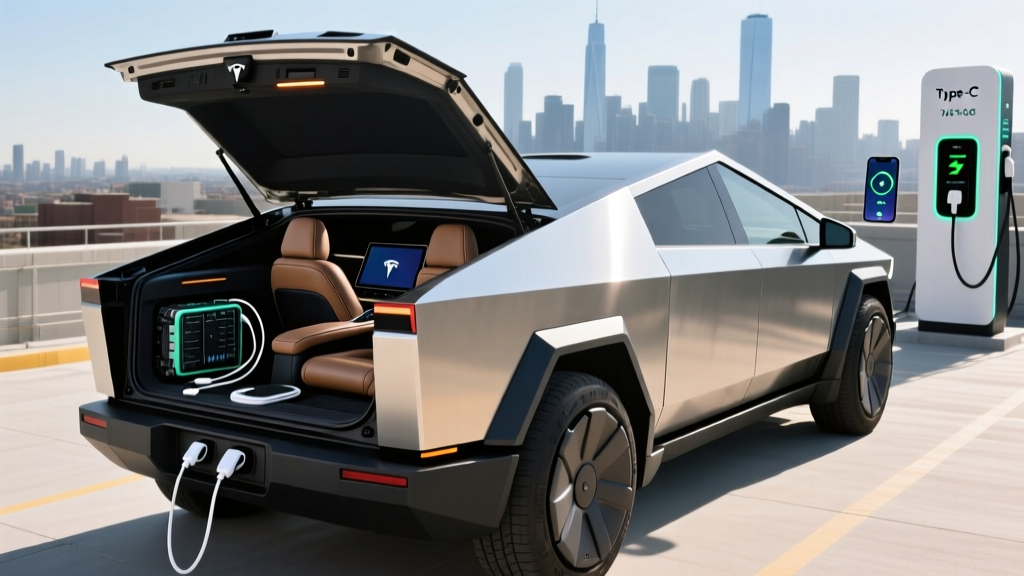
Cargo space behind the rear seats is limited compared to a traditional truck bed, but the 6-foot composite bed (lockable tonneau cover standard) offers 74 cubic feet of volume. The front trunk (frunk) adds roughly 7 cubic feet of lockable, drainable storage — useful for charging cables or wet gear.
Range, Efficiency, and the Real-World Reality Check
Tesla offers the Cybertruck in three configurations for 2026, and range varies substantially by trim. The EPA numbers tell one story; real-world driving tells another.
- AWD (Dual-Motor): EPA 340 miles | Expect 280–310 mi highway at 70 mph; ~240–260 mi in freezing weather
- Cyberbeast (Tri-Motor): EPA 320 miles | Expect 260–290 mi highway; ~220–250 mi in freezing weather
- RWD (Single-Motor, late 2026): EPA est. 250+ miles (announced, preliminary)
The Cybertruck's 6,600+ lb curb weight and flat-panel aerodynamics create significant efficiency penalties at highway speeds. Cold-weather range loss of 20–30% is consistent with other large EVs, though the standard heat pump helps mitigate cabin energy draw.
Efficiency lands around 47–50 MPGe combined (roughly 70–74 kWh/100mi), making the Cybertruck one of the least efficient EVs per mile — a direct consequence of its mass and shape. For comparison, the Rivian R1T Dual-Motor achieves approximately 73 MPGe combined.
Battery, Chemistry, and Charging Speeds
The Cybertruck uses an estimated 123 kWh (usable) battery pack with a structural battery pack design integrating 4680-format cells. Tesla has not publicly confirmed whether the pack uses NMC (nickel manganese cobalt) or a hybrid chemistry approach, but industry analysis and energy-density figures point to an NMC-based chemistry optimized for power delivery rather than the LFP chemistry found in the standard-range Model 3/Y.
| Spec | AWD (Dual-Motor) | Cyberbeast (Tri-Motor) |
|---|---|---|
| EPA Range | 340 miles | 320 miles |
| Battery (usable) | ~123 kWh | ~123 kWh |
| Chemistry | NMC (4680 cells) | NMC (4680 cells) |
| 0–60 mph | 4.1 seconds | 2.6 seconds |
| Horsepower | 600 hp | 845 hp |
| Drivetrain | Dual-Motor AWD | Tri-Motor AWD |
| Towing Capacity | 11,000 lbs | 11,000 lbs |
| Bed Length | 6 ft (74 cu ft) | 6 ft (74 cu ft) |
| Rear Legroom | ~38.4 in | ~38.4 in |
| Base MSRP | $79,990 | $99,990 |
| Battery Warranty | 8 yr / 120,000 mi | 8 yr / 120,000 mi |
The Cybertruck's 800-volt architecture enables impressive DC fast-charging performance. On a V4 Supercharger or equivalent 350 kW station, Tesla rates the peak charge rate at approximately 350 kW, with a 10–80% charge time of roughly 15–18 minutes under optimal conditions (battery preconditioned via navigation routing).
| Charging Level | Power (kW) | Rate / Time | Notes |
|---|---|---|---|
| Level 1 (120V) | ~1.4 kW | ~3–4 mi/hr | Emergency/trickle only |
| Level 2 (240V, 48A) | 11.5 kW | ~30–34 mi/hr | Wall Connector; full charge ~10–12 hr |
| Level 2 (240V, 80A) | 19.2 kW | ~50–55 mi/hr | Requires upgraded Wall Connector + 100A circuit |
| DC Fast Charge | Up to 350 kW | 10–80% in ~15–18 min | Requires preconditioning; tapers above 80% |
A critical note on the charge curve: the Cybertruck, like all large-battery EVs, does not sustain peak kW for the entire session. The 350 kW rate applies roughly between 10–35% State of Charge (SoC), after which the rate progressively tapers. From 60–80%, expect rates closer to 120–150 kW. This is physics — higher SoC means increased cell resistance, and the battery management system protects longevity by reducing current. Always precondition by navigating to a Supercharger; arriving cold can add 5–10 minutes to your session.
Performance and Driving Dynamics
The dual-motor AWD Cybertruck delivers 600 horsepower and a 4.1-second 0–60 mph time — remarkable for a 6,600-lb truck. The tri-motor Cyberbeast pushes 845 hp and 2.6 seconds, placing it in supercar territory. Steering is heavily assisted and numb by enthusiast standards, but the steer-by-wire system (yoke or round wheel) provides a variable ratio that feels quick at parking speeds and stable on the highway.
Ride quality benefits from the adaptive air suspension, which offers up to 16 inches of ground clearance in Extract mode (for off-road obstacles) and automatically lowers at highway speeds for efficiency. However, the truck's sheer mass is felt during hard cornering — body roll is well-controlled for a pickup, but this is not a sports sedan, and the 20-inch or optional 22-inch wheels transmit more road imperfections than a luxury-oriented SUV.
Pricing, Trims, and Federal Tax Credit Eligibility
For 2026, the Cybertruck lineup has stabilized after the controversial "Foundation Series" pricing of its launch year. Here is where pricing stands and how the federal tax credit applies.
| Trim | Base MSRP | As-Tested (typical) | §30D Credit Eligible? |
|---|---|---|---|
| RWD (late 2026, announced) | $59,990 (est.) | $62,000–$65,000 | Likely eligible (under $80K truck cap) |
| AWD (Dual-Motor) | $79,990 | $82,000–$87,000 | Eligible — at MSRP cap for trucks |
| Cyberbeast (Tri-Motor) | $99,990 | $102,000–$110,000 | NOT eligible (exceeds $80K truck cap) |
Under current IRS §30D rules, the federal EV tax credit provides up to $7,500, but eligibility requires meeting several conditions simultaneously:
- MSRP Cap: Trucks, vans, and SUVs must have an MSRP at or below $80,000. The AWD trim barely qualifies; Cyberbeast does not.
- Buyer Income Cap: Modified AGI must not exceed $150,000 (single), $225,000 (head of household), or $300,000 (joint).
- Battery Sourcing: A percentage of critical minerals and battery components must be sourced from the U.S. or FTA partners — Tesla's domestic manufacturing generally satisfies this, but confirm at purchase.
- Point-of-Sale Transfer: The credit can be transferred to the dealer at purchase, reducing your out-of-pocket cost immediately.
The RWD model, expected later in 2026, would likely qualify for the full $7,500, bringing its effective price into the low $50Ks — a significant value proposition if Tesla delivers on schedule. Always verify eligibility at fueleconomy.gov before purchasing, as rules and eligible VIN lists update regularly.
Tech, Driver Assistance, and Standout Features
The Cybertruck runs Tesla's latest infotainment system on an 18.5-inch front touchscreen with a secondary 9.4-inch rear touchscreen for back-seat passengers. Features include:
- Autopilot (standard): SAE Level 2 adaptive cruise and lane-centering — requires continuous driver supervision. This is not self-driving.
- Full Self-Driving Supervised ($8,000 option): Also SAE Level 2, adds automated lane changes, traffic light/stop sign recognition, and parking assist. Driver must remain fully engaged at all times.
- Bioweapon Defense Mode: HEPA filtration system capable of pressurizing the cabin against outside contaminants.
- Powershare (V2L/V2H): Up to 11.5 kW of vehicle-to-load and vehicle-to-home backup power, capable of running tools on a job site or essential home circuits during an outage.
- Armor Glass: Tesla claims ultra-hardened glass, though real-world owner reports suggest it resists impacts better than standard auto glass but is not impervious.
Who Should Buy the Cybertruck — And Who Shouldn't
- Class-leading DC fast-charge speed (350 kW peak, 10–80% in ~15 min)
- 11,000-lb towing capacity with integrated trailer brake controller
- Stainless-steel exoskeleton resists dents and corrosion
- Standard air suspension with Extract mode for off-road clearance
- 11.5 kW Powershare V2L/V2H capability
- Supercharger network access (most reliable public charging in the U.S.)
- Rear seats are upright with limited headroom for tall passengers
- Efficiency is poor (~70 kWh/100mi) — costly to charge on road trips
- AWD MSRP sits exactly at the $80K tax-credit cap — options can disqualify you
- 6-foot bed is shorter than most full-size trucks (F-150 offers 6.5–8 ft)
- Steer-by-wire yoke has a steep learning curve for some drivers
- Visibility is compromised by thick A-pillars and angular rear design
Best for: Tech-forward truck buyers who need serious towing capacity, want V2H backup power, and prioritize fast DC charging for road trips. The Cybertruck AWD is a credible work truck with supercar acceleration.
Look elsewhere if: You need maximum rear-seat comfort for adults (Rivian R1T or F-150 Lightning are better), want an 8-foot bed for commercial use, or need the lowest cost-per-mile efficiency (consider the Hyundai Ioniq 5 or Tesla Model Y instead).
Warranty and Long-Term Ownership
Tesla covers the Cybertruck battery and drive units for 8 years or 120,000 miles, whichever comes first, with a minimum 70% capacity retention threshold over that period. The limited vehicle warranty is 4 years / 50,000 miles. Given the 4680 cell architecture and structural pack design, battery replacement cost is projected to be significant — likely $15,000–$25,000 out of warranty, though real-world degradation data on 4680 packs in heavy trucks is still maturing.
Insurance costs are notably high. The Cybertruck's repair complexity (stainless-steel panels, proprietary glass, structural battery) pushes annual premiums 30–50% above comparable trucks. Get an insurance quote before purchasing — this is a meaningful ownership cost that many buyers overlook.
Frequently Asked Questions
What is the real-world range of the Cybertruck on a road trip?
On a 70-mph highway drive in moderate temperatures (60–80°F), expect 280–310 miles from the AWD model before needing to charge. In winter conditions (below 32°F), plan for 240–260 miles. Towing a 7,000-lb trailer cuts range roughly in half — to approximately 150–170 miles.
How fast does the Cybertruck charge at home?
On a standard Tesla Wall Connector at 48 amps (11.5 kW), the Cybertruck gains approximately 30–34 miles of range per hour, with a full 10–100% charge taking roughly 10–12 hours. Upgrading to an 80-amp circuit (19.2 kW) cuts this to about 6–7 hours but requires a 100-amp dedicated circuit — consult a licensed electrician for panel capacity.
Does the Cybertruck qualify for the $7,500 federal tax credit?
The AWD trim at $79,990 MSRP qualifies, provided the buyer meets income caps ($300K joint / $150K single) and battery sourcing requirements are met. The Cyberbeast at $99,990 exceeds the $80,000 truck MSRP cap and does NOT qualify. The upcoming RWD model will likely qualify. Rules can change — verify at IRS.gov.
Are Cybertruck seats comfortable for long drives?
Front seats are supportive but firm, with good adjustment range and ventilation. Most drivers find them comfortable for 2–3 hour stretches. Rear seats are the weak point: the upright seatback and limited headroom make them better suited for children or shorter trips. If rear passenger comfort is a priority, the Ford F-150 Lightning or Rivian R1T offer more spacious back seats.
Is the Cybertruck worth buying over the F-150 Lightning or Rivian R1T?
The Cybertruck wins on DC fast-charge speed (350 kW vs. ~150–200 kW for competitors), towing (11,000 lbs), and V2H capability. The F-150 Lightning wins on bed length options, rear-seat space, and familiarity for fleet/commercial buyers. The Rivian R1T wins on build quality, off-road sophistication (quad-motor), and interior refinement. Your priority — charging speed, space, or refinement — determines the best choice.
How much does it cost to charge a Cybertruck?
At home on utility electricity averaging $0.15/kWh, a full 123 kWh charge costs roughly $18.45. At a Supercharger averaging $0.35/kWh, the same charge runs about $43. Over 15,000 miles annually at mixed home/public charging, expect $1,200–$1,800 in electricity costs — compared to roughly $2,800–$3,500 in gasoline for a similarly capable gas truck.