Tesla has dominated the electric SUV segment for years, but 2025 brought headwinds the company hasn't faced before. A measurable Tesla sales decline in key markets, combined with high-profile executive departures — including the exits of longtime design chief Franz von Holzhausen's expanded role shifts and key Autopilot engineering leads — has buyers asking a fair question: Is the Tesla Model Y still the default EV SUV pick, or has the competition closed the gap?
This review cuts through the noise. We'll evaluate the 2026 Tesla Model Y on the metrics that actually matter to EV buyers: real-world range, charging speed, total cost after tax credits, and how it stacks up against the Hyundai Ioniq 5, Ford Mustang Mach-E, and Kia EV6. The corporate headlines matter for long-term ownership confidence, but the spec sheet determines whether this SUV fits your driveway.
2026 Tesla Model Y: Core Specifications at a Glance
| Spec | Long Range AWD | Performance |
|---|---|---|
| EPA Range | 320 miles | 295 miles |
| Battery Capacity | 78.1 kWh usable (NMC) | 78.1 kWh usable (NMC) |
| Drivetrain | Dual-Motor AWD | Dual-Motor AWD |
| Horsepower | 384 hp | 456 hp |
| 0-60 mph | 4.8 seconds | 3.5 seconds |
| Max DC Fast Charge | 250 kW (peak) | 250 kW (peak) |
| 10-80% DC Time | ~22 minutes | ~22 minutes |
| Level 2 Charge Rate | 11.5 kW (~37 mi/hr) | 11.5 kW (~37 mi/hr) |
| Efficiency (MPGe) | 122 MPGe combined | 111 MPGe combined |
| Efficiency (kWh/100mi) | 28 kWh/100mi | 30 kWh/100mi |
| Cargo (rear seats up) | 30.2 cu ft | 30.2 cu ft |
| Cargo (rear seats folded) | 72.1 cu ft | 72.1 cu ft |
| Rear Legroom | 37.0 inches | 37.0 inches |
| Base MSRP | $44,990 | $52,490 |
| Battery Warranty | 8 yr / 120,000 mi | 8 yr / 120,000 mi |
Real-World Range: What the EPA Number Doesn't Tell You
Real-World Expectation: ~260-280 miles highway at 70+ mph; ~200-230 miles in freezing temperatures (below 32°F); ~300+ miles city/commuter driving with regen braking engaged.
The 320-mile EPA figure on the Long Range AWD is competitive, but EPA testing cycles favor mixed city/highway driving with moderate climate control use. In our experience and consistent with independent testing, sustained highway driving at 75 mph drops usable range by roughly 15-18%. That puts a realistic road-trip range between Supercharger stops at approximately 260-280 miles in mild weather.
Cold weather is the bigger variable. Lithium-ion NMC chemistry loses efficiency in freezing temperatures — both from cabin heating demands and from the battery's increased internal resistance. Expect a 25-35% range reduction in sub-freezing conditions, bringing winter range to roughly 200-230 miles. Tesla's heat pump (standard on all 2026 Model Y trims) mitigates this compared to older resistive-heating EVs, but the physics of cold-weather battery performance remain unavoidable.
For daily commuting under 60 miles round-trip with home charging, these reductions are academic. For cross-country road trips, plan your Supercharger stops with a 20% buffer below the EPA number and precondition the battery before each stop — the Model Y does this automatically when a Supercharger is set as a navigation destination, warming the pack to optimize charge acceptance.
Charging Speed: DC Fast Charging and Home Setup
The Model Y retains Tesla's proprietary NACS (North American Charging Standard) connector, which has become the de facto industry standard after Ford, GM, Rivian, and most major automakers adopted it for 2025-2026 models. This gives Tesla owners access to the largest and most reliable fast-charging network in North America.
| Charging Level | Power | Speed (Miles Added) | Notes |
|---|---|---|---|
| Level 1 (120V household) | ~1.4 kW | ~3-4 mi/hr | Emergency/trickle only; ~80 hrs for full charge |
| Level 2 (240V / 48A Wall Connector) | 11.5 kW | ~37 mi/hr | Full charge in ~8 hrs; ideal for overnight |
| Level 2 (240V / 32A mobile connector) | 7.7 kW | ~25 mi/hr | Slower; ~12 hrs for full charge |
| DC Fast (V3 Supercharger) | 250 kW peak | ~180 mi in 15 min | 10-80% in ~22 min; tapers sharply above 80% |
| DC Fast (V4 Supercharger) | 250 kW peak* | ~180 mi in 15 min | Same peak rate for Model Y; cable is lighter |
*Note: Tesla's V4 Supercharger cabinets support higher power for future vehicles, but the 2026 Model Y's architecture peaks at 250 kW. The Cybertruck and next-gen platforms will utilize higher rates.
The charging curve matters more than the peak number. The Model Y hits 250 kW only briefly between roughly 10-20% state of charge (SoC), then tapers progressively: ~175 kW through 40%, ~120 kW through 60%, and ~60 kW by 80%. This is typical for NMC chemistry with aggressive thermal management. The 10-80% time of approximately 22 minutes remains competitive with the Hyundai Ioniq 5 (which peaks at 240 kW on its 800V architecture but with a smaller 77.4 kWh pack) and faster than the Ford Mustang Mach-E (peak 150 kW on extended-range models).
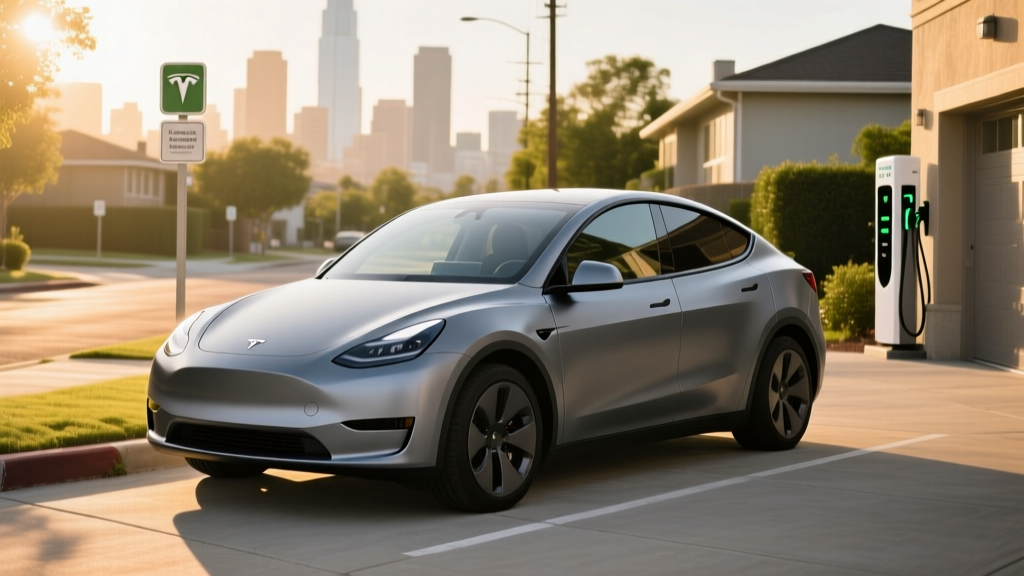
For home charging, Tesla's Wall Connector at $420 (hardware only) delivers a full 48 amps on a 60-amp circuit, adding roughly 37 miles of range per hour. Most owners charging overnight from 20-80% SoC will wake to a full battery every morning. Installation costs vary widely: expect $500-$1,500 if your electrical panel has capacity, or $2,000-$4,000+ if a panel upgrade to 200A service is needed. Always get a quote from a licensed electrician before committing.
Performance, Efficiency, and the Driving Experience
The Long Range AWD's 4.8-second 0-60 mph time is quick by any SUV standard, and the dual-motor all-wheel-drive system provides confident traction in rain and light snow. The Performance trim drops that to 3.5 seconds — genuinely sports-car territory — with sharper throttle mapping and a lowered sport suspension.
Efficiency is where Tesla's vertical integration shows. At 28 kWh per 100 miles (Long Range), the Model Y extracts more miles per kilowatt-hour than most competitors in its class. The Ford Mustang Mach-E Extended Range AWD consumes roughly 32 kWh/100mi, and the Kia EV6 AWD sits at about 29 kWh/100mi. Over 15,000 miles annually at the US average electricity rate of $0.17/kWh, that efficiency gap translates to roughly $100-$150 in annual electricity savings versus less efficient rivals.
One-pedal driving via regenerative braking is strong in the Model Y, though Tesla removed the user-adjustable regen setting in 2024 (a decision reversed partially with a software update allowing limited adjustment). The ride quality on the refreshed "Juniper" Model Y is noticeably improved over the pre-2025 model, with revised damper tuning that absorbs highway imperfections more competently. Road noise remains moderate — better than pre-refresh, but the Hyundai Ioniq 5 and Kia EV6 are quieter at highway speeds.
Pricing, Tax Credits, and Total Cost
| Trim | Base MSRP | Destination | Federal Credit (§30D) | Effective Price* |
|---|---|---|---|---|
| Long Range AWD | $44,990 | $1,390 | Up to $7,500 | ~$38,880 |
| Performance AWD | $52,490 | $1,390 | Up to $7,500 | ~$46,380 |
*Effective price assumes full $7,500 federal tax credit eligibility. Actual credit depends on buyer income, battery sourcing compliance, and tax liability.
The IRS §30D clean vehicle credit remains available for the 2026 Model Y, but eligibility is not automatic. Key requirements include:
- MSRP Cap: SUVs must have an MSRP at or below $80,000 (both Model Y trims qualify)
- Income Limits: Modified AGI must not exceed $300,000 (joint filers), $225,000 (head of household), or $150,000 (single)
- Battery Sourcing: Critical minerals and battery components must meet escalating domestic/free-trade-agreement sourcing thresholds — Tesla has largely restructured its supply chain to comply, but verify at purchase as rules tighten annually
- Point-of-Sale Transfer: You can transfer the credit to the dealer at purchase for an immediate price reduction rather than waiting to claim it on your tax return
Consult a tax professional for your specific situation. State incentives vary significantly — California's CVRP, Colorado's innovative motor vehicle credit, and other programs may stack on top of the federal credit but have their own income and price caps.
Tech, Interior, and the Autopilot Question
The refreshed Model Y's interior is cleaner and more refined than earlier builds, with ventilated front seats, ambient lighting, a rear-seat touchscreen, and power-folding second-row seats. The 15.4-inch front touchscreen handles all vehicle controls — there are no physical buttons for climate, mirrors, or glovebox, which remains polarizing. Build quality has improved substantially, though panel gaps still vary unit to unit.
On driver assistance: Tesla's Autopilot (standard) and Full Self-Driving Supervised ($8,000 option or $99/month subscription) remain SAE Level 2 systems. This means the driver must remain fully engaged, with hands on the wheel and eyes on the road, at all times. FSD Supervised handles highway lane changes, on-ramps, and some city-street navigation impressively in favorable conditions, but it is not autonomous driving. It makes errors — phantom braking, missed construction zones, confused unprotected left turns — that require instant driver takeover. The NHTSA continues to monitor Tesla's Autopilot/FSD safety record closely.
The infotainment system remains best-in-class for responsiveness and over-the-air update frequency. Netflix, YouTube, and gaming are available while parked. The Tesla app ecosystem, Sentry Mode dashcam system, and remote climate/preconditioning controls set the standard that competitors are still chasing.
What the Sales Decline and Executive Departures Mean for Buyers
The Tesla sales decline in late 2025 and early 2026 reflects several converging factors: increased competition from Hyundai/Kia's 800V-charging EVs, brand perception challenges in some demographics, and natural market saturation among early EV adopters. Executive departures in engineering and design leadership raise questions about Tesla's innovation pipeline, though the company's core software and manufacturing teams remain largely intact.
For current buyers, the practical implications are modest but worth noting:
- Supercharger network: Still expanding, still the most reliable public charging network in North America. Now open to non-Tesla EVs via Magic Dock adapters, which increases utilization but hasn't degraded Tesla owner access meaningfully.
- Service centers: Wait times for body repair remain long in some markets. Mobile service handles routine issues well. Verify service center proximity before purchasing.
- Resale value: Tesla's price cuts in 2023-2025 devastated resale values for existing owners. The 2026 Model Y's stabilized pricing should help, but depreciation remains higher than peak-Tesla years.
- Software support: Tesla's OTA update cadence shows no signs of slowing. Long-term software support remains a core competitive advantage.
Model Y vs. Key Competitors: Quick Comparison
| Spec | Tesla Model Y LR | Hyundai Ioniq 5 LR AWD | Ford Mach-E ER AWD | Kia EV6 LR AWD |
|---|---|---|---|---|
| EPA Range | 320 mi | 290 mi | 305 mi | 282 mi |
| Battery | 78.1 kWh NMC | 77.4 kWh NMC | 91 kWh NMC | 77.4 kWh NMC |
| Peak DC Charge | 250 kW | 240 kW | 150 kW | 240 kW |
| 10-80% Time | ~22 min | ~18 min | ~38 min | ~18 min |
| 0-60 mph | 4.8 sec | 5.1 sec | 5.1 sec | 5.1 sec |
| Base MSRP (AWD) | $44,990 | $48,400 | $48,995 | $47,900 |
| Charging Network | Tesla Supercharger (NACS) | NACS (SA access) | NACS (SA access) | NACS (SA access) |
The Ioniq 5 and EV6 charge faster on DC (their 800V architecture enables a quicker 10-80% sprint despite similar peak kW), and both offer more conventional interiors with physical buttons. The Mach-E provides the largest battery but charges the slowest. The Model Y's advantages remain its range efficiency, Supercharger ecosystem seamlessness, software integration, and cargo space.
Pros and Cons
- Best-in-class range efficiency (28 kWh/100mi)
- Supercharger network access — still the gold standard
- Excellent OTA software and app integration
- Strong cargo capacity (72.1 cu ft seats folded)
- Competitive pricing after tax credit
- Improved ride quality on Juniper refresh
- No physical buttons — all controls via touchscreen
- FSD Supervised is expensive and not truly autonomous
- Road noise still above class average
- Service center wait times can be long
- Depreciation uncertainty amid brand perception shifts
- NMC battery — less cycle-life longevity than LFP alternatives
Who Should Buy the 2026 Tesla Model Y?
Buy it if: You value the Supercharger network for road trips, want maximum range per kWh, prefer a minimalist tech-forward interior, and live in an area with reliable Tesla service access. The Long Range AWD at ~$38,880 after the federal credit is a strong value for a 320-mile AWD electric SUV.
Consider alternatives if: You prefer physical buttons and a more traditional cabin (Ioniq 5/EV6), you prioritize the absolute fastest DC charging (Ioniq 5/EV6 with 800V), you want a larger battery for extreme cold-weather range retention (Mach-E), or corporate governance and brand association are significant purchase factors for you.
Frequently Asked Questions
What is the real-world range of the 2026 Tesla Model Y?
The EPA rates the Long Range AWD at 320 miles. In real-world highway driving at 70+ mph, expect 260-280 miles. In freezing weather, that drops to roughly 200-230 miles. City driving with regenerative braking can exceed 300 miles.
How fast does the Model Y charge at home and on the road?
On a Tesla Wall Connector (Level 2, 11.5 kW), it adds ~37 miles of range per hour, fully charging overnight in about 8 hours. On a V3 or V4 Supercharger (DC fast), it peaks at 250 kW and charges from 10-80% in approximately 22 minutes.
Does the 2026 Model Y qualify for the $7,500 federal tax credit?
The Model Y qualifies for up to $7,500 under IRS §30D, provided the buyer meets income caps ($300K joint / $150K single), the MSRP is under $80,000 (both trims qualify), and battery sourcing requirements are met at time of purchase. The credit can be transferred at point of sale for an immediate price reduction. Always verify current eligibility with your dealer and tax professional.
Is the Tesla Model Y worth buying despite the sales decline and executive departures?
The corporate turbulence hasn't materially affected the product or the Supercharger network. The 2026 Juniper-refreshed Model Y remains one of the most efficient, well-integrated electric SUVs available. The decision comes down to whether you prefer its minimalist approach and ecosystem versus the faster-charging or more traditional alternatives from Hyundai/Kia/Ford.
What's the battery warranty on the Model Y?
Tesla covers the battery and drive unit for 8 years or 120,000 miles (whichever comes first), with a guaranteed minimum 70% capacity retention over that period. This is competitive with most rivals, though Hyundai/Kia offer 10-year/100,000-mile powertrain warranties on their EVs.