The European Backdrop: Why Tesla Sales Are Collapsing in Europe
Headlines across the auto industry in early 2026 have been hard to miss: Tesla sales collapse in Europe is no longer a speculative fear—it's a documented trend. Registration data from the European Automobile Manufacturers' Association (ACEA) and national transport agencies show Tesla's European market share eroding under pressure from BYD's expanding lineup, Volkswagen's ID.7 and refreshed ID.4, Hyundai's Ioniq 5 and Ioniq 6, and a wave of competitive Chinese imports. In markets like Germany, Norway, and the Netherlands, Tesla's once-dominant position has narrowed significantly compared to its 2023 peak.
But for U.S. buyers, this European sales collapse raises a practical question: Does what's happening overseas affect whether I should buy a Tesla here? The answer is nuanced. European dynamics involve different charging standards (CCS2 vs. NACS), different tax incentives, and brand-political headwinds that don't translate directly stateside. What does translate is the product itself—and the 2026 Tesla Model Y remains a technically formidable electric SUV, even as its competitive moat shrinks.
This review evaluates the 2026 Model Y on the metrics that matter to American buyers: real-world range, charging speed, pricing after federal tax credits, interior practicality, and whether it still earns its segment-leader status against rivals like the Hyundai Ioniq 5, Ford Mustang Mach-E, and Kia EV6.
Range, Battery, and Efficiency: The Numbers That Matter
The 2026 Tesla Model Y Long Range AWD carries an EPA-estimated range of 320 miles on its 78.1 kWh usable battery pack (NMC chemistry). The base Rear-Wheel Drive variant, which uses a lithium iron phosphate (LFP) battery, is rated at 280 miles EPA.
EPA 320 mi (Long Range AWD) — Expect approximately 265–285 miles on sustained highway driving at 70–80 mph, and 220–250 miles in cold weather (below 32°F) due to cabin heating demand and reduced battery efficiency. The LFP RWD variant loses proportionally more range in cold conditions—plan for 190–220 miles in winter highway use. Tesla's heat pump helps, but physics wins in deep cold.
| Spec | Long Range AWD | Performance AWD | Rear-Wheel Drive |
|---|---|---|---|
| EPA Range | 320 mi | 295 mi | 280 mi |
| Battery (usable) | 78.1 kWh (NMC) | 78.1 kWh (NMC) | 60 kWh (LFP) |
| Efficiency | 122 MPGe / 28 kWh/100mi | 111 MPGe / 30 kWh/100mi | 129 MPGe / 26 kWh/100mi |
| 0–60 mph | 4.8 sec | 3.5 sec | 6.6 sec |
| Horsepower | 384 hp | 456 hp | 295 hp |
| Drivetrain | Dual-Motor AWD | Dual-Motor AWD | Single-Motor RWD |
| Base MSRP | $44,990 | $51,490 | $36,490 |
The LFP chemistry in the RWD model trades energy density for longevity and thermal stability. LFP cells tolerate regular 100% charging without accelerated degradation—Tesla actually recommends periodic full charges for LFP packs to keep the battery management system calibrated. The NMC packs in the Long Range and Performance variants deliver more range and power but benefit from daily charge limits around 80–90% for optimal lifespan.
Charging Speed: DC Fast Charge and Home Level 2
Charging infrastructure remains one of Tesla's strongest competitive advantages in the U.S., thanks to the Supercharger network's reliability and density. With the industry's broad adoption of NACS (the Tesla connector standard), the Supercharger ecosystem now serves non-Tesla EVs as well—but Tesla owners still benefit from seamless plug-and-charge integration and vehicle-routed preconditioning.
| Charging Level | Power / Rate | Speed | Notes |
|---|---|---|---|
| Level 1 (120V) | 1.4 kW | ~3–4 mi/hr | Emergency/trickle only |
| Level 2 (240V, 48A) | 11.5 kW | ~37 mi/hr | Tesla Wall Connector; full overnight charge in ~8 hr |
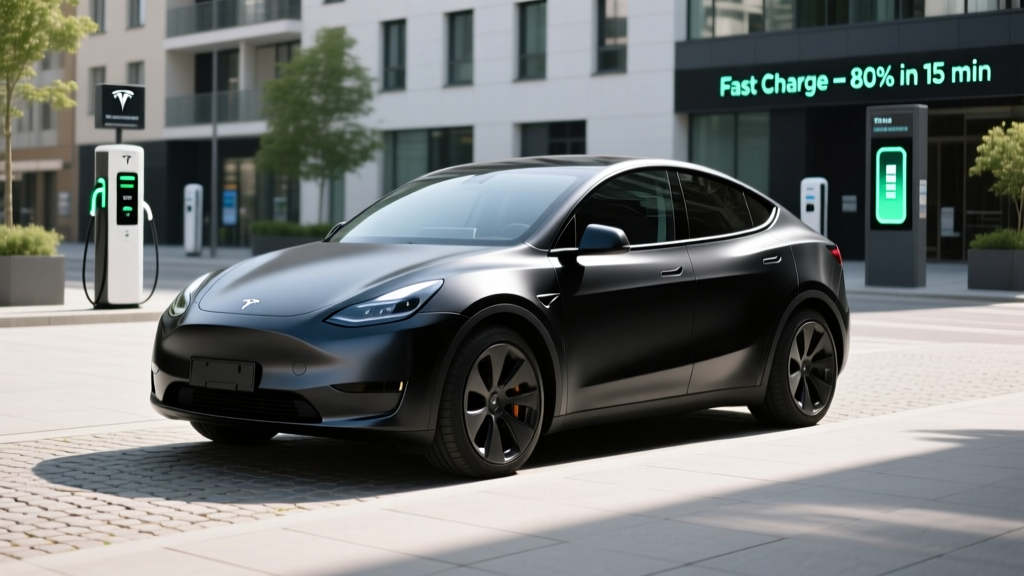
| DC Fast (V3 Supercharger) | Peak 250 kW | 10–80% in ~22 min | Sustained rate tapers above 50%; preconditioning required for peak speed |
| DC Fast (V4 Supercharger) | Peak 250 kW* | 10–80% in ~22 min | *Model Y architecture caps at 250 kW; V4 supports up to 350 kW for future vehicles |
Charging-curve reality: The 250 kW peak is not sustained across the entire session. The Model Y Long Range typically holds above 200 kW from roughly 10% to 35% State of Charge, then steps down progressively—dropping to around 120 kW near 60% and further to 50–60 kW approaching 80%. This is why the 10–80% time of ~22 minutes is a more honest metric than peak kW alone. If you regularly charge past 80% on road trips, expect the final 20% to add another 15–20 minutes.
At home, the Tesla Wall Connector on a 60A circuit (48A continuous) delivers 11.5 kW, replenishing the Long Range's 78.1 kWh pack from empty in roughly 8 hours. Most owners charging from 20–80% overnight will see a full top-up in 4–5 hours. A standard NEMA 14-50 outlet on a 50A circuit provides about 9.6 kW (~30 mi/hr), which is adequate for most daily driving patterns under 60 miles.
Interior, Cargo, and Daily Practicality
The 2026 Model Y's Juniper-refresh interior brings a cleaner dashboard, ventilated front seats, ambient lighting, and a rear-seat touchscreen for climate and media control. Build quality has improved noticeably over pre-2024 units, with tighter panel gaps and higher-quality soft-touch materials.
Cargo volume: 30.2 cubic feet behind the second row, expanding to 72.1 cubic feet with the 60/40 split rear seats folded. The front trunk (frunk) adds 4.1 cubic feet—useful for charging cables, a small bag, or groceries. Total usable storage with both rows folded rivals compact crossovers like the Subaru Outback.
Passenger space: Front legroom measures 41.8 inches; rear legroom is 37.4 inches. The panoramic glass roof creates an airy cabin feel, though it does reduce headroom slightly compared to vehicles with a conventional steel roof. Rear-seat comfort has improved with the Juniper update's revised cushion angle and added padding, but taller passengers (6'2"+) may still find the sloping roofline limits head clearance on longer trips.
Towing: The Long Range AWD is rated for 3,500 lbs when properly equipped with Tesla's tow hitch. That's sufficient for a small utility trailer or a pair of dirt bikes but falls short of the Ford Mustang Mach-E's available towing and well behind the Rivian R1S. Towing cuts range dramatically—expect a 35–50% reduction depending on trailer weight and aerodynamics.
Pricing, Tax Credits, and Ownership Costs
| Trim | Base MSRP | As-Tested* | Est. §30D Credit | Effective Price |
|---|---|---|---|---|
| Rear-Wheel Drive | $36,490 | $38,490 | Up to $7,500 | ~$30,990 |
| Long Range AWD | $44,990 | $47,990 | Up to $7,500 | ~$40,490 |
| Performance AWD | $51,490 | $54,490 | Up to $7,500 | ~$46,990 |
*As-tested includes destination fee and common options (FSD capability, premium color).
The IRS §30D federal tax credit offers up to $7,500 for qualifying new EVs, but eligibility depends on several conditions that change regularly:
- MSRP cap: SUVs must be at or below $80,000 — all Model Y trims qualify.
- Buyer income cap: Modified AGI must not exceed $150,000 (single), $225,000 (head of household), or $300,000 (joint).
- Battery sourcing: The $7,500 credit splits into two halves ($3,750 each) — one for critical minerals sourcing and one for battery component manufacturing. Tesla's shifting supply chain means the exact credit amount can vary by production batch and model year.
- Point-of-sale transfer: As of 2024, buyers can transfer the credit to the dealer at purchase, reducing the out-of-pocket price immediately rather than waiting for a tax return offset.
Verify current eligibility on the IRS Clean Vehicle Credit page or with a tax professional before purchasing — battery sourcing compliance changes as supply chains evolve, and a vehicle that qualifies in January may have a different status by mid-year.
Warranty: Tesla covers the Model Y's battery and drive unit for 8 years or 120,000 miles (Long Range/Performance) and 8 years or 100,000 miles (RWD), whichever comes first, with a minimum 70% capacity retention threshold. The basic vehicle warranty is 4 years or 50,000 miles. This is competitive with Hyundai's 10-year/100,000-mile battery warranty, though Hyundai's retention guarantee is less explicitly defined.
Tech, Driver Assistance, and the Autopilot Reality
The 2026 Model Y runs Tesla's latest software on a 15.4-inch center touchscreen with the AMD Ryzen processor—snappy, responsive, and feature-dense. Navigation, media, climate, and vehicle settings all route through this single screen. There is no traditional instrument cluster; speed and drive-state information appears in the upper-left corner of the main display.
Driver assistance: Standard Autopilot includes Traffic-Aware Cruise Control and Autosteer (lane centering). The optional Full Self-Driving (Supervised) package ($8,000 one-time or $99/month subscription) adds automatic lane changes, Navigate on Autopilot, Autopark, and Smart Summon.
Despite the "Full Self-Driving" branding, Tesla's FSD (Supervised) is an SAE Level 2 driver-assistance system. The driver must remain fully engaged — eyes on the road, hands prepared to take over — at all times. Tesla's cabin camera monitors attention, but this is not autonomous driving. Only Level 4 services like Waymo operate without a human driver. No Tesla vehicle currently sold is capable of unsupervised self-driving.
Standout tech features: Over-the-air updates that meaningfully add features post-purchase, Sentry Mode (360° parking surveillance), Dog Mode (climate-maintained cabin for pets), the Tesla app ecosystem (remote preconditioning, location sharing, service scheduling), and built-in dashcam recording with USB storage.
Notable drawbacks: No Apple CarPlay or Android Auto (a dealbreaker for some), no physical buttons for climate or volume (everything is touchscreen), the glass roof can cause cabin heat buildup in hot climates despite UV tinting, and the minimalist interior aesthetic doesn't appeal to buyers who prefer traditional luxury finishes.
✓ Pros
- Supercharger network: most reliable DC fast-charging ecosystem in the U.S.
- Segment-leading efficiency (122–129 MPGe)
- Strong cargo capacity (72.1 cu ft max) with practical frunk
- Continuous OTA updates add real features over time
- LFP option for buyers who want maximum battery longevity
- Competitive pricing after §30D credit (RWD from ~$30,990)
✗ Cons
- No Apple CarPlay / Android Auto
- Touchscreen-only controls frustrate some drivers
- FSD (Supervised) is expensive and still Level 2 — not self-driving
- Cold-weather range loss is significant (30%+ in deep cold)
- Insurance costs above segment average in many states
- European sales collapse signals brand risk; resale value uncertainty
Is the Model Y Still Worth Buying vs. Competitors?
The European sales collapse is partly a product story: competitors have caught up. The Hyundai Ioniq 5 charges faster on 800V architecture (10–80% in ~18 minutes at 350 kW chargers), the Kia EV6 offers a more driver-focused interior, and the Ford Mustang Mach-E delivers engaging dynamics with CarPlay support. The Chevrolet Equinox EV undercuts on price with competitive range.
Decision Framework: Choose the Model Y If...
- You rely on the Supercharger network for frequent road trips and want seamless plug-and-charge reliability.
- You value OTA updates that genuinely improve the vehicle over time.
- You want the most cargo space in a compact electric crossover (72.1 cu ft).
- You prefer the efficiency advantage — the Model Y's kWh/100mi is among the lowest in class.
Look at Competitors If...
- DC fast-charge speed is your top priority (Ioniq 5/EV6 on 800V architecture is measurably faster).
- You need Apple CarPlay or Android Auto integration.
- You prefer physical buttons and a traditional instrument cluster.
- Brand perception and resale stability concern you given Tesla's market headwinds.
Frequently Asked Questions
What is the real-world range of the 2026 Tesla Model Y?
The EPA rates the Long Range AWD at 320 miles, but real-world highway driving at 70–80 mph typically yields 265–285 miles. In cold weather (below freezing), expect 220–250 miles. The RWD with LFP battery rates 280 miles EPA but may deliver only 190–220 miles in winter highway conditions.
How fast does the Model Y charge at home and on the road?
On a Level 2 Tesla Wall Connector (11.5 kW / 48A), the Long Range adds about 37 miles per hour of charging, reaching a full charge overnight in ~8 hours. On a V3 or V4 Supercharger, DC fast charging peaks at 250 kW, achieving 10–80% in approximately 22 minutes with proper battery preconditioning.
Does the 2026 Model Y qualify for the $7,500 federal EV tax credit?
All Model Y trims fall under the $80,000 SUV MSRP cap. However, full $7,500 eligibility depends on your income (AGI limits apply) and the battery's critical-mineral and component sourcing at time of manufacture. Check the IRS §30D page and confirm with your tax advisor before purchase. Point-of-sale transfer is available if you qualify.
Is the Model Y worth buying despite Tesla's European sales collapse?
For U.S. buyers, the European sales decline has limited direct impact on product quality, Supercharger access, or service infrastructure. The Model Y remains a technically strong vehicle with best-in-class efficiency and charging network access. However, if resale value is a priority, the brand's global headwinds introduce uncertainty that competitors like Hyundai and Toyota don't carry.
What's the biggest drawback of the Model Y?
The absence of Apple CarPlay and Android Auto is the most-cited dealbreaker. Beyond that, the touchscreen-only interface, FSD's high cost relative to its Level 2 capabilities, and cold-weather range loss are the primary friction points for new owners.
Final Verdict
The 2026 Tesla Model Y remains a capable, efficient, and practical electric SUV. Its 320-mile EPA range (Long Range), 250 kW peak DC charging, 72.1 cu ft of cargo space, and Supercharger network access make it a rational choice for road-trippers and daily commuters alike. Starting at $36,490 for the RWD—and potentially dropping to ~$30,990 after the federal credit—it's priced to compete.
The European sales collapse reflects a market where competitors have matched or exceeded Tesla on specific dimensions: faster charging (Hyundai/Kia), richer interiors (BMW iX3, Mercedes EQB), and stronger brand trust (Volkswagen). Those same competitors are increasingly viable in the U.S. as well. The Model Y no longer wins by default—it wins when its specific strengths (efficiency, Supercharger network, OTA evolution, cargo space) align with your priorities. Test-drive it alongside the Ioniq 5 and Mach-E, run the tax-credit numbers for your situation, and decide on the data.