Why the Tesla Sales Chart Matters in 2026
Tesla's U.S. market dominance is being tested harder than ever. Legacy automakers from Hyundai and Ford to Rivian and BMW have launched compelling EVs, narrowing the gap in range, charging speed, and interior quality. Yet Tesla's lineup still accounts for a commanding share of new EV registrations. Understanding the Tesla sales chart is about more than volume bragging rights — it reveals which models deliver the best value, which are aging out, and where Tesla's engineering priorities lie heading into the late 2020s.
This profile breaks down every current-production Tesla as of the 2026 model year: the refreshed Model 3 Highland, the Juniper-updated Model Y, the polarizing Cybertruck, and the legacy Model S and Model X. We pair each vehicle's sales-chart position with the hard specs buyers actually need — EPA range, real-world highway and cold-weather expectations, DC fast-charging curves, battery chemistry, pricing after federal tax credits, and ownership realities.
2026 Tesla Lineup at a Glance: The Sales Chart
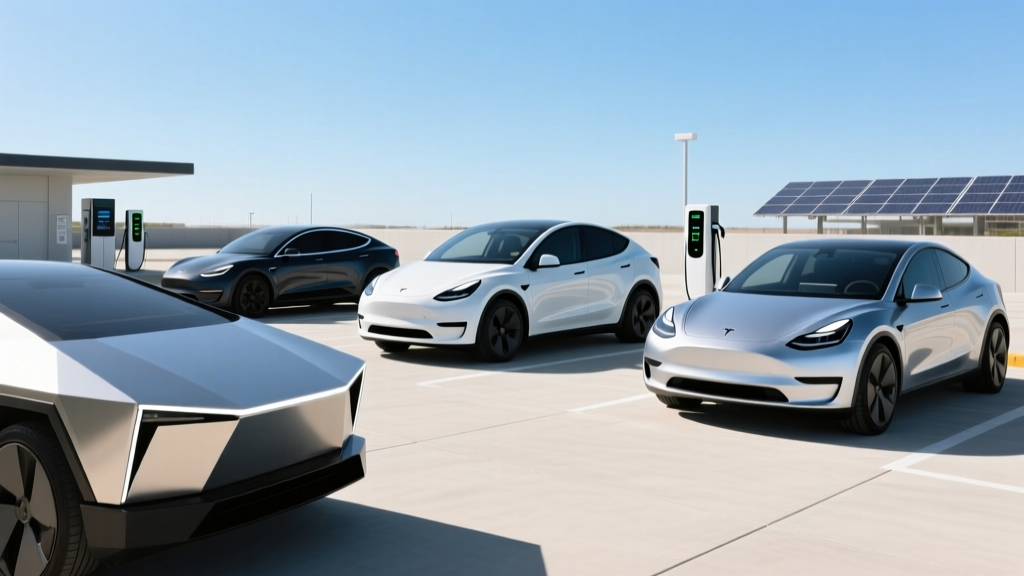
The table below ranks Tesla's current U.S. lineup by estimated 2025–2026 annualized sales volume. The Model Y remains Tesla's global and domestic volume leader, followed by the Model 3 sedan. The Cybertruck has ramped to meaningful volume after a difficult 2024 production launch, while the Model S and Model X continue as low-volume, high-margin halo vehicles.
| Rank | Model | Body Style | Est. Annual U.S. Volume | Starting MSRP |
|---|---|---|---|---|
| 1 | Model Y (Juniper) | Compact SUV | ~400,000+ | $44,990 |
| 2 | Model 3 (Highland) | Sedan | ~180,000+ | $38,990 |
| 3 | Cybertruck | Pickup | ~80,000+ | $79,990 |
| 4 | Model S | Luxury Sedan | ~15,000 | $79,990 |
| 5 | Model X | Luxury SUV | ~12,000 | $84,990 |
Volume estimates based on industry registration data and Tesla quarterly delivery reports; figures are approximate and subject to quarterly fluctuation.
Model Y (Juniper): The Volume King
The refreshed Juniper-generation Model Y is Tesla's best-selling vehicle globally for good reason. It blends practical SUV proportions with sedan-like efficiency, and the 2025–2026 interior refresh finally addressed the cabin-quality complaints that dogged the pre-refresh model. Ventilated front seats, ambient lighting, a rear-seat touchscreen, and improved sound insulation bring it closer to rivals like the Hyundai Ioniq 5 and BMW iX3 in perceived quality.
| Spec | Model Y Long Range AWD | Model Y Performance |
|---|---|---|
| EPA Range | 320 miles | 280 miles |
| Battery (usable) | ~75 kWh, NMC | ~75 kWh, NMC |
| Drivetrain | Dual-Motor AWD | Dual-Motor AWD |
| Horsepower | ~384 hp | ~456 hp |
| 0–60 mph | 4.8 sec | 3.5 sec |
| Peak DC Charge | 250 kW | 250 kW |
| 10–80% DC Time | ~25 min | ~25 min |
| Level 2 Rate | 11.5 kW (~44 mi/hr) | 11.5 kW (~44 mi/hr) |
| MPGe (combined) | 122 MPGe | 111 MPGe |
| Cargo (rear seats up) | 30.2 cu ft | 30.2 cu ft |
| Cargo (rear seats folded) | 72.1 cu ft | 72.1 cu ft |
| Base MSRP | $44,990 | $52,490 |
Real-World Range Note: The EPA 320-mile figure for the Long Range AWD is achievable in mixed city/suburban driving at moderate temperatures. Expect ~265–285 miles on sustained highway trips at 70–75 mph, and ~230–250 miles in sub-freezing winter conditions where cabin heating and battery cold-soak reduce efficiency by 20–30%. Tesla's heat pump helps, but physics wins in deep cold.
Charging on Tesla's Supercharger network remains a strong advantage. The Model Y Juniper peaks at 250 kW on V3 and V4 Superchargers, though the charging curve tapers significantly above 60% state of charge — a 10–80% session takes roughly 25 minutes, but 80–100% can add another 20+ minutes. For home charging, the 11.5 kW onboard charger adds about 44 miles of range per hour on a 48-amp Level 2 circuit, meaning a full overnight charge is realistic for most daily drivers.
Model 3 (Highland): The Value Leader
The Highland-refreshed Model 3 is Tesla's most affordable entry point and, for many buyers, the most rational choice. The 2024–2026 redesign brought a quieter cabin, rear passenger ventilation, a more refined suspension, and the elimination of the stalk-mounted turn signals in favor of steering-wheel buttons — a change that remains divisive among owners. Efficiency is excellent, and the Long Range variant offers over 340 miles of EPA range.
| Spec | Model 3 RWD | Model 3 Long Range AWD | Model 3 Performance |
|---|---|---|---|
| EPA Range | 272 miles | 341 miles | 309 miles |
| Battery (usable) | ~57.5 kWh, LFP | ~75 kWh, NMC | ~75 kWh, NMC |
| Drivetrain | RWD | Dual-Motor AWD | Dual-Motor AWD |
| Horsepower | ~271 hp | ~346 hp | ~510 hp |
| 0–60 mph | 5.8 sec | 4.2 sec | 2.9 sec |
| Peak DC Charge | 170 kW | 250 kW | 250 kW |
| 10–80% DC Time | ~30 min | ~25 min | ~25 min |
| Level 2 Rate | 11 kW (~40 mi/hr) | 11.5 kW (~44 mi/hr) | 11.5 kW (~44 mi/hr) |
| MPGe (combined) | 132 MPGe | 131 MPGe | 118 MPGe |
| Cargo (trunk + frunk) | 21.0 cu ft | 21.0 cu ft | 21.0 cu ft |
| Base MSRP | $38,990 | $44,990 | $52,990 |
Battery chemistry matters here. The base RWD Model 3 uses a lithium iron phosphate (LFP) battery, which trades energy density for longevity and thermal stability. LFP cells tolerate regular 100% charging better than NMC, meaning daily commuters can charge to full without accelerated degradation concerns. The trade-off: less range, slower DC charging (170 kW peak vs. 250 kW), and reduced cold-weather performance — LFP cells lose more capacity in freezing temps than NMC. The Long Range and Performance trims use NMC chemistry for higher density and faster charging.
Real-World Range Note: The Long Range AWD's 341-mile EPA rating is class-leading. Real-world highway driving at 70 mph yields ~280–300 miles. In winter cold (below 32°F), expect ~240–270 miles depending on cabin heat usage and whether the battery is preconditioned. The RWD LFP model's 272 EPA miles drops to ~210–230 highway and ~180–200 in deep cold.
Cybertruck: The Polarizing Pickup
No vehicle on the Tesla sales chart generates more debate than the Cybertruck. Its stainless-steel exoskeleton, steer-by-wire system, and 48-volt electrical architecture are genuinely novel engineering. Production ramped through 2024–2025, and by 2026 Tesla is delivering meaningful volume, though well below the initial 2019 projection of 250,000+ annual units. Pricing has also crept well above the originally announced figures.
| Spec | Cybertruck AWD | Cyberbeast |
|---|---|---|
| EPA Range | 318 miles (est.) | 300 miles (est.) |
| Battery (usable) | ~123 kWh, NMC | ~123 kWh, NMC |
| Drivetrain | Dual-Motor AWD | Tri-Motor AWD |
| Horsepower | ~600 hp | ~845 hp |
| 0–60 mph | 4.1 sec | 2.6 sec |
| Peak DC Charge | 250 kW (V3) / ~350 kW (V4) | 250 kW (V3) / ~350 kW (V4) |
| 10–80% DC Time | ~30 min | ~30 min |
| Towing Capacity | 11,000 lbs | 11,000 lbs |
| Bed Length | 6 ft (vault) | 6 ft (vault) |
| Base MSRP | $79,990 | $99,990 |
The Cybertruck's 800-volt-class architecture enables fast charging, though real-world Supercharger sessions show a peak around 250 kW on existing V3 stalls with potential for higher rates on newer V4 infrastructure. The massive ~123 kWh battery means a 10–80% session still takes roughly 30 minutes — more energy to push through the same peak rate. Towing at the 11,000-lb max rating cuts range roughly in half, a reality all electric pickups face.
Real-World Range Note: The angular stainless-steel body creates more aerodynamic drag than a sleek sedan. Expect ~260–280 highway miles unloaded, dropping to ~150–170 miles when towing a 7,000–10,000 lb trailer. Cold weather reduces range by an additional 15–25%.
Model S and Model X: The Legacy Flagships
The Model S and Model X occupy the bottom of the Tesla sales chart but remain important as technology showcases. The Plaid variants deliver supercar-rivaling acceleration, and the yoke steering option (love it or hate it) keeps these models in the conversation. However, the platform dates to 2012 (Model S) and 2015 (Model X), and despite interior refreshes, competitors like the Lucid Air, BMW i7, and Mercedes EQS offer more modern luxury execution.
| Spec | Model S Long Range | Model S Plaid | Model X Long Range | Model X Plaid |
|---|---|---|---|---|
| EPA Range | 402 miles | 359 miles | 335 miles | 311 miles |
| Battery (usable) | ~95 kWh, NMC | ~95 kWh, NMC | ~95 kWh, NMC | ~95 kWh, NMC |
| 0–60 mph | 3.1 sec | 1.99 sec | 3.8 sec | 2.5 sec |
| Peak DC Charge | 250 kW | 250 kW | 250 kW | 250 kW |
| 10–80% DC Time | ~30 min | ~30 min | ~30 min | ~30 min |
| MPGe (combined) | 120 MPGe | 116 MPGe | 102 MPGe | 98 MPGe |
| Base MSRP | $79,990 | $94,990 | $84,990 | $99,990 |
The Model S Long Range's 402-mile EPA rating remains one of the highest of any production EV sold in the U.S., aided by the large ~95 kWh pack and Tesla's efficiency tuning. The Model X's falcon-wing rear doors are still a conversation starter, though they add complexity and have been a source of reliability complaints over the years. Neither model qualifies for the federal EV tax credit due to MSRP and battery-sourcing limitations.
Pricing, Tax Credits, and True Cost
Tesla pricing in 2026 reflects years of adjustments, and the federal §30D clean vehicle credit eligibility is model-specific. Under current IRS rules, the credit is up to $7,500 — split between a critical-minerals component ($3,750) and a battery-components component ($3,750). Eligibility requires the buyer to meet adjusted gross income caps ($150,000 single / $300,000 joint), the vehicle MSRP must be under $55,000 for sedans or $80,000 for SUVs/pickups, and battery components and critical minerals must meet phased-in domestic-sourcing thresholds that tighten each year.
| Model / Trim | Base MSRP | Vehicle Class | MSRP Cap | Est. §30D Credit | Effective Price |
|---|---|---|---|---|---|
| Model 3 RWD | $38,990 | Sedan | $55,000 | Up to $7,500* | ~$31,490 |
| Model 3 Long Range | $44,990 | Sedan | $55,000 | Up to $7,500* | ~$37,490 |
| Model 3 Performance | $52,990 | Sedan | $55,000 | Up to $7,500* | ~$45,490 |
| Model Y Long Range | $44,990 | SUV | $80,000 | Up to $7,500* | ~$37,490 |
| Model Y Performance | $52,490 | SUV | $80,000 | Up to $7,500* | ~$44,990 |
| Cybertruck AWD | $79,990 | Pickup | $80,000 | Partial / $0** | $72,490–$79,990 |
| Model S Long Range | $79,990 | Sedan | $55,000 | $0 (over cap) | $79,990 |
| Model X Long Range | $84,990 | SUV | $80,000 | $0 (over cap) | $84,990 |
*Credit amount depends on battery-sourcing compliance for the specific build week; partial credit ($3,750) is possible if only one of the two sourcing thresholds is met. **Cybertruck MSRP sits near the $80,000 SUV/pickup cap; eligibility varies by trim and options. Consult fueleconomy.gov and a tax professional before purchasing.
The point-of-sale transfer option allows qualified buyers to apply the credit as an immediate price reduction at delivery rather than waiting to claim it on their tax return. This effectively lowers the drive-off price, though income verification and sourcing documentation are still required.
Driver Assistance, Tech, and the Autopilot Reality
Every 2026 Tesla ships with Basic Autopilot, which provides adaptive cruise control and lane-centering on highways. The optional Full Self-Driving (Supervised) package ($8,000 one-time or $99/month subscription as of early 2026) adds automated lane changes, traffic-light and stop-sign recognition, and city-street navigation assistance.
SAE Automation Level: Level 2. Despite the "Full Self-Driving" name, Tesla's FSD (Supervised) is an SAE Level 2 driver-assistance system. The driver must remain fully engaged, hands on or near the wheel, and eyes on the road at all times. Tesla's cabin camera monitors attention. This is not autonomous driving — it is an advanced cruise-and-steering assist. True Level 4 driverless operation (like Waymo's robotaxi service) requires no human oversight; Tesla does not offer this.
Tesla's infotainment remains a strong suit: a responsive 15.4-inch center touchscreen (Model 3/Y) handles navigation, media, climate, and vehicle settings. The Netflix/YouTube/Gaming suite is best-in-class for parked entertainment. Over-the-air updates continue to add features post-purchase, though some promised capabilities have taken years to materialize. Notably, Tesla still lacks Apple CarPlay and Android Auto — a dealbreaker for some buyers accustomed to phone-mirrored interfaces.
Warranty Coverage and Long-Term Ownership
Tesla's warranty structure is straightforward but not class-leading:
- New Vehicle Limited Warranty: 4 years / 50,000 miles, whichever comes first.
- Battery & Drive Unit Warranty: 8 years / 100,000 miles for Model 3 RWD (LFP); 8 years / 120,000 miles for Model 3 Long Range, Model Y, Model S, and Model X.
- Battery Capacity Retention Threshold: Tesla warrants that the battery will retain at least 70% of its original capacity during the warranty period. If degradation drops below 70%, Tesla will repair or replace the battery to bring it above that threshold.
Real-world degradation data from fleet aggregators like Recurrent Auto shows Tesla batteries typically retain 88–92% capacity at 100,000 miles, with the steepest drop occurring in the first 15,000–20,000 miles before leveling off. LFP batteries in the Model 3 RWD show slightly different degradation curves but generally strong longevity when charged to 100% regularly (as Tesla recommends for LFP).
Pros, Cons, and Who Should Buy
Pros
- Supercharger network remains the most reliable and extensive DC fast-charging network in the U.S.
- Class-leading efficiency (kWh/100mi) across Model 3 and Model Y
- OTA updates continually improve the vehicle post-purchase
- Strong resale value relative to most EV competitors
- LFP option on Model 3 RWD offers excellent long-term battery durability
- Model 3 and Model Y eligible for up to $7,500 federal tax credit (income/sourcing dependent)
Cons
- No Apple CarPlay or Android Auto
- Turn-signal buttons on steering wheel (Model 3 Highland) frustrate some drivers
- DC fast-charging capped at 250 kW — competitors like Hyundai Ioniq 5 (350 kW capability) charge faster on compatible stations
- Model S and Model X platform is aging; no major redesign since 2021 refresh
- Cybertruck pricing well above original promises; limited service center familiarity
- FSD (Supervised) remains Level 2 despite premium pricing and autonomous-sounding branding
- Build quality inconsistency still reported, though improved post-Highland/Juniper
Who Should Buy a Tesla in 2026?
Choose Model 3 RWD if: You want the most affordable Tesla, commute under 50 miles daily, have reliable home charging, and value LFP battery longevity over maximum range.
Choose Model 3 Long Range if: You take regular road trips, want AWD for inclement weather, and need the 341-mile EPA range buffer for highway and cold-weather driving.
Choose Model Y Long Range if: You need SUV cargo space for a family, want the best-selling EV with the strongest Supercharger compatibility, and value practicality over sedan efficiency.
Choose Model Y Performance if: You want SUV utility with sports-car acceleration and don't mind sacrificing ~40 miles of range for the privilege.
Choose Cybertruck if: You need a full-size electric pickup with serious towing capacity and are willing to pay a premium for cutting-edge (and unproven) steer-by-wire and 48V architecture.
Skip Model S/X if: You prioritize interior luxury execution, the latest platform engineering, or federal tax-credit eligibility. Consider Lucid Air, BMW i7, or Rivian R1S instead.
Frequently Asked Questions
What is the real-world range of Tesla's best-selling model?
The Model Y Long Range AWD carries a 320-mile EPA rating. In real-world highway driving at 70–75 mph, expect roughly 265–285 miles. In sub-freezing winter conditions, range drops to approximately 230–250 miles due to cabin heating demands and reduced battery efficiency. Preconditioning the battery while plugged in mitigates some of this loss.
How fast does a Tesla charge at home and on the road?
On a home Level 2 charger (48-amp, 11.5 kW), the Model Y adds about 44 miles of range per hour — a full charge from 10% takes roughly 7 hours overnight. On a Tesla V3 Supercharger, the Model Y peaks at 250 kW and charges from 10–80% in approximately 25 minutes. The base Model 3 RWD with LFP charges at a lower 170 kW peak on DC, taking about 30 minutes for 10–80%.
How much does a Tesla cost after the federal tax credit?
The Model 3 RWD starts at $38,990 and can drop to approximately $31,490 with the full $7,500 §30D credit, assuming the buyer meets income caps ($150K single / $300K joint) and the vehicle's battery meets critical-mineral and component sourcing thresholds. The Model Y Long Range at $44,990 can effectively cost ~$37,490. Model S, Model X, and most Cybertruck configurations exceed MSRP caps or fail sourcing requirements, making them ineligible.
Does Tesla qualify for the federal EV tax credit in 2026?
Yes, but only specific models and trims. The Model 3 (all trims, under the $55,000 sedan cap) and Model Y (all trims, under the $80,000 SUV cap) are potentially eligible. Eligibility depends on the buyer's adjusted gross income, the vehicle's battery-sourcing compliance (which tightens annually under the Inflation Reduction Act), and the MSRP of the specific configuration. Always verify on fueleconomy.gov and consult a tax professional before relying on the credit.
Is a Tesla worth buying versus competitors in 2026?
For buyers who prioritize Supercharger access, over-the-air updates, and strong efficiency, Tesla remains compelling — especially the Model 3 Long Range and Model Y Long Range. However, competitors like the Hyundai Ioniq 5 (faster 800V charging), BMW i4 (more refined interior), and Ford Mustang Mach-E (more conventional controls) are strong alternatives. If Apple CarPlay, a traditional stalk shifter, or a luxury-grade cabin matters, test-drive the competition before committing.
What are the biggest drawbacks of owning a Tesla?
The most-cited owner complaints include the absence of Apple CarPlay/Android Auto, the learning curve of steering-wheel turn-signal buttons (Model 3 Highland), build-quality inconsistency (panel gaps, paint), and the gap between FSD marketing and its actual Level 2 capabilities. Service center wait times can also be lengthy in some metro areas, though mobile service and remote diagnostics help for minor issues.