The Reality of Towing an RV Trailer With a Tesla
Searches for "Tesla RV trailer" have surged as more owners wonder whether their electric SUV or truck can double as a tow rig for a camper, boat, or utility trailer. The short answer: yes, several Tesla models can tow — but the real questions are how much, how far, and at what cost to range. Towing with any EV introduces physics that no software update can solve: a 3,000-pound trailer can slash highway range by 40-60%, and DC fast-charging infrastructure still isn't designed for pull-through lanes at most stations.
This guide breaks down every current Tesla model's towing capability, what happens to range when you hitch up, and whether the math works for your next camping trip. We'll also cover the one Tesla product that was explicitly designed for RV-style living — the Cybertruck — and the ecosystem gaps you'll need to plan around.
Which Tesla Models Can Tow, and How Much?
Not every Tesla is rated for towing. Here's the full lineup as of the 2026 model year, with factory tow ratings and the trailer types each can realistically handle:
| Model | Max Tow Rating | Hitch Type | Realistic RV Trailer Match |
|---|---|---|---|
| Model Y (AWD) | 3,500 lbs | 2" receiver (factory option) | Teardrop, small pop-up, light travel trailer |
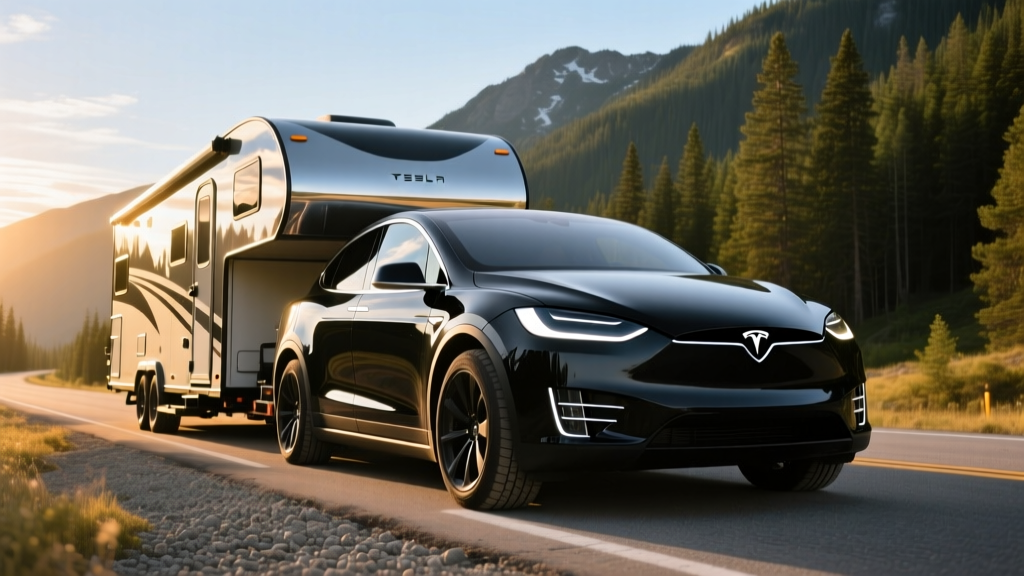
| Model X (AWD) | 5,000 lbs | 2" receiver (factory) | Mid-size travel trailer (20-25 ft) |
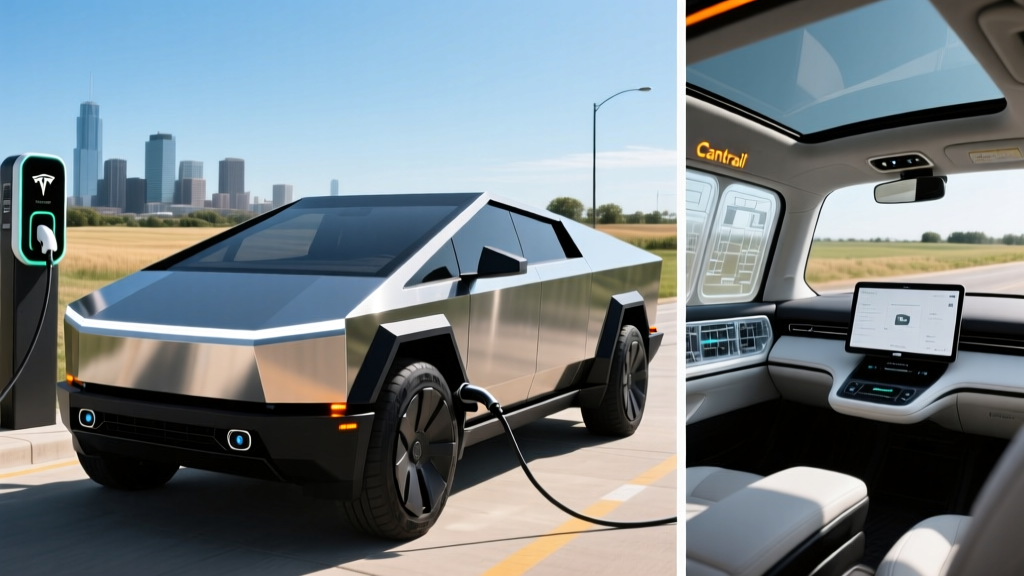
| Cybertruck (AWD) | 11,000 lbs | 2.5" receiver (factory) | Large travel trailer, fifth-wheel (w/ adapter), toy hauler |
| Model 3 | Not rated | N/A | None — no factory tow rating in North America |
| Model S | Not rated (2026) | N/A | None — prior EU rating not available in US |
The Cybertruck is the only Tesla that enters serious tow-territory, competing with full-size ICE trucks like the Ford F-150 and Ram 1500. The Model X sits in a useful middle ground for mid-size campers. The Model Y handles lightweight trailers but requires careful weight management. And the Model 3 and Model S are simply not engineered for towing in the US market.
Towing Range Loss: The Physics No One Warns You About
This is where most first-time EV towers get burned. Towing a trailer increases aerodynamic drag and rolling resistance dramatically. Unlike a gas truck that simply burns more fuel (and you fill up in 5 minutes), an EV's limited energy storage means that extra drag translates directly into fewer miles between charges.
Here's what to expect when towing at highway speeds (65-70 mph) with a loaded trailer:
- Model Y AWD (EPA 310 mi solo): Expect ~155-190 miles towing a 2,800-lb teardrop trailer. Cold weather drops this to ~130-160 miles.
- Model X AWD (EPA 320 mi solo): Expect ~170-210 miles towing a 4,200-lb travel trailer. Cold weather: ~140-175 miles.
- Cybertruck AWD (EPA 340 mi solo): Expect ~175-220 miles towing an 8,500-lb large trailer. Cold weather: ~150-185 miles.
These figures assume flat-to-rolling terrain. Mountain passes can reduce range an additional 15-25% on the climb (though regenerative braking recovers some energy on descents).
The reason is straightforward: energy consumption roughly doubles when towing a mid-size trailer at highway speed. Where a Model Y might use 28 kWh/100mi solo, expect 48-65 kWh/100mi with a loaded camper in tow. The EPA's fueleconomy.gov site does not publish towing-specific efficiency data, so these figures come from owner-reported testing and third-party evaluations.
Cybertruck: The Tesla Most Suited for RV Trailer Duty
If you're serious about towing a Tesla RV trailer setup, the Cybertruck is the only model that makes the conversation practical for larger campers. Here's a full spec breakdown:
| Specification | Value |
|---|---|
| EPA Range (solo) | 340 miles (Long Range AWD) |
| Battery Capacity | ~123 kWh usable (NMC chemistry) |
| Max DC Fast Charge | 250 kW peak (V3 Supercharger) |
| 10-80% DC Charge Time | ~28 minutes (solo, preconditioned) |
| Level 2 Home Charging | 11.5 kW / ~37 mi/hr (48A Wall Connector) |
| 0-60 mph | 3.9 sec (AWD) / 2.6 sec (Cyberbeast) |
| Horsepower | 600 hp (AWD) / 845 hp (Cyberbeast) |
| Max Tow Rating | 11,000 lbs |
| Payload Capacity | 2,500 lbs |
| Bed Length | 6 ft (vault with tonneau) |
| Efficiency (solo) | ~44 MPGe combined / 58 kWh/100mi |
| Battery Warranty | 8 years / 150,000 miles |
| Base MSRP | $79,990 (AWD) / $99,990 (Cyberbeast) |
The Cybertruck's 123 kWh battery is among the largest in any production EV, which gives it a meaningful advantage when towing — more stored energy means more miles before you need to stop. The stainless-steel exoskeleton and integrated tow/haul modes also help with trailer sway control and power delivery under load.
Charging While Towing: The Infrastructure Gap
Here's the uncomfortable truth about long-distance RV towing with any EV: most Supercharger stations are not designed for pull-through parking. You'll need to unhitch your trailer at most stops, or seek out stations with dedicated pull-through spots (Tesla has been adding these at select high-traffic locations, but coverage is still sparse).
When you do find a compatible charger, expect charging to take longer while towing. The battery is under higher thermal load from the increased energy draw, which can cause the battery management system to throttle charge speeds slightly. Plan for 35-45 minutes for a 10-80% session when arriving with a hot battery from towing, versus ~28 minutes under normal driving conditions.
Model X and Model Y: Lighter Trailer Options
For owners who don't need full-size truck capability, the Model X and Model Y open up the lightweight and mid-weight trailer market.
Model Y AWD — The Teardrop and Pop-Up Specialist
With a 3,500-lb tow rating, the Model Y handles teardrop campers (typically 1,000-2,500 lbs), pop-up tent trailers, and small utility trailers. Popular matches include the NuCamp TAB 320 (~2,900 lbs loaded) and the Scamp 13 (~1,500 lbs). The Model Y's 310-mile EPA range drops to roughly 155-190 miles with a loaded teardrop at highway speed — tight for long hauls, but manageable with Supercharger planning.
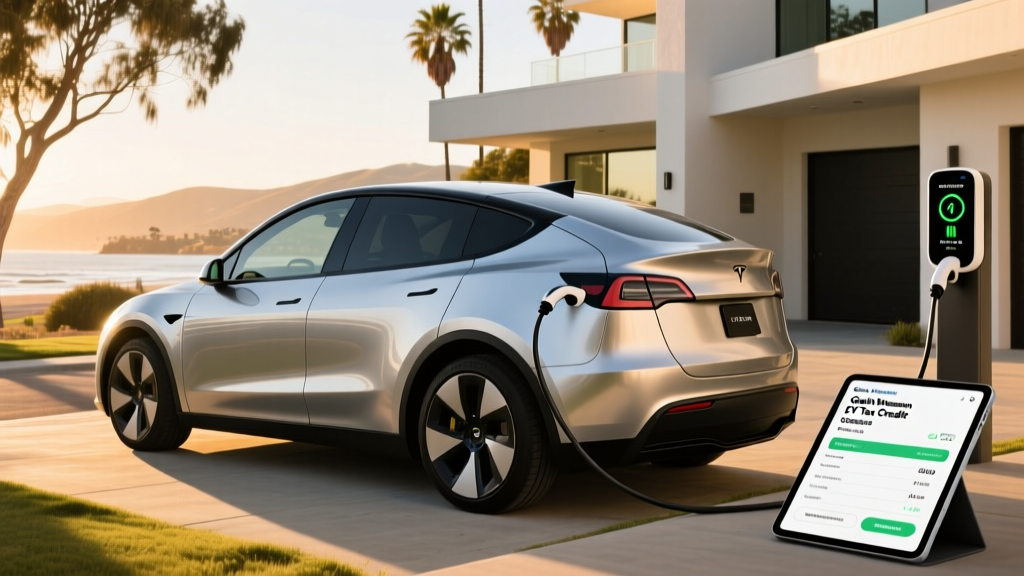
The Model Y Long Range AWD starts at $44,990 for 2026. Under current IRS §30D rules, it may qualify for up to $7,500 in federal tax credits (transferable at point of sale), subject to buyer income caps ($150K single / $300K joint AGI), battery component sourcing requirements, and the $80,000 SUV MSRP cap. Always verify current-year eligibility with a tax professional.
Model X AWD — Mid-Size Camper Territory
The Model X's 5,000-lb rating puts mid-size travel trailers in reach — think the Airstream Bambi (~3,500 lbs loaded), Jayco Jay Feather Micro (~4,200 lbs), or similar 20-25 foot campers. Falcon-wing rear doors make hitch access awkward compared to a conventional SUV liftgate, and the air suspension can complicate weight-distribution hitch setup. Budget for an aftermarket hitch solution if the factory unit doesn't suit your trailer's coupler height.
The Model X Long Range AWD starts at $79,990 for 2026, placing it above the $80,000 SUV MSRP cap for the §30D credit — meaning most trims will not qualify for the federal incentive. A fully loaded Model X Plaid at $94,990 is definitively ineligible.
Federal Tax Credit and Towing-Related Costs
If you're buying a Tesla specifically for towing, factor in costs beyond the vehicle MSRP:
| Item | Estimated Cost |
|---|---|
| Factory tow hitch (Model Y/X) | $1,000-$1,500 (installed) |
| Weight-distribution hitch system | $400-$800 |
| Trailer brake controller (if needed) | $200-$400 (aftermarket) |
| Extended side mirrors (towing) | $150-$300 |
| Home Level 2 charger install (48A) | $800-$2,500 (w/ electrical work) |
| Range-extender battery (Cybertruck, if offered) | TBD — announced but not available |
Towing also accelerates tire wear significantly. Expect to replace tires 20-30% sooner when towing regularly, and EV-specific tires (which tend to be pricier) will amplify this cost. Budget $1,200-$2,000 per axle for premium EV-rated rubber.
Tesla's Driver-Assist Systems While Towing
Tesla's Autopilot and Full Self-Driving (Supervised) are SAE Level 2 driver-assist systems. You must remain fully engaged, hands on or near the wheel, eyes on the road at all times. These systems do not make the vehicle autonomous. When towing, Autopilot's behavior changes — it may not account for trailer length during lane changes, and emergency braking distances increase substantially with added mass. Always drive manually in complex towing situations (backing up, tight campgrounds, steep grades).
Tesla does offer a Trailer Mode that adjusts stability control, acceleration mapping, and regenerative braking behavior when a trailer is detected. This is a useful feature, but it doesn't replace attentive driving. The surround cameras and parking sensors do help with hitch alignment and low-speed maneuvering.
Is a Tesla Worth It for RV Trailer Towing?
- Instant torque makes hill starts and merging effortless under load
- Zero tailpipe emissions at campgrounds (quieter than idling diesel)
- Lower "fuel" cost per mile vs. gas/diesel trucks (electricity ~$0.13/kWh vs. $3.50+/gal)
- Regenerative braking on descents recovers energy and reduces brake wear
- Cybertruck's 11,000-lb rating is genuinely competitive with full-size ICE trucks
- Over-the-air updates can improve tow/haul algorithms over time
- 40-60% range loss while towing makes trip planning essential
- Most Supercharger stations lack pull-through parking for trailers
- Charging takes longer under towing thermal load
- Model 3 and Model S have no tow rating — limited lineup options
- Model X above MSRP cap for federal tax credit
- Cold-weather towing compounds range loss significantly
- Charging deserts in rural/mountain camping areas remain a real concern
- Choose the Cybertruck if you need to tow 5,000+ lbs regularly, camp off-grid, or want a truck that doubles as a daily driver with best-in-class EV range under load.
- Choose the Model X if your trailer is under 4,500 lbs, you value passenger comfort and cargo space, and you mostly camp within 150 miles of home or along well-served Supercharger corridors.
- Choose the Model Y if you're towing a teardrop or pop-up under 3,000 lbs, want the lowest entry price with potential tax credit eligibility, and accept that long-distance towing trips require careful planning.
- Look at an ICE or hybrid truck if you tow over 300 miles one-way through charging deserts, need pull-through convenience at every stop, or regularly tow in extreme cold at high altitude.
Competitor Comparison: Tesla vs. ICE Trucks for Towing
For context, here's how the Cybertruck stacks up against popular ICE and hybrid tow rigs:
| Vehicle | Max Tow | Range/MPG | Est. Fuel Cost/Mi (Towing) | Starting MSRP |
|---|---|---|---|---|
| Tesla Cybertruck AWD | 11,000 lbs | 340 mi / 44 MPGe | ~$0.18-0.28/mi | $79,990 |
| Ford F-150 Lightning | 10,000 lbs | 320 mi / 70 MPGe | ~$0.16-0.25/mi | $59,990 |
| Ford F-150 Hybrid | 12,700 lbs | ~22 MPG combined | ~$0.32-0.45/mi | $52,000 |
| Ram 1500 (HEMI V8) | 12,750 lbs | ~17 MPG combined | ~$0.40-0.55/mi | $48,000 |
| Rivian R1T (Dual) | 11,000 lbs | 352 mi / 42 MPGe | ~$0.18-0.28/mi | $79,900 |
The EV trucks (Cybertruck, F-150 Lightning, R1T) offer dramatically lower per-mile energy costs when towing, but sacrifice range and charging convenience compared to a 5-minute gas fill-up. The F-150 Lightning offers a lower entry price and more established pull-through charging infrastructure via Ford's partnership networks. The Rivian R1T matches the Cybertruck's tow rating with a more conventional truck form factor and access to the Tesla Supercharger network via its NACS adapter.
Frequently Asked Questions
Can a Tesla Model 3 tow a small trailer?
Tesla does not provide a factory tow rating for the North American Model 3. While European Model 3 variants have a rated tow capacity (up to 2,016 lbs), US-spec models are not rated or equipped with a factory hitch option. Towing with an unrated Model 3 may void warranty coverage and create liability issues. If you need a Tesla sedan with towing, consider the Model X or wait for future platform updates.
How much range do I actually lose towing a camper with a Tesla?
Expect 40-60% range reduction depending on trailer weight, frontal area, speed, terrain, and temperature. A Model Y towing a 2,800-lb teardrop at 65 mph on flat terrain will see roughly 45% loss (310 mi EPA drops to ~170 mi real-world). A Cybertruck towing an 8,500-lb travel trailer in mountainous terrain with headwinds could see 55-60% loss. Always plan charging stops with a 20% buffer below your estimated remaining range.
Does the Cybertruck qualify for the federal EV tax credit?
Under 2026 IRS §30D rules, the Cybertruck qualifies as a light truck (MSRP cap: $80,000). The base AWD at $79,990 falls just under the cap, but the Cyberbeast at $99,990 exceeds it. Even at the base trim, eligibility depends on your AGI (income caps: $150K single, $225K head of household, $300K joint), battery component and critical mineral sourcing requirements, and whether you've reached your lifetime credit limit. The credit can be transferred to the dealer at point of sale. Consult a tax professional for your specific situation.
Can I charge my Tesla at RV campgrounds?
Most RV campgrounds offer 30-amp or 50-amp NEMA outlets (NEMA 14-50 or TT-30). With the appropriate adapter, you can charge at Level 2 speeds (up to ~11.5 kW on a 14-50, delivering ~37 miles of range per hour on a Cybertruck). This is ideal for overnight charging at your campsite. Tesla's Mobile Connector and various third-party adapters (like those from NEMA-rated manufacturers) cover most campground outlet types. Charge at 50-amp sites whenever possible for faster overnight replenishment.
Is towing bad for a Tesla's battery long-term?
Towing increases battery cycling frequency (more charge-discharge cycles due to reduced range) and generates higher thermal loads. However, Tesla's battery management system actively manages temperatures and limits output to protect cell health. Occasional towing should not meaningfully accelerate degradation beyond normal use. If you tow frequently (weekly or more), expect slightly faster degradation — perhaps 2-3% additional capacity loss over 100,000 miles compared to non-towing use. The 8-year/150,000-mile battery warranty (Cybertruck) or 8-year/120,000-mile (Model X/Y) still applies regardless of towing.
What's the best Tesla for towing an RV trailer?
For serious RV use (trailers over 5,000 lbs, long-distance trips, off-grid camping), the Cybertruck AWD is the clear choice with its 11,000-lb rating and 123 kWh battery. For mid-size campers under 4,500 lbs with a focus on family comfort, the Model X works well. For lightweight teardrops and pop-ups, the Model Y offers the best value, especially with potential tax credit eligibility reducing the effective purchase price below $38,000.