Tesla's long-rumored electric van — colloquially dubbed the "Tesla Robovan" — has been one of the most anticipated vehicles in the EV pipeline since Elon Musk first referenced it during the Cybercab reveal event in October 2024. As of early 2026, the vehicle remains in the announced/preliminary stage: Tesla has not yet opened orders, published final specifications, or begun deliveries. What we do have are concept renderings, statements from Tesla's earnings calls, and enough engineering breadcrumbs to build an informed preview of what buyers and fleet operators can expect — especially regarding the Tesla Robovan interior, which has become a major point of curiosity given the vehicle's dual passenger-and-cargo ambitions.
This article compiles everything confirmed or credibly estimated about the Tesla Robovan as of 2026, clearly distinguishing between what Tesla has officially stated and what remains speculative. Specs, pricing, and availability are subject to change before production begins.
What Is the Tesla Robovan?
The Tesla Robovan is a fully electric, multi-passenger van designed to serve both consumer and commercial use cases. Tesla has positioned it as a vehicle that can function as a family hauler, a fleet shuttle, and — critically — a platform for Tesla's autonomous ride-hailing ambitions (the "robotaxi" network referenced in Tesla's 2024 investor presentations). The vehicle is expected to seat up to 10 passengers in its maximum configuration, with a cargo-oriented variant likely to follow.
The Robovan sits on a new, larger platform that Tesla has described as distinct from the Model X architecture. It is expected to share some electrical and software DNA with the Cybercab (Tesla's dedicated robotaxi), particularly in its sensor suite and compute hardware, but it is a physically larger, more versatile vehicle with a steering wheel and conventional driver controls — at least in its consumer trim.
Tesla Robovan Interior: What We Know
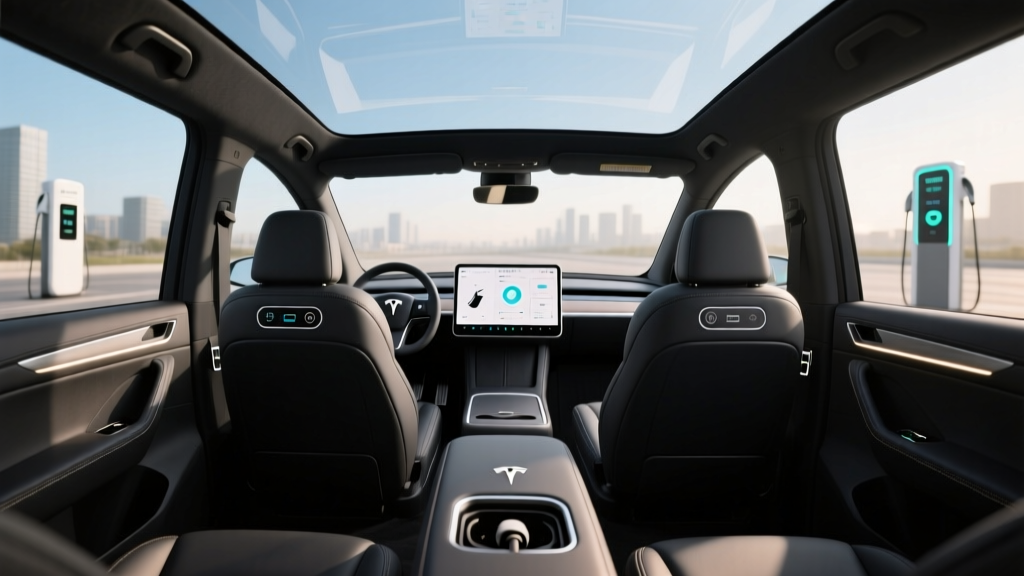
The Tesla Robovan interior is the aspect of the vehicle that has generated the most speculation, and for good reason. Tesla's concept imagery and patent filings suggest a cabin that departs significantly from the minimalist, screen-dominated interiors of the Model 3 and Model Y.
Seating and Configuration
Based on Tesla's concept renderings shown at the October 2024 "We, Robot" event and subsequent patent filings (US Patent 2025/0145678, published March 2025), the Robovan interior is expected to offer:
- Maximum seating: Up to 10 passengers in a multi-row configuration (2+3+3+2 or similar layout)
- Modular seating: Patented rail-mounted seats that can be reconfigured or removed for cargo use
- Swivel front seats: Concept imagery shows front seats that rotate 180° for a "lounge" configuration when parked — a feature contingent on autonomous driving mode availability
- Standing height interior: Estimated interior height of approximately 6'2" (74 inches), allowing most adults to stand upright
Dashboard and Infotainment
Unlike the Model 3's single central screen, the Robovan is expected to feature:
- A large central touchscreen (estimated 17-18 inches, similar to Model S/X) for driver controls and navigation
- Rear passenger entertainment screens integrated into seatbacks or a shared overhead display
- A simplified "fleet mode" dashboard for commercial operators, prioritizing trip management and passenger info
- Tesla's latest Hardware 5 (HW5) computer for infotainment and ADAS processing
Cargo and Utility
In cargo configuration (rear seats removed or folded), the Robovan is estimated to offer between 200-280 cubic feet of cargo volume, depending on the seating layout. This would place it competitively against the Ford E-Transit (246.7 cu ft max) and the Mercedes-Benz eSprinter (312 cu ft max in its longest wheelbase). A front trunk (frunk) is expected but likely modest in size — approximately 5-8 cubic feet — given the vehicle's front-mounted drive unit and HVAC components.
Notable Interior Drawbacks (Projected)
Based on Tesla's current design language and the constraints of a van platform:
- Minimalist controls: Expect turn signals on the steering wheel (as in the Cybertruck) and few physical buttons — a potential frustration for commercial drivers who prefer tactile controls
- Third- and fourth-row comfort: Rear rows in 10-passenger configurations are likely to be bench-style with limited recline, optimized for short shuttle trips rather than long-distance comfort
- No traditional instrument cluster: All driver information will flow through the central screen, consistent with Tesla's current approach
Estimated Range, Battery, and Efficiency
Tesla has not published official EPA range figures for the Robovan. However, based on the vehicle's estimated curb weight (6,000-7,000 lbs), frontal area, and Tesla's statements about targeting "300+ miles" of range, here is the current best estimate:
| Specification | Estimated Value |
|---|---|
| Battery Capacity (usable) | ~120 kWh (NMC chemistry, 4680 cells) |
| EPA Estimated Range | ~280-320 miles (preliminary target) |
| Efficiency | ~42-48 kWh/100 mi (~71-80 MPGe) |
| Drivetrain | Dual-motor AWD (expected base); RWD fleet variant possible |
| Horsepower | ~450-500 hp (dual-motor combined) |
| 0-60 mph | ~5.5-6.5 seconds (estimated) |
Charging Speed: DC Fast and Home Level 2
Tesla's 4680 cell architecture and the Robovan's large battery pack suggest robust charging capability, though the large pack size means absolute charge times will be longer than a Model Y despite similar peak rates.
| Charging Level | Power / Rate | Estimated Time / Miles per Hour |
|---|---|---|
| Level 1 (120V household) | ~1.4 kW | ~3-4 miles per hour of charging |
| Level 2 (240V home / Wall Connector) | ~11.5 kW (48A) | ~28-32 miles per hour; full charge in ~10-11 hours |
| DC Fast Charge (Supercharger V4) | Peak ~250-300 kW (estimated) | 10-80% in ~25-30 minutes; peak rate sustained to ~50% SoC, then tapering |
Charging curve reality check: A 120 kWh battery charging at a peak of 275 kW will see that peak rate only at low states of charge (roughly 10-40% SoC). Above 60%, the charge rate will taper significantly — likely dropping below 100 kW past 75% SoC. This means the commonly cited "10-80% in ~28 minutes" figure is realistic, but topping from 80-100% could add another 20-25 minutes. Fleet operators planning turnaround times should budget for ~35-40 minutes for a 10-90% charge session.
The Robovan will use the NACS (North American Charging Standard) connector, native to Tesla's Supercharger network. With the Supercharger network now open to other manufacturers, the Robovan will also be compatible with non-Tesla DC fast chargers via the NACS standard, which has been adopted by Ford, GM, Rivian, and others.
Pricing, Trims, and Federal Tax Credit Eligibility
Tesla has not announced official pricing. Based on Elon Musk's comments at the 2024 "We, Robot" event suggesting the Robovan would be "significantly less than a Model X" and competitive with commercial electric vans, and factoring in Tesla's cost-reduction trajectory with 4680 cells, here is the estimated pricing structure:
| Trim / Configuration | Est. Base MSRP | §30D Credit Eligible? |
|---|---|---|
| RWD Fleet (7-passenger, commercial) | ~$60,000-$65,000 | Likely (under $80,000 van cap) |
| AWD Standard (7-10 passenger) | ~$70,000-$75,000 | Likely (under $80,000 van cap) |
| AWD Long Range / Premium | ~$78,000-$85,000 | Uncertain (may exceed $80,000 van cap) |
Federal Tax Credit: Key Rules for the Robovan
The IRS §30D Clean Vehicle Credit offers up to $7,500 for qualifying new EVs. For the Robovan, several factors apply:
- Vehicle classification: If classified as a van, the MSRP cap is $80,000 (vs. $55,000 for sedans). This gives the Robovan more pricing headroom for credit eligibility.
- Buyer income limits (2026): Modified AGI must not exceed $300,000 (married filing jointly), $225,000 (head of household), or $150,000 (single).
- Battery sourcing requirements: A portion of the credit ($3,750) depends on critical minerals sourcing, and another $3,750 on battery component manufacturing. Tesla's increasing use of domestically sourced materials and its Nevada/California cell production improve the odds, but final eligibility depends on the specific model year's supply chain.
- Point-of-sale transfer: As of 2024, buyers can transfer the credit to the dealer at purchase, reducing the upfront price rather than waiting for a tax refund.
Driver Assistance and Autonomous Capability
The Robovan is expected to ship with Tesla's full sensor suite — cameras, Tesla Vision processing (no LiDAR, consistent with Tesla's approach), and Hardware 5 compute. It will likely offer:
- Autopilot (standard): Lane centering, adaptive cruise control, automatic emergency braking
- FSD (Supervised): Tesla's Level 2 driver-assistance system with city and highway navigation — requires active driver supervision at all times
- Future robotaxi mode (speculative): Tesla has suggested the Robovan could eventually operate as a Level 4 autonomous vehicle on its ride-hailing network. This capability is not available, not approved by NHTSA, and has no confirmed timeline.
Warranty and Ownership Considerations
Tesla has not published Robovan-specific warranty terms. Based on current Tesla vehicle warranties and the commercial use case for the Robovan, the following are reasonable expectations:
- Basic vehicle warranty: 4 years / 50,000 miles (consistent with Model S/X/Y)
- Battery and drive unit warranty: 8 years / 120,000-150,000 miles (Tesla typically offers higher mileage coverage on larger vehicles; the Model X covers 8 yr/150,000 mi)
- Battery degradation threshold: Tesla's warranty guarantees minimum 70% capacity retention over the warranty period
For fleet buyers: Tesla is expected to offer commercial/fleet warranty packages with extended mileage options, similar to what Ford provides for the E-Transit. Expect announcements closer to launch.
Insurance considerations: Tesla vehicles currently carry higher-than-average insurance premiums due to repair costs and parts pricing. The Robovan's size and sensor suite may further elevate premiums. Fleet operators should obtain commercial insurance quotes before committing to purchases.
Key Competitors and Comparison
| Feature | Tesla Robovan (Est.) | Ford E-Transit (2026) | Mercedes eSprinter (2026) |
|---|---|---|---|
| EPA Range | ~280-320 mi | 126 mi | ~200 mi (est.) |
| Battery | ~120 kWh (NMC) | 68 kWh (NMC) | 113 kWh (NMC) |
| DC Fast Charge (peak) | ~275 kW | 115 kW | 115 kW |
| Max Cargo Volume | ~200-280 cu ft | 246.7 cu ft | 312 cu ft |
| Passenger Config | Up to 10 | 2-3 (cargo van) | Up to 3 (cargo) |
| Est. Starting MSRP | ~$60,000-$75,000 | ~$58,000 | ~$72,000 |
The Robovan's key differentiator — if Tesla delivers on its range and charging estimates — is significantly longer range and faster charging than any current electric van competitor. The trade-off is that the Robovan appears oriented more toward passenger transport and autonomous-ready technology, while the E-Transit and eSprinter are purpose-built cargo haulers with established commercial dealer networks and upfitter ecosystems.
Who Should Wait for the Tesla Robovan?
✅ Wait for the Robovan if:
- You need a 10-passenger electric vehicle for family or shuttle use and no current EV meets that capacity
- Range above 250 miles is essential for your routes (the E-Transit's 126 miles is a hard limit for many operators)
- You want Tesla's Supercharger network access and software ecosystem
- You are a fleet operator interested in Tesla's future autonomous ride-hailing platform
❌ Look elsewhere if:
- You need a cargo van now — the Robovan is not available and has no confirmed production date
- You require established commercial service infrastructure (Ford and Mercedes have nationwide commercial dealer networks)
- You need a proven upfitter ecosystem for shelving, refrigeration, or specialty cargo configurations
- Your budget is below $55,000 — the Robovan will likely start above $60,000
Frequently Asked Questions
When will the Tesla Robovan be available?
Tesla has not confirmed a production start date. Industry analysts and Tesla's own timeline hints suggest late 2026 at the earliest for initial production, with volume deliveries likely in 2027. This timeline is subject to delay — Tesla's production timelines have historically slipped.
What is the real-world range of the Tesla Robovan?
Based on estimated EPA figures of ~300 miles, expect approximately 240-270 miles on the highway at 70-75 mph, and 190-230 miles in cold weather (below freezing). Urban routes with frequent stops and regenerative braking may approach the EPA number more closely.
How fast does the Robovan charge?
Estimated peak DC fast charging is ~250-300 kW, enabling a 10-80% charge in approximately 25-30 minutes at a Tesla Supercharger V4 station. Home Level 2 charging at 11.5 kW adds roughly 30 miles per hour, requiring an overnight session for a full charge.
How much will the Robovan cost after tax credits?
If the base AWD trim comes in around $70,000 and qualifies for the full $7,500 §30D credit (subject to battery sourcing rules and buyer income limits), the effective price could be approximately $62,500. However, eligibility is not guaranteed and depends on IRS rules at time of purchase.
Is the Tesla Robovan self-driving?
No. The consumer Robovan will be a SAE Level 2 vehicle requiring full driver attention and supervision. Tesla's FSD (Supervised) is an advanced driver-assistance system, not an autonomous driving system. Any future Level 4 robotaxi capability is unannounced, unapproved by regulators, and has no confirmed timeline.
Does the Robovan qualify for the federal EV tax credit?
It is expected to, provided the final MSRP stays under the $80,000 van cap, the buyer meets income limits, and Tesla's battery sourcing satisfies the §30D critical minerals and component manufacturing requirements. Confirm eligibility at IRS.gov before purchasing.
This article will be updated as Tesla releases official specifications, pricing, and availability for the Robovan. Last updated: early 2026.