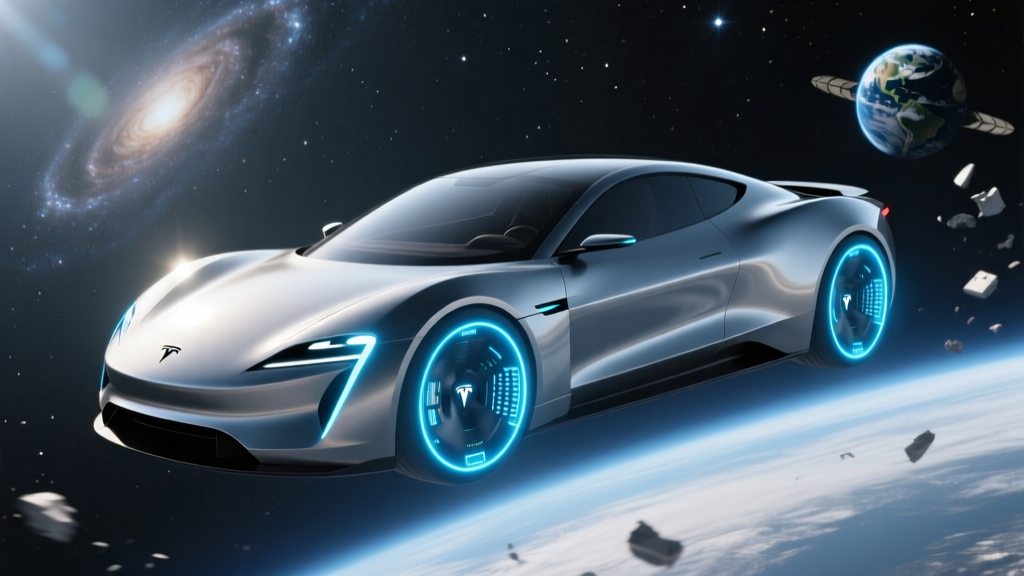
In February 2018, SpaceX strapped a first-generation Tesla Roadster to a Falcon Heavy rocket and launched it into a heliocentric orbit that stretches past Mars. Seven years later, that cherry-red EV is still silently circling the sun — and thousands of people search for "tesla car in space live tracking" every month wondering where it is now and what it has to do with the electric cars they can actually buy today.
The honest answer: the Roadster in space is a cultural milestone, not a product you can order. But the engineering DNA behind that stunt — battery chemistry, thermal management, powertrain efficiency — runs through every Tesla you can buy in 2026. This article tracks where the spacebound Roadster is today, then shifts to a hard-spec look at the current Tesla lineup, with the range, charging, pricing, and tax-credit data real buyers need.
Where Is the Tesla Roadster in Space Right Now?
The midnight-cherry Tesla Roadster launched on February 6, 2018, aboard the Falcon Heavy's maiden flight. Starman, the mannequin in the driver's seat, is still behind the wheel. The car was pushed into an elliptical heliocentric orbit with an aphelion (farthest point from the sun) of roughly 1.66 AU — extending past Mars' orbital distance — and a perihelion (closest point) near Earth's orbit at ~0.99 AU.
Live tracking of the Roadster is maintained by astronomer Jono Brandel's whereisroadster.com, which calculates the car's position using orbital mechanics and publicly available ephemeris data. As of early 2026, the Roadster has completed approximately five full orbits around the sun and has traveled well over 2 billion miles. The car is not equipped with an active transmitter, so its position is calculated, not broadcast in real time. You won't get a live GPS ping — orbital math is the closest thing available.
Over long timescales, the Roadster's orbit is chaotic. A 2018 study published in Monthly Notices of the Royal Astronomical Society estimated a ~6% chance the car will collide with Earth and a ~2.5% chance of a Venus impact within one million years. For now, it's simply a piece of space history and a remarkably effective marketing artifact.
What the Space Roadster Has to Do With Today's Teslas
The 2008 Roadster in space is a museum piece — a 53 kWh lithium-ion cobalt-oxide pack, 244 hp, and 244 miles of EPA range (adjusted). The battery is completely inert in the vacuum and radiation environment of space and has been dead since shortly after launch due to extreme thermal cycling.
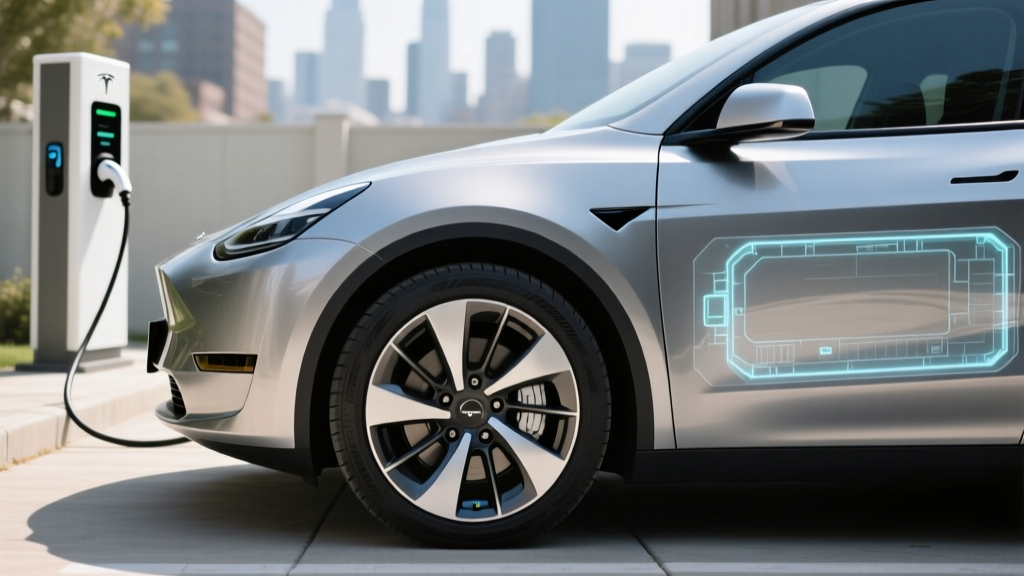
But Tesla's production vehicles in 2026 share engineering lineage with that car. The company's advances in cell chemistry (moving from cobalt-heavy cells to LFP and high-nickel NMC/NCA), structural battery packs, and thermal management systems all trace back to lessons learned from the original Roadster program. Let's look at what that means for buyers today.
2026 Tesla Lineup: Specs That Matter to Real Buyers
Rather than review a car floating in orbit, here's a data-dense look at the Tesla models you can actually purchase and drive in 2026 — the Model 3, Model Y, Model S, and Model X — with the exact numbers that matter for purchase decisions.
| Spec | 2026 Model 3 Long Range AWD | 2026 Model Y Long Range AWD | 2026 Model S Long Range | 2026 Model X Long Range |
|---|---|---|---|---|
| EPA Range | 363 mi | 320 mi | 402 mi | 335 mi |
| Battery (usable, est.) | ~79 kWh (NMC/NCA) | ~79 kWh (NMC/NCA) | ~100 kWh (NMC/NCA) | ~100 kWh (NMC/NCA) |
| Drivetrain | Dual Motor AWD | Dual Motor AWD | Dual Motor AWD | Dual Motor AWD |
| Horsepower | ~346 hp | ~384 hp | ~670 hp | ~670 hp |
| 0–60 mph | 4.2 sec | 4.8 sec | 3.1 sec | 3.8 sec |
| Efficiency (MPGe) | 134 MPGe combined | 122 MPGe combined | 124 MPGe combined | 116 MPGe combined |
| Peak DC Fast Charge | ~250 kW | ~250 kW | ~250 kW | ~250 kW |
| 10–80% DC Time | ~27 min | ~27 min | ~33 min | ~33 min |
| Level 2 Home Rate | ~11.5 kW (44 mi/hr) | ~11.5 kW (44 mi/hr) | ~11.5 kW (44 mi/hr) | ~11.5 kW (44 mi/hr) |
| Battery Warranty | 8 yr / 120,000 mi | 8 yr / 120,000 mi | 8 yr / 150,000 mi | 8 yr / 150,000 mi |
| Base MSRP (est.) | $47,740 | $48,990 | $79,990 | $84,990 |
Source: fueleconomy.gov and Tesla.com specifications. Prices and specs reflect the latest available model-year data; confirm at time of purchase.
Real-World Range: What the EPA Sticker Doesn't Tell You
EPA Sticker vs. Reality: The Model 3 Long Range AWD carries an EPA estimate of 363 miles. In real-world highway driving at 70–75 mph, expect approximately 290–310 miles on a full charge. In cold weather (below 30°F / -1°C), range can drop 20–30%, yielding roughly 220–260 miles depending on cabin heating use and driving conditions. City driving with regenerative braking recovers energy and often exceeds the EPA combined figure.
Tesla's thermal management system is among the best in the industry — the heat pump (standard since the 2021 refresh) significantly reduces cold-weather range loss compared to resistive heating. However, physics is physics: cold electrolyte conducts ions more slowly, and cabin heating draws from the same pack. Preconditioning the battery while plugged in before departure is essential to minimize range loss and optimize charging speed at your first DC fast-charging stop.
For the Model Y Long Range (320 mi EPA), expect roughly 260–280 miles highway and 200–230 miles in deep cold. The Model S (402 mi EPA) and Model X (335 mi EPA) follow similar patterns — real-world highway figures typically run 15–20% below sticker, with cold weather compounding the reduction.
Charging Speed: Home, Supercharger, and the Curve
| Charging Level | Power (kW) | Miles of Range Added per Hour | Typical Use Case |
|---|---|---|---|
| Level 1 (120V household) | ~1.4 kW | ~3–5 mi/hr | Emergency / overnight trickle |
| Level 2 (240V home, 48A) | ~11.5 kW | ~44 mi/hr | Daily home charging |
| DC Fast (Tesla Supercharger V3) | Up to 250 kW peak | ~1,000+ mi/hr (peak) | Road trips, 10–80% in ~27 min |
| DC Fast (V4 Supercharger cabinet) | Up to 250+ kW (current vehicles) | Similar to V3 for current models | Newer plaza hardware; future vehicles may unlock higher rates |
The charging curve matters more than peak kW. Tesla's 250 kW peak is achievable only when the battery is preconditioned, at a low state of charge (below ~30%), and at optimal temperature. Above 50% SoC, the charge rate tapers significantly — by 80% SoC, you may be pulling only 50–70 kW. This is why the 10–80% time is the most useful metric for road-trip planning. Plan to charge to 80% and move on; the time spent waiting from 80–100% is rarely worth it.
Home Level 2 charging on a 240V/48A circuit (like a Tesla Wall Connector) adds roughly 44 miles of range per hour, meaning a full overnight charge from 20% to 90% takes about 10–11 hours — plenty for daily use. Installation costs typically run $500–$2,000 depending on panel proximity and local permitting. If your home has a 100A electrical panel, a panel upgrade to 200A may be needed, adding $1,500–$3,000.
Pricing, Trims, and the Federal EV Tax Credit
| Model | Base MSRP | Federal §30D Credit Eligibility | Effective Price (if eligible) |
|---|---|---|---|
| Model 3 RWD (LFP) | ~$38,990 | Up to $7,500 (subject to sourcing/income rules) | ~$31,490 |
| Model 3 Long Range AWD | ~$47,740 | Up to $7,500 (subject to sourcing/income rules) | ~$40,240 |
| Model Y Long Range AWD | ~$48,990 | Up to $7,500 (subject to sourcing/income rules) | ~$41,490 |
| Model S Long Range | ~$79,990 | Not eligible (exceeds $55,000 sedan MSRP cap) | $79,990 |
| Model X Long Range | ~$84,990 | Not eligible (exceeds $80,000 SUV/truck MSRP cap) | $84,990 |
Federal tax credit rules are complex and evolving. Under IRS §30D Clean Vehicle Credit, eligibility for the full $7,500 requires meeting all of the following:
- MSRP cap: Sedans must be priced at or below $55,000; SUVs, vans, and trucks at or below $80,000.
- Buyer income cap: Modified AGI ≤ $150,000 (single), $225,000 (head of household), or $300,000 (joint).
- Battery sourcing requirements: Critical minerals and battery components must meet escalating domestic-sourcing thresholds that tighten each year. As of 2026, a significant percentage must be sourced from the U.S. or FTA-partner countries.
- Final assembly: Must occur in North America (all U.S.-sold Teslas qualify — Fremont and Gigafactory Texas).
The credit can now be transferred to the dealer at point of sale, reducing your purchase price directly rather than waiting for a tax refund. However, battery-sourcing rules have disqualified some trims in prior years. Always verify current eligibility on the IRS website or with a tax professional before finalizing a purchase.
The Model S and Model X exceed their respective MSRP caps and do not qualify for the federal credit regardless of buyer income. State and local incentives (e.g., utility rebates, HOV lane access) may still apply — check your jurisdiction.
Tech, Driver Assistance, and Interior
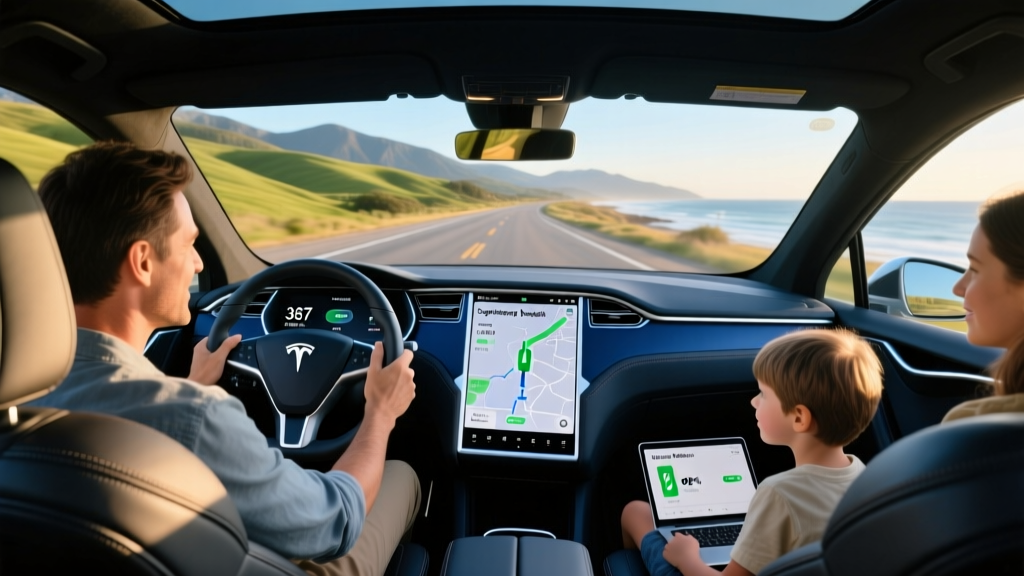
Infotainment: Tesla's 15.4-inch center touchscreen (Model 3/Y) and 17-inch display (Model S/X) remain the primary interface for all vehicle controls, navigation, media, and climate. The system is responsive and feature-rich, but the absence of physical buttons for climate, mirrors, and glovebox remains a polarizing choice. Wireless phone charging, premium audio (14–22 speakers depending on model), and over-the-air updates are standard.
Driver Assistance:
SAE Level 2 — Not Self-Driving: Tesla's Autopilot (standard) and Full Self-Driving (Supervised) are SAE Level 2 driver-assistance systems. They provide adaptive cruise control and lane-centering, but the driver must remain fully engaged, hands on the wheel, and eyes on the road at all times. FSD (Supervised) can navigate on-ramps, city streets, and stoplights, but it makes errors and requires constant supervision. It is not autonomous driving. Only Level 4 services like Waymo operate without a human driver.
FSD (Supervised) costs $8,000 as a one-time purchase or $99/month as of 2026. Its real-world performance has improved substantially through neural-net-based vision processing, but it remains a convenience feature, not a replacement for an attentive driver. NHTSA continues to investigate incidents involving Tesla's driver-assist systems, and buyers should weigh the cost against their actual commuting needs.
Interior and Cargo:
- Model 3: 23 cu ft trunk + rear seats fold flat; rear legroom ~35.2 in. Minimalist cabin with quality materials post-refresh.
- Model Y: 30 cu ft behind rear seats, ~72 cu ft with seats folded; rear legroom ~41.6 in. The most practical Tesla for families.
- Model S: 28 cu ft cargo (hatchback) + front trunk (frunk); rear legroom ~40.9 in.
- Model X: Up to 88 cu ft with seats folded; falcon-wing rear doors ease child-seat installation; available 6- or 7-seat configurations.
Who Should Buy a Tesla in 2026 — and Who Shouldn't
Pros
- Access to the Tesla Supercharger network — still the most reliable and widespread DC fast-charging ecosystem in North America (20,000+ stalls)
- Class-leading efficiency (MPGe) and strong real-world range across the lineup
- Over-the-air updates continuously add features and refine performance
- Strong resale value relative to most EV competitors
- Model 3 and Model Y eligible for up to $7,500 federal credit (if sourcing/income rules met)
Cons
- No physical controls — everything through the touchscreen, including climate and mirrors
- FSD (Supervised) is expensive and still requires full driver attention
- Model S and X exceed MSRP caps — no federal tax credit
- Service center availability can be limited in rural areas; mobile service helps but doesn't cover everything
- Insurance premiums tend to be higher than comparable non-EV sedans/SUVs
Choose the Model 3 if: You want the most affordable entry into the Tesla ecosystem, prioritize efficiency and handling, and don't need cargo space. The RWD trim with LFP battery (lower cost, longer cycle life, ~100% SoC charging OK) is a strong value play at ~$38,990 before credits.
Choose the Model Y if: You need family-friendly cargo volume, easy rear-seat access, and an SUV ride height. It's the best-selling Tesla for good reason — practical, efficient, and credit-eligible.
Choose the Model S if: You want flagship performance (3.1 sec 0–60), 400+ miles of range, and don't mind paying premium prices without a federal credit. Best for long-distance commuters and enthusiasts.
Choose the Model X if: You need three rows, falcon-wing doors for tight parking, and maximum cargo versatility. It's niche and expensive, but nothing else offers the same combination.
Look elsewhere if: You prefer physical buttons, want a non-Tesla charging ecosystem (CCS/NACS adapters now work at Superchargers for non-Tesla EVs, but the native experience is still Tesla-only), or need a truck/SUV from a brand with broader dealer service coverage.
Frequently Asked Questions
Can I track the Tesla Roadster in space live?
Not in real time — the car has no active transmitter. Its position is calculated using orbital mechanics. The best tracker is whereisroadster.com, which updates the car's estimated distance from Earth, speed, and orbital position based on its known trajectory.
What is the real-world range of a Tesla in 2026?
Real-world range depends on model, speed, and temperature. The Model 3 Long Range AWD (363 mi EPA) typically delivers 290–310 miles on the highway, 220–260 miles in freezing weather, and can exceed 350 miles in city driving with regenerative braking. Always plan road trips around 80% of the EPA figure for safety margin.
How fast does a Tesla charge at home and on the road?
At home on a Level 2 (240V/48A) Tesla Wall Connector, you'll add ~44 miles of range per hour — a full overnight charge handles most daily needs. On a V3 Supercharger, peak rate is 250 kW with a 10–80% charge in approximately 27 minutes, though the rate tapers significantly above 50% SoC.
Does the Tesla Model 3 or Model Y qualify for the $7,500 federal tax credit?
Yes — both the Model 3 and Model Y are assembled in the U.S. and priced below the MSRP caps ($55,000 for sedans, $80,000 for SUVs). However, full eligibility also depends on buyer income (≤$150K single / $300K joint), battery critical-mineral sourcing thresholds, and component manufacturing requirements. Verify on irs.gov before purchasing.
Is Tesla's FSD actually self-driving?
No. Full Self-Driving (Supervised) is an SAE Level 2 driver-assist system. It can handle highway ramps, city intersections, and parking, but it requires constant driver supervision, hands on the wheel, and eyes on the road. It makes mistakes and is not a substitute for an attentive driver. True autonomous driving (Level 4) is currently available only through robotaxi services like Waymo in limited geofenced areas.
Is a Tesla worth buying vs. competitors like the Hyundai Ioniq 5, BMW i4, or Ford Mustang Mach-E?
Tesla's advantages are Supercharger network access, efficiency, and software. Competitors often offer more traditional interiors with physical controls, competitive or faster DC charging (e.g., Ioniq 5's 800V architecture enabling 10–80% in ~18 minutes), and in some cases lower pricing. If charging infrastructure access is your top concern, Tesla still leads. If interior ergonomics or charging speed on non-Tesla networks matter more, cross-shop aggressively.
Will the space Roadster ever come back to Earth?
There's a roughly 6% probability of an Earth encounter within one million years, per orbital-dynamics modeling. In practical terms, it will remain in solar orbit for hundreds of thousands of years barring an unlikely gravitational perturbation. It's not coming home.
Editorial note: Specs, pricing, and tax-credit eligibility reflect the latest available data as of 2026 and are subject to change. Always confirm with Tesla.com, fueleconomy.gov, and the IRS before making a purchase decision.