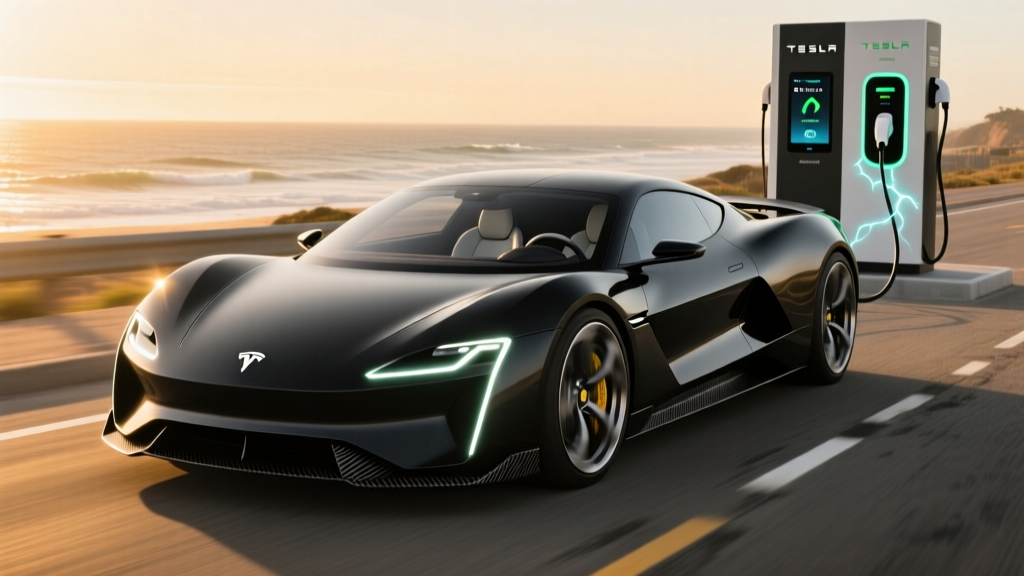
The next-generation Tesla Roadster has been one of the longest-running previews in automotive history. First teased in 2017 with a promised 2020 launch, then repeatedly delayed, the car remains in what Tesla calls a "reservation" phase — where buyers put down refundable deposits to hold a place in line for a vehicle that, as of early 2026, has not yet entered production. If and when it arrives, Tesla has floated staggering numbers: a 620-mile target range, a sub-2.0-second 0-60 time, and a price tag well into six figures.
This profile compiles every confirmed spec, every Tesla-stated estimate, and the real-world ownership factors that will matter if the Roadster ever reaches driveways. Because this vehicle is announced but unreleased, figures marked as "preliminary" or "target" should be treated as engineering goals, not EPA-certified guarantees.
Announced Specs: What Tesla Has Stated (and What Remains Unverified)
| Attribute | Tesla-Stated or Estimated Figure | Status |
|---|---|---|
| Target EPA Range | 620 miles | Unverified (pre-production) |
| Battery Capacity (estimated usable) | ~200 kWh | Estimated from range targets |
| Battery Chemistry | Not disclosed (likely NMC high-nickel) | Preliminary |
| Drivetrain | Tri-motor AWD | Confirmed by Tesla |
| 0-60 mph | 1.9 seconds (base); <1.0 sec with SpaceX package | Target (unverified) |
| Top Speed | 250+ mph | Target |
| Peak Horsepower | Not officially stated; estimated 1,000+ hp | Estimated |
| Quarter Mile | 8.8 seconds (claimed) | Target |
| Max DC Fast Charge | Not disclosed; likely 350+ kW | Estimated |
| 10-80% DC Charge Time | Not disclosed | Unknown |
| Level 2 Home Charge | Not disclosed | Unknown |
| Seating | 2+2 (two front, two small rear) | Confirmed |
| Base Reservation Deposit | $50,000 (fully refundable) | Current |
| Founder's Series Deposit | $250,000 (non-refundable applied to purchase) | Current |
| Estimated Base MSRP | $200,000+ | Estimated |
| Battery/Powertrain Warranty | Not disclosed | Unknown |
Several of these numbers — especially the 1.9-second 0-60 and 620-mile range — are engineering targets Tesla has referenced in earnings calls and on its website. None have been validated by the EPA, NHTSA, or independent testing bodies. The 200 kWh battery figure is an inference: achieving 620 miles in a ~4,400-lb sports car would require roughly 3.2–3.5 miles per kWh, which is plausible with a large pack but extraordinary for a performance vehicle.
Range Reality: 620 Miles on Paper, What to Expect on the Road
Real-World Expectation: If certified near 620 mi, expect ~480–530 mi at sustained 75 mph highway speeds, and ~370–430 mi in sub-30°F winter conditions. A 200 kWh NMC pack in a low-drag sports coupe should outperform most EVs on the highway, but cold-weather chemistry losses and cabin heating still apply.
No production Roadster has been submitted for EPA testing as of early 2026, so the 620-mile figure remains a Tesla projection. For context, the longest-range EV currently EPA-certified is the Lucid Air Grand Touring at 516 miles with a 118 kWh pack. Tesla's claim implies either a substantially larger battery, dramatically better efficiency, or both.
If the Roadster achieves even 500 EPA-certified miles, it would reset the range benchmark for any production vehicle. But buyers should plan for the real-world discount that every EV faces: highway driving at 75+ mph typically reduces range by 15–25% versus the EPA combined cycle, and cold weather (below freezing) can cut range by 25–40% depending on heat-pump efficiency and battery preconditioning.
Charging: The 200 kWh Problem
Here's the physics challenge that Tesla hasn't publicly addressed: a 200 kWh battery takes a long time to fill, even at high power. Without disclosed charge specs, we can model the math:
| Charging Method | Power (kW) | Estimated 10-80% Time | Notes |
|---|---|---|---|
| Level 1 (120V / 12A) | ~1.4 kW | ~100+ hours | Emergency/trickle only |
| Level 2 (240V / 48A) | ~11.5 kW | ~12 hours | Overnight home charging |
| Level 2 (240V / 80A) | ~19.2 kW | ~7.5 hours | High-amperage Wall Connector |
| DC Fast (V4 Supercharger) | 350 kW (peak est.) | ~30–40 minutes | Assuming sustained 250 kW avg |
| DC Fast (theoretical 500 kW) | 500 kW (peak) | ~20–25 minutes | Would require new architecture |
At a standard 48-amp Level 2 home charger (11.5 kW), a full 10-80% charge would take roughly 12 hours — meaning overnight charging works, but only if you start with a near-depleted pack. Most owners will charge 20-80% daily, which at 11.5 kW takes about 10 hours, fitting an overnight window.
For DC fast charging, Tesla's V4 Supercharger cabinets support up to 350 kW on the CCS/NACS connector. If the Roadster can accept that peak rate — and sustain an average of ~250 kW through the 10-80% window — you're looking at 30-40 minutes for a meaningful road-trip top-up. That's longer than a Model 3's ~18-minute 10-80% session, but proportionate to a battery roughly three times larger.
The charge curve will matter enormously. Most NMC packs taper significantly above 80% SoC. With a 200 kWh pack, the difference between charging to 80% vs. 100% at a DC station could add 30+ minutes to your stop. Smart road-trippers will plan around 10-80% sprints.
Performance: The Numbers That Define the Roadster
Performance is the Roadster's core proposition. Tesla's claimed 1.9-second 0-60 mph time (base tri-motor) would make it the quickest-accelerating production car ever sold, surpassing the Rimac Nevera's 1.85-second verified run by a negligible margin — though the Nevera's time was independently validated, while Tesla's remains a target.
The optional "SpaceX package" — which Elon Musk has said would include cold-gas thrusters mounted around the rear license plate area — claims a sub-1.0-second 0-60. This has been met with widespread skepticism from automotive engineers, as achieving sub-1.0 second on street tires on a prepared surface would require extraordinary downforce and traction management. If it exists at all, expect it as a limited, track-only option.
The tri-motor AWD layout (one front, two rear) mirrors the architecture in the Model S Plaid, which delivers 1,020 hp and a verified 2.1-second 0-60 in a ~4,800-lb sedan. The Roadster, expected to weigh around 4,400 lbs with a lower center of gravity and more aggressive aero, should theoretically improve on those figures — but the gap between a 2.1 and a 1.9 is exponentially harder to close than the gap from 3.0 to 2.5.
Pricing, Reservations, and the Federal Tax Credit Question
The Tesla Roadster is not a vehicle you can currently buy. It exists in a reservation system with two tiers:
- Standard Reservation: $50,000 deposit (refundable), securing a place in the production queue.
- Founder's Series: $250,000 deposit (applied toward purchase price, non-refundable), for the first 1,000 units built. These are expected to be fully loaded and may carry a total price around $250,000.
For post-Founder's production, the base MSRP is estimated at $200,000 or more, though Tesla has not published official trim pricing. With options and potential performance packages, as-tested prices could reach $250,000–$300,000.
| Item | Amount | Notes |
|---|---|---|
| Estimated Base MSRP | $200,000+ | Not officially confirmed |
| Founder's Series (first 1,000) | ~$250,000 | Deposit applied to purchase |
| Federal §30D Tax Credit | $0 | Exceeds MSRP cap; buyer likely exceeds income cap |
| Estimated Out-of-Pocket | $200,000–$300,000 | No federal credit; state incentives unlikely to apply |
Federal tax credit reality: Under IRS §30D rules, the Roadster will almost certainly not qualify for the up-to-$7,500 clean vehicle credit. The reasons are threefold:
- MSRP Cap: §30D limits the credit to vehicles with an MSRP of $55,000 or less (sedans/coupes) or $80,000 or less (SUVs/pickups). The Roadster, as a coupe, would need to be priced at $55,000 or below — roughly 75% less than expected.
- Buyer Income Cap: Modified adjusted gross income must not exceed $150,000 (single) / $300,000 (joint). Most buyers spending $200K+ on a sports car will exceed these thresholds.
- Battery Sourcing: Even if the above were met, critical-mineral and battery-component sourcing requirements would need to be satisfied, which is uncertain for a low-volume halo car.
Bottom line: budget the full MSRP. No federal incentive will meaningfully offset this purchase.
Interior, Cargo, and Daily Usability
The Roadster is a 2+2 coupe, meaning two front seats and two rear seats suitable for children or very short adults on brief trips. Tesla has shown a minimalist interior with a central touchscreen and a yoke-style steering wheel, consistent with the current Model S/X cabin architecture. Expect:
- Front legroom: Estimated ~43 inches (sports car generous)
- Rear legroom: Estimated ~28–30 inches (occasional-use only)
- Cargo (trunk + frunk): Estimated ~10–14 cu ft combined — enough for two carry-on bags and a weekend duffel, but not a road-trip hauler
- Removable glass roof panel: Confirmed; stores in the trunk
This is not a daily-driver commuter in the Model 3 sense. It's a weekend car, a track-day companion, and a statement piece. The 2+2 layout gives it marginal practicality over a pure two-seater like the previous Roadster or a Lotus Evija, but buyers should not expect family-hauler utility.
Tech, Driver Assistance, and the Autopilot Question
The Roadster is expected to ship with Tesla's current hardware suite (HW4/AI4 cameras and processing), supporting:
- Autopilot: Standard adaptive cruise control and lane-keeping (SAE Level 2)
- FSD (Supervised): Optional full-self-driving capability with city streets and highway navigation, still requiring active driver supervision at all times (SAE Level 2)
- Infotainment: 17-inch touchscreen, gaming-capable processor, streaming, Tesla app integration
- Over-the-air updates: Continuous feature additions and performance tweaks
For a $200K+ performance car, the tech suite is adequate but not exotic. Competitors like the Rimac Nevera offer more bespoke interior materials and dedicated performance telemetry systems. Tesla's advantage remains the Supercharger network and OTA update ecosystem.
How It Stacks Up: Roadster vs. the Hypercar EV Field
The Roadster occupies a strange space: priced below the Rimac Nevera ($2.2M) and Lotus Evija ($2.3M) but above the Tesla Model S Plaid ($108K). Its closest comparison points:
- Tesla Model S Plaid ($108,490): 1,020 hp, 2.1s 0-60, 396-mi EPA range, 4 doors, 5 seats. A fraction of the Roadster's price with 90% of the straight-line thrill and far more daily usability. The rational choice for Tesla performance buyers.
- Rimac Nevera ($2,200,000): 1,914 hp, 1.85s 0-60 (verified), 340-mi WLTP range, 18 units/year. Hand-built Croatian hypercar with proven performance. 10x the Roadster's price but delivered and validated today.
- Lotus Evija ($2,300,000): 1,972 hp, sub-3.0s 0-60, ~250-mi range. Limited to 130 units. More exclusive, less practical, available now.
- Porsche Taycan Turbo GT ($230,000): 1,019 hp, 2.1s 0-60, 269-mi EPA range. A real production car you can buy today with Porsche build quality and dealer support.
The Roadster's value proposition hinges on whether Tesla can deliver its claimed specs at its estimated price. If it hits 620 miles and a 1.9-second 0-60 at ~$200K, nothing else in the market competes on paper. But "if" is doing a lot of work in that sentence.
Pros
- Target 620-mile range would shatter all EV records
- Sub-2.0s 0-60 (if achieved) redefines production-car performance
- Access to Tesla Supercharger network for road trips
- OTA updates mean the car improves over time
- Refundable $50K reservation limits financial risk
- 2+2 layout offers more practicality than most hypercars
Cons
- Not in production — no delivery date confirmed as of 2026
- All specs are targets, not EPA-certified or independently verified
- $200K+ price with zero federal tax credit eligibility
- 200 kWh pack means long charge times even at 350 kW
- No confirmed warranty terms, service plan, or insurance data
- Tesla's track record on timeline promises is poor (original 2020 launch missed by 6+ years)
Who Should Reserve the Tesla Roadster — and Who Should Pass
Reserve if: You're a Tesla enthusiast with $200K+ in discretionary automotive budget, you accept that delivery may still be years away, and you want to hold a place in line for what could be a landmark vehicle. The $50K refundable deposit carries limited risk if your finances allow it.
Pass if: You need a car in the next 12-24 months, you want independently verified performance data before committing, or you'd rather spend $108K on a Model S Plaid today and get 90% of the experience with 100% of the certainty. Also pass if you're counting on the federal tax credit — it will not apply here.
Consider instead: The Model S Plaid for real-world Tesla performance today, or the Porsche Taycan Turbo GT if you want six-figure EV thrills with established dealer support and verified build quality.
Frequently Asked Questions
What is the real-world range of the Tesla Roadster?
Tesla targets 620 miles (EPA), but this is unverified. If certified near that figure, expect approximately 480–530 miles at highway speeds and 370–430 miles in freezing weather. No production Roadster has undergone EPA testing as of early 2026.
How fast does the Roadster charge at home and on the road?
Tesla has not disclosed official charging specs. Based on the estimated 200 kWh pack, a Level 2 home charger (11.5 kW) would require roughly 12 hours for a 10-80% charge. At a 350 kW DC Supercharger, expect 30-40 minutes for 10-80%, assuming the pack can sustain high charge rates — which is a significant engineering challenge at this capacity.
How much does the Tesla Roadster cost after tax credits?
The estimated base price is $200,000+, with Founder's Series units around $250,000. The federal §30D tax credit will not apply due to the MSRP cap ($55,000 for coupes), buyer income limits, and likely battery-sourcing complications. Expect to pay full MSRP.
Is the Tesla Roadster worth reserving vs. buying a Model S Plaid or Porsche Taycan?
If you can buy a car today, the Model S Plaid ($108,490) delivers 1,020 hp and a verified 2.1-second 0-60 at half the Roadster's estimated price. The Porsche Taycan Turbo GT ($230,000) offers comparable performance with established build quality. The Roadster only makes sense if you're willing to wait for unverified specs at a premium price.
Does the Tesla Roadster qualify for the $7,500 federal EV tax credit?
Almost certainly not. Under current IRS §30D rules, the vehicle exceeds the $55,000 MSRP cap for coupes, most buyers will exceed the income cap ($150K single / $300K joint), and battery critical-mineral sourcing requirements add further uncertainty.
When will the Tesla Roadster actually ship?
Tesla has not confirmed a production start date as of early 2026. The vehicle was originally announced for 2020 delivery, then pushed to 2022, 2023, 2024, and 2025. Elon Musk has suggested production could begin after the Cybercab and next-gen platform ramp, which implies 2027 or later. Treat any date as speculative.
What battery chemistry will the Roadster use?
Tesla has not officially disclosed the chemistry. Given the extreme range and performance targets, a high-nickel NMC (nickel manganese cobalt) or NCA (nickel cobalt aluminum) formulation is most likely. LFP chemistry, used in standard-range Tesla models, is too heavy and energy-dense-limited for a 620-mile performance application.
What is the warranty on the Tesla Roadster battery and drivetrain?
Tesla has not published warranty terms for the Roadster. For reference, the Model S carries an 8-year/150,000-mile battery and drive unit warranty with a minimum 70% capacity retention threshold. Given the Roadster's price and low production volume, a similar or more generous warranty would be expected, but nothing is confirmed.