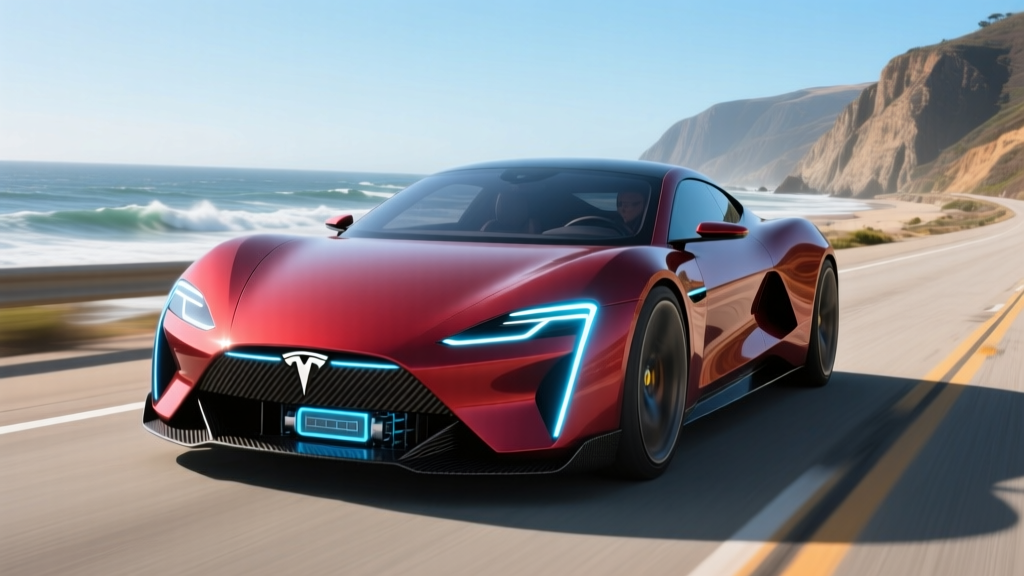
The next-generation Tesla Roadster has lived in automotive limbo since Elon Musk first unveiled it in November 2017. Promised as a halo supercar that would embarrass gasoline exotics while delivering over 600 miles of range, the Roadster has repeatedly missed production targets. As of early 2026, Tesla has confirmed the model is entering limited production, but final EPA certifications and customer deliveries remain pending. Here is every confirmed and estimated specification you need to evaluate whether the Roadster delivers on its headline claims — particularly the much-searched Tesla Roadster max speed figure — and whether it makes financial sense versus established electric supercars.
Performance: Tesla Roadster Max Speed and Acceleration
The headline number that keeps enthusiasts searching is the Tesla Roadster max speed: Tesla has claimed a top speed exceeding 250 mph (402 km/h), which would place it among the fastest production cars ever built, electric or otherwise. The tri-motor all-wheel-drive powertrain is rated at an estimated 1,000+ wheel torque pound-feet at the wheels, translating to roughly 1,024 horsepower in the base configuration.
Acceleration figures are staggering even by 2026 EV standards. Tesla targets a 0–60 mph time of 1.9 seconds in the standard Roadster, dropping to an estimated 1.1 seconds with the optional SpaceX cold-gas thruster package (a pressurized air system mounted around the vehicle for cornering, braking, and acceleration assist). That thruster package has never been homologated for street use in any production vehicle, and U.S. DOT approval remains an open question.
| Specification | Base Roadster | With SpaceX Package |
|---|---|---|
| 0–60 mph | 1.9 seconds (claimed) | 1.1 seconds (claimed) |
| Max Speed | 250+ mph (claimed) | 250+ mph (claimed) |
| 1/4 Mile | 8.8 seconds (claimed) | 8.8 seconds (claimed) |
| Horsepower | ~1,024 hp (est.) | ~1,024 hp + thrust assist |
| Drivetrain | Tri-motor AWD | Tri-motor AWD |
| Torque (wheel) | 10,000 Nm / 7,376 lb-ft | 10,000 Nm / 7,376 lb-ft |
Real-world context: Sustaining 250 mph requires not just motor output but extreme aerodynamic efficiency, tire integrity, and thermal management. The Roadster's claimed 0.36 Cd drag coefficient is respectable but not class-leading — the Lucid Air Sapphire achieves 0.21 Cd. Achieving and holding top speed will depend heavily on Tesla's active aero and thermal systems, which remain unverified in independent testing.
Battery, Range, and Efficiency
Tesla has stated the Roadster will carry a 200 kWh battery pack — roughly double the capacity of a Model S Long Range. The pack chemistry is expected to use high-nickel NMC (nickel-manganese-cobalt) cells, likely sourced from Tesla's 4680 cell production lines, prioritizing energy density over the cycle-life advantages of LFP chemistry.
Range Reality Check
EPA estimated range: 620 miles (claimed by Tesla, not yet EPA-certified as of early 2026).
Real-world expectation: At highway speeds of 75–80 mph, expect approximately 420–480 miles based on the aerodynamic drag penalty a low-slung sports car faces and the energy consumption typical of a 4,400+ lb vehicle producing supercar-level power. In cold weather (below 32°F), lithium-ion chemistry limitations and cabin heating demands could reduce usable range by 20–30%, bringing effective winter highway range to roughly 300–380 miles. These figures are estimates pending official EPA testing.
Efficiency will be the Roadster's biggest question mark. A 200 kWh pack delivering 620 miles implies roughly 32.3 kWh/100mi — competitive with the Lucid Air Grand Touring's EPA-rated 28 kWh/100mi but far from the Tesla Model 3 Long Range's 25 kWh/100mi. Any hard driving, track use, or sustained high-speed runs will push consumption well above 50 kWh/100mi, cutting range dramatically.
Charging Speed: DC Fast and Home Level 2
With a 200 kWh battery, charging speed is not optional — it is existential. Tesla has not published final DC fast-charging specs, but based on the Cybertruck's architecture and Tesla's V4 Supercharger capabilities, the Roadster is expected to support peak DC charging at approximately 350 kW via the NACS connector.
| Charging Level | Power / Rate | Estimated Time / Range Added |
|---|---|---|
| Level 1 (120V household) | ~1.4 kW | ~4 miles per hour |
| Level 2 (240V home, 48A) | 11.5 kW | ~35 miles per hour; full charge ~18 hours |
| DC Fast Charge (V4 Supercharger) | Peak ~350 kW (est.) | 10–80% in approximately 30–35 minutes (est.) |
Charging curve reality: A 200 kWh pack charging at 350 kW peak will not sustain that rate. Expect peak speed between 10–40% State of Charge, tapering to ~200 kW by 60% and below 100 kW past 80%. A 10–80% session will likely take 30–35 minutes under ideal thermal conditions. Battery preconditioning via the Tesla navigation system is essential — arriving at a Supercharger without preconditioning can add 10–15 minutes to your session in cold weather.
For home charging, a full 18-hour Level 2 session means the Roadster is a vehicle you charge overnight and drive during the day, not one you "top off" in an afternoon. Buyers should plan for a dedicated 60A circuit with a Tesla Wall Connector or equivalent NACS-compatible Level 2 unit.
Pricing, Tax Credits, and Ownership Costs
The Tesla Roadster was originally announced with a base price of $200,000, with a $250,000 "Founders Series" limited to the first 1,000 reservations. As of 2026, Tesla's pricing page lists the Roadster base at $200,000 before options, with the Founders Series requiring full payment upfront.
| Item | Amount |
|---|---|
| Base MSRP | $200,000 |
| Founders Series MSRP | $250,000 |
| SPC SpaceX Package (est.) | +$50,000 (unconfirmed) |
| Federal §30D Tax Credit | $0 — exceeds MSRP cap |
| Estimated Out-the-Door (base) | $200,000+ (delivery fees, state taxes additional) |
Federal tax credit verdict: The Roadster does not qualify for the IRS §30D clean vehicle credit. The §30D credit imposes an MSRP cap of $55,000 for sedans and $80,000 for SUVs, trucks, and vans. At $200,000+, the Roadster exceeds every cap by a wide margin. Additionally, buyer income limits ($150,000 single / $300,000 joint AGI) and battery critical-mineral sourcing requirements further restrict eligibility for high-end vehicles. Do not factor any federal credit into your Roadster purchase budget.
Interior, Cargo, and Technology
The Roadster is a 2+2 sports car, but rear seats are best described as occasional-use — suitable for children or cargo overflow rather than adult passengers on any trip longer than 30 minutes. Tesla has not published final interior dimensions, but the predecessor Roadster (2008–2012) offered essentially zero cargo space. The new Roadster is expected to provide a small rear trunk area and a modest front trunk (frunk), with combined cargo volume likely in the 8–12 cubic-foot range based on the vehicle's low-slung proportions.
Technology will center on a minimalist Tesla interior: expect a single central touchscreen (likely 17-inch, similar to the refreshed Model S), no traditional instrument cluster, and Tesla's latest infotainment software. Autopilot will be standard, with Full Self-Driving (Supervised) available as an add-on — though this is an SAE Level 2 driver-assistance system, not autonomous driving. The driver must remain fully engaged at all times.
Notable drawbacks: The removable glass roof panel, while a signature feature, adds weight high in the chassis and introduces potential wind noise and sealing concerns at 200+ mph. Ground clearance is expected to be extremely low (under 4 inches), making speed bumps, steep driveways, and parking-garage ramps genuine obstacles. Visibility rearward will be limited by the coupe roofline.
Warranty and Battery Longevity
Tesla's standard warranty for high-end vehicles covers the battery and drive unit for 8 years or 150,000 miles (whichever comes first), with a minimum 70% capacity retention threshold. The limited vehicle warranty covers 4 years or 50,000 miles. These terms are expected to carry over to the Roadster, though Tesla has not confirmed final warranty documentation for the model.
With a 200 kWh NMC pack, degradation management will be critical. NMC chemistry typically retains 85–90% capacity after 150,000 miles under normal use, but frequent DC fast-charging to high states of charge and repeated hard acceleration will accelerate wear. Tesla's thermal management system is among the best in the industry, which should help mitigate degradation, but buyers should plan for 10–15% capacity loss over 8 years of aggressive use.
How the Roadster Stacks Up Against Competitors
| Spec | Tesla Roadster (est.) | Lucid Air Sapphire | Rimac Nevera | Porsche Taycan Turbo GT |
|---|---|---|---|---|
| Price | $200,000 | $249,000 | $2,200,000 | $230,000 |
| 0–60 mph | 1.9 sec | 1.89 sec | 1.85 sec | 2.1 sec |
| Top Speed | 250+ mph | 205 mph | 258 mph | 190 mph |
| Range (EPA) | 620 mi (claimed) | 427 mi | 300 mi (WLTP adj.) | 276 mi |
| Horsepower | ~1,024 | 1,234 | 1,914 | 1,092 |
| Production Status | Limited (2026) | In production | Limited (150 units) | In production |
The Roadster's claimed range advantage is enormous if Tesla delivers, but the Lucid Air Sapphire is a proven, EPA-certified, four-door sedan you can buy today with comparable acceleration and superior interior practicality. The Rimac Nevera holds the verified top-speed crown but costs 11× more. The Porsche Taycan Turbo GT offers track-focused dynamics and build quality the Roadster is unlikely to match, at a similar price point.
Who Should Buy the Tesla Roadster?
Buy the Roadster if: You want a headline-holding electric supercar with unmatched claimed range, you already own a practical daily driver, you can absorb a $200,000+ purchase with no federal tax credit, and you accept the risk of buying a first-year production vehicle from a model with a 9-year development delay.
Look elsewhere if: You need rear seats, cargo space, proven build quality, or immediate availability. The Lucid Air Sapphire delivers similar straight-line performance with four doors, EPA-certified range, and a dealership/service network today. The Porsche Taycan Turbo GT offers superior chassis dynamics and build quality for track-focused buyers.
Tesla Roadster FAQ
What is the real-world range of the Tesla Roadster?
Tesla claims 620 miles, but this figure has not been EPA-certified. Real-world highway driving at 75–80 mph will likely yield 420–480 miles, with cold-weather range dropping to approximately 300–380 miles. These are estimates based on the 200 kWh battery capacity and the vehicle's expected energy consumption profile.
How fast does the Tesla Roadster charge?
Estimated peak DC fast-charging rate is 350 kW on Tesla V4 Superchargers, with a 10–80% session taking approximately 30–35 minutes. Home Level 2 charging at 11.5 kW will take roughly 18 hours for a full charge of the 200 kWh battery.
Does the Tesla Roadster qualify for the federal EV tax credit?
No. The IRS §30D clean vehicle credit has an MSRP cap of $55,000 for sedans and $80,000 for SUVs/trucks. At $200,000+, the Roadster is ineligible regardless of buyer income or battery sourcing. Consult a tax professional for your specific situation.
Is the Tesla Roadster actually available to buy?
As of early 2026, Tesla has confirmed limited production is underway, but mass customer deliveries and full EPA certification remain pending. Reservation holders from 2017–2025 are being contacted in waves. The model is not yet available for walk-in purchase.
What is the Tesla Roadster max speed?
Tesla claims a top speed exceeding 250 mph. This figure has not been independently verified and will depend on tire ratings, thermal management, and aerodynamic configuration at the time of production delivery.
How does the SpaceX thruster package work?
The optional SpaceX package uses cold-gas thrusters (compressed air, not combustion) positioned around the vehicle to provide additional downforce, cornering grip, braking assist, and acceleration boost. This technology has never been certified for street use by U.S. regulators, and its availability on delivered vehicles is uncertain.