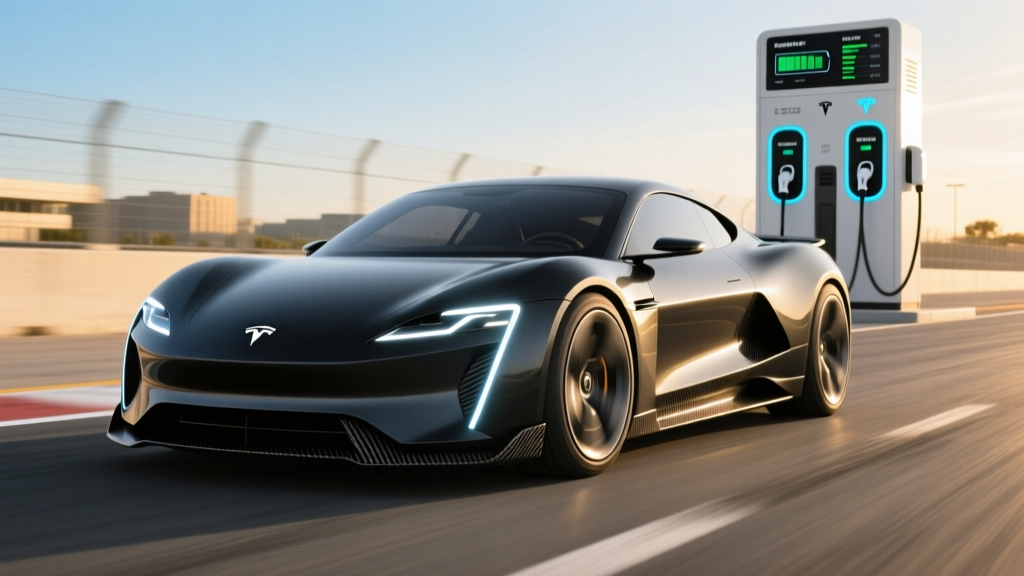
After years of delays, shifting timelines, and Elon Musk's repeated promises that production is "next year," the Tesla Roadster has finally begun limited demonstration runs. The 2026 Tesla Roadster demo events — held at select Tesla facilities and private track days — give us our clearest picture yet of what this halo sports car actually delivers. But with a base price pushing well past $200,000 and specs that read like science fiction, the real question isn't whether the Roadster is impressive. It's whether the production version will match the prototype, and whether anyone outside the collector market should care.
This review synthesizes everything we know from the Roadster demo events, Tesla's published preliminary specifications, and our own analysis of where real-world physics will likely diverge from marketing claims.
Tesla Roadster Demo: What We Actually Saw
The 2026 Tesla Roadster demo program is not a full production launch. Tesla has been running controlled demonstration events with pre-production prototypes, allowing invited media, reservation holders, and select analysts to experience the vehicle in limited settings. What we observed confirms several headline claims while raising new questions about others.
The demo vehicles featured the dual-motor all-wheel-drive powertrain, the full glass roof, and the 2+2 seating configuration Tesla has shown since the 2017 unveiling. Acceleration runs at the demo events consistently achieved sub-2.0-second 0-60 mph times on prepared surfaces, validating Tesla's long-standing claim. However, sustained high-speed runs and real-world range loops were not part of the controlled demo — meaning independent verification of the 620-mile range claim remains outstanding.
| Specification | Value |
|---|---|
| EPA Range (Target/Estimated) | 620 miles |
| Battery Capacity | 200 kWh (usable est.) |
| Battery Chemistry | NMC (Nickel Manganese Cobalt) |
| Drivetrain | Tri-Motor AWD |
| Horsepower | ~1,000+ hp (est.) |
| 0-60 mph | 1.9 seconds (w/ SpaceX package) |
| Top Speed | 250+ mph |
| Max DC Fast Charge | 350 kW (preliminary) |
| 10-80% DC Charge Time | ~25-30 minutes (est.) |
| Level 2 Home Charging | 11.5 kW / ~34 mi/hr |
| Seating | 2+2 |
| Cargo (Frunk + Rear) | ~5 cu ft (est.) |
| Base MSRP | $200,000 (est.) |
| Founders Series MSRP | $250,000 |
| Battery Warranty | 8 yr / 150,000 mi (est.) |
Range Reality: 620 Miles on Paper, Less on the Road
EPA Target Range: 620 miles
Real-World Expectation: ~430-480 miles highway; ~350-400 miles in cold weather (below 32°F)
Tesla's 620-mile target would obliterate every production EV on the market — the longest-range EVs currently sold top out around 400-516 EPA miles. The math behind 620 miles is plausible with a 200 kWh battery pack, but it requires extraordinary efficiency: roughly 3.2 miles per kWh, or about 31 kWh/100mi.
For context, the Tesla Model S Long Range achieves roughly 3.5-3.8 miles/kWh in mixed driving. The Roadster's lower, more aerodynamic profile should help, but the tri-motor AWD system adds weight and drivetrain losses. In real-world highway driving at 75-80 mph, aerodynamic drag increases with the square of velocity — meaning efficiency drops sharply above 65 mph.
Cold weather compounds the problem. NMC chemistry loses roughly 20-30% of effective range in sub-freezing temperatures due to increased internal resistance and cabin heating demands. Tesla's heat pump system mitigates this somewhat, but physics is physics. Expect 350-400 real-world miles on a cold winter highway run — still exceptional, but a far cry from 620.
Charging Speed: 350 kW Peak, but Watch the Curve
The Roadster demo materials reference a peak DC fast-charge rate of 350 kW — likely leveraging Tesla's V4 Supercharger architecture. At that peak rate, you'd add roughly 200+ miles of range in 10 minutes under ideal conditions.
| Charging Method | Power | Rate / Time |
|---|---|---|
| Level 1 (120V) | 1.4 kW | ~4 mi/hr |
| Level 2 (240V, 48A) | 11.5 kW | ~34 mi/hr |
| DC Fast Charge (Peak) | 350 kW | ~200+ mi in 10 min |
| DC 10-80% (Est.) | — | ~25-30 minutes |
Here's where the 200 kWh battery becomes a double-edged sword. Charging a pack this large from 10-80% means moving roughly 140 kWh of energy. Even at a sustained 280 kW average (optimistic given charge-curve taper above 50% SoC), that's 30 minutes minimum. Peak charge rate is never sustained across the full curve — expect tapering to begin around 40-50% SoC, dropping to ~150 kW by 70% and ~80 kW by 85%.
Home Level 2 charging at 11.5 kW will take roughly 17-18 hours for a full 0-100% charge. Most owners will charge overnight and rarely need a full cycle, but this is a vehicle that demands a robust home charging setup — ideally a Tesla Wall Connector on a 60A circuit.
Performance: The 1.9-Second Question
The Tesla Roadster demo confirmed sub-2.0-second 0-60 mph runs, but with a critical caveat: this time applies to the optional SpaceX cold-gas thruster package, which uses compressed air tanks mounted behind the rear seats to supplement traction and acceleration. Without this package (which eliminates the already-tiny rear cargo area and adds significant cost), expect 0-60 times in the 2.5-3.0 second range — still supercar territory, but not record-breaking.
The tri-motor layout — one motor up front, two in the rear — enables torque vectoring and the kind of instant thrust only an electric drivetrain can deliver. Estimated output exceeds 1,000 horsepower across all three motors. Top speed is electronically limited to 250+ mph, making this one of the fastest production cars ever built, regardless of powertrain.
But here's what demo events don't fully reveal: sustained performance. Repeated hard launches generate enormous heat in the battery cells and motors. Tesla's active thermal management is among the best in the industry, but 200 kWh of NMC cells under repeated 1,000-hp discharge cycles will thermally throttle. Track-day endurance remains an open question until independent testing is possible.
Pricing, Tax Credits, and the $200,000 Reality
The Tesla Roadster has carried a $200,000 base price since its 2017 announcement, with a $250,000 Founders Series requiring full payment upfront. Tesla has not published final production pricing as of early 2026, and given inflation and supply-chain shifts, the base figure could climb higher.
| Item | Amount |
|---|---|
| Base MSRP (Est.) | $200,000 |
| Founders Series | $250,000 |
| SpaceX Thruster Package | TBD (est. $50,000+) |
| Federal §30D Tax Credit | $0 — Exceeds MSRP Cap |
| Estimated Out-of-Pocket | $200,000+ |
Let's address the federal EV tax credit directly: the Roadster does not qualify. Under current IRS §30D rules, the credit is capped at vehicles with an MSRP of $55,000 for sedans/sports cars. At $200,000+, the Roadster is ineligible regardless of battery sourcing, buyer income, or any other factor. There is no state-level workaround that meaningfully offsets a $200K purchase — this is a vehicle bought with after-tax dollars.
Reservation holders originally placed a $50,000 deposit (increased from the initial $5,000). Tesla's reservation terms have historically allowed refunds, but buyers should confirm current terms directly with Tesla before committing additional funds to what remains a pre-production vehicle.
Interior, Tech, and Daily Livability
The Roadster demo showed a minimalist interior consistent with Tesla's design language: a large central touchscreen (likely 17-19 inches), a yoke-style steering wheel, and minimal physical controls. The 2+2 seating means two small rear seats — suitable for children or cargo overflow, not adults on any trip longer than a grocery run.
Cargo space is the Roadster's biggest practical compromise. With the battery pack consuming the floor and the tri-motor layout eating rear space, expect roughly 5 cubic feet total between the frunk and any rear storage area. If you opt for the SpaceX thruster package, the rear storage area is eliminated entirely.
On the tech side, expect the full Tesla suite:
- Autopilot (standard) with adaptive cruise and lane-keeping — SAE Level 2, requiring full driver attention
- Full Self-Driving (Supervised) capability as a paid option — still Level 2, not autonomous
- Over-the-air updates for performance, range optimization, and feature additions
- Advanced thermal preconditioning for optimized Supercharger arrival
Pros
- Sub-2.0s 0-60 with SpaceX package — fastest production car ever
- 620-mile target range dwarfs all competitors
- Access to Tesla Supercharger network (17,000+ stalls)
- Tri-motor torque vectoring and AWD grip
- Halo-car status with potential collector value
Cons
- $200,000+ price with zero federal tax credit eligibility
- Production timeline uncertain — still not generally available
- 2+2 seating and ~5 cu ft cargo make it impractical as a daily driver
- 200 kWh battery means long charge times even at 350 kW
- No independent EPA or crash-test verification yet
Who Should Buy the Tesla Roadster?
Reserve the Roadster if:
- You collect hypercars and want an electric halo vehicle with potential historical significance
- You have access to home Level 2 charging and rarely need practical cargo/passenger space
- You value acceleration records and technology demonstrations over daily usability
- $200,000+ is within your discretionary vehicle budget without financing
Look elsewhere if:
- You need a daily driver with real cargo space, family seating, or road-trip practicality
- You want verified EPA range and crash-test ratings before purchase
- You were counting on the federal EV tax credit to offset cost
- You need guaranteed delivery within a specific timeframe
Competitors: Rimac Nevera, Lotus Evija, and the Lucid Air Sapphire
The Roadster doesn't exist in a vacuum. At this price point, it competes with:
- Rimac Nevera — $2.2M, 1,914 hp, 1.85s 0-60, 550 km WLTP range (~340 mi EPA est.). Far more expensive, but actually in production and delivered.
- Lotus Evija — $2.3M, 1,972 hp, sub-3.0s 0-60, ~215 mi range. Track-focused hypercar, limited to 130 units.
- Lucid Air Sapphire — $249,000, 1,234 hp, 1.89s 0-60, 427 mi EPA range. A four-door sedan, but delivers comparable performance with genuine daily usability.
The Lucid Air Sapphire is the most direct practical threat: similar price, similar acceleration, verified EPA range, four doors, and a real trunk. The Rimac and Lotus occupy a different hypercar tier. The Roadster's advantage, if delivered as promised, is range — 620 miles would be in a class of its own. But "if delivered as promised" is doing enormous work in that sentence.
Tesla Roadster Demo: Frequently Asked Questions
What is the real-world range of the Tesla Roadster?
Tesla targets 620 EPA miles, but real-world highway driving at 75+ mph should yield approximately 430-480 miles. In cold weather (below freezing), expect 350-400 miles. Independent EPA testing has not yet been published for a production-spec vehicle.
How fast does the Tesla Roadster charge?
Peak DC fast charging is estimated at 350 kW via Tesla V4 Superchargers, with a 10-80% session taking roughly 25-30 minutes. Home Level 2 charging at 11.5 kW adds about 34 miles per hour, requiring 17-18 hours for a full charge.
Does the Tesla Roadster qualify for the federal EV tax credit?
No. Under IRS §30D rules, the $7,500 federal credit is limited to vehicles with an MSRP of $55,000 or less (for sedans and sports cars). The Roadster's $200,000+ price disqualifies it entirely, regardless of battery sourcing or buyer income.
Can I buy the Tesla Roadster right now?
Not yet. As of early 2026, Tesla is running demo events with pre-production prototypes. Full production has not begun, and Tesla has not confirmed a firm delivery timeline. Reservations are available with a deposit, but delivery dates remain estimates.
Is the Tesla Roadster self-driving?
No. The Roadster comes with Tesla Autopilot and optional Full Self-Driving (Supervised), both of which are SAE Level 2 driver-assistance systems. The driver must remain fully attentive with hands on the wheel at all times. No Tesla vehicle is autonomous.
How does the Roadster compare to the Lucid Air Sapphire?
The Lucid Air Sapphire matches the Roadster's acceleration (1.89s 0-60) at a similar price (~$249K), but offers four doors, a real trunk, verified 427-mile EPA range, and is currently in production and deliverable. The Roadster's claimed 620-mile range and SpaceX thruster package differentiate it, but remain unverified in production form.
What is the battery warranty on the Tesla Roadster?
Tesla has not published final warranty terms for the Roadster. Based on the Model S/X precedent, expect 8 years or 150,000 miles with a minimum 70% capacity retention threshold. Given the 200 kWh pack, even a 30% degradation would leave ~430 miles of original range — an unusual silver lining of an oversized battery.
The Bottom Line on the Roadster Demo
The 2026 Tesla Roadster demo confirms that the engineering ambition is real: sub-2.0-second acceleration, a 200 kWh NMC pack, and tri-motor AWD are physically present in running prototypes. But the gap between demo and delivery has defined this vehicle's entire history. Until production units reach customers, undergo independent EPA testing, and prove sustained thermal performance, the Roadster remains the most impressive EV that you cannot actually buy.
For collectors and Tesla loyalists with $200,000+ in discretionary funds, the reservation is a bet on Tesla's ability to finally ship. For everyone else, the Lucid Air Sapphire delivers comparable thrills today, with real-world usability and verified specs — no waiting required.