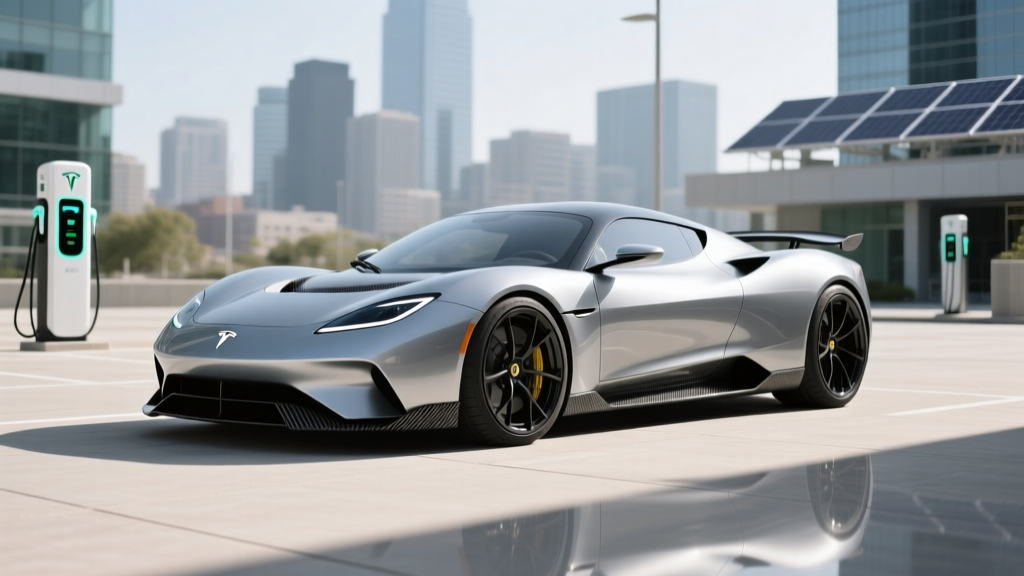
The original Tesla Roadster (2008–2012) holds a singular place in automotive history. It was the first highway-legal, all-electric production car to use lithium-ion battery cells, and the vehicle that proved EVs could be desirable, fast, and capable of real-world range. Now, more than a decade after the last example rolled off the line, enthusiasts and collectors are asking: does the Tesla Roadster have classic car status? And what does owning one actually look like in 2026?
This isn't a review of a new vehicle you can order today. The original Roadster is long out of production, and the next-generation Roadster remains unreleased. Instead, this profile treats the 2008–2012 Tesla Roadster as a collectible EV — examining its original specifications, real-world ownership considerations, battery and charging realities, and its trajectory in the collector-car market.
Original Tesla Roadster (2008–2012) Specifications
| Spec | Value |
|---|---|
| EPA Range (original) | 244 miles (later software updates adjusted this figure) |
| Battery Capacity | 53 kWh usable (lithium-ion, NMC chemistry) |
| Motor | Single rear-mounted AC induction motor, RWD |
| Horsepower | 288 hp (Sport model) |
| 0–60 mph | 3.7 seconds (Sport) / 3.9 seconds (base) |
| Top Speed | 125 mph (electronically limited) |
| Efficiency | ~280 Wh/mi (combined) |
| DC Fast Charging | None (CHAdeMO adapter was a rare aftermarket option) |
| Level 2 Charging | Up to 70 A / 16.8 kW via High Power Connector (HPC); standard J1772 adapter at ~3.3 kW |
| 10–80% Charge Time (L2 HPC) | ~3.5 hours |
| Weight | 2,690 lbs (base) |
| Cargo Space | ~3.5 cu ft (rear trunk, minimal) |
| Original MSRP | $109,000 (base, 2008) / $128,500 (Sport, 2010+) |
| Units Produced | ~2,450 globally |
| Warranty (original) | 3 yr / 36,000 mi bumper-to-bumper; 5 yr / 100,000 mi battery (expired) |
The Roadster That Started It All: Why It Matters
Before the Model S made Tesla a household name, the Roadster was the company's proof of concept. Built on a modified Lotus Elise chassis, the Roadster packed a 53 kWh lithium-ion battery pack — revolutionary for 2008 — into a lightweight, two-seat roadster body. It was the first production EV to crack 200 miles of range, silencing critics who claimed battery-electric cars were limited to golf carts and neighborhood runabouts.
Only about 2,450 units were built between 2008 and 2012, with the majority sold in the United States. That low production volume, combined with the car's historical significance, is the foundation of its emerging classic car status. For context, Ferrari produced roughly 7,500 examples of the F430 during a similar timeframe, and that model is firmly established in the collector market.
Real-World Range and Battery Health in 2026
The original 244-mile EPA estimate assumed a brand-new battery pack in ideal conditions. In 2026, most surviving Roadsters have experienced some degree of battery degradation. Expect 180–220 miles of real-world range from a Roadster with a healthy original pack, depending on driving style and ambient temperature.
Highway driving at 75+ mph reduces range by roughly 10–15% due to the car's lack of active aero optimization and older thermal management. Cold weather (below 40°F) can cut range by 20–30%, as the Roadster's battery heating system draws significant energy and the NMC cells lose efficiency in low temperatures.
The Roadster's battery pack uses NMC (nickel-manganese-cobalt) chemistry, which offered excellent energy density for its era but is more susceptible to calendar degradation than modern LFP cells. Tesla's original battery management system was sophisticated for the time, but 14–18 years of age means most packs have lost 10–25% of their original capacity.
Tesla offered a battery replacement program for the Roadster, but that program ended years ago. Today, owners rely on specialized independent EV shops for pack diagnostics and cell-level repairs. A full battery replacement, if available through third-party services, can cost $30,000–$45,000 — a critical factor in any purchase decision. Some owners have reported successful cell-level refurbishment for $15,000–$25,000 through niche providers.
Charging: The Roadster's Biggest Modern Limitation
If there's one area where the original Roadster shows its age most clearly, it's charging. The car predates modern DC fast-charging standards entirely.
| Charging Level | Connector | Max Power (kW) | Miles per Hour of Charge | Notes |
|---|---|---|---|---|
| Level 1 (120V) | Proprietary mobile connector | ~1.4 kW | ~5 mi/hr | Emergency/trickle only; full charge in ~36 hours |
| Level 2 (J1772 adapter) | J1772 → Roadster proprietary | 3.3 kW | ~11 mi/hr | Standard public L2 stations; full charge ~16 hours |
| Level 2 (HPC) | Tesla High Power Connector (proprietary) | 16.8 kW (70A) | ~56 mi/hr | Rare; requires original HPC wall unit, mostly in private homes |
| DC Fast Charge | None native | N/A | N/A | No CCS, CHAdeMO, or NACS support; extremely rare aftermarket CHAdeMO adapters exist |
The practical implication is significant: the Roadster is essentially a home-charging-only vehicle for most owners. Public charging infrastructure has moved almost entirely to CCS1 and NACS connectors, neither of which is compatible without complex and unreliable adapters. The original HPC (High Power Connector) units, which enabled the fastest Level 2 charging at 16.8 kW, are aging and increasingly difficult to service.
For a collector car that lives in a garage and is driven on weekends, this limitation is manageable. For anyone considering the Roadster as a regular-use vehicle, the lack of fast charging is a serious constraint that limits it to local driving within home-charging range.
Performance: Still Thrilling by Any Measure
The Roadster's driving experience remains compelling even by 2026 standards. The single rear-mounted AC induction motor delivers instant torque with zero gear shifts (the production cars used a single-speed gearbox after Tesla abandoned the original two-speed transmission design). The 3.7-second 0–60 mph time in the Sport model still puts it in serious sports car territory.
What makes the Roadster special compared to modern EVs is its weight. At 2,690 pounds, it's nearly 1,500 lbs lighter than a 2026 Tesla Model 3 Performance and roughly 2,000 lbs lighter than a Model S Plaid. That low mass, combined with the Lotus-derived suspension geometry, gives the Roadster a nimble, analog feel that no current production EV replicates. The steering is unassisted and communicative — a rarity even among modern sports cars.
The trade-off: the cabin is tight, noisy, and spartan by modern standards. There's no large touchscreen, no Autopilot or FSD driver-assistance (this is a pre-ADAS era vehicle), and the infotainment system is essentially a basic radio with a small display. The convertible top is manually operated. This is a driver's car, not a technology showcase in the way later Teslas became.
Collector Market Values and Classic Car Trajectory
The Tesla Roadster's collector values have been on an upward trajectory, though with the volatility typical of emerging classics. As of early 2026, market observations from auction results and private sales show:
- Driver-quality examples (higher mileage, original battery with degradation, cosmetic wear): $80,000–$110,000
- Well-maintained examples (under 40,000 miles, documented service, healthy battery): $120,000–$160,000
- Low-mileage/collector-grade examples (under 15,000 miles, exceptional condition, rare colors): $170,000–$250,000+
- Signature Series / celebrity-owned examples: can exceed $300,000 at auction
For comparison, the Roadster's original MSRP was $109,000–$128,500. Well-preserved examples have appreciated above their original sticker price, which is notable for a vehicle from a brand that was once considered a risky startup.
Several factors support the Roadster's classic car case:
- Historical significance: First production lithium-ion EV, first Tesla vehicle, the car that launched the modern EV movement.
- Limited production: ~2,450 units globally — far fewer than comparable collectible sports cars.
- Lotus Elise connection: The chassis pedigree adds credibility among traditional car collectors.
- Diminishing supply: Battery failures, accidents, and attrition are gradually reducing the number of roadworthy examples.
However, the Roadster faces challenges that traditional classics do not. Battery degradation is an existential concern — a Roadster with a failed or heavily degraded pack is essentially a non-driving shell, and replacement options are limited and expensive. Parts availability is also tightening; Tesla no longer manufactures Roadster-specific components, and the aftermarket ecosystem is small.
Ownership Costs: What to Budget in 2026
Buying a collector-grade Tesla Roadster is only the beginning. Here's a realistic look at annual ownership costs:
| Category | Estimated Cost |
|---|---|
| Insurance (collector/agreed-value policy) | $2,500–$5,000/yr |
| Electricity (3,000 miles/year at $0.16/kWh) | ~$135/yr |
| Specialist maintenance (cooling system, brakes, suspension) | $1,500–$3,500/yr |
| Battery health monitoring / cell balancing service | $500–$1,500/yr |
| Tire replacement (specialty sizes, low production) | $800–$1,200 every 3–4 years |
| Storage (climate-controlled recommended) | $1,200–$3,600/yr |
| Total estimated annual cost | $6,635–$15,935 |
The battery is the single largest financial risk. Setting aside a reserve fund of $20,000–$40,000 for a potential pack replacement or refurbishment is prudent for any buyer who intends to drive the car regularly.
Federal Tax Credit and Registration Considerations
The original Tesla Roadster does not qualify for the federal §30D new EV tax credit, as it is no longer in production. Purchasers of used Roadsters may wonder about the used clean vehicle credit (up to $4,000 or 30% of sale price, whichever is less, under IRS §25E). However, this credit has strict requirements:
- The sale price must be $25,000 or less — effectively disqualifying any Roadster on the current market.
- The buyer must meet income caps ($75,000 single / $150,000 married filing jointly).
- The vehicle must be purchased from a licensed dealer.
- The vehicle must be at least two model years old (the Roadster qualifies on this point).
In practice, no Tesla Roadster sale in 2026 will trigger any federal EV tax credit. Buyers should consult a tax professional regarding any potential state or local collector-vehicle incentives, which vary by jurisdiction. Some states offer reduced registration fees for historic or collector vehicles, which can provide modest savings on annual costs.
For authoritative guidance on current EV tax credit rules, refer to the IRS clean vehicle credits page.
Pros
- Historically significant — the car that launched the EV revolution
- Extremely low production volume (~2,450 units) supports collector scarcity
- Lightweight, analog driving feel unmatched by any modern EV
- Strong appreciation trajectory for well-preserved examples
- Lotus Elise chassis pedigree appeals to traditional sports car collectors
- Near-zero running costs for electricity (~$0.045/mile)
Cons
- No DC fast charging — impractical for road trips or public charging
- Battery degradation is a serious and expensive risk ($30K–$45K replacement)
- Parts availability is shrinking; no new OEM components being produced
- Cramped cabin, no modern driver assists, minimal infotainment
- Specialist service required — limited shop network nationwide
- No federal tax credit eligibility at current market prices
Who Should Consider the Roadster as a Collector Car?
Choose the Tesla Roadster if:
- You want a historically significant EV with strong collector-appreciation potential
- You have access to home Level 2 charging and plan to drive locally (under 150 miles per outing)
- You value lightweight, analog sports car dynamics over technology features
- You can budget $10,000+ annually for maintenance, insurance, and a battery reserve fund
- You're an EV enthusiast who wants the origin story in your garage
Look elsewhere if:
- You need a daily driver with modern convenience, range, and fast-charging capability
- You're uncomfortable with the risk of a $30,000+ battery replacement
- You want modern driver-assistance features (ADAS) or infotainment
- You need cargo space, passenger room, or practicality of any kind
- You're looking for a reliable, low-maintenance collector car — the Roadster requires specialist attention
Frequently Asked Questions
What is the real-world range of the original Tesla Roadster in 2026?
Most surviving Roadsters deliver 180–220 miles of real-world range depending on battery health, driving style, and temperature. The original EPA estimate of 244 miles assumed a new battery; expect 10–25% degradation on a 14–18-year-old NMC pack. Cold weather (below 40°F) can reduce range by an additional 20–30%.
How fast does the Roadster charge at home and on public chargers?
With the original High Power Connector (HPC), the Roadster charges at up to 16.8 kW, adding roughly 56 miles per hour — a full charge takes about 3.5 hours. Using a standard J1772 adapter on public Level 2 stations, charging drops to 3.3 kW (~11 miles/hour). There is no DC fast-charging capability. The Roadster is essentially a home-charging-only vehicle in 2026.
Does the Tesla Roadster qualify for any federal EV tax credit?
No. The Roadster is out of production, so it cannot qualify for the §30D new vehicle credit. The used clean vehicle credit (§25E) requires a sale price of $25,000 or less, which no Roadster meets at current market values. Consult a tax professional for any state-level collector-vehicle incentives.
Is the Tesla Roadster a good investment as a collector car?
The Roadster has shown steady appreciation, with well-preserved examples selling above their original MSRP. Its historical significance, low production volume, and Lotus pedigree support long-term collector value. However, battery replacement risk ($30K–$45K) and shrinking parts availability introduce financial uncertainty that traditional collector cars don't face. It's a speculative but defensible collector play for knowledgeable buyers.
What are the biggest risks of owning a 2008–2012 Tesla Roadster?
The three primary risks are: (1) battery pack failure or severe degradation, with replacement costs of $30,000–$45,000 and limited service options; (2) parts scarcity, as Tesla no longer produces Roadster-specific components; and (3) the inability to use modern public charging infrastructure, limiting the car to home-charging range.
How does the Roadster compare to the upcoming next-generation Tesla Roadster?
The next-generation Roadster (announced in 2017, still unreleased as of 2026) is a completely different vehicle — a four-seat, all-wheel-drive performance car with claimed 620+ mile range and sub-2-second 0–60 times. It shares only the name with the original. The two vehicles occupy entirely different market segments: the original is a collectible lightweight roadster; the next-gen (when and if it arrives) will be a modern hypercar-EV.
The Tesla Roadster's classic car status in 2026 is real but still maturing. It has the rarity, the historical significance, and the growing appreciation to support a collector-car thesis. But unlike a vintage Porsche 911 or Ferrari, the Roadster carries unique EV-specific risks — primarily battery health and charging obsolescence — that demand careful evaluation. For the right buyer, one who understands these trade-offs and has the infrastructure and budget to support them, the Roadster is more than a car. It's a piece of automotive history that changed the industry.
Sources: fueleconomy.gov — 2011 Tesla Roadster; IRS — Clean Vehicle Credits.