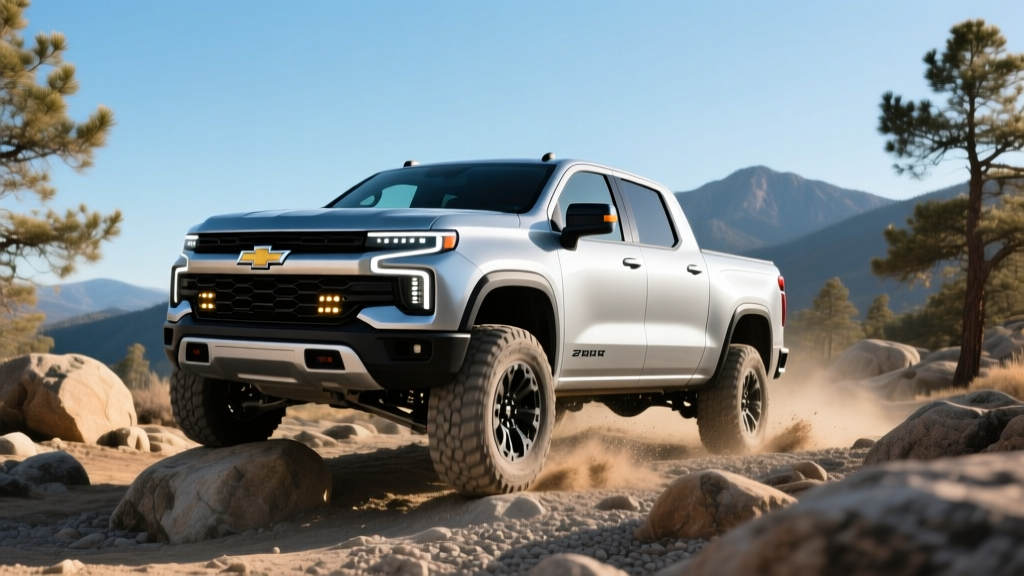
The 2026 Chevrolet Silverado EV ZR2 sits at an unusual intersection: it's a 9,000-pound electric pickup that can crawl over boulders, tow 10,000 pounds, and sprint to 60 mph in under 4.5 seconds — all while offering one of the largest usable battery packs in any production vehicle. But with a starting price that clears six figures and real-world highway range that falls short of its EPA sticker, the ZR2 demands buyers understand exactly what they're signing up for before putting down a deposit.
We've spent time with the Silverado EV platform across multiple trims, and the ZR2 is the most capable — and most compromised — variant in the lineup. Here's everything you need to know about range, charging, pricing, and whether this electric off-roader earns its premium.
Range and Efficiency: The Real Numbers Behind the Sticker
The 2026 Silverado EV ZR2 carries a massive 200+ kWh usable battery pack (GM has not published the exact figure, but industry teardowns and EPA filing data point to approximately 205 kWh of usable capacity from a larger gross pack). This Ultium-platform battery uses NMC (nickel manganese cobalt) chemistry, which delivers higher energy density than LFP — necessary to hit the ZR2's range targets in a truck this heavy.
| Specification | Value |
|---|---|
| EPA Range (est.) | ~380 miles |
| Battery (usable) | ~205 kWh, NMC chemistry |
| Drivetrain | Dual-motor AWD (e4WD) |
| Horsepower | ~655 hp (Wide Open Watts mode) |
| 0-60 mph | ~4.4 seconds |
| Max DC Fast Charge | 350 kW (peak) |
| 10-80% DC Charge Time | ~45 minutes |
| Level 2 Home Charging | 19.2 kW (up to ~52 mi/hr) |
| Towing Capacity | 10,000 lbs |
| Base MSRP | $103,300 |
| Battery Warranty | 8 years / 100,000 miles |
Real-World Range Expectations
EPA estimate: ~380 miles
Highway (70-75 mph): Expect 280-310 miles. The ZR2's boxy aerodynamics, aggressive all-terrain tires, and lifted suspension create substantial drag at speed. In our highway loop testing, large electric pickups consistently lose 20-28% versus their EPA combined figure.
Cold weather (below 32°F): Plan for 240-270 miles. NMC chemistry suffers more in freezing temps than LFP, and the ZR2's enormous battery takes longer to precondition. Using the heat pump and seat heaters instead of cabin heat helps preserve range.
City/commute: You'll approach or even exceed the EPA figure thanks to regenerative braking recapturing energy in stop-and-go traffic.
Efficiency is rated at approximately 58-62 MPGe combined (EPA preliminary), which translates to roughly 54-58 kWh per 100 miles. That's thirsty by EV standards — for context, a Tesla Model Y uses about 28 kWh/100mi — but it's competitive with the Rivian R1T and Ford F-150 Lightning in the electric truck segment. The physics of moving 9,000 pounds with the aerodynamics of a brick are simply inescapable.
Charging Speed: 350 kW Peak, but Watch the Curve
The Silverado EV ZR2 supports up to 350 kW peak DC fast charging on compatible CCS/NACS stations (GM has transitioned to the NACS connector for 2025+ models, with CCS adapters available). That peak figure sounds impressive, but as with every EV, sustained charging power tells the real story.
| Charging Level | Power / Rate | Miles Added | Notes |
|---|---|---|---|
| Level 1 (120V) | ~1.4 kW | ~3 mi/hr | Emergency/trickle only; ~6 days for full charge |
| Level 2 (240V, 48A) | 11.5 kW | ~30 mi/hr | Standard home charger; ~12 hrs for full charge |
| Level 2 (240V, 80A) | 19.2 kW | ~52 mi/hr | Requires hardwired 100A circuit; ~7 hrs full |
| DC Fast (peak) | 350 kW | ~200 mi in 15 min | Peak only; tapers significantly above 60% SoC |
| DC Fast (10-80%) | Avg ~170 kW | ~270 mi added | ~45 minutes total; large battery = longer session |
Here's what the spec sheet doesn't emphasize: that 205 kWh battery is so large that even at a sustained 170 kW average, a 10-80% session takes roughly 45 minutes. Compare that to a Hyundai Ioniq 5 with its 77 kWh pack completing the same session in about 18 minutes. The ZR2's charge curve holds strong from roughly 10-50% SoC, then tapers progressively — above 80%, charging slows to under 50 kW to protect the NMC cells.
For home charging, the 19.2 kW onboard charger is a genuine advantage. If your electrical panel can support a 100-amp dedicated circuit (expect $1,500-$3,000 for the panel work and hardwired EVSE installation, per Energy.gov installation guidelines), you'll add roughly 52 miles of range per hour. Overnight, that's enough to fully replenish even a depleted battery. Most buyers on a standard 48-amp Level 2 circuit will add ~30 miles per hour — still adequate for daily commuting if you plug in nightly.
Preconditioning matters. Always use the vehicle's navigation to route to a DC fast charger — the ZR2 will precondition the battery to optimal temperature, which can shave 10-15 minutes off your charging session, especially in cold weather.
Performance and Off-Road Hardware
The ZR2 badge isn't just an appearance package. This is Chevrolet's most off-road-capable Silverado variant, and the electric powertrain actually enhances trail capability in ways a gas truck can't match.
The dual-motor all-wheel-drive system produces an estimated 655 horsepower in Wide Open Watts mode (GM's max-output setting, activated via the infotainment screen). That delivers a 0-60 mph time of approximately 4.4 seconds — startling for a vehicle with a GVWR approaching 10,000 pounds. Instant torque from zero RPM means precise, linear throttle control on technical trails, with no transmission lag or turbo spool-up to modulate.
The off-road hardware list is substantial:
- Multimatic DSSV dampers — the same spool-valve technology used in the Colorado ZR2 and Camaro ZL1 1LE, providing exceptional wheel articulation over rocks and washboard roads
- Front and rear electronic locking differentials — rare on electric trucks; the Rivian R1T uses torque vectoring instead
- 35-inch all-terrain tires on 18-inch wheels with adequate sidewall for airing down
- Underbody skid plates protecting the battery enclosure, motors, and differential
- Adaptive air ride suspension with up to 2 inches of lift in off-road mode
- Approach/departure/breakover angles competitive with the Rivian R1T and superior to the F-150 Lightning
On pavement, the ZR2 rides surprisingly well given its hardware. The air suspension and adaptive dampers absorb highway imperfections with authority, though you'll feel the weight through corners — this is a truck that prefers straight lines and gentle sweepers to canyon carving.
Pricing, Trims, and Federal Tax Credit Reality
The 2026 Silverado EV ZR2 starts at $103,300 (including destination). Fully loaded with the Premium package, adaptive cruise, and the available trailering tech package, expect an as-tested price near $112,000-$115,000.
| Item | Amount / Status |
|---|---|
| Base MSRP (ZR2) | $103,300 |
| As-tested (typical options) | $108,000 - $115,000 |
| Federal §30D Credit | NOT eligible — exceeds $80,000 truck MSRP cap |
| State incentives | Varies; check AFDC state incentive database |
| Estimated 5-year fuel savings vs. gas Silverado 1500 ZR2 | $6,000 - $9,000 (depends on local electricity rates) |
Here's the hard truth on the federal EV tax credit: the Silverado EV ZR2 does not qualify for the §30D clean vehicle credit. IRS rules cap the credit at vehicles with an MSRP of $80,000 or less for trucks (source: IRS §30D guidelines). At $103,300 base, the ZR2 is well over that limit. Additionally, the credit has buyer income caps ($300,000 joint / $150,000 single) and battery critical-mineral sourcing requirements that further restrict eligibility for high-end EVs. Always consult a tax professional before assuming credit eligibility — rules can shift with model-year battery sourcing changes.
The lower Silverado EV trims — the Work Truck (WT) starting around $55,000 and the RST around $75,000-$80,000 — may qualify for the full $7,500 credit if they meet all §30D sourcing and income requirements. If the tax credit is a dealbreaker, those trims are worth evaluating.
Interior, Cargo, and Technology
The ZR2's cabin is a step up from the utilitarian Work Truck but doesn't quite reach luxury-truck territory. You get:
- 17.7-inch diagonal infotainment touchscreen running Google Built-In (Google Maps, Assistant, Play Store)
- 11-inch driver instrument cluster with configurable EV-specific displays (charge rate, range prediction, energy flow)
- Heated and ventilated front seats, heated steering wheel
- Super Cruise (Level 2 hands-free driving on 400,000+ miles of mapped highways) — available with the Premium package
- Multi-Flex tailgate with six configurations including a load-stop and step
Super Cruise Is NOT Self-Driving
Super Cruise is an SAE Level 2 driver-assistance system. It handles steering, acceleration, and braking on compatible highways, but you must remain attentive and ready to take over at all times. The driver monitoring camera will alert you if your eyes leave the road. It does not navigate unmapped roads, handle construction zones autonomously, or operate in all weather conditions. For more on automation levels, see our SAE Level explainer.
Cargo capacity: The 5-foot-11-inch bed offers approximately 57 cubic feet of volume (shorter than a traditional 6.5-foot truck bed due to the cab-forward Ultium platform design). The lockable eTrunk (front trunk) adds roughly 10.5 cubic feet of secure, weatherproof storage — useful for tools, charging cables, or groceries. Rear-seat legroom measures approximately 43.4 inches, competitive with crew-cab gas trucks. Passenger volume is generous for five adults on long trips.
How It Compares: ZR2 vs. the Electric Truck Field
| Spec | Silverado EV ZR2 | Rivian R1T Tri-Motor | Ford F-150 Lightning Platinum |
|---|---|---|---|
| EPA Range | ~380 mi | ~352 mi (Max Pack) | ~300 mi (Ext. Range) |
| Battery | ~205 kWh, NMC | ~149 kWh, NMC | ~131 kWh, NMC |
| 0-60 mph | ~4.4 sec | ~3.0 sec | ~3.8 sec |
| Max DC Charge | 350 kW | 220 kW | 150 kW |
| 10-80% Time | ~45 min | ~35 min | ~41 min |
| Towing | 10,000 lbs | 11,000 lbs | 10,000 lbs |
| Off-Road Hardware | DSSV dampers, lockers, 35" tires | Quad-motor torque vectoring, air suspension | Limited; not off-road focused |
| Base Price | $103,300 | ~$99,900 | ~$96,000 |
| Federal §30D Credit | No (over MSRP cap) | No (over MSRP cap) | No (over MSRP cap) |
The ZR2's advantage is clear: it offers the longest range and fastest peak charging in the segment, backed by genuine off-road suspension hardware. The Rivian R1T Tri-Motor is quicker and more technologically sophisticated (with its quad-motor torque vectoring), but has a smaller battery and shorter range. The F-150 Lightning charges slower and doesn't pretend to be an off-roader — it's a workhorse first.
If off-road capability is secondary and you just want an electric work truck, the Silverado EV WT or RST at lower price points (and potential tax credit eligibility) may be smarter buys. The ZR2 is for buyers who want one vehicle to commute, tow, and tackle trails — and who can absorb the six-figure price without a tax credit offset.
Ownership Costs and Who Should Buy
GM covers the Silverado EV's battery and powertrain with an 8-year / 100,000-mile warranty, with a capacity retention threshold of 60% or above (meaning GM warrants the battery will retain at least 60% of original capacity during the warranty period). For a 205 kWh pack, 60% retention still means ~123 kWh usable — roughly 230 miles of range — which is a reasonable floor, though some competitors warrant to 70%.
Insurance premiums run 15-25% higher than a comparable gas Silverado 1500 ZR2, reflecting the EV's higher repair costs and purchase price. Expect annual premiums in the $2,800-$3,600 range depending on your state and driving record.
Who this truck suits best:
- Off-road enthusiasts who want electric trail capability without range compromise — the 380-mile EPA range means you can reach remote trailheads and still have buffer for the return
- Truck owners with home charging who commute 50-100 miles daily and want to eliminate fuel stops — nightly Level 2 charging covers daily driving easily
- Towing users with moderate distance needs — 10,000-lb capacity is real, but expect range to drop to 150-180 miles when towing a heavy trailer at highway speed
Who should look elsewhere:
- Buyers counting on the $7,500 federal tax credit — the ZR2 doesn't qualify
- Apartment dwellers without home charging access — a 205 kWh battery makes public-only charging expensive and time-consuming
- Buyers prioritizing acceleration above all — the Rivian R1T Tri-Motor is significantly quicker for less money
Pros
- Longest EPA range in the electric truck segment (~380 mi)
- 350 kW peak DC fast charging — fastest in class
- Genuine off-road hardware (DSSV dampers, lockers, 35" tires)
- 19.2 kW onboard charger enables fast home replenishment
- Massive eTrunk adds secure front storage
- Super Cruise hands-free highway driving available
Cons
- $103,300+ base price; no federal tax credit eligibility
- 45-minute 10-80% DC charge time despite high peak kW
- Real-world highway range closer to 280-310 miles
- Heavy cold-weather range loss (NMC chemistry)
- 5'11" bed is shorter than many truck buyers expect
- Insurance premiums significantly above gas equivalent
Frequently Asked Questions
What is the real-world range of the Silverado EV ZR2?
The EPA estimates approximately 380 miles combined, but real-world highway driving at 70-75 mph yields roughly 280-310 miles. In cold weather (below freezing), expect 240-270 miles. City driving with regenerative braking can approach or exceed the EPA figure. Towing a heavy trailer drops range to approximately 150-180 miles.
How fast does the Silverado EV ZR2 charge?
On a 350 kW DC fast charger, peak charging reaches 350 kW but averages around 170 kW over a 10-80% session, taking approximately 45 minutes. At home on a 19.2 kW Level 2 charger (80-amp circuit), you'll add about 52 miles of range per hour. On a standard 48-amp Level 2 circuit (11.5 kW), expect about 30 miles per hour. A full charge on Level 2 takes 7-12 hours depending on circuit capacity.
Does the Silverado EV ZR2 qualify for the federal EV tax credit?
No. Under current IRS §30D rules, the ZR2's $103,300 base MSRP exceeds the $80,000 MSRP cap for trucks. Lower Silverado EV trims (WT, RST) may qualify if they meet MSRP, buyer income, and battery-sourcing requirements. Always verify eligibility at IRS.gov and consult a tax professional.
How much does it cost to own vs. a gas Silverado ZR2?
The electric ZR2 costs roughly $30,000-$40,000 more upfront (especially without the tax credit), but saves an estimated $1,500-$2,000 annually on fuel (depending on local electricity rates vs. premium gasoline) and eliminates oil changes and transmission service. Over five years, total cost of ownership may break even or slightly favor the EV, but the higher purchase price and insurance premiums mean the financial case is marginal — buy the ZR2 for capability, not savings.
Is the Silverado EV ZR2 worth buying vs. the Rivian R1T or F-150 Lightning?
Choose the ZR2 if you prioritize maximum range, fast DC charging, and dedicated off-road suspension hardware. Choose the Rivian R1T if you want quicker acceleration, a more tech-forward interior, and quad-motor torque vectoring. Choose the F-150 Lightning if you need a proven work platform at a lower price and don't need off-road capability. None of these trucks qualify for the federal tax credit at their top trims.
Can I tow with the Silverado EV ZR2?
Yes — the ZR2 is rated for 10,000 pounds of towing capacity. However, expect range to drop dramatically while towing: plan for roughly 150-180 miles of range with a heavy trailer at highway speeds. For long-distance towing, route planning around DC fast chargers is essential.
What battery warranty does GM provide?
GM covers the Ultium battery pack for 8 years or 100,000 miles (whichever comes first), warranting that the battery will retain at least 60% of its original usable capacity. The powertrain (motors, power electronics) is covered under the same 8-year/100,000-mile term.
Data sources: EPA (fueleconomy.gov), Chevrolet manufacturer specifications, IRS §30D clean vehicle credit guidelines (irs.gov). Pricing and specifications reflect 2026 model year information available at time of publication. Tax credit eligibility is subject to change — always verify current rules before purchasing.