Quick Verdict: The Halo Car That Keeps Moving
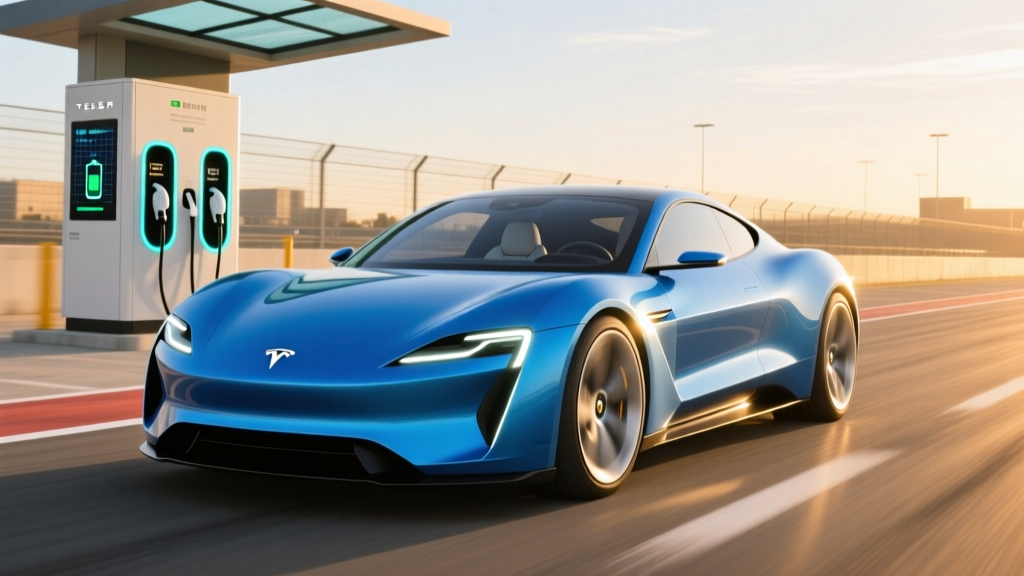
Originally unveiled in November 2017, the next-generation Tesla Roadster has been pushed back multiple times. As of early 2026, Tesla targets a 2027 model-year production start, with deliveries likely in late 2026 or early 2027. Elon Musk has called it Tesla's "halo car" — a low-volume, high-performance flagship designed to showcase the upper limits of battery-electric engineering. With a claimed 620-mile range, a 1.9-second 0-60 mph time, and a rumored 200 kWh battery pack, the Roadster 2027 would be the most extreme production EV ever sold. But announced specs are not delivered cars. This profile breaks down what Tesla has confirmed, what remains preliminary, and what buyers should realistically expect.
Tesla Roadster 2027 Specifications at a Glance
| Spec | Tesla Roadster 2027 (Announced/Preliminary) |
|---|---|
| EPA Range | ~620 miles (claimed, pre-EPA certification) |
| Battery Capacity | ~200 kWh usable (announced) |
| Battery Chemistry | Expected NMC (nickel manganese cobalt) — high energy density required for range target |
| Drivetrain | Tri-motor AWD (1 front, 2 rear) |
| Horsepower | ~1,000+ hp (wheel torque: 10,000 Nm claimed) |
| 0–60 mph | 1.9 seconds (claimed, with rollout subtracted) |
| Top Speed | 250+ mph (claimed) |
| Quarter Mile | 8.8 seconds (claimed) |
| Max DC Fast Charge | Expected ~350 kW (V4 Supercharger compatible) |
| 10–80% DC Charge | Estimated ~25–30 min (dependent on charge curve) |
| Level 2 Home Charge | ~11.5 kW / ~34 mi/hr (est.) |
| Base MSRP | ~$200,000 (announced base); $250,000 Founders Series |
| Federal Tax Credit (§30D) | Not eligible — MSRP exceeds $55,000 passenger car cap |
| Seating | 2+2 (tight rear seats; primarily a 2-seater) |
| Cargo Volume | ~5 cu ft (front trunk); minimal rear storage |
| Warranty | Expected 8 yr / 150,000 mi battery & drive unit (Tesla standard for high-performance models) |
Range and Efficiency: 620 Miles Claimed, But What's Real?
Tesla has stated a target range of 620 miles on a single charge. If certified by the EPA at or near that figure, the Roadster would hold the longest EPA range of any production vehicle ever sold. That number relies on the massive ~200 kWh battery pack — roughly double the capacity of a Model S Long Range.
EPA (claimed): ~620 miles
Real-world highway (70–80 mph): Expect ~450–520 miles. At sustained highway speeds, aerodynamic drag dominates, and a low-slung sports car with wide tires carries a significant drag penalty versus the test cycle.
Real-world mixed driving: ~500–560 miles
Cold weather (below 32°F): Expect a 20–30% reduction, yielding ~370–450 miles. The 200 kWh pack provides a large absolute buffer even with degradation.
Note: These are projections based on Tesla's claimed efficiency targets and physics-based modeling. No independent EPA testing has been completed.
Efficiency will likely land in the 130–150 MPGe range (approximately 22–26 kWh/100 mi). That sounds low for a Tesla, but moving a 4,400+ lb vehicle at sports-car speeds demands energy. The original 2017 Roadster concept targeted a 125 MPGe combined figure. For context, the current Model S Long Range achieves 120 MPGe combined with a 100 kWh pack — so Tesla's claimed Roadster efficiency is plausible given advances in motor and inverter design.
Charging Speed: Massive Battery, Manageable Charge Times
A 200 kWh battery creates a unique charging challenge. Even at high charge rates, filling a pack this large takes time. Tesla's V4 Supercharger cabinets support up to 350 kW for passenger vehicles, and the Roadster is expected to be compatible with the full V4 architecture.
| Charge Level | Power (kW) | Miles Added per Hour | Notes |
|---|---|---|---|
| Level 1 (120V / 12A) | ~1.4 kW | ~4 mi/hr | Emergency/trickle only; full charge in ~140+ hours |
| Level 2 (240V / 48A) | ~11.5 kW | ~34 mi/hr | Full charge in ~17–18 hours; overnight refill covers ~270 mi |
| Level 2 (240V / 80A, Wall Connector) | ~19.2 kW | ~57 mi/hr | Requires 100A circuit; full charge in ~10–11 hours |
| DC Fast Charge (V4 Supercharger) | Up to ~350 kW peak | ~900+ mi/hr (peak) | 10–80% in est. ~25–30 min; charge curve tapers significantly above 80% |
Charging-curve reality check: A 200 kWh pack can absorb enormous power in the low state-of-charge window (10–40%), potentially sustaining 300–350 kW. But as the pack fills past 60–70%, the battery management system will taper charge rate to protect cell health. Expect the final 70–80% segment to run at 100–150 kW. The 10–80% time of 25–30 minutes is an estimate; Tesla has not published an official charge curve.
For home charging, most Roadster owners will want a Tesla Wall Connector on a 60A or 100A circuit. An overnight session (8–10 hours at 11.5–19.2 kW) adds 270–570 miles — more than enough for daily use, and sufficient to fully replenish the pack over a weekend.
Performance: Sub-2-Second Acceleration and Tri-Motor AWD
The headline number is 1.9 seconds 0–60 mph, which Tesla claims includes a 1-foot rollout subtraction (standard in drag racing but inflates the figure versus a true standing-start measurement). Even accounting for that, independent testing of the Model S Plaid — which achieves a verified 1.99 seconds — demonstrates that Tesla's powertrain team can deliver on these claims.
The Roadster uses a tri-motor all-wheel-drive layout: one motor on the front axle and two on the rear. This enables torque vectoring across the rear axle, improving cornering traction and stability at the 250+ mph top speed Tesla has claimed. The 10,000 Nm of wheel torque (not motor torque — an important distinction) translates to roughly 7,400 lb-ft at the wheels, which is achievable through the gear reduction ratio.
Tesla has also teased an optional SpaceX package involving cold-gas thrusters mounted around the vehicle to improve braking, cornering, and acceleration. If this option materializes, it would be a first in production automotive history. However, regulatory approval for thruster-equipped road vehicles remains uncertain, and Tesla has provided no timeline or pricing for this package.
Pricing, Tax Credits, and the $200,000+ Reality
Tesla originally announced Roadster pricing in 2017:
- Base Roadster: $200,000 (with a $50,000 reservation deposit)
- Founders Series (first 1,000 units): $250,000 (full payment required at reservation)
Given inflation, supply-chain cost increases, and the addition of features not in the original 2017 spec, the final production price will likely exceed these figures. Industry analysts estimate a $220,000–$270,000 realistic range for the base model at launch, with the Founders Series potentially reaching $300,000.
| Cost Item | Amount |
|---|---|
| Estimated Base MSRP | $200,000–$220,000 |
| Founders Series MSRP | $250,000+ |
| Federal §30D Tax Credit | $0 — MSRP far exceeds the $55,000 passenger car cap |
| Destination Fee | ~$1,500–$2,500 (est.) |
| Estimated Out-the-Door | $202,000–$255,000+ |
Federal tax credit ineligibility: Under IRS §30D rules, the clean vehicle credit is capped at vehicles with an MSRP of $55,000 for sedans/sports cars (and $80,000 for SUVs/trucks/vans). The Roadster, as a sports car with an MSRP above $200,000, does not qualify. Buyer income caps ($150,000 single / $300,000 joint MAGI) and battery critical-mineral sourcing requirements are moot in this case, as the MSRP cap alone disqualifies the vehicle. Consult a tax professional for advice specific to your situation.
Interior, Tech, and Daily Usability
The Roadster is a 2+2, but the rear seats are best described as occasional-use. Expect rear legroom in the 22–26 inch range — suitable for small children or cargo overflow, not adults on any trip longer than a few miles. The front trunk (frunk) offers approximately 5 cubic feet of storage, enough for two carry-on bags or a set of track-day gear. There is no traditional rear trunk; the glass roof panel is removable and stores in the frunk (reducing available cargo space when stowed).
Tech features will build on Tesla's current software stack, likely including:
- 15–17" center touchscreen with Tesla's latest UI
- Ambient lighting and configurable drive modes (Track, Sport, Range)
- Over-the-air updates for performance tuning and feature additions
- Tesla's Premium Connectivity suite
- Advanced climate preconditioning for battery thermal management
Driver assistance: The Roadster will ship with Tesla Autopilot (SAE Level 2), including Traffic-Aware Cruise Control and Autosteer. Full Self-Driving (Supervised) capability will likely be available as a paid add-on. However, neither system is autonomous — the driver must remain fully engaged with hands on the wheel and eyes on the road at all times. This is a Level 2 driver-assistance system, not self-driving.
Pros, Cons, and Who Should Wait
✅ Pros
- Class-leading claimed range (620 mi) — no production EV comes close
- Sub-2-second 0–60 mph; genuine hypercar acceleration
- Access to Tesla's Supercharger network (17,000+ stalls in North America)
- Tri-motor AWD with torque vectoring for track capability
- OTA software updates and Tesla's proven powertrain reliability
- Removable glass roof for open-air driving
❌ Cons
- Not yet in production — delivery dates have slipped repeatedly since 2017
- $200,000+ price with no federal tax credit eligibility
- 2+2 seating is effectively a 2-seater for practical purposes
- Extremely limited cargo space (~5 cu ft frunk)
- 200 kWh pack means long home charge times (10–18 hours for full charge)
- Insurance costs will be substantial (estimated $5,000–$8,000+/year)
- SpaceX thruster package faces uncertain regulatory approval
Who the Tesla Roadster 2027 Suits Best
Choose the Roadster if: You want a collectible halo EV with unmatched acceleration and range claims, you have a $200K+ budget where tax credits are irrelevant, and you accept the risk of further production delays. This is a weekend/track car, not a daily driver.
Look elsewhere if: You need practical seating, cargo space, or daily usability. The Tesla Model S Plaid ($89,990) delivers 1,020 hp and a 1.99-second 0–60 in a full-size sedan with 30 cu ft of cargo space. The Rimac Nevera ($2.2M, 1,914 hp) is already in production for buyers who want a delivered hypercar today. The Porsche Taycan Turbo GT ($230,000) offers track-proven performance with established dealer support.
Battery Chemistry, Degradation, and Warranty
A 200 kWh pack almost certainly requires NMC (nickel manganese cobalt) chemistry. LFP (lithium iron phosphate) cells, while cheaper and longer-lasting, have lower energy density and would make the pack prohibitively heavy for a sports car application. Tesla's latest NMC cells (likely the 4680 form factor or an evolution thereof) offer energy densities around 260–300 Wh/kg at the cell level, making a ~200 kWh pack weigh roughly 650–770 kg (1,430–1,700 lbs).
Degradation projection: Tesla's NMC packs historically lose 5–10% capacity over the first 100,000 miles, then stabilize. With a 200 kWh pack, a 10% loss still leaves 180 kWh usable — more than most EVs start with. The battery warranty is expected to mirror Tesla's performance-model coverage: 8 years / 150,000 miles with a minimum 70% capacity retention threshold, per Tesla's warranty documentation.
Replacement cost is the elephant in the room. At current NMC cell pricing (~$120–$140/kWh at the pack level), a 200 kWh replacement could cost $25,000–$35,000 out of warranty. However, by 2035+ when most Roadsters might need replacement, cell costs are projected to decline significantly.
Is the Tesla Roadster 2027 Worth Buying vs. Competitors?
| Vehicle | Price | 0–60 mph | Range | Status |
|---|---|---|---|---|
| Tesla Roadster 2027 | ~$200,000+ | 1.9s (claimed) | 620 mi (claimed) | Announced |
| Tesla Model S Plaid | $89,990 | 1.99s | 396 mi (EPA) | In production |
| Rimac Nevera | $2,200,000 | 1.85s | 340 mi (WLTP) | In production (150 units) |
| Porsche Taycan Turbo GT | $230,000 | 2.1s | 269 mi (EPA) | In production |
| Lotus Evija | $2,300,000 | ~2.8s | 217 mi (WLTP) | Limited production |
The Roadster occupies a unique position: it undercuts every hypercar competitor on price while claiming superior range and matching or exceeding their acceleration. The risk is delivery. If Tesla ships on schedule with the announced specs, it will be the best value proposition in the electric hypercar segment by a wide margin. If delays continue, buyers may opt for the Model S Plaid (available now, nearly as fast) or wait for the next announcement cycle.
Frequently Asked Questions
What is the real-world range of the Tesla Roadster 2027?
Tesla claims 620 miles, but that figure has not been EPA-certified. Real-world highway driving at 70–80 mph should yield approximately 450–520 miles, with cold-weather driving potentially reducing range to 370–450 miles. The 200 kWh battery provides a large absolute buffer, so even with significant range loss, the Roadster should remain practical for long trips.
How fast does the Tesla Roadster charge?
On a V4 Supercharger, expect a peak rate of ~350 kW with a 10–80% charge in approximately 25–30 minutes. At home on a Level 2 Wall Connector (48A), the Roadster adds about 34 miles per hour, meaning a full 200 kWh charge takes 17–18 hours. An 80A circuit reduces that to about 10–11 hours.
How much does the Tesla Roadster cost after tax credits?
The Roadster does not qualify for the $7,500 federal EV tax credit under IRS §30D. The MSRP cap for passenger cars is $55,000, and the Roadster's $200,000+ price far exceeds that threshold. Expect to pay full MSRP plus destination fees and applicable state taxes. Some states may offer their own incentives — check your local DMV or energy office for details.
Does the Tesla Roadster qualify for the federal EV tax credit?
No. The IRS §30D clean vehicle credit has a strict MSRP cap of $55,000 for sedans, sports cars, and wagons. The Roadster's $200,000+ price makes it ineligible regardless of buyer income, battery sourcing, or any other factor.
Is the Tesla Roadster 2027 worth buying vs. the Model S Plaid?
If you want hypercar acceleration and bragging rights and can tolerate production uncertainty, the Roadster offers more range and exclusivity at a lower price than the Rimac Nevera. If you want a usable daily driver with nearly identical straight-line performance, the Model S Plaid at $89,990 is the rational choice — it's available now, seats five, and has 30 cu ft of cargo space.
When will the Tesla Roadster actually be available?
Tesla has targeted a 2027 production start, but the company has a history of missing announced timelines (the Roadster was originally due in 2020). Reservation holders should plan for potential further delays. Non-reservation-holders will likely face a wait until 2028 or later for general-availability units.
What are the biggest drawbacks of the Tesla Roadster?
The main drawbacks are the unconfirmed production timeline, the $200,000+ price with no tax credit, effectively 2-seat practicality, extremely long home charging times for the 200 kWh pack, and uncertain insurance costs. The SpaceX thruster package also faces regulatory hurdles that may prevent it from reaching production.
Sources: Tesla Roadster product page, IRS §30D Clean Vehicle Credit rules, EPA Fuel Economy (for comparison data). Specifications listed as "claimed" or "announced" are preliminary and subject to change upon EPA certification and production start.