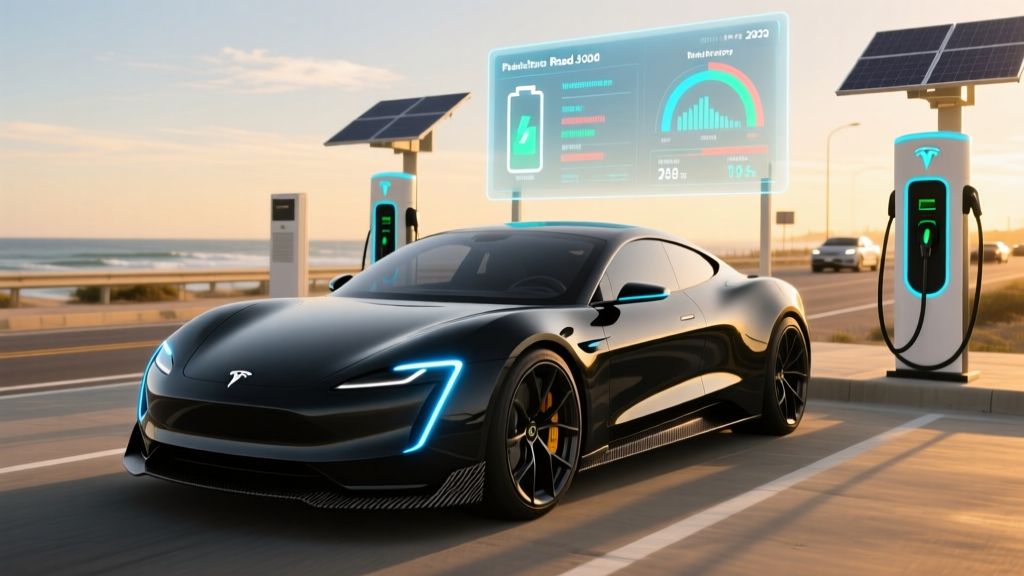
The Tesla Roadster was unveiled in November 2017, with Tesla initially targeting production for 2020. Six years later, that timeline has slipped repeatedly. As of early 2026, the second-generation Roadster remains an announced but unreleased vehicle — not available for purchase, delivery, or independent testing. What follows is a forensic look at every spec Tesla has publicly stated, the engineering realities behind those claims, and what prospective reservation holders should actually expect if and when this car reaches production.
Announced Specifications: The Numbers Tesla Has Promised
| Specification | Tesla Claim (Preliminary) | Status |
|---|---|---|
| EPA Range (claimed) | 620 miles | Unverified |
| Battery Capacity | ~200 kWh (announced) | Unverified |
| Battery Chemistry | Not disclosed (likely NMC/NCA) | Speculative |
| 0-60 mph | 1.9 seconds (base); under 1 sec with SpaceX package | Unverified |
| Top Speed | 250+ mph | Unverified |
| Drivetrain | AWD (tri-motor) | Announced |
| Horsepower | Not officially disclosed; estimated 1,000+ hp | Estimated |
| Wheel Torque | 10,000 Nm (claimed) | Unverified |
| Quarter Mile | 8.8 seconds | Unverified |
| Seating | 2+2 (4 seats) | Announced |
| Roof | Removable glass roof | Announced |
The 620-Mile Range Claim: Engineering Reality Check
A 620-mile EPA range from a 200 kWh battery pack implies an efficiency of roughly 323 Wh/mile (200,000 Wh ÷ 620 mi). That's plausible for a low-slung, aerodynamic sports car driven conservatively at moderate speeds — but it demands scrutiny.
For context, the Lucid Air Grand Touring achieves 516 EPA miles from a 112 kWh usable battery, operating at roughly 217 Wh/mile — the most efficient large-battery EV on the market today. The Roadster's claimed efficiency would need to be roughly 48% worse than a Lucid Air despite having nearly double the battery capacity. That math actually checks out for a wider, heavier performance car, but it also means the Roadster would carry an estimated 4,800-5,000 lbs curb weight, which erodes real-world efficiency under hard driving.
- EPA sticker (if certified as claimed): 620 miles
- Highway driving at 75 mph: Expect ~430-480 miles (30-35% reduction is typical for sports cars at sustained speed)
- Cold weather (below 32°F): Expect ~370-440 miles (25-40% reduction depending on cabin heating and battery preconditioning)
- Track/aggressive driving: Range could drop below 200 miles — energy consumption scales exponentially with speed
The 200 kWh pack, if it uses current-generation NMC (nickel manganese cobalt) cells at roughly 250-270 Wh/kg at the cell level, would weigh approximately 740-800 kg (1,630-1,760 lbs) for the cells alone. Total pack weight with cooling, structure, and BMS would likely exceed 2,000 lbs. That's a significant mass penalty that directly impacts tire wear, braking distances, and cornering dynamics — trade-offs Tesla has not publicly addressed.
Charging: What a 200 kWh Battery Means for Plug-In Times
This is where the Roadster's massive battery becomes a double-edged sword. Even with the fastest charging hardware available, filling a 200 kWh pack is a time-intensive process.
| Charging Method | Estimated Power | 10-80% Time (Projected) | Notes |
|---|---|---|---|
| Level 1 (120V / 12A) | ~1.4 kW | ~100 hours | Effectively unusable for this battery size |
| Level 2 (240V / 48A) | ~11.5 kW | ~12-14 hours | Overnight charge covers ~55-65 miles per hour of charging |
| Level 2 (240V / 80A) | ~19.2 kW | ~7-9 hours | Requires dedicated 100A circuit; adds ~95 mi/hr of charging |
| DC Fast Charge (V4 Supercharger, projected) | ~350 kW peak | ~25-35 minutes | Sustained rate will taper significantly above 60% SoC |
The critical insight here is charge curve taper. A 200 kWh battery charging at 350 kW peak is accepting roughly 1.75C at maximum rate. But lithium-ion cells cannot sustain peak rate — expect the charge curve to taper sharply after 50-60% State of Charge. The 10-80% time could stretch to 35+ minutes despite a headline-grabbing peak rate. On a road trip, you're looking at one substantial charging stop every 4-5 hours of highway driving.
For home charging, an 80-amp Level 2 circuit (requiring a 100-amp breaker) is practically mandatory. Most residential panels would need a service upgrade to support this — budget $2,000-$4,000 for panel work plus $800-$1,500 for the Tesla Wall Connector and installation, according to typical Tesla home charging installation partner estimates.
Performance Claims and the Laws of Physics
A 1.9-second 0-60 mph time would make the Roadster the quickest production car ever built. The tri-motor AWD layout (one front, two rear motors) with torque vectoring is the only architecture that could plausibly achieve this, and Tesla has demonstrated similar capability with the Model S Plaid (1.99 sec 0-60).
The sub-1-second claim tied to the "SpaceX package" — which reportedly uses cold-gas thrusters for additional downforce and acceleration — moves from automotive engineering into aerospace territory. No production road car has ever achieved a sub-1-second 0-60 on street tires. The physics challenge is traction: at launch, a car can only accelerate as fast as its tires can transmit force to the road. Even with 10,000 Nm of wheel torque, the limiting factor is the tire contact patch, not the motor output. Cold-gas thrusters could theoretically add downforce to increase grip, but the regulatory and safety implications of rocket thrusters on a street vehicle remain unaddressed by NHTSA.
The claimed 250+ mph top speed requires roughly 600-700 hp to overcome aerodynamic drag alone at that velocity, which is well within the tri-motor system's estimated 1,000+ hp output. However, sustaining that speed would drain the 200 kWh battery in approximately 15-20 minutes, covering about 65-85 miles.
Pricing, Reservations, and Tax Credit Reality
| Item | Amount |
|---|---|
| Base MSRP (announced) | $200,000 |
| Founders Series (limited) | $250,000 |
| Reservation Deposit | $50,000 ($5,000 initial + $45,000 to secure) |
| Federal §30D Tax Credit | Not eligible — MSRP exceeds $55,000 sedan cap (sports cars classified under sedan limit per IRS guidance) |
| Estimated Price After Incentives | $200,000+ (no federal credit available) |
Under current IRS §30D rules, the Roadster would not qualify for the federal EV tax credit. The MSRP cap for sedans and sports cars is $55,000 — the Roadster's announced $200,000 base price exceeds this by a factor of nearly four. Additionally, buyer income caps ($150,000 single / $300,000 joint MAGI) would disqualify many buyers even if the price cap weren't a barrier. The critical minerals and battery component sourcing requirements add further layers of complexity that Tesla has not disclosed for this vehicle.
For reservation holders: the $50,000 deposit has been sitting with Tesla for years. Tesla's reservation terms typically allow refunds, but check your specific agreement. There is no confirmed delivery date, and Tesla has a documented history of significant delays between announcement and production across the Cybertruck, Semi, and original Roadster timelines.
Interior, Cargo, and Practical Ownership Considerations
Tesla has shown a prototype interior with a minimalist design language similar to the Model S, featuring a large central touchscreen and a yoke-style steering wheel. The 2+2 seating configuration suggests rear seats suitable for children or very short trips only — similar to a Porsche 911's rear seats.
Concrete cargo dimensions have not been published. Based on the exterior proportions and mid-engine-equivalent battery placement, expect:
- Frunk: Minimal — the front motor and electronics bay leaves limited space, likely under 3 cu ft
- Rear cargo area: A shallow shelf behind the rear seats, possibly 5-8 cu ft with seats folded
- Total cargo: Likely 8-12 cu ft combined — this is a sports car, not a tourer
For daily usability, the removable glass roof is the standout practicality feature, offering an open-air experience. However, glass roof panels on the original Tesla Roadster (2008-2012) were prone to cracking and sealing issues — a concern worth monitoring if this feature carries over.
Warranty and Long-Term Battery Outlook
Tesla has not published warranty terms for the Roadster. Using current Tesla warranties as a baseline:
- Battery warranty (Model S/X precedent): 8 years / 150,000 miles, with minimum 70% capacity retention
- Drive unit warranty: 8 years / 150,000 miles
- Vehicle limited warranty: 4 years / 50,000 miles
A 200 kWh NMC pack replacement, if needed out of warranty, would carry an estimated cost of $30,000-$45,000 based on current battery cell pricing ($130-$170/kWh at the pack level) plus labor. LFP chemistry — which offers longer cycle life and lower replacement cost — is unlikely in a performance-focused vehicle where energy density is paramount.
For a 200 kWh battery, the 70% retention threshold means the pack could lose up to 60 kWh of capacity (dropping range from 620 to ~434 miles) before a warranty claim would be honored. That's still substantial range, but the dollar value of degradation on a $200,000 vehicle affects resale value significantly.
Tesla Roadster vs. the Competition: Who Wins?
The Roadster exists in a price bracket with very few electric peers. Here's how the announced specs compare to available alternatives:
| Vehicle | Price | EPA Range | 0-60 mph | Availability |
|---|---|---|---|---|
| Tesla Roadster (announced) | $200,000 | 620 mi (claimed) | 1.9 sec | Not available |
| Rimac Nevera | $2,200,000 | ~340 mi (WLTP) | 1.85 sec | Limited production |
| Lotus Evija | $2,300,000 | ~217 mi (WLTP) | ~3.0 sec | Limited production |
| Lucid Air Sapphire | $249,000 | 427 mi (EPA) | 1.89 sec | Available now |
| Porsche Taycan Turbo GT | $230,000 | 269 mi (EPA) | 2.1 sec | Available now |
The Lucid Air Sapphire is the most direct threat to the Roadster's value proposition. It delivers a verified 1.89-second 0-60 time, 427 miles of real EPA-certified range, four full-size doors, and is available for purchase today at $249,000. For buyers who want extreme performance in an EV right now, the Sapphire exists; the Roadster does not.
✅ Pros (If Delivered as Announced)
- Class-leading 620-mile range claim would obliterate every production EV
- Sub-2-second 0-60 at a fraction of Rimac/Lotus pricing
- Access to Tesla Supercharger network (NACS connector)
- Removable glass roof — unique in the hypercar segment
- Over-the-air updates and Tesla software ecosystem
- Tri-motor torque vectoring for exceptional cornering grip
❌ Cons & Risks
- Not available — years of delays with no confirmed production date
- 200 kWh battery means extremely long home charging times
- $200,000+ price with no federal tax credit eligibility
- $50,000 reservation deposit tied up indefinitely
- Weight likely exceeds 4,800 lbs — impacts handling dynamics
- SpaceX thruster package faces unresolved regulatory hurdles
- No independent testing, safety ratings, or EPA certification
- Tesla's track record on announced timelines is poor
Who Is This Car Actually For?
If the Roadster ever reaches production, it targets a very specific buyer:
- Hypercar collectors who want electric performance at a fraction of Rimac pricing
- Tesla loyalists already deep in the ecosystem who want the brand's halo vehicle
- Spec buyers betting that limited production will drive appreciation
It is not a practical daily driver, a road-trip car (despite the range claim — charging a 200 kWh battery adds significant downtime), a family vehicle, or a rational financial decision at $200,000+ with no tax incentives and uncertain production timing.
Choose an alternative now if: you want verified performance, warranty coverage, immediate delivery, and independently tested range. The Lucid Air Sapphire, Porsche Taycan Turbo GT, and even the Tesla Model S Plaid ($89,990, 396 mi EPA, 1.99 sec 0-60) are all available today with known quantities.
Frequently Asked Questions
Can I buy the Tesla Roadster right now?
No. As of 2026, the Tesla Roadster is not in production and cannot be purchased. Tesla accepts $50,000 reservation deposits, but no delivery timeline has been confirmed. Elon Musk indicated in late 2023 that the design would be "finished" in 2024, with production to follow — but no production start date has been announced as of early 2026.
What is the real-world range of the Tesla Roadster?
There is no verified real-world range because no production vehicle exists for testing. Tesla claims 620 miles (EPA), but based on the physics of a 200 kWh battery in a heavy performance car, expect roughly 430-480 miles on the highway, 370-440 miles in cold weather, and significantly less under aggressive driving. These are projections based on comparable EVs, not measured data.
How fast does the Roadster charge?
Tesla has not published official charging specs. Based on the announced 200 kWh battery and Tesla's V4 Supercharger architecture (up to 350 kW peak), a 10-80% DC fast charge would likely take 25-35 minutes, with significant taper above 60% SoC. Home Level 2 charging at 11.5 kW (48A) would require 12-14 hours for a full charge; an 80A circuit would reduce this to 7-9 hours.
Does the Tesla Roadster qualify for the federal EV tax credit?
No. Under IRS §30D rules, the Roadster's $200,000+ MSRP far exceeds the $55,000 cap for sedans and sports cars. Buyer income limits ($150K single / $300K joint) and battery sourcing requirements create additional barriers. No federal purchase incentive applies to this vehicle.
Is the Tesla Roadster worth waiting for vs. buying a Lucid Air Sapphire?
If you can buy today, the Lucid Air Sapphire is the rational choice: verified 1.89-second 0-60, 427-mile EPA range, available now, with full warranty and safety testing. The Roadster offers higher claimed specs at a lower price, but the years-long wait, $50,000 deposit risk, and zero guarantees make it speculative. Only buyers comfortable with indefinite delays and unverified claims should maintain a reservation.
What happened to the SpaceX thruster package?
Tesla announced an optional "SpaceX package" using cold-gas thrusters around the vehicle for enhanced acceleration, braking, and cornering. No regulatory framework exists for rocket thrusters on public roads. NHTSA has not commented on the legality of such a system, and Tesla has provided no technical details on propellant storage, refill logistics, or safety certification. Treat this feature as highly speculative.
Will the Roadster use NACS or CCS?
As a Tesla vehicle, the Roadster will use the NACS (North American Charging Standard) connector natively, granting access to the full Tesla Supercharger network — currently the largest and most reliable DC fast-charging network in North America with over 50,000 stalls.